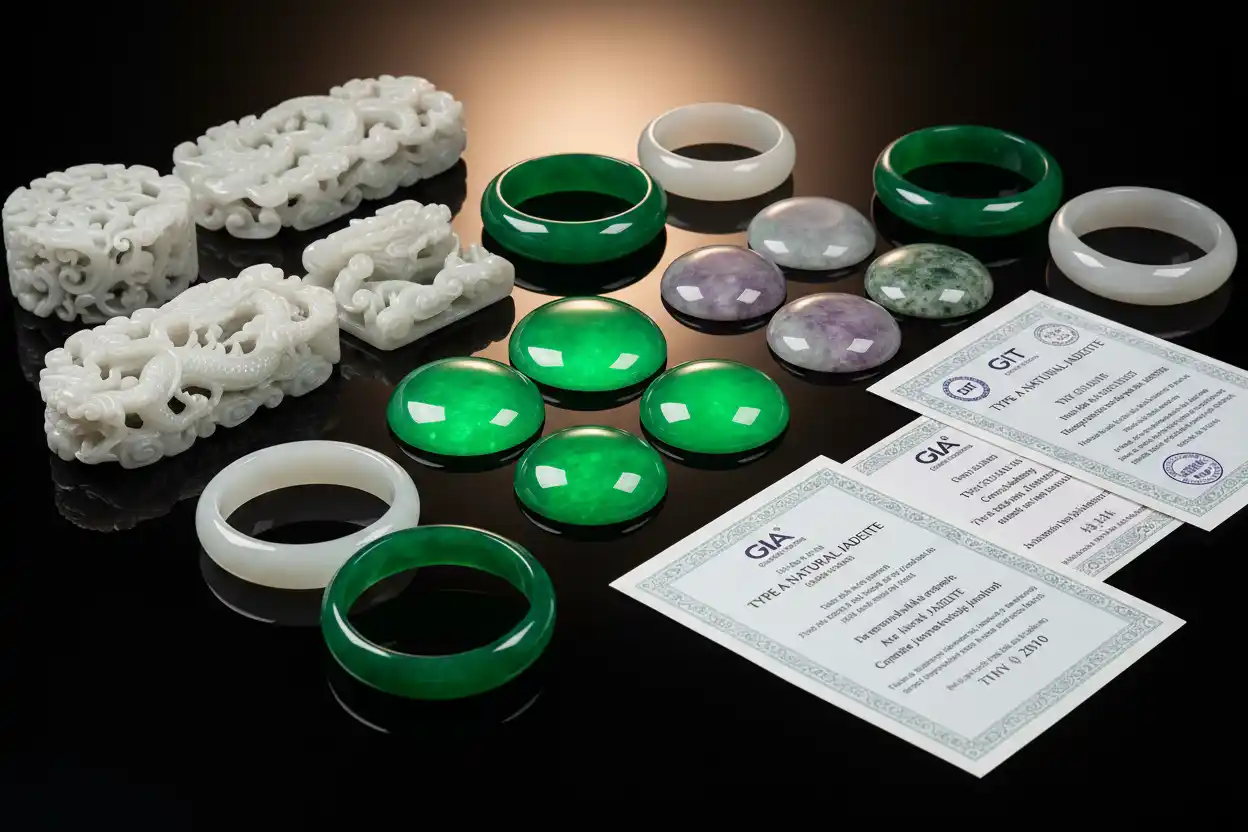
Jade Price: Value, Cost & What Affects Price
A useful jade price cannot be reduced to one universal figure per carat because “jade” itself covers materially and commercially different products. Modern gemology uses the term primarily for jadeite and nephrite, with certain green omphacite also included under defined conditions. A loose commercial jadeite cabochon, fine untreated translucent jadeite, white nephrite carving, hololith bangle, antique object, bead strand, and diamond-set jadeite jewel can all be genuine jade while belonging to completely different valuation markets. GIA notes that jadeite is commonly sold by the piece rather than purely by weight and that color, transparency, and texture are its three dominant quality factors.
That is why a statement such as “jade costs $X per carat” is usually incomplete. Current public listings include ordinary loose jadeite at only a few dollars per carat, seller-described untreated material at tens or hundreds of dollars per carat, and fine documented jadeite jewelry selling at auction for totals measured in hundreds of thousands or even millions of Hong Kong dollars. Those figures are all real observations, yet combining them into one average would create a meaningless number because identity, quality, treatment, transparency, workmanship, provenance, setting, and sales channel are not controlled.
This page therefore treats jade price as a comparison problem rather than a price-chart problem. The broader Buying & Value category covers related valuation topics, while general seller-selection questions belong in the separate buy jade guide.
Jade Price at a Glance
| Question | Practical answer |
|---|---|
| Is there one jade price per carat? | No. Jadeite, nephrite, loose stones, bangles, carvings, beads, and finished jewelry should not be pooled into one rate. |
| What matters most for jadeite? | Color, transparency, texture, treatment status, size, cut/form, condition, and documentation. |
| What matters for nephrite? | Color, whiteness or attractive green color depending on market, texture, translucency, luster, origin claims, workmanship, condition, and provenance. |
| Is jadeite usually more expensive than nephrite? | Fine jadeite commonly reaches much higher gem-market prices, but exceptional nephrite can also be extremely valuable. |
| Does larger jade always cost more per carat? | No. Size can create strong premiums in fine jadeite, but only when quality remains high. |
| Does “Type A” mean top-quality jadeite? | No. It principally concerns treatment status, not a universal quality grade. |
| Does “Imperial jade” have a fixed price? | No. It is a high-end quality description, not a standardized price category. |
| Can treatment strongly affect value? | Yes. Bleaching, polymer impregnation, dyeing, coating, and other alterations can materially change market interpretation. |
| Does Myanmar origin automatically make jade expensive? | No. Origin may matter, but quality and reliable documentation are still essential. |
| Are asking prices the same as market value? | No. Asking prices show seller expectations; completed transactions show what a buyer actually paid under specific conditions. |
| Is jade an investment with guaranteed appreciation? | No. No gemstone purchase guarantees profit, liquidity, or future resale value. |
What Is Actually Being Priced?
The first step in any jade price comparison is identifying the object. Loose cabochons are comparatively simple because dimensions, weight, transparency, color, polish, fissures, and treatment claims can be recorded individually. A bead strand is harder because matching becomes part of the value: GIA notes that fine jadeite beads are selected for color, texture, transparency, size, and symmetry, and assembling a well-matched long strand can be difficult. A hololith bangle requires enough sound rough to carve an entire ring without joints, causing considerable material loss and potentially supporting a premium over constructed alternatives.
Carvings introduce artistic workmanship and rough utilization. A masterfully carved nephrite object cannot be valued by multiplying its weight by a generic nephrite rate because carving quality, subject, age, condition, cultural importance, provenance, and the quality of the original material all contribute. Historical pieces add another valuation layer altogether.
Finished jewelry combines gemstone value with metal, diamonds or other gems, design, labor, brand, age, and condition. The market context of a jade bracelet, jade earrings, jade necklace, or jade ring therefore differs from a loose cabochon. Dividing a finished jewel’s total price by the estimated jade weight can falsely attribute precious-metal, diamond, workmanship, and brand value to the jade itself.
Even rough material belongs to a different market. Buyers of jade rough must estimate usable yield, internal fissuring, color distribution, texture, and what lies beneath weathered surfaces. GIA’s research on jade trading describes buyers using light to assess color, transparency, texture, and the amount of material likely to produce usable finished objects.
Jadeite and Nephrite Need Separate Price Frameworks
Jadeite and nephrite share the jade name but not the same value structure. Fine jadeite occupies one of the highest-value segments of the colored-gem market. GIA identifies color, transparency, and texture—in that order—as the principal factors influencing jadeite value. The most coveted green jadeite combines vivid, penetrating color with high translucency and fine texture. Exceptional examples traditionally described as Imperial jade can reach extraordinary prices.
Nephrite markets operate differently. Fine white nephrite from historically prestigious sources can command strong premiums, particularly material associated with Xinjiang and the Hetian tradition. GIA research notes that high-quality white nephrite from Xinjiang has historically occupied the highest price position in the Chinese nephrite market, while fine “mutton fat” material is prized for whiteness, fine texture, translucency, and greasy luster.
Green nephrite can also be commercially important. Material from British Columbia, Siberia, Pakistan, China, and other localities enters different parts of the market, and origin labels can influence perception even when visual quality is similar. GIA has documented cases in which Canadian green nephrite was marketed as Hetian material because the prestigious name could support higher prices, illustrating why provenance claims must be independently assessed rather than priced automatically.
Jadeite Quality Bands Without Inventing a Grading System
There is no universal numerical jade quality scale equivalent to the standardized diamond color-and-clarity framework. The bands below are therefore comparison categories for this page, not GIA grades and not promises of value.
| Comparison band | Typical characteristics | Pricing implication |
|---|---|---|
| Commercial jadeite | Opaque to weakly translucent; muted, grayish, uneven, or darker color; medium/coarse texture; visible fissures or modest polish possible | Often occupies the lowest loose-stone price levels |
| Attractive jewelry jadeite | Pleasing color; some translucency; reasonably fine texture; good polish; acceptable condition | Can command a meaningful premium over basic commercial material |
| Fine jadeite | Strong or distinctive color, high translucency, fine texture, good proportions, minimal distracting fractures, favorable treatment status | Price can rise sharply because several desirable factors coincide |
| Exceptional jadeite | Vivid penetrating green or another exceptionally desirable color/transparency combination; very fine texture; strong documentation; scarce form or matched set | Can enter high-end auction and collector markets where ordinary per-carat comparisons lose usefulness |
Color should not be interpreted as “greener is always better.” GIA emphasizes hue, tone, saturation, evenness, and the way color appears under different light sources. Lavender jadeite can also be valuable, and highly transparent colorless material has developed its own premium market. The deeper science behind different hues belongs in jade color meaning, while optical behavior is covered separately in jade optical properties and color behavior.
Nephrite Quality Is Not Just “Green Versus White”
For nephrite, the commercial hierarchy changes with market and cultural context. Fine white material can command exceptional premiums in Chinese collecting traditions, while saturated green material is important in other sectors. Texture, translucency, freedom from distracting inclusions or fractures, polish, luster, size, carving quality, and provenance all matter.
Whiteness deserves particular caution. GIA research identifies whiteness as a major parameter in grading fine white nephrite and notes that subtle transitions between white, grayish white, bluish green, and pale green can be commercially important. The material’s appearance reflects iron and magnesium relationships within the amphibole structure, so vague seller terms such as “snow white” or “mutton fat” should not be treated as laboratory grades.
Similarly, the phrase “Hetian jade” can carry geographic, historical, or commercial implications depending on how it is used. The name should not be priced at a premium until the seller’s claim, laboratory evidence if available, and exact meaning of the term are understood.
Documented Jade Price Sample
The following sample records publicly observable asking prices and completed transactions. Seller names are intentionally omitted because the purpose is methodology, not endorsement. Seller descriptions such as “Type A,” “untreated,” “Myanmar,” “icy,” or “semi-transparent” remain seller claims unless a recognized independent report is specifically documented. Asking prices are not completed sales.
| Source type | Material / observed description | Price status | Observed price | Calculated unit figure | Key limitation |
|---|---|---|---|---|---|
| Loose-gem retailer A | 36.94 ct white jadeite, oval, translucent | Asking | US$60.71 | ~US$1.64/ct | Commercial listing; quality should not be inferred from weight or translucency label alone. |
| Loose-gem retailer A | 9.78 ct green jadeite, oval, translucent | Asking | US$21.43 | ~US$2.19/ct | Shows that ordinary listed jadeite can occupy very low per-carat levels. |
| Marketplace seller B | 30.25 ct green cabochon described as untreated Type A and translucent | Asking | US$225 | ~US$7.44/ct | Treatment and origin statements are seller-provided in the listing; no independent report was established from the retrieved evidence. |
| Marketplace seller C | 14.13 ct apple-green jadeite described as untreated Myanmar material | Asking | US$543.52 | ~US$38.47/ct | Discounted marketplace asking price; seller description is not equivalent to independent grading. |
| Marketplace seller D | 4.71 ct pale-green cabochon described as natural untreated Type A Myanmar jadeite | Asking | US$390.13 | ~US$82.83/ct | Stronger seller positioning, but quality terminology is not standardized. |
| Marketplace seller E | 4.40 ct semitransparent green jadeite described as untreated A jade, with identification report | Asking | US$1,697.31 | ~US$385.75/ct | Report details and quality still need direct review; an asking price is not a completed-market value. |
| Marketplace seller F | 35.18 ct green nephrite cabochon described as untreated, Pakistan origin | Asking | US$147 | ~US$4.18/ct | Seller-stated identity/origin; cannot be directly compared with high-grade Hetian white nephrite. |
| Major auction house | Pair of jadeite saddle rings with GIA reports stating Myanmar origin and no indications of dye or impregnation | Completed sale | HK$139,700 | Not calculated | Finished jewelry; gross weight includes complete rings, so a jade-only per-carat figure would be misleading. |
This sample demonstrates several important points. First, the observed asking prices for loose jadeite span more than two orders of magnitude even before entering exceptional auction material. Second, carat weight alone clearly does not explain the differences. A smaller stone marketed as semitransparent untreated jadeite can carry a dramatically higher asking price per carat than a much larger commercial jadeite cabochon. Third, even an apparently precise price-per-carat calculation remains only arithmetic until color, transparency, texture, treatment evidence, condition, origin documentation, and seller context are normalized.
The completed auction result is deliberately not converted into a jade price per carat because the object is finished jewelry and the reported gross weight includes the entire construction. Creating an artificial per-carat number would look precise while measuring the wrong thing.
What the Highest-End Market Shows
Exceptional jadeite demonstrates why ordinary retail averages cannot be extended upward. Sotheby’s documented a 277.673-carat jadeite bangle selling for HK$30.425 million. The auction house described the piece as possessing green to vivid-green color and outstanding translucency and cited independent laboratory characterization. This is real completed-sale evidence, but it is an extreme-quality auction result—not a benchmark for an ordinary green bangle.
Another high-end Sotheby’s sale involved an Imperial Green jadeite and diamond parure containing ten jadeite cabochons totaling 176.93 carats and realizing HK$46.355 million. The same auction recap emphasized intense color and strong translucency among the factors attracting buyers. Again, jewelry design, matched stones, auction competition, rarity, documentation, and luxury-market context all contribute to the price.
The correct lesson is not that jade is “worth millions.” It is that exceptional jadeite exists in a market structurally different from ordinary commercial jade. Using those auction records to advertise a modest opaque pendant as an investment-grade object would be misleading.
Treatment Can Change Jade Price Dramatically
Treatment status is one of the most consequential jadeite price variables because treatment can improve apparent color or transparency while changing rarity, durability considerations, and market classification. GIA explains that jadeite may be bleached with acid to remove undesirable coloration and then polymer impregnated because bleaching leaves the structure more porous or vulnerable. Dyeing, coating, waxing, heat, and related treatments also occur.
The familiar A/B/C terminology describes treatment categories rather than quality grades. In common trade usage, A jade refers to natural jadeite or material receiving only traditional waxing; B jade has been bleached and polymer impregnated; C jade has added color. A Type A jadeite can therefore be pale, opaque, poorly cut, or fractured while still being A jade. Conversely, calling something “Grade A” can be confusing if a seller uses it as though it means the highest visual quality.
For pricing, treatment should be treated as a separate variable after identity has been established. The dedicated treated jade page covers enhancement terminology and evidence in greater detail. When treatment uncertainty materially affects a purchase, a recognized laboratory report carries far more evidential weight than surface appearance or seller assurances.
Laboratory Reports: What They Add to a Price Comparison
A laboratory report can establish information that photographs and marketing language cannot reliably provide. GIA’s jade reporting framework identifies jade material and, where appropriate, provides jade type information. Modern laboratory analysis can also identify important treatment evidence such as polymer impregnation or dye.
Current GIA services also include geographic-origin determination for eligible untreated jadeite jade and omphacite jade from Myanmar or Guatemala. That development matters when sellers ask an origin premium because a documented laboratory origin conclusion is categorically different from a seller simply writing “Burmese” in a product title.
A report does not tell a buyer what the stone should cost. It does not turn color, texture, transparency, workmanship, rarity, or market demand into a standardized universal grade. It also does not guarantee resale. The report’s role is evidential: it can reduce uncertainty about material, treatment, and eligible origin conclusions so those factors can then be incorporated into a valuation.
Microscopic evidence can also contribute to treatment and material evaluation, although interpreting aggregate jade can require specialist experience. The mapped jade microscope inclusion notebook addresses that evidence separately rather than repeating identification procedures inside this price guide.
How Size Changes Jade Price
Size has a nonlinear effect on fine jadeite. GIA states that the value of jadeite cabochons, beads, and bangles rises as size increases when other quality factors remain equal, and that relatively small size differences can create large value changes in top-quality Imperial jadeite.
The phrase “all other factors equal” is essential. A 30-carat opaque, low-saturation commercial jadeite cabochon is not automatically worth more than a 4-carat highly translucent, vivid, fine-textured stone. The current sample above demonstrates that larger listed stones can have dramatically lower per-carat asking prices when their commercial positioning differs.
Certain forms also create their own size premium. A large hololith bangle requires enough usable rough to preserve an unbroken circle after substantial cutting loss. A long strand of large matched beads requires multiple pieces with sufficiently similar color, transparency, texture, and dimensions. Scarcity is therefore partly a function of usable continuous quality rather than gross mass.
Nephrite behaves differently. GIA notes that increasing size does not usually raise nephrite’s value as dramatically as it can with top-quality jadeite. For nephrite carvings, material quality and artistic workmanship can become more important than a simple carat calculation.
Origin Claims and the Price Premium Problem
Origin can affect jade markets because certain localities have long-standing reputations. Myanmar has historically been the principal source of top-grade jadeite, while Guatemala is an important jadeite source with distinct material entering international markets. GIA has also studied jadeite from Japan, Russia, and other regions.
Current research also demonstrates why origin and appearance cannot be treated as identical. GIA reported high-quality green jadeite-omphacite material from Guatemala with visual similarities to desirable Myanmar material and noted that Guatemalan examples were being offered for considerably less than comparable Myanmar material of similar color and size.
That price difference does not mean the origin label should be accepted without evidence. If a Myanmar premium is being charged on eligible untreated jadeite, independent origin determination can be commercially relevant. For nephrite, geographic origin is even more complex. GIA research has documented the market importance of Xinjiang provenance while also noting how visually similar nephrite from other deposits can make rigorous origin determination difficult.
The geology underlying different jade occurrences belongs in jade formation and deposit geology. On a price page, the key rule is simpler: locality is a claim requiring evidence, not a substitute for assessing the material itself.
Retail Context Can Explain Huge Price Differences
A wholesale parcel, marketplace listing, specialist jade dealer, luxury jewelry boutique, antique dealer, and international auction house do not operate under the same economics. The same broad material name can therefore produce radically different prices even before quality is considered.
Low-price loose-gem sellers may carry commercial opaque or moderately translucent stones in volume. Marketplace sellers can price individual pieces according to their own quality language, return policies, reputations, photographs, certificates, and discounting strategies. Specialist jade dealers may spend more on selection, testing, documentation, matching, and inventory. Auction houses add provenance research, cataloguing, specialist assessment, buyer competition, and premium-market access.
Finished jewelry also embeds non-jade value. Precious-metal weight, diamond setting, designer attribution, restoration, craftsmanship, and age may account for a substantial portion of the sale price. That is why a diamond-set jadeite ring selling for HK$100,800 cannot responsibly be treated as evidence that a loose jadeite cabochon of approximately similar dimensions is “worth HK$100,800.” The completed Christie’s example includes diamonds, gold, and a laboratory report in addition to the jadeite.
A Reproducible Jade Price Method
A useful jade price method begins by filtering before calculating.
First, establish whether the object is jadeite, nephrite, qualifying omphacite, or merely sold under a jade trade name. Identity uncertainty should not be priced away.
Second, classify the object type: loose cabochon, bead, bangle, carving, rough, ring, pendant, antique, or another form. Only compare like with like.
Third, record observable quality. For jadeite, document color, tone, saturation, evenness, transparency, texture, polish, proportions, fissures, and other condition issues. For nephrite, document color or whiteness, translucency, texture, luster, inclusions, surface character, workmanship, and condition. More specialized surface and cutting considerations belong in jade cutting, orientation, and polish.
Fourth, establish treatment status as far as the evidence allows. “No treatment stated” is not the same as “laboratory-confirmed no dye or impregnation.”
Fifth, record dimensions and weight, but do not assume weight is the dominant factor. Jade is commonly priced as an individual object.
Sixth, separate provenance levels: unknown, seller-stated, historically documented, or laboratory-supported origin where an appropriate service exists.
Seventh, record the transaction type. Asking price, negotiated retail sale, dealer wholesale price, auction estimate, hammer price, and price realised are different observations.
Only after these steps should price per carat, price per gram, or price per piece be calculated—and the unit should only be compared within a compatible set.
A Comparison Worksheet for Real Listings
A simple comparison table can prevent weak listings from being averaged with fine material.
| Field | Stone A | Stone B | Stone C |
|---|---|---|---|
| Material | Jadeite / nephrite / uncertain | ||
| Form | Cabochon / bangle / carving / bead | ||
| Weight | |||
| Dimensions | |||
| Color | |||
| Transparency | |||
| Texture | |||
| Major fissures | |||
| Treatment | Lab-confirmed / seller-stated / unknown | ||
| Origin | Lab-supported / documented / seller-stated / unknown | ||
| Report | Laboratory and exact conclusion | ||
| Asking or sold? | |||
| Total price | |||
| Price per carat if meaningful | |||
| Non-jade value included? | Metal / diamonds / brand / carving | ||
| Comparable enough to average? | Yes / no, with reason |
The last row is the most important. A spreadsheet full of numbers does not produce useful valuation evidence if the underlying objects are not comparable.
Example Comparison 1: Two Loose Green Jadeites
A current loose-gem retailer lists a 9.78-carat green translucent jadeite for US$21.43, or roughly US$2.19 per carat. Another marketplace listing describes a 4.40-carat semitransparent green jadeite as untreated A jade and asks US$1,697.31, roughly US$385.75 per carat.
It would be incorrect to conclude that the second stone is precisely 176 times “better.” The comparison lacks standardized side-by-side color observations, identical lighting, equivalent texture evaluation, confirmed treatment evidence for both, and a completed transaction for either. What can be concluded is narrower: current asking prices for stones both described broadly as green jadeite can differ enormously because seller positioning and apparent quality differ.
Example Comparison 2: Large Versus Small
The price sample also illustrates why a large carat number does not guarantee a higher jade price. One marketplace listing describes a 30.25-carat green, translucent Type A jadeite cabochon at an asking price of US$225, roughly US$7.44 per carat. Another describes a much smaller 4.71-carat pale-green untreated jadeite at US$390.13, about US$82.83 per carat.
Even those calculations cannot establish which is the better value without controlling color, texture, actual transparency, polish, fissuring, treatment documentation, and photographic conditions. They do show that weight is subordinate to quality in real seller pricing.
Example Comparison 3: Loose Jade Versus Auction Jewelry
A completed auction sale of two jadeite saddle rings reached HK$139,700. GIA reports accompanied the pieces and stated Myanmar origin with no indications of dye or impregnation. The gross weight was 8.5 grams, but using that gross weight to calculate “jade price per gram” would be analytically wrong because it includes the complete ring constructions rather than only the jadeite.
This is a common valuation error. Auction results are valuable market evidence, but the object being sold must match the object being valued. A verified Burmese jadeite ring is evidence for the jewelry auction market, not a direct per-carat quotation for loose commercial jade.
Price Does Not Prove Authenticity or Healing Value
A high jade price does not prove that an object is natural, untreated, historically important, spiritually powerful, or medically beneficial. Expensive objects can be misidentified or misrepresented, and inexpensive jade can be genuine. Authentication must come from evidence rather than the size of the price tag.
Similarly, symbolic or wellness claims should not be turned into pricing factors. Cultural meaning may influence desirability, but there is no scientific basis for charging a premium because a jade object supposedly cures illness, treats anxiety, guarantees prosperity, or emits stronger “energy.” The distinction between cultural interpretation and medical evidence is discussed in jade meaning and jade healing properties.
Condition and Care Affect Resale Comparability
Existing chips, fractures, scratches, repaired drill holes, degraded polymer, surface staining, damaged mountings, or poor repolishing can reduce desirability even when the underlying jade is valuable. Condition is particularly important for bangles and carvings because damage can affect structural integrity and visual continuity.
Jadeite and nephrite are exceptionally tough materials, but they can still be scratched, affected by heat, and complicated by treatments. GIA recommends warm soapy water as a conservative cleaning approach because treatment history is not always known. The mapped how to clean jade jewelry guide covers maintenance rather than market valuation.
For pricing, the relevant lesson is that two nominally similar pieces should not be compared as equals if one has major fissures, repairs, treatment deterioration, or surface damage.
Price-Sample Limits and Updating the Evidence
Public jade listings change rapidly. Asking prices can be discounted, increased, removed, or left online long after buyer interest changes. Auction prices depend on the exact lot, bidder competition, buyer’s premiums, economic conditions, provenance, condition, and the reputation of the sale venue.
For that reason, the documented sample on this page should be treated as a snapshot rather than a permanent jade price index. If a cited listing changes materially, its recorded observation should either be updated or clearly retained as historical evidence rather than silently presented as a live quotation. Arithmetic errors should likewise be corrected at the calculation level while preserving the original source price and weight used.
Most importantly, an average should not be calculated simply because enough rows exist. Data quality matters more than sample size when the stones themselves are heterogeneous.
Can Jade Be Considered an Investment?
Jade can be valuable, collectible, culturally important, and in exceptional cases extraordinarily expensive. None of those facts produces a guaranteed investment return. Gemstone markets have large retail-to-resale spreads, specialized buyer networks, transaction costs, authentication costs, liquidity limitations, and rapidly changing demand.
The highest auction results also represent exceptional objects, not a promise about ordinary inventory. A seller should not use a multimillion-dollar Imperial jadeite result to imply that every jade bangle will appreciate similarly.
Someone purchasing jade primarily for financial return should therefore distinguish collectible quality from guaranteed performance. There is no guarantee that a stone can later be resold for its purchase price, much less at a profit.
Frequently Asked Questions
How much is jade worth per carat?
There is no reliable universal jade price per carat. Current loose jadeite asking prices can range from only a few dollars per carat to hundreds of dollars per carat before the market even reaches exceptional fine jadeite. Jadeite is also commonly priced by the piece rather than strictly by carat.
Why is some jade extremely cheap?
Low-priced jade may be opaque commercial material, lower-quality nephrite or jadeite, small calibrated material, heavily included stone, treated material, poorly documented inventory, or simply a seller operating in a low-margin market. Low price does not automatically mean fake, just as high price does not prove authenticity.
Why is Imperial jade so expensive?
Fine Imperial jadeite combines intense desirable green color, high translucency, very fine texture, rarity, and strong market demand. GIA describes exceptional Imperial jadeite as among the world’s most expensive gems.
Is jadeite more expensive than nephrite?
Fine jadeite generally reaches much higher international gem-market prices than ordinary nephrite, but exceptional nephrite—particularly fine white material with prestigious provenance and outstanding carving—can also be extremely valuable. The two markets should not be reduced to one universal rule.
Is Type A jade the most expensive jade?
Not necessarily. Type A principally addresses treatment status. A low-quality untreated Type A jadeite can be worth less than another untreated jadeite with superior color, translucency, texture, size, and workmanship. Treatment status is important, but it is only one valuation factor.
Does B jade have value?
Bleached and polymer-impregnated jadeite can still have decorative and commercial value, but it should be disclosed accurately and should not be priced as equivalent to comparable untreated jadeite. GIA documents acid bleaching followed by polymer impregnation as a significant jadeite treatment.
Does Myanmar jade always cost more?
Myanmar is historically associated with much of the world’s finest jadeite, and origin can influence market demand. However, a Myanmar claim does not make a poor-quality stone fine, and seller-stated origin should not be treated as laboratory evidence. Current GIA services can provide origin determination for eligible untreated jadeite and omphacite jade from Myanmar or Guatemala.
Is Guatemalan jadeite valuable?
Yes. Guatemala produces genuine jadeite and jadeite-omphacite material in several colors and qualities. Fine material can be attractive and commercially important, although GIA has observed that visually comparable Guatemalan green material may be priced below Myanmar material in parts of the market.
What affects jadeite price the most?
GIA identifies color, transparency, and texture as the three most important jadeite value factors. Treatment, size, cut or form, fissures, workmanship, matching, condition, provenance, and laboratory documentation can then modify the commercial result.
Does a larger jade stone always cost more?
No. Size raises value most strongly when quality remains comparable. Fine jadeite can receive substantial size premiums, but a large opaque commercial stone may be worth far less per carat than a smaller highly translucent, fine-textured example.
How much does nephrite jade cost?
There is no single nephrite rate. Current marketplace examples range from inexpensive commercial cabochons to expensive fine white nephrite carvings. Whiteness, texture, translucency, luster, provenance, workmanship, condition, and cultural market all influence value.
Is white nephrite more valuable than green nephrite?
In important Chinese nephrite markets, fine white material—particularly historically prestigious Xinjiang material—can command very high prices. GIA research notes that white nephrite from Xinjiang has held the highest price position in that market. That does not mean every white nephrite is automatically more valuable than every green specimen.
Does a certificate guarantee the jade price is fair?
No. A laboratory report can help establish material identity, treatment status, and certain eligible origin conclusions, but it does not set a universal retail value. Pricing still depends on quality, form, condition, workmanship, market context, and comparable transactions.
Should I use auction prices to value my jade?
Auction results can be useful when the sold item closely matches your material in identity, treatment, quality, size, form, condition, provenance, and market level. An exceptional Imperial jadeite bangle is not an appropriate comparable for an ordinary opaque commercial bangle.
Can jade prices keep rising forever?
No price trend is guaranteed. Jade markets can rise or fall with demand, supply, economic conditions, fashion, collector preferences, regulation, and access to high-quality material. Past auction records do not guarantee future appreciation.
What is the best way to compare jade prices?
Compare like with like. Establish material identity first, separate jadeite from nephrite, match object type and approximate size, assess color, transparency and texture, verify treatment and origin claims where relevant, note condition and workmanship, and separate asking prices from completed sales. Only then calculate unit prices when a per-carat or per-gram comparison is actually meaningful.