Lab Emerald Price: Cost, Value Factors & Buying Tips
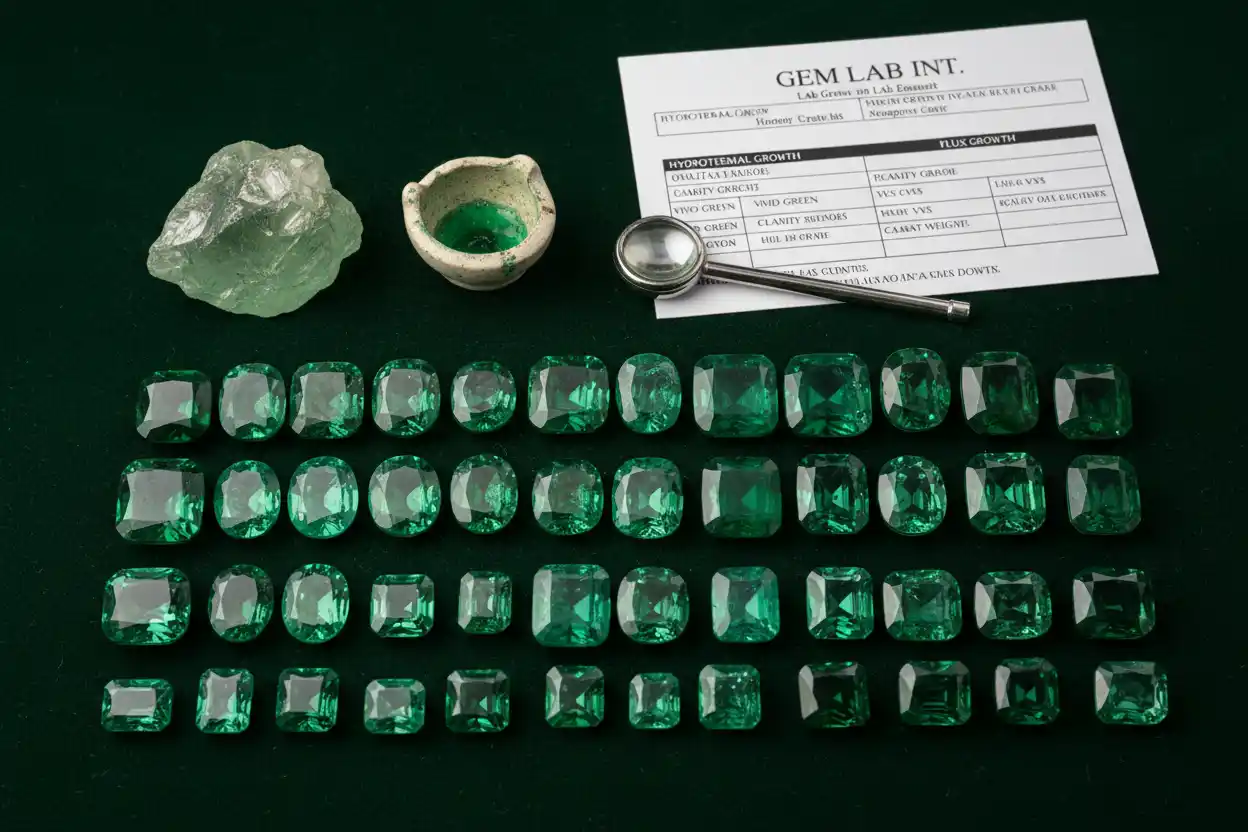
Lab emerald price cannot be reduced responsibly to one permanent dollar-per-carat figure. Laboratory-grown emerald is emerald material produced through controlled crystal growth rather than geological formation, but finished stones still vary substantially in green saturation, tone, transparency, inclusions, growth method, cutting, calibrated dimensions, treatment history, documentation, manufacturer, and retail channel. Those differences can produce asking prices separated by hundreds or even thousands of dollars for stones that are all legitimately described as laboratory-grown emerald.
The market is also structured differently from natural emerald. A natural emerald’s price can incorporate geological scarcity, mining locality, rarity of clean material, treatment level, provenance, and extraordinary premiums for exceptional origin and quality. Laboratory production changes several of those scarcity constraints. Flux and hydrothermal processes can create repeated batches of emerald material with controlled chemistry and relatively predictable sizes, although neither method makes every finished stone identical. FTC guidance requires laboratory-created gemstones to be clearly identified as laboratory-grown, laboratory-created, or equivalent wording rather than represented as mined material.
This page therefore treats lab emerald price as a comparison methodology, not a promise of exact value. Mineral identity and laboratory growth are covered in Lab Emerald meaning, while this page owns quality bands, size effects, growth and treatment context, retail price structure, reporting, and documented market observations within Buying & Value.
Lab Emerald Price at a Glance
| Price factor | Why it matters |
|---|---|
| Color | Usually the strongest visible value factor |
| Saturation | Strong attractive green generally commands more than weak or washed-out green |
| Tone | Excessively dark stones can lose brightness; very pale stones may fall outside desirable emerald appearance |
| Transparency | Hazy or heavily included material usually carries less visual value |
| Growth method | Flux and hydrothermal material can occupy different manufacturer and collector markets |
| Size | Larger calibrated stones generally cost more in total |
| Shape | Cutting yield and demand can change prices among round, cushion, emerald, oval, and other shapes |
| Cut quality | Windowing, depth, symmetry, polish, and color orientation affect appearance |
| Treatment | Post-growth filling, coating, or other alteration should be treated separately from synthetic origin |
| Laboratory report | Can confirm material identity, laboratory origin, and detectable treatments |
| Manufacturer/provenance | Recognized historic or specialty producers can influence collector or branded-retail pricing |
| Retail channel | Wholesale, marketplace, specialist retail, and branded jewelry are not comparable price environments |
| Jewelry mounting | Metal, design, labor, side stones, and brand markup can exceed the loose-stone cost |
| Resale | Retail purchase price is not guaranteed recoverable value |
What Is Actually Being Priced?
The first step is identifying the product category. “Lab emerald price” can refer to a loose faceted synthetic emerald, a rough hydrothermal crystal, a flux-grown collector specimen, calibrated melee, a cabochon, a bead, or finished jewelry. These categories should not be combined into one per-carat table.
A loose faceted gemstone is primarily judged by color, transparency, face-up appearance, size, shape, cut, growth evidence, treatment disclosure, and documentation. Rough material requires an estimate of usable cutting yield. A research or collector crystal may be valued for intact growth morphology, seed plates, flux inclusions, historic producer provenance, or unusual synthesis evidence. Finished jewelry incorporates metal, manufacturing, setting, design, warranty, branding, and retail service.
That distinction is essential because a $1,500 finished ring does not imply that its laboratory-grown emerald alone is worth $1,500. Likewise, a low-cost wholesale crystal cannot be compared directly with a carefully selected, individually photographed premium-retail faceted stone.
Seller selection, return terms, and transaction-specific screening belong on buy Lab Emerald rather than being repeated here.
Color Is Usually the Most Important Quality Factor
GIA describes color as the central value factor for emerald generally. The most desirable emerald appearance falls in the bluish-green to pure-green range, with strong saturation and a tone that is neither excessively light nor overly dark. Color distribution and transparency also influence quality.
Those principles remain useful for laboratory-grown material even though the rarity mechanism changes. A weak yellowish-green synthetic emerald is still visually less desirable than an evenly colored vivid bluish-green stone of comparable size and cutting. Laboratory growth can make attractive saturated material more available, but it does not eliminate differences in hue, tone, zoning, or orientation.
A buyer should therefore describe color through observable components:
| Color component | Lower-value tendency | Higher-value tendency |
|---|---|---|
| Hue | Noticeably yellowish, grayish, or poorly balanced | Attractive pure green to bluish green |
| Tone | Too pale or excessively dark | Medium to medium-dark while retaining brightness |
| Saturation | Weak or washed out | Strong and vivid |
| Distribution | Obvious distracting zoning | Attractive, reasonably even face-up appearance |
| Transparency | Cloudy or dull | Transparent with good light return |
These are comparative descriptors, not universal laboratory grades.
The physics behind chromium, vanadium, iron, pleochroism, and green absorption belongs in Lab Emerald optical properties and color behavior.
There Is No Universal “AAA Lab Emerald” Grade
Commercial labels such as AAA, AAA+, premium, royal green, Colombian green, or investment quality may appear in listings, but they do not represent one universally standardized laboratory-grown emerald grading system.
GIA evaluates emerald but does not issue an overall quality grade comparable to the diamond D-to-Z and clarity systems. Its colored-stone reports can identify the material, state whether an emerald is natural or laboratory-grown, record measurements and color description, and report detectable treatments.
This distinction matters when two sellers both advertise “AAA lab emerald.” One may mean vivid color and high transparency; another may apply the same label to almost all inventory.
A useful grade must therefore be translated back into observable characteristics.
Practical Lab Emerald Quality Bands
The following bands are editorial comparison categories, not laboratory grades.
| Band | Typical characteristics | Pricing implication |
|---|---|---|
| Commercial | Light-to-medium green, ordinary transparency, visible growth features or modest cut | Lower price range |
| Good | Attractive green, reasonable transparency, acceptable cutting, limited distracting inclusions | Mid-market |
| Fine | Strong green-to-bluish-green color, good transparency, attractive orientation, careful cutting | Premium |
| Exceptional | Vivid balanced green, excellent transparency and face-up appearance, strong cutting, unusual size or provenance | Highest specialist tier |
Growth inclusions should not automatically push a stone into a lower band. A flux veil or hydrothermal feature may prove laboratory origin while remaining visually unobtrusive. The question is whether the feature materially affects transparency, durability, or face-up beauty.
Detailed microscopic evidence belongs in the Lab Emerald microscope inclusion notebook.
Documented Retail Price Sample
A current specialist-retail sample provides a useful view of how calibrated size and shape affect asking price. The following stones were sold as loose laboratory-grown emeralds selected for jewelry use. They are anonymized because this analysis is about methodology rather than retailer recommendation.
| Source type | Calibrated size / shape | Seller-described context | Asking price |
|---|---|---|---|
| Premium specialist retail | 6 mm round | Loose lab-grown emerald | $850 |
| Premium specialist retail | 6 mm cushion | Medium green, eye-clean | $990 |
| Premium specialist retail | 7 × 5 mm emerald cut | Loose lab-grown emerald | $890 |
| Premium specialist retail | 7 mm round | Loose lab-grown emerald | $1,250 |
| Premium specialist retail | 8 × 6 mm emerald cut | Loose lab-grown emerald | $1,290 |
| Premium specialist retail | 9 × 7 mm emerald cut | Loose lab-grown emerald | $1,790 |
| Premium specialist retail | 8 mm round | Loose lab-grown emerald | $1,890 |
| Premium specialist retail | 10 × 8 mm emerald cut | Loose lab-grown emerald | $2,290 |
| Premium specialist retail | 11 × 8 mm emerald cut | Loose lab-grown emerald | $2,590 |
| Premium specialist retail | 11 × 9 mm emerald cut | Loose lab-grown emerald | $2,850 |
Limits of This Sample
This table is not a universal lab emerald price chart. The listings are from one premium retail environment and are priced primarily by calibrated dimensions rather than supplying a standardized carat-weight-and-grade dataset for every stone. Exact saturation, growth method, cutting depth, actual weight, transparency, and manufacturer may differ.
That limitation is useful rather than inconvenient. It illustrates an important characteristic of the lab-created colored-stone market: many retail stones are sold by millimeter dimensions because jewelers need calibrated sizes for settings, whereas natural fine-gem markets often emphasize individual carat weight and provenance much more heavily.
The table should therefore be read as a same-channel size progression, not as a per-carat valuation standard.
What the Retail Sample Reveals
Within the emerald-cut sequence, asking prices rose from $890 for 7 × 5 mm material to $1,290 at 8 × 6 mm, $1,790 at 9 × 7 mm, $2,290 at 10 × 8 mm, and $2,850 at 11 × 9 mm.
The progression demonstrates a size premium, but it should not be treated as a mathematical formula. Increasing linear dimensions increases face-up area and usually requires substantially more rough volume. Larger crystals must also provide enough usable transparent green material to produce the finished stone.
Round shapes show their own pattern: a 6 mm round was listed at $850, a 7 mm round at $1,250, and an 8 mm round at $1,890.
Again, this does not prove that every additional millimeter has a fixed dollar value. It shows why comparing calibrated size within the same channel is more defensible than quoting a universal price per carat.
Wholesale Pricing Shows Why Retail Channel Matters
The opposite end of the market looks dramatically different. One hydrothermal synthetic-emerald manufacturer listing offered approximately 2 ct baguette-cut material at $74 per piece for small orders, decreasing toward $65 per piece at higher quantities.
That price should not be compared directly with the premium retail sample as though it were the same product. The wholesale listing has different minimum quantities, quality controls, photography, selection standards, consumer protections, verification, branding, service, and potentially very different color and clarity assumptions.
The gap is nevertheless informative. It demonstrates that retail context can account for far more price variation than a small difference in gemstone dimensions.
A lab emerald price article that ignores sales channel can therefore create false precision even if every quoted number is technically real.
Why Price Per Carat Can Be Misleading
Carat weight is useful because it provides an objective mass measurement. Yet laboratory-grown emerald is frequently cut to calibrated dimensions, and two stones with identical carat weight can show different visible sizes because their depth and proportions differ.
Consider two hypothetical stones weighing 2 ct:
- Stone A is deeply cut, carrying substantial weight below the girdle.
- Stone B is moderately proportioned and has a larger face-up outline.
If their color and transparency are similar, Stone B may deliver more visible presence despite identical mass.
A simple price-per-carat comparison could therefore miss the better visual value.
For calibrated jewelry stones, record both carat weight and millimeter dimensions whenever possible.
Size Effect Is Real, but Laboratory Supply Changes the Curve
Natural emerald prices can rise sharply with size when high quality is held constant because large transparent natural crystals with fine color are scarce. GIA specifically notes that natural emerald pricing can escalate dramatically as size increases quality-for-quality.
Laboratory production changes that scarcity relationship. A grower can produce crystal material repeatedly, and larger growth runs can create substantial synthetic rough. This does not mean large lab emerald is free or trivial to manufacture. Larger transparent volumes still require successful crystal growth, time, cutting yield, quality control, and marketable color.
The result is a size premium without the same geological rarity curve that defines exceptional natural emerald.
That broader distinction is examined in Lab Grown vs Natural Gemstones rather than duplicated in detail here.
Growth Method: Flux Versus Hydrothermal
Flux and hydrothermal emeralds are both legitimate laboratory-grown emerald when their material properties meet the definition. They should not automatically be ranked as “good” and “bad.”
Flux growth can be slow and technically demanding. GIA notes that flux synthetic gemstone production may require substantial equipment, careful control, and prolonged growth. Hydrothermal production uses hot pressurized aqueous solutions and has its own demanding engineering requirements.
Pricing can differ according to:
- manufacturer;
- growth time;
- batch yield;
- usable transparent volume;
- color;
- seed configuration;
- production scale;
- cutting quality;
- brand recognition;
- collector interest.
The actual synthesis mechanisms and their relationship with natural emerald formation belong in Lab Emerald formation and deposit geology.
Does Flux-Grown Emerald Cost More?
Not as a universal rule.
Some historic flux-grown material has collector appeal because of producer reputation, unusual inclusions, discontinued manufacturing, or documented provenance. Modern hydrothermal material can also be extremely attractive and may achieve strong green color and clarity.
Growth method should therefore be treated as a specification rather than a quality grade.
A seller asking a substantial premium because a stone is “flux-grown” should be able to explain why that production origin matters to the specific item—manufacturer, provenance, color, rarity, research importance, or another measurable reason.
Treatment Is Separate From Laboratory Origin
A laboratory-grown emerald can be correctly identified as synthetic emerald and still have a separate treatment history.
Fracture filling is particularly important in emerald commerce generally. GIA reports can identify whether an emerald shows clarity enhancement and quantify the degree of filling rather than treating enhancement as part of the mineral identity.
For laboratory-grown material, cleaner growth can reduce the need for extensive filling in many stones, but “lab-grown” should not automatically be translated into “untreated after growth.”
Potential post-growth issues can include:
- fracture filling;
- coatings;
- surface modification;
- composite construction;
- repair;
- stabilization.
FTC guidance also distinguishes legitimate laboratory-grown gemstones from products made with gemstone material plus substantial filler or binder. Such composites should not simply be marketed as laboratory-grown emerald.
How Treatment Can Affect Price
A treatment matters when it changes one or more of the following:
- transparency;
- durability;
- long-term maintenance;
- disclosure expectations;
- collector interest;
- comparability with untreated material.
A visibly fractured stone whose appearance depends strongly on filling should not automatically receive the same premium as a comparable stone whose clarity comes from the grown crystal itself.
At the same time, treatment should not be treated morally. The relevant questions are whether it is disclosed, stable, appropriately priced, and suitable for the intended use.
Clarity: Cleaner Is Not Always Rare in the Same Way
Natural emerald is famous for inclusions, and GIA notes that eye-clean natural emeralds are uncommon and can command substantial premiums.
Laboratory-grown emerald changes this relationship. Controlled growth can produce highly transparent material more predictably, so eye-clean appearance may not carry the same scarcity premium.
This is an important pricing difference.
A synthetic emerald should not receive an enormous premium merely because a seller calls it “flawless” or “VVS.” Those terms may not correspond to a standardized emerald clarity scale, and high transparency can be relatively attainable in laboratory-grown material.
Instead, determine whether inclusions actually affect:
- face-up transparency;
- brightness;
- color;
- durability;
- aesthetics;
- growth-method documentation.
Some visible flux veils or hydrothermal structures may even add collector interest rather than simply lowering quality.
Cut Quality Can Be Worth Paying For
A technically clean laboratory-grown emerald can still look poor if cut badly.
GIA’s emerald quality guidance emphasizes that cutting influences color, apparent darkness, light return, weight retention, and durability. A deep cut can darken pale material, while a shallow cut may lighten overly dark rough.
For lab emerald, examine:
| Cut issue | Why it matters |
|---|---|
| Large window | Center appears transparent or washed out |
| Excessive depth | Hidden weight without equivalent visible size |
| Poor symmetry | Reduces visual balance |
| Uneven steps | Distracting reflections |
| Weak polish | Reduces luster |
| Very thin corners | Greater damage risk |
| Poor color orientation | Face-up color can be weaker than rough suggested |
The detailed lapidary tradeoffs belong in Lab Emerald cutting, orientation, and polish.
Shape Also Changes Price
The same calibrated width does not imply the same rough requirement across shapes.
Round stones generally require different cutting yield from rectangular step cuts. Cushions, pears, ovals, hexagons, and custom shapes each impose their own yield and labor constraints.
The current retail sample illustrates this. A 6 mm round was listed at $850, while a 6 mm cushion in the same premium channel was $990.
That difference cannot be attributed to shape alone because individual stone quality may vary. It does demonstrate why the most useful comparison is same shape, similar size, similar quality, same channel.
Manufacturer and Provenance Can Matter
Laboratory-grown gemstones are manufactured products, but some manufacturers have become historically or commercially distinctive.
Chatham, for example, is strongly associated with flux-grown emerald and continues to market laboratory-grown emerald as a branded gemstone category. Its loose stones are distributed through authorized retailers rather than openly priced through the manufacturer for ordinary direct retail comparison.
A historically documented Chatham, Gilson, Biron, or experimental research specimen can therefore have a provenance dimension that generic hydrothermal cutting material lacks.
That premium should be supported by documentation. A seller simply describing an anonymous stone as “Chatham type” is not equivalent to verified Chatham provenance.
“Colombian Lab Emerald” Needs Careful Interpretation
Natural emerald origin terms refer to where a gemstone formed geologically. A laboratory-grown emerald did not crystallize in a Colombian mine.
Some commercial listings use expressions such as “Colombian color,” “Colombian green,” or “Colombian hydrothermal emerald” to describe color style or a synthetic product category. Such wording should not obscure the fact that the gemstone is laboratory-created.
FTC guidance requires the laboratory-created nature of the stone to be disclosed clearly and immediately rather than allowing consumers to infer mined origin.
For lab emerald pricing, geographic mine-origin premiums should therefore not be copied mechanically from natural emerald.
The meaningful provenance variables are manufacturer, growth method, production history, and documentation.
Laboratory Reports and Price
A respected gemological report can add confidence when the purchase value justifies testing.
GIA’s colored-stone reports can identify whether an emerald is natural or laboratory-grown and report detectable treatments. GIA evaluates emerald characteristics but does not provide an overall emerald quality grade or appraisal value.
That creates an important distinction:
Identification report: What is the material? Is it natural or laboratory-grown? Is treatment detected?
Appraisal: What monetary value is assigned within a defined market and purpose?
A laboratory report can strengthen a high-value transaction without proving that the asking price is fair.
A Lab Report Does Not Create Fine Color
A mediocre stone with excellent documentation remains a mediocre-looking stone.
Reports can verify objective gemological facts, but they cannot transform weak saturation, excessive darkness, poor cutting, or obvious windowing into desirable quality.
For ordinary lower-cost lab emerald, the cost of extensive laboratory reporting may also represent a significant percentage of the stone’s value.
The report should therefore be proportional to the financial and evidentiary question being answered.
Retail Context Can Dominate Price
The documented sample makes this particularly clear. Premium individually selected retail lab emeralds were priced in the hundreds to thousands of dollars, while manufacturer-level hydrothermal inventory could appear at only tens of dollars per stone under wholesale conditions.
Those are not contradictory prices.
They represent different stages of the supply chain.
Retail price can include:
- stone selection;
- rejected inventory cost;
- cutting and finishing;
- individual photography;
- gemological screening;
- fulfillment;
- shipping;
- insurance;
- return rights;
- customer support;
- warranties;
- marketing;
- brand positioning;
- inventory financing;
- retailer margin.
A buyer should therefore compare one retailer with genuinely comparable retailers rather than treating factory pricing as a direct benchmark for premium consumer service.
Original Price-Normalization Method
Before comparing two lab emerald listings, record the following.
| Field | Stone A | Stone B | Why it matters |
|---|---|---|---|
| Product type | Loose / rough / jewelry | Record | Must compare like with like |
| Growth origin | Flux / hydrothermal / unknown | Record | Production context |
| Manufacturer | Known / unknown | Record | Provenance may matter |
| Shape | Record | Record | Affects yield and demand |
| Carat weight | Record | Record | Mass |
| Dimensions | Record | Record | Visible size |
| Hue | Green / bluish green / yellowish green | Record | Major quality factor |
| Tone | Light / medium / dark | Record | Controls brightness |
| Saturation | Weak / medium / vivid | Record | Often major price driver |
| Transparency | Clean / moderate / hazy | Record | Affects appearance |
| Growth inclusions | Minor / visible / distracting | Record | Quality and provenance |
| Windowing | None / moderate / large | Record | Cut efficiency |
| Depth | Balanced / shallow / deep | Record | Reveals hidden weight |
| Polish | Good / weak | Record | Surface appearance |
| Post-growth treatment | None stated / disclosed / unknown | Record | Comparability |
| Report | Laboratory and conclusion | Record | Verification |
| Retail channel | Wholesale / marketplace / specialist | Record | Major price variable |
| Asking price | Record | Record | Starting point |
| Return/service context | Record | Record | Transaction value |
Only after these fields are normalized does the cheaper stone become meaningfully comparable.
Example Comparison 1: 7 × 5 mm Versus 8 × 6 mm
In the same specialist retail channel, a 7 × 5 mm emerald-cut lab emerald was listed at $890, while an 8 × 6 mm stone was listed at $1,290.
The larger stone costs about $400 more, but that premium should not be interpreted as the universal value of increasing one calibrated size step.
The stones can differ in total weight, saturation, depth, transparency, and individual selection. The comparison simply establishes a real retail reference point.
Example Comparison 2: 9 × 7 mm Versus 10 × 8 mm
The same channel listed 9 × 7 mm material at $1,790 and 10 × 8 mm at $2,290.
A buyer deciding between the two should compare the actual face-up visual difference against the $500 price difference rather than assuming the larger option automatically offers better value.
If the 9 × 7 mm stone has richer saturation or better cutting, it could be the stronger purchase despite being smaller.
Example Comparison 3: Wholesale Hydrothermal Versus Premium Retail
A roughly 2 ct hydrothermal synthetic emerald wholesale listing at approximately $74 cannot responsibly be compared directly with a specialist-retail calibrated emerald priced near $1,000 or more.
The lesson is not that the retailer is overcharging by a factor of ten.
The lesson is that the products lack controlled equivalence.
Without consistent data on color, transparency, cut, manufacturer, treatment, selection standard, service, and verification, the ratio is commercially interesting but gemologically incomplete.
Example Comparison 4: “Flawless” Versus Better Color
Suppose Stone A is described as perfectly clean but has pale green color.
Stone B contains a subtle flux veil but has stronger balanced bluish-green saturation and better cutting.
For a jewelry buyer, Stone B may be significantly more attractive and reasonably worth more because color is central to emerald appearance.
The word “flawless” should not outrank the actual gemstone.
Natural Emerald Price Should Not Be Used as a Lab Emerald Anchor
A common sales tactic compares a laboratory-grown emerald with a very expensive natural Colombian or Zambian emerald and presents the difference as the amount the buyer has “saved.”
That comparison is incomplete because the two markets value different scarcity factors.
Natural emerald can carry premiums for geological rarity, origin, treatment level, historic provenance, exceptional natural transparency, and collector demand. Laboratory-grown emerald is manufactured material with a different supply model.
Both can be emerald. Their market structures do not have to be identical.
Comparing Lab Emerald Pricing With Lab Diamond Pricing
Laboratory-grown emerald and laboratory-grown diamond are both manufactured gemstone markets, but production economics are different.
Lab diamonds are produced principally through HPHT and CVD technologies and have a highly standardized cut/color/clarity retail ecosystem. Lab emerald is primarily flux- or hydrothermal-grown and tends to be sold through colored-stone conventions, calibrated dimensions, color description, manufacturer reputation, and individual appearance.
For readers evaluating how manufactured supply can affect gemstone pricing more broadly, Lab Diamond price provides a useful comparison without implying that the two markets should move identically.
Jewelry Price Is Not Loose-Stone Price
A laboratory-grown emerald ring or pendant can cost several times more than the loose center stone after precious metal, setting work, diamonds, side gems, engraving, sizing, brand, and retail support are included.
Mechanical design also matters. Emerald material has useful hardness but can still chip or fracture, particularly around corners and existing internal features.
The engineering consequences of prong pressure, bezel coverage, corner protection, and wear exposure belong in Lab Emerald setting and wear engineering.
When comparing finished jewelry, isolate the center stone from the mounting whenever the seller provides enough information to do so.
Cleaning and Condition Affect Ownership, Not Initial Grade
A dirty emerald can look duller and less saturated because oils and surface films reduce light transmission and reflection. Cleaning restores visibility; it does not increase the gemstone’s intrinsic grade.
Damage is different. Chips, scratches, broken corners, surface-reaching fractures, coating wear, or degraded filling can reduce desirability and resale appeal.
Routine jewelry care belongs in how to clean Lab Emerald jewelry so cleaning instructions do not displace price analysis here.
Collector and Research Specimens Follow Another Market
Some synthetic emeralds have significance beyond jewelry.
Early flux-grown crystals, discontinued producer material, unusual hydrothermal seeds, cat’s-eye synthetic emeralds, research samples, and specimens preserving diagnostic growth structures may attract mineralogical or technological collectors.
In these cases, preserving producer labels, old reports, packaging, seed information, and growth documentation can matter more than achieving maximum faceting yield.
Those records belong in the Lab Emerald specimen conservation record.
Resale Value
Retail purchase price should not be confused with guaranteed resale value.
A secondhand buyer may compare the stone with newly manufactured material available at current production prices. Retail service, warranties, shipping, marketing, and original seller margin may contribute little to a secondary-market offer.
Recognized manufacturer provenance, unusually fine color, significant size, historic synthesis, or research value can create stronger collector interest, but none provides guaranteed liquidity.
There is no defensible fixed rule such as “lab emerald retains 50%” or “lab emerald loses 80%.” Resale depends on the specific stone and sales channel.
Is Lab Emerald an Investment?
It should not be sold or purchased on a promise of predictable financial appreciation.
Laboratory-grown emerald can be valuable jewelry or an interesting collector object, but future price depends on manufacturing capacity, technology, consumer demand, brand recognition, inflation, retail margins, and the availability of comparable new stones.
Terms such as “investment grade,” “guaranteed appreciation,” or “future heirloom value” require evidence beyond color and clarity.
The broader limits around price interpretation and financial claims are defined in the Disclaimer.
When a Lab Emerald Price Looks Too Low
A low price is not automatically proof of fake material. Wholesale hydrothermal production demonstrates that genuine laboratory-created emerald can exist at much lower acquisition prices than premium specialist retail.
Instead, ask what the low price actually includes.
Potential explanations include:
- wholesale quantity;
- commercial color;
- weak transparency;
- poor cut;
- minimal quality selection;
- no independent report;
- direct-manufacturer sale;
- limited returns;
- uncertain treatment;
- inexpensive setting;
- unusually high production supply.
The material may still be genuine lab emerald.
When a Lab Emerald Price Looks Too High
A premium price should be explainable through the actual stone or transaction.
Possible legitimate reasons include:
- exceptional color;
- unusually strong transparency;
- large calibrated dimensions;
- precision cutting;
- recognized manufacturer;
- historical provenance;
- unusual flux-grown material;
- specialist selection;
- laboratory documentation;
- premium service or warranty;
- custom cutting.
Marketing phrases alone are insufficient.
“AAA++ Colombian lab emerald” does not explain a $3,000 premium unless the seller can translate those words into measurable or documented characteristics.
A Better Lab Emerald Pricing Workflow
Start by defining the desired product narrowly.
For example:
Loose laboratory-grown emerald, emerald cut, approximately 8 × 6 mm, medium-to-vivid bluish green, transparent, good symmetry, no significant window, treatment disclosed.
Then collect several comparable listings.
Reject comparisons that differ fundamentally in product type or sales channel.
Compare dimensions before carat weight.
Judge color under similar lighting.
Record transparency and visible inclusions.
Check growth-method and treatment claims.
Verify any laboratory report.
Only then compare price.
This sequence prevents a low number from persuading the buyer to accept a stone that did not meet the original quality requirement.
Evidence and Scope
GIA’s quality guidance supports using color, transparency, cut, size, and treatment as meaningful emerald evaluation factors, but it does not publish a universal laboratory-grown emerald price list.
The documented prices here are asking-price observations, not appraisals or guaranteed transaction values. Listings can change, and no individual example establishes the value of another stone.
The broader evidence methodology used by Gems Lore is described on About, while Contact is the general communication route for the site rather than a substitute for independent gemological examination.
Frequently Asked Questions
How much does a lab emerald cost?
There is no single universal price. Current retail examples range from hundreds of dollars for smaller calibrated loose stones into several thousand dollars for larger premium-retail lab-grown emeralds, while wholesale synthetic material can cost substantially less.
Why are some lab emeralds so cheap?
Laboratory production reduces geological scarcity, and wholesale material may be sold with lower margins, limited selection, commercial color, minimal documentation, or bulk-order economics.
Why are some lab emeralds expensive?
Strong color, high transparency, large dimensions, skilled cutting, premium retail selection, recognized manufacturer provenance, documentation, warranties, and brand positioning can all increase the asking price.
What matters most in lab emerald price?
Color is usually the most important visible quality factor. Saturation, tone, transparency, cut, size, growth method, treatment, and retail context also matter.
Is a darker lab emerald always worth more?
No. Excessively dark material can lose brightness and transparency. Strong saturation with an attractive medium-to-medium-dark tone is generally more desirable than darkness alone.
Is a flawless lab emerald more valuable?
High transparency is desirable, but laboratory growth can produce clean material relatively predictably. “Flawless” is not a universal emerald grade and should not automatically justify a large premium.
Is AAA lab emerald an official grade?
No universal AAA laboratory-grown emerald grading system exists. Seller grades should be translated into actual color, transparency, cut, size, and treatment information.
Does GIA grade lab emerald quality?
GIA can identify an emerald as natural or laboratory-grown, describe its characteristics, and report detectable treatment, but it does not issue an overall emerald quality grade or appraisal value.
Does a laboratory report increase value?
It can increase confidence and marketability when material origin or treatment matters, especially for higher-priced stones. The report does not guarantee that the seller’s price is fair.
Is flux-grown emerald worth more than hydrothermal emerald?
Not automatically. Growth method is not a universal quality grade. Color, transparency, size, manufacturer, provenance, cutting, and market demand still determine the actual premium.
What is the difference between flux and hydrothermal lab emerald?
Flux emerald crystallizes from a molten solvent, while hydrothermal emerald grows from hot pressurized aqueous solutions. Both can produce genuine laboratory-grown emerald material.
Are larger lab emeralds more expensive?
Usually yes in total price, but the increase is not a universal per-carat formula. The documented premium-retail sample shows prices rising as calibrated dimensions increase.
Should I compare lab emeralds by carat or millimeter size?
Use both when available. Carat measures weight; millimeter dimensions show visible size. Many laboratory-grown colored stones are sold by calibrated dimensions because they are intended for standardized jewelry settings.
Does shape affect lab emerald price?
Yes. Shape can affect cutting yield, labor, demand, face-up dimensions, and availability. Compare the same shape whenever possible.
Does cut affect lab emerald value?
Yes. Windowing, excess depth, weak symmetry, poor polish, and unfavorable color orientation can make an otherwise attractive stone less desirable.
Can lab emerald be fracture filled?
Laboratory-grown origin and post-growth treatment are separate questions. A finished synthetic emerald should not automatically be assumed untreated, and significant treatment should be disclosed where relevant.
Is “Colombian lab emerald” actually from Colombia?
Not necessarily. Laboratory-grown emerald does not acquire geological Colombian origin merely because it resembles Colombian color. Clear laboratory-created disclosure is important so consumers do not confuse synthetic origin with a mined locality.
Is Chatham emerald laboratory grown?
Yes. Chatham markets laboratory-grown emerald and distributes loose material through authorized retail channels rather than ordinary direct loose-stone retail on its public site.
Is lab emerald cheaper than natural emerald?
Generally, laboratory production allows comparable-looking green material to be offered at lower prices than exceptional natural emerald because the geological rarity and mine-origin premiums are different. Exact prices still depend on individual quality.
Does lab emerald hold its value?
There is no guaranteed retention percentage. Secondary-market value depends on the specific stone, producer, color, size, condition, documentation, demand, and the current cost of newly manufactured alternatives.
Is lab emerald a good investment?
It should not be purchased with a guaranteed-appreciation assumption. Laboratory-grown emerald is better evaluated as jewelry, a gemstone, or a specialist collectible than as a promised financial-return product.
Why can wholesale lab emerald cost much less than retail?
Wholesale and retail prices include different levels of selection, documentation, cutting, service, warranty, marketing, returns, inventory cost, and margin. A wholesale price is not automatically the fair consumer-retail price.
How can I compare two lab emerald prices fairly?
Match product type, growth method, shape, dimensions, color, transparency, cut, treatment, documentation, and sales channel first. Compare the asking price only after those variables are reasonably aligned.