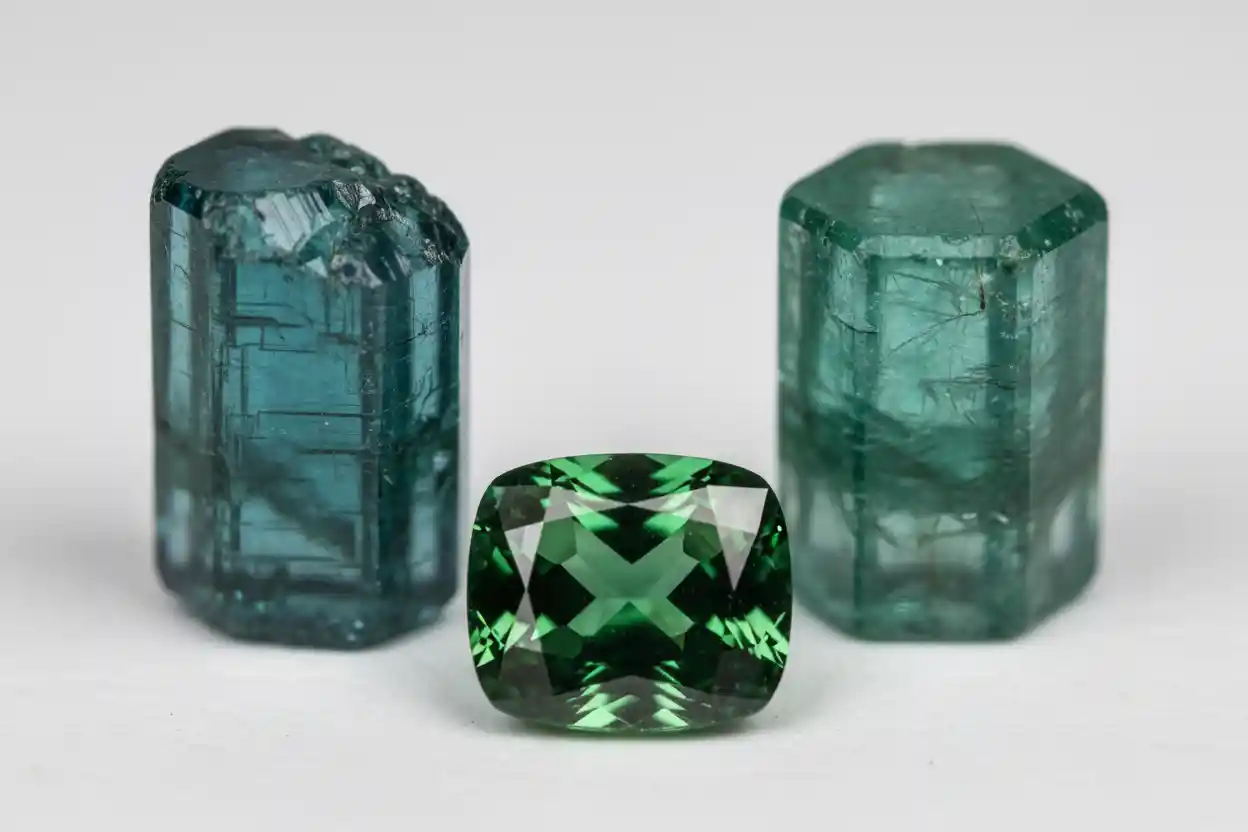
Lab Emerald Meaning: Properties, Uses & Symbolism
Lab emerald meaning begins with the difference between material identity and growth origin. A properly described laboratory-grown emerald is emerald material produced under controlled laboratory conditions rather than crystallized through natural geological processes. Emerald itself is the green to bluish-green variety of beryl, Be₃Al₂Si₆O₁₈. GIA lists emerald at approximately Mohs 7.5–8, refractive index 1.577–1.583, birefringence 0.005–0.009, and specific gravity around 2.72. Laboratory-created emerald is designed to reproduce essentially the same chemical, physical, and optical material rather than merely imitating emerald’s color.
That definition matters commercially as well as scientifically. U.S. Federal Trade Commission guidance allows terms such as laboratory-grown, laboratory-created, or appropriately qualified synthetic emerald only when the manufactured product possesses essentially the same optical, physical, and chemical properties as the named mined gemstone. A green glass, green cubic zirconia, dyed material, or product made substantially from gemstone fragments and filler is therefore not made into “lab emerald” simply by resembling emerald visually.
Laboratory-grown emeralds are produced principally through two families of crystal-growth technology: flux growth and hydrothermal growth. Both can create genuine synthetic beryl with emerald color, but they leave different growth structures, inclusions, impurity patterns, and spectroscopic evidence. GIA notes that experienced laboratories can usually distinguish natural, flux-grown, and hydrothermal emeralds by combining microscopy, spectroscopy, chemistry, and growth-pattern examination rather than relying on color alone.
The symbolic layer is much less objective. Modern users may associate lab-created emerald with renewal, deliberate creation, affection, clarity, technological achievement, or choosing beauty independent of geological rarity. Those interpretations can be personally meaningful, but they are not measurable consequences of chromium, vanadium, beryllium, hydrothermal growth, or laboratory equipment. This page keeps that distinction clear within the broader Gemstone Guides.
Lab Emerald at a Glance
| Feature | Evidence-based description |
|---|---|
| Material | Emerald |
| Mineral species | Beryl |
| Formula | Be₃Al₂Si₆O₁₈ |
| Crystal system | Hexagonal |
| Origin | Laboratory-created rather than geologically mined |
| Principal growth routes | Flux and hydrothermal |
| Typical color | Green to bluish green |
| Main chromophores | Chromium and/or vanadium; iron can modify appearance |
| Mohs hardness | Approximately 7.5–8 |
| Refractive-index context | Emerald broadly around 1.577–1.583, with composition-dependent variation |
| Birefringence | Approximately 0.005–0.009 in general emerald data |
| Specific gravity | Around 2.72 in general emerald reference data |
| Optical character | Uniaxial negative |
| Pleochroism | Green/bluish-green directional differences can occur |
| Same geological origin as natural emerald? | No |
| Same basic gemstone material? | Yes, when correctly classified as laboratory-grown emerald |
| Common hydrothermal clues | Chevron growth, seed-related structures, nail-head-type features, characteristic water/chlorine spectroscopy in some products |
| Common flux clues | Wispy flux veils, trapped flux, growth striae, crucible-related metallic platelets in some products |
| Main use | Faceted jewelry gems, research material, teaching samples, collector crystals |
| Proven healing effects | None established |
What a Lab Emerald Actually Is
Laboratory emerald is synthetic emerald in the technical gemological sense: a human-grown counterpart of a naturally occurring gemstone whose material properties closely reproduce the natural mineral. GIA defines synthetic gems broadly as laboratory-produced crystals that share virtually all of the chemical, optical, and physical characteristics of their natural counterparts.
The word synthetic can cause confusion because ordinary conversation often uses it to mean imitation, fake, or plastic. Gemology uses it differently. A synthetic emerald is beryl with emerald coloration. An imitation emerald is something else chosen to resemble emerald.
The distinction can be summarized as:
Natural emerald: emerald material + natural geological growth.
Lab emerald: emerald material + laboratory growth.
Emerald imitation: different material + emerald-like appearance.
This same separation between material and origin is central to Lab Diamond meaning. Laboratory origin does not automatically change the underlying material identity, but it does change the crystal’s growth history, rarity framework, diagnostic features, provenance, and market context.
When Green Lab-Grown Beryl Is Actually “Emerald”
Even within beryl, green color does not automatically make every specimen emerald. GIA notes that gemologists disagree somewhat on the precise boundary between emerald and lighter green beryl, but laboratories generally require sufficient green color and saturation before applying the emerald variety name.
That boundary applies logically to laboratory-grown material as well. A laboratory can grow chromium- or vanadium-bearing green beryl, but if the finished material is too pale for the accepted emerald color range, calling it laboratory-grown green beryl may be more precise.
This is why “made with chromium” is not by itself an emerald grading criterion. Color appearance remains part of the variety definition.
Lab Emerald Identity Table
| Claim or observation | Evidence-based interpretation | Importance |
|---|---|---|
| Be₃Al₂Si₆O₁₈ composition | Beryl chemistry | Fundamental |
| Saturated green/bluish-green appearance | Required for emerald variety classification | Strong |
| Hexagonal beryl structure | Required | Fundamental |
| Laboratory growth | Establishes synthetic origin | Fundamental |
| Flux-grown | One legitimate synthetic route | Growth-method information |
| Hydrothermal-grown | Another legitimate synthetic route | Growth-method information |
| RI compatible with emerald | Supports identity | Useful |
| SG compatible with beryl | Supports identity | Useful |
| Chromium present | Common color cause | Supporting |
| Vanadium present | Can contribute to color | Supporting |
| “Perfectly clean” appearance | Not proof of laboratory origin | Weak |
| Seed plate | Strong synthetic-growth clue when present | Strong |
| Chevron zoning | Characteristic of many hydrothermal synthetics | Strong supporting clue |
| Flux veil | Characteristic of many flux synthetics | Strong supporting clue |
| Three-phase natural-looking inclusion | Can support natural origin | Must be interpreted carefully |
| Seller says “created emerald” | Commercial representation only | Needs verification |
| Green glass passes visual inspection | Still not lab emerald | Different material |
Flux-Grown Lab Emerald
Flux growth uses a molten solvent capable of dissolving the chemical ingredients needed to form emerald. Instead of melting beryl itself, which is impractical for producing gem-quality crystals in this context, the components dissolve in the flux and slowly crystallize as conditions change.
Commercially successful flux-grown emerald became established around the middle of the twentieth century, with producers such as Chatham and later Gilson becoming important names in synthetic emerald history. GIA’s historical review identifies Chatham and Gilson as major flux producers and describes lithium molybdate-based flux systems in early commercial manufacturing.
Flux growth can create distinctive internal evidence. GIA studies of Gilson material document wispy flux fingerprints, veils, growth striae, elongated cavities, and residual flux-related inclusions. Metallic platelets from crucibles have also been documented in some historical flux-grown material.
These features are useful because they record the manufactured growth environment directly.
The detailed process chemistry, crystal-growth sequence, and comparison with natural emerald geology belong in Lab Emerald formation and deposit geology rather than being expanded into a production manual here.
Hydrothermal Lab Emerald
Hydrothermal growth uses hot aqueous solutions under elevated pressure to dissolve emerald-forming nutrients and transport them toward seed material where crystals can grow. Conceptually, it resembles some natural hydrothermal mineral growth processes while occurring inside engineered equipment under controlled conditions.
Commercial hydrothermal emerald followed the development of flux material and became an important second production route. GIA describes hydrothermal synthetic emerald as one of the two main laboratory methods in current gemological identification and notes that the process can generate characteristic features such as chevron graining, seed-related structures, nail-head spicules, and unusual synthetic mineral inclusions.
Certain hydrothermal products also possess distinctive chemical or infrared signatures. GIA’s work on Chinese hydrothermal emerald, for example, documented oriented needle-like tubes, cone-shaped voids, nail-head features, growth zoning, and chlorine-related spectroscopic characteristics.
Again, one feature alone should not be treated as universal proof. Different manufacturers use different solutions, seed orientations, dopants, growth rates, and post-growth procedures.
Why Lab Emerald Is Green
Emerald color arises when trace chromophores modify beryl’s otherwise much paler appearance. Chromium is one of the principal emerald chromophores, while vanadium can also produce or contribute to emerald green. Iron can influence hue and absorption as well.
Laboratory growers can deliberately introduce suitable trace elements into the growth system. Historical GIA analysis of Nacken synthetic emeralds found chromium as the primary color-causing trace element in examined material, with minor iron and, in some growth types, vanadium present as part of the growth chemistry.
The result is not merely green dye sitting on a crystal. The chromophore becomes incorporated into the beryl structure during growth, creating optical absorption in the crystal itself.
This distinction matters when comparing a genuine laboratory-grown emerald with a green-coated simulant. One possesses emerald’s bulk crystal structure and color-producing chemistry; the other may simply carry color at or near the surface.
The deeper relationship among chromium, vanadium, iron, absorption bands, pleochroism, refractive indices, and directional appearance belongs in Lab Emerald optical properties and color behavior.
Laboratory Color Is Not Automatically “Better”
Laboratory growth can produce material with relatively even, saturated color because the growth environment and chromophore supply can be controlled. That does not mean every synthetic emerald is perfectly colored.
Growth zoning, seed orientation, local trace-element concentration, crystal thickness, cutting direction, and manufacturer-specific chemistry can all affect hue and saturation. Historical synthetic emerald studies document growth zoning and color zoning precisely because manufactured crystals are not necessarily optically uniform.
Likewise, an emerald that looks unusually vivid is not automatically synthetic. Fine natural emerald can also show intense color.
Color is therefore a quality observation, not a reliable origin test.
Diagnostic Traits: Natural Versus Lab-Grown Emerald
Natural and laboratory-grown emeralds share enough fundamental properties that an untrained observer can find them extremely difficult to separate. GIA’s comprehensive work on emerald identification describes microscopy, chemical analysis, visible/UV spectroscopy, and infrared spectroscopy as important tools because areas of overlap exist between natural, hydrothermal, and flux-grown material.
Natural emerald may contain mineral inclusions reflecting its geological host rock, as well as irregular multiphase fluid inclusions formed during natural growth and fracture healing. Synthetic material can contain residual flux, seed-related structures, synthetic growth zoning, characteristic tubes, metallic crucible particles, or laboratory-specific chemical signatures.
The key is assemblage, not one inclusion.
A single needle does not prove natural origin.
A bubble does not automatically prove synthetic origin.
A clean stone does not automatically prove laboratory growth.
A strongly included stone does not automatically prove natural growth.
Microscopic context matters.
Original Source-Comparison Table: Lab Emerald Claims Tested
| Common claim | Evidence status | More accurate interpretation |
|---|---|---|
| “Lab emerald is fake emerald.” | Misleading | Proper lab emerald is synthetic beryl with emerald properties |
| “Lab emerald is just green glass.” | Incorrect | Glass is an imitation material |
| “Synthetic means imitation.” | Incorrect in gemological usage | Synthetic means laboratory-grown counterpart of the natural gem |
| “All lab emeralds are hydrothermal.” | Incorrect | Flux and hydrothermal methods are both established |
| “All synthetic emeralds are flux-grown.” | Incorrect | Hydrothermal production is also major |
| “A flawless emerald must be synthetic.” | Incorrect | Clarity alone cannot establish origin |
| “Any bubble proves synthetic emerald.” | Incorrect | Fluid and gas phases occur in natural gemstones too |
| “Nail-head spicules always prove synthetic origin.” | Too absolute | They are important clues but similar-looking structures can occasionally occur elsewhere |
| “Chevron growth strongly suggests hydrothermal synthesis.” | Supported | Particularly useful in context |
| “Flux veils support flux growth.” | Supported | Best interpreted with additional observations |
| “Chromium proves natural emerald.” | Incorrect | Synthetic emerald can deliberately contain chromium |
| “Vanadium proves natural origin.” | Incorrect | Vanadium also occurs in synthetic growth systems |
| “Laboratory-grown emerald has different hardness.” | Incorrect as a general rule | It retains emerald/beryl’s fundamental hardness range |
| “Lab emerald cannot have inclusions.” | Incorrect | Growth-related inclusions are common and diagnostically useful |
| “Lab emerald is ancient.” | Incorrect as a growth-origin category | Laboratory emerald technology is modern |
| “Lab emerald heals because it is emerald.” | Unsupported medical claim | Material identity does not establish therapeutic action |
| “Natural emerald has more spiritual power.” | Unsupported | Growth origin is measurable; spiritual strength is not |
This comparison demonstrates why natural-versus-laboratory origin must be treated as a gemological problem rather than an aesthetic judgment.
Original Lab Emerald Specimen and Photo Checklist
| Observation | What to record | Why it matters |
|---|---|---|
| Overall color | Green, bluish green, yellowish green | Establishes actual appearance |
| Saturation | Weak, medium, vivid | Important for emerald variety terminology |
| Color zoning | Uniform, straight, chevron, irregular, sector-like | May provide growth information |
| Crystal habit | Hexagonal prism, tabular, seed-grown plate, faceted | Useful context |
| Seed evidence | Visible boundary, remnant, absent | Strong synthetic clue when present |
| Growth striae | Straight, curved, chevron, irregular | Can aid growth-method interpretation |
| Flux inclusions | Wispy, veil-like, granular, bubble-bearing | Potential flux-growth evidence |
| Nail-head features | Shape, orientation, cap crystal, associated tube | Important but not interpreted alone |
| Metallic platelets | Color, shape, reflected-light behavior | Can indicate crucible/flux growth history |
| Fluid inclusions | One-, two-, or multiphase; shape and distribution | Natural and synthetic interpretations differ |
| RI | Exact readings | Confirms compatibility with emerald |
| SG | Measurement and method | Supports beryl identity |
| Pleochroism | Directional colors | Normal emerald optical behavior |
| UV response | Wavelength and observation | Supporting evidence only |
| Spectrum | Chromium/vanadium/iron-related absorption | Helps characterize color |
| FTIR | Water/chlorine-related features | Particularly useful for origin separation |
| Treatment evidence | Filling, coating, composite structure | Separate from synthetic-growth origin |
| Report | Laboratory, report number, conclusion | Strongest transaction-level evidence |
| Photo conditions | White balance, illumination, magnification | Prevents artificial green enhancement |
No percentage-based authenticity score is appropriate. Origin determination should become stronger as independent observations converge.
Why Inclusions in Lab Emerald Are Valuable Evidence
Consumers sometimes assume that laboratory-grown stones should be perfectly flawless. Gemologists often appreciate exactly the opposite: inclusions can preserve a readable record of how the stone grew.
Flux-grown emerald can trap droplets, wisps, fingerprints, or devitrified residues of the flux from which the crystal crystallized. GIA has documented veil-like flux inclusions, contraction bubbles, spontaneous beryl crystals, and crucible-derived particles in historical synthetic material.
Hydrothermal emerald may display seed-plate boundaries, chevron structures, oriented tubes, growth zoning, nail-head-type spicules, or synthetic mineral inclusions.
These internal structures are examined in more depth in the Lab Emerald microscope inclusion notebook. The meaning page only establishes why inclusions should not automatically be interpreted as defects or proof of natural origin.
Can a Lab Emerald Contain Natural Beryl Seed Material?
Yes. Some laboratory growth systems use slices or plates of beryl as seeds on which synthetic emerald develops. Historical Gilson material, for example, was commonly grown using beryl seed plates oriented relative to the crystal axis.
This produces an interesting identification lesson. A laboratory-grown emerald can contain a small pre-existing seed that is natural beryl while the bulk of the gemstone is synthetic growth.
Origin classification therefore describes how the finished gem material was produced overall, not whether every atomic region in the specimen necessarily shares one history.
Seed remnants can be powerful clues when preserved, but cutters frequently orient or remove them from finished stones.
Flux Versus Hydrothermal: A Practical Comparison
| Characteristic | Flux-Grown Emerald | Hydrothermal Emerald |
|---|---|---|
| Growth medium | Molten flux solvent | Hot aqueous solution |
| Seed use | Often used, depending on producer | Common |
| Typical visible growth evidence | Flux veils, wisps, striae, metallic platelets | Chevron growth, seed structures, nail-head features |
| Water-related infrared behavior | Often much lower/absent compared with hydrothermal material | Water-related features commonly important |
| Manufacturer variation | High | High |
| Natural-looking inclusions possible? | Yes | Yes |
| Can eye examination alone always identify it? | No | No |
| Strongest approach | Microscopy + chemistry/spectroscopy | Microscopy + FTIR/spectroscopy + chemistry |
GIA’s modern FTIR review highlights a particularly useful distinction: flux-grown emerald can lack the water-related infrared absorptions expected in hydrothermal or many natural emeralds, whereas hydrothermal synthetics preserve different hydrogen-bearing spectral behavior.
Documented History of Synthetic Emerald
Attempts to reproduce emerald extend back into the nineteenth century, but successful commercial gem-quality production came much later. GIA’s historical synthesis review identifies commercially successful flux-grown Chatham emerald around the middle of the twentieth century, followed by additional flux producers and eventually commercial hydrothermal production.
Research has also uncovered earlier experimental work by Richard Nacken. GIA’s examination of surviving Nacken synthetic emeralds showed that early investigators had already experimented with molybdenum-bearing fluxes, chromium coloration, and in some batches vanadium-bearing growth environments.
The scientifically defensible history of lab emerald is therefore a history of crystal-growth research, chemistry, engineering, gemological identification, and commercial jewelry—not an ancient healing tradition.
Any symbolic meaning specifically attached to laboratory origin is necessarily modern.
Lab Emerald Meaning in Modern Symbolism
General emerald symbolism is much older than synthetic emerald technology, so modern owners may choose to carry some familiar emerald themes—renewal, affection, growth, prosperity, loyalty, or springlike green symbolism—into laboratory-grown stones.
Laboratory origin can add newer interpretations. Some people may see a lab emerald as representing deliberate creation, technological skill, making beauty through controlled knowledge, or separating emotional value from geological rarity.
Another interpretation can center on transparency. A clearly disclosed lab emerald can symbolize the idea that origin should be stated accurately rather than hidden behind appearance.
Those are human meanings, not physical emissions.
A laboratory-grown emerald cannot scientifically guarantee wealth, improve fertility, repair relationships, treat anxiety, alter the cardiovascular system, improve eyesight, or create predetermined emotional outcomes.
Symbolism Boundary
A mineralogical statement can say the stone is green beryl with the emerald crystal structure and properties.
A growth-origin statement can say the stone crystallized by flux or hydrothermal synthesis.
A historical statement can describe the development of emerald-growing technologies.
A symbolic statement can say a person associates the stone with renewal, affection, technology, or intentional creation.
Those categories should not be collapsed.
Chromium creating green absorption does not make chromium a mechanism for emotional healing. Hydrothermal growth does not make a person mentally “flow” better. A crystal grown deliberately does not scientifically improve intentionality.
The site’s limits around health, financial, and metaphysical interpretations are summarized in the Disclaimer.
Lab Emerald Does Not Provide Therapeutic Chromium
Emerald coloration can involve chromium, but chromium incorporated inside a beryl crystal is not equivalent to dietary chromium, medication, or a controlled biological exposure.
Ordinary skin contact with a polished laboratory-grown emerald does not establish therapeutic chromium delivery.
Likewise, beryllium, aluminum, silicon, vanadium, or iron within the gemstone’s crystal chemistry should not be treated as nutritional ingredients.
Do not powder, ingest, lick, dissolve, or intentionally prepare gemstone drinking water from laboratory-grown emerald for health purposes. Material composition does not establish dosage, purity, bioavailability, or medical benefit.
Durability and Safe Ownership
Laboratory-grown emerald inherits beryl’s fundamental hardness range. GIA places emerald at Mohs 7.5–8. That provides good resistance to many ordinary scratches but does not make emerald indestructible. GIA describes emerald toughness as fair to good and warns that fractures can reduce durability.
Laboratory material can sometimes be cleaner and less fractured than typical natural emerald, but that should be evaluated stone by stone rather than assumed from origin. A synthetic emerald with significant growth features, cracks, thin corners, or a vulnerable setting can still chip or break.
Setting design, edge protection, prong pressure, girdle exposure, and wear frequency belong in Lab Emerald setting and wear engineering.
Cleaning
Warm soapy water is the conservative cleaning approach for emerald material, particularly when fracture condition or treatment status is uncertain. GIA warns against assuming that every emerald can tolerate steam or ultrasonic cleaning because fractures and filling substances can create vulnerabilities.
A laboratory-grown emerald is not automatically fracture filled merely because fracture filling is common in natural emerald commerce. Conversely, laboratory origin should not be used as proof that a finished jewelry stone has never been coated, filled, assembled, or otherwise altered after growth.
Detailed cleaning steps belong on how to clean Lab Emerald jewelry rather than being duplicated here.
Laboratory-Grown Does Not Mean Composite
A particularly important commercial boundary comes from FTC guidance. Products made using gemstone material plus significant filler or binder should not be marketed as laboratory-grown emerald merely because emerald particles are present.
This prevents three different product types from being confused:
- a laboratory-grown emerald crystal;
- an emerald-containing composite;
- an emerald imitation.
They can all appear green. They are not equivalent materials.
For a meaningful purchase, seller wording and gemological documentation matter more than the generic phrase “created green stone.”
Purchase-specific checks, return terms, seller representations, and documentation belong in buy Lab Emerald.
Cutting Lab Emerald
Laboratory growth can produce crystals whose seed orientation, color zoning, inclusions, and growth structures influence cutting decisions. A cutter may orient a stone to maximize attractive green saturation while minimizing visible seed boundaries, flux veils, or hydrothermal growth features.
Those choices affect yield and appearance but do not change the fact that the final gem remains laboratory-grown emerald.
Detailed orientation, facet planning, polish response, and rough-yield tradeoffs belong in Lab Emerald cutting, orientation, and polish.
Price Is a Different Question
A laboratory-grown emerald can possess emerald’s material properties without having the same market scarcity or price framework as an equivalent fine natural emerald.
Synthetic production can create more predictable supply, while natural emerald value may reflect geological rarity, locality, treatment, provenance, inclusion character, and collector demand.
The difference is commercial rather than proof that one material is “real” and the other is not.
Current pricing methodology and quality factors are handled separately in Lab Emerald price so market value does not become confused with the meaning or identity of the material.
What a Photograph Can Establish
A photograph can show color, apparent saturation, facet pattern, obvious inclusions, seed-related boundaries, zoning, surface condition, and crystal habit.
Macro photography can sometimes reveal features suspicious for flux or hydrothermal growth.
A photograph cannot conclusively determine:
- beryl chemistry;
- RI;
- specific gravity;
- infrared water behavior;
- trace-element chemistry;
- exact manufacturer;
- natural versus synthetic origin in every case;
- post-growth filling or treatment in every case.
An unusually clean emerald photograph should therefore produce a question, not a verdict.
When Microscopy Is Enough—and When It Is Not
Some synthetic emeralds display highly characteristic inclusion scenes. A clear seed boundary combined with chevron growth, for example, can be powerful evidence for hydrothermal origin. Abundant wispy flux veils and crucible-related particles can strongly support flux growth.
Other stones are much more difficult.
GIA’s major natural-versus-synthetic emerald study emphasizes that microscopic features can overlap and that chemical, UV-visible, infrared, Raman, and other analytical methods can become necessary.
The correct conclusion from insufficient evidence may therefore be “laboratory testing required,” not a forced identification from a loupe.
FTIR and Chemical Analysis
Infrared spectroscopy is especially valuable because water-related absorption behavior differs among natural, flux-grown, and hydrothermal emeralds. GIA’s modern spectroscopy review notes that flux-grown synthetic emerald commonly lacks water-related FTIR absorptions found in hydrothermal or natural material.
Chemical analysis can add another dimension. Chromium, vanadium, iron, chlorine, alkalis, flux residues, and trace metals can reveal clues about growth environment or manufacturer, although interpretation requires reference datasets.
No individual elemental result should be converted into a simplistic rule. Chromium can occur in both natural and synthetic emerald. Vanadium can as well.
Growth history is established from patterns across multiple measurements.
Lab Emerald Versus Unrelated Green Materials
Green color is among the weakest possible identification criteria because many unrelated minerals and manufactured materials can occupy emerald-like hues.
This is useful when comparing lab emerald with something as different as Larvikite meaning. Larvikite is a multi-mineral igneous rock whose optical appeal arises from feldspar-related effects, while laboratory emerald is crystalline beryl grown by controlled synthesis. If both are assigned metaphysical words such as grounding, balance, or clarity, the vocabulary tells us about human symbolism—not shared mineral chemistry.
Original Evidence Hierarchy for Lab Emerald
The weakest evidence is a product photograph labeled “lab emerald.”
A reliable seller statement improves provenance but remains a commercial claim.
Refractive index, specific gravity, pleochroism, and other standard gemological measurements can establish that the material behaves like emerald/beryl.
Microscopy can then investigate growth structures and inclusions.
FTIR, UV-visible spectroscopy, Raman methods, X-ray fluorescence, and other chemical analysis can distinguish growth histories more confidently.
A respected gemological laboratory conclusion provides the strongest transaction-level evidence when origin materially affects price or disclosure.
That hierarchy is more reliable than “too perfect to be natural” or “included enough to be mined.”
Evidence Limits
This reference does not claim first-hand observation of an individual laboratory growth run, private chemical analysis, manufacturer access, or unpublished specimen testing. It synthesizes published gemological evidence and clearly separates general emerald properties from features documented in particular synthetic products.
The publication’s material-first scope is explained on About. Questions about Gems Lore itself can use Contact; specimen origin still requires appropriate gemological evidence rather than website correspondence.
Specimen and Research Value
Most laboratory-grown emerald enters the jewelry market, but historically significant synthetic crystals can also be interesting specimens. Early flux material, discontinued manufacturer products, unusual seed arrangements, experimental hydrothermal crystals, cat’s-eye synthetic emerald, or samples with diagnostic growth inclusions can document changes in crystal-growth technology.
In such cases, original packaging, manufacturer records, laboratory reports, historical labels, and photographs may become part of the specimen’s importance.
Those preservation questions belong in Lab Emerald specimen conservation record.
Common Lab Emerald Misunderstandings
One misconception is that lab emerald is green glass. Properly classified laboratory-grown emerald is beryl rather than glass.
A second is that synthetic means visually similar imitation. Gemological usage distinguishes synthetic counterparts from simulants.
A third is that every laboratory emerald uses the same growth method. Both flux and hydrothermal growth are established.
A fourth misconception is that every lab emerald is flawless. Synthetic growth can preserve abundant inclusions and zoning.
A fifth is that any bubble proves laboratory origin. Natural emerald can contain fluid-and-gas inclusions.
A sixth is that chromium proves natural emerald. Chromium is also deliberately used in laboratory growth.
A seventh assumes a vivid green color establishes synthetic origin. Exceptional natural emerald can also be strongly saturated.
An eighth assumes laboratory emerald requires no jewelry care. It still has beryl’s mechanical properties and can contain fractures or vulnerable features.
A ninth is that laboratory-created emerald has ancient origin-specific symbolism. Synthetic emerald technology is modern even though emerald symbolism itself is much older.
A tenth is that lab-grown origin scientifically changes healing ability. No established evidence demonstrates therapeutic action from either natural or laboratory emerald.
Frequently Asked Questions
What is a lab emerald?
A lab emerald is laboratory-grown emerald: green-to-bluish-green beryl created through a controlled synthesis process rather than natural geological growth. Proper laboratory-grown emerald possesses essentially the same fundamental chemical, physical, and optical properties as mined emerald.
Is lab emerald real emerald?
It is emerald material with laboratory origin. It is not a mined natural emerald, but it is fundamentally different from an imitation such as glass.
What is lab emerald made of?
Like emerald generally, the mineral is beryl with the formula Be₃Al₂Si₆O₁₈. Trace elements such as chromium and vanadium create or contribute to green coloration.
Is lab emerald the same as green glass?
No. Green glass is an emerald imitation. Laboratory-grown emerald has the beryl crystal structure and emerald’s fundamental gemstone properties.
Is synthetic emerald fake?
Not in gemological terminology. Synthetic emerald means laboratory-created emerald material. The laboratory origin should be disclosed clearly so it is not confused with mined emerald.
How is lab emerald grown?
The principal methods are flux growth and hydrothermal growth. Flux processes crystallize emerald from a molten solvent, while hydrothermal processes use hot aqueous solutions under pressure.
What is flux-grown emerald?
It is laboratory emerald crystallized from ingredients dissolved in a molten flux. Characteristic internal clues can include wispy flux veils, trapped residues, growth striae, bubbles, and sometimes crucible-derived particles.
What is hydrothermal emerald?
It is laboratory emerald grown from hot, pressurized water-based solutions on or around seed material. Chevron growth, seed structures, oriented tubes, and nail-head-type inclusions can occur.
What causes lab emerald’s green color?
Chromium and vanadium are important emerald chromophores, while iron can modify hue. Laboratory growers can deliberately introduce appropriate trace elements during crystal growth.
Is every green lab-grown beryl an emerald?
Not necessarily. GIA distinguishes emerald from green beryl partly by whether the green color is sufficiently strong and saturated to qualify as emerald.
How hard is lab emerald?
Emerald is approximately Mohs 7.5–8, and properly grown synthetic emerald shares beryl’s fundamental hardness characteristics.
Is lab emerald durable?
It has useful scratch resistance, but emerald has only fair-to-good toughness. Individual fractures, inclusions, cutting, and setting design still affect durability.
Can lab emerald have inclusions?
Yes. Flux-grown and hydrothermal emerald can contain highly characteristic growth inclusions, zoning, seed-related structures, cavities, and other internal features.
Does a flawless emerald prove laboratory origin?
No. Exceptional natural stones can be clean, while synthetic emeralds can be strongly included. Origin should not be decided from clarity alone.
Do bubbles prove an emerald is synthetic?
No. Natural emeralds can contain gas as part of multiphase fluid inclusions. The shape, distribution, associated phases, and overall inclusion scene must be interpreted together.
What are nail-head spicules?
They are tube- or cone-like inclusions capped by a small crystal or related structure and are well documented in several synthetic emerald growth systems. They are useful evidence but should not be interpreted without context.
What are chevron growth lines?
They are angular growth structures commonly associated with hydrothermal synthetic crystal growth. In emerald they can provide important evidence for laboratory origin.
Can a jeweler identify lab emerald by eye?
Sometimes obvious synthetic features may be visible under magnification, but natural and synthetic emerald can overlap strongly. Laboratory testing may be required for a confident conclusion.
How do laboratories identify lab emerald?
They may combine microscopy, refractive-index measurements, chemistry, UV-visible spectroscopy, FTIR, Raman techniques, fluorescence, and growth-pattern analysis.
Is a seed plate proof of synthetic origin?
A preserved seed boundary can be powerful evidence of laboratory growth, although seed material may be removed during cutting and not every synthetic emerald retains visible seed evidence.
Can lab emerald be fracture filled?
Laboratory origin does not by itself prove that a finished stone has never received post-growth enhancement. Treatment assessment should be treated as a separate gemological question.
Is lab emerald safer or stronger than natural emerald?
Not automatically. It may contain fewer fractures than heavily included natural emerald in some cases, but the individual stone’s inclusions, fractures, cut, and setting determine its practical durability.
How should lab emerald be cleaned?
Warm soapy water is a conservative method, especially when fracture or treatment history is uncertain. Detailed jewelry-care procedures should account for the complete mounted piece rather than the emerald alone.
What does lab emerald symbolize?
Modern symbolism may connect laboratory-grown emerald with renewal, affection, deliberate creation, technological skill, or choosing meaning independently of geological rarity. These are personal interpretations rather than measurable mineral effects.
Does lab emerald have healing properties?
No scientifically established evidence shows that wearing or holding laboratory-grown emerald treats physical or psychological illness.
Does chromium in lab emerald help the body?
There is no established basis for treating chromium incorporated into beryl as a therapeutic chromium source through ordinary skin contact.
Is lab emerald less valuable than natural emerald?
Laboratory and natural emerald generally occupy different rarity and market frameworks. Price depends on color, cut, size, transparency, manufacturer or provenance, documentation, demand, and sales context rather than material identity alone.
Can a photograph prove an emerald is laboratory-grown?
No. Photographs can show compatible growth features and inclusions, but reliable origin determination may require microscopic and spectroscopic laboratory evidence.
Is laboratory-grown emerald required to be disclosed?
FTC guidance says laboratory-created gemstones should be clearly described using qualifying language such as laboratory-grown or laboratory-created so consumers understand that the stone is not mined.