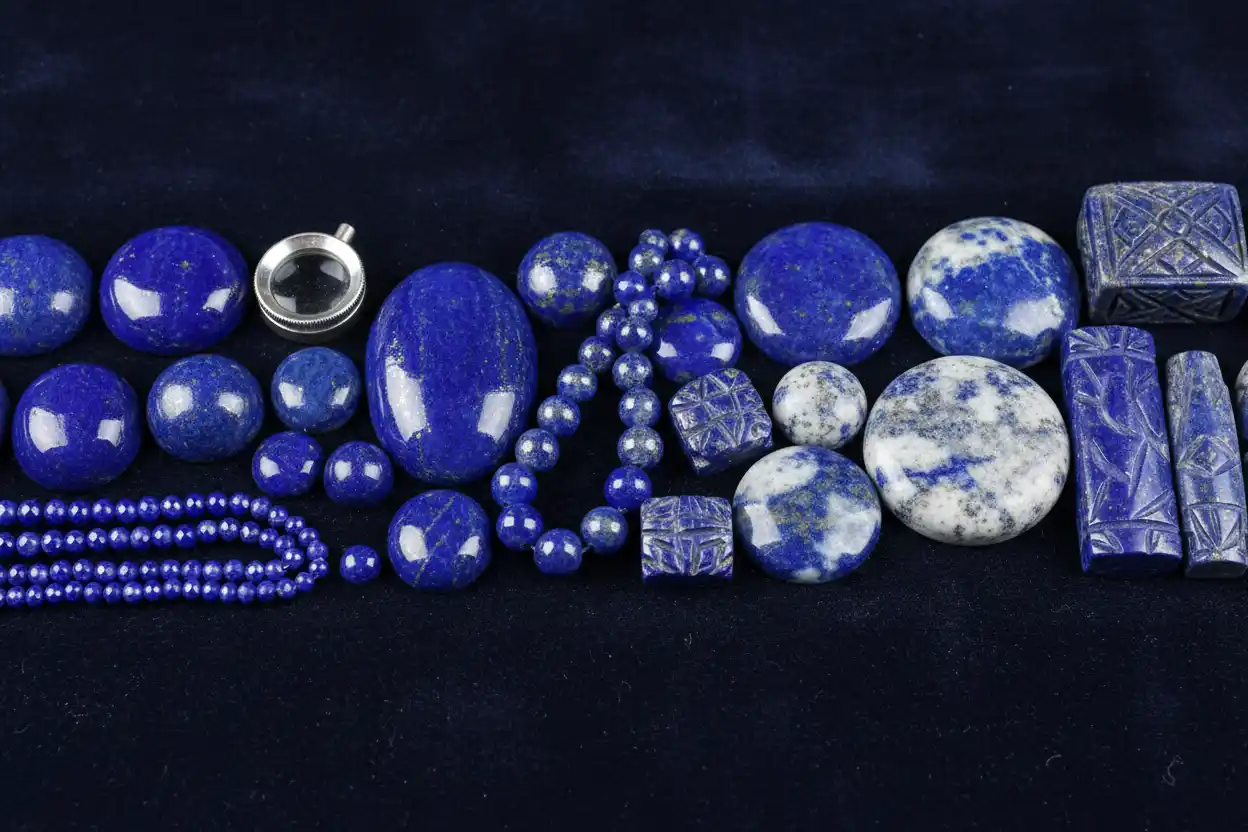
Lapis Lazuli Price: Value Benchmarks, Color, Quality & Market Demand
Lapis lazuli can cost less than $1 per carat for lower commercial grades and ordinary large stones, while attractive loose cabochons in current online retail inventory commonly sit around $1 to $2 per carat. Fine natural lapis with intense, even blue, little visible calcite, good polish, and convincing provenance can command much higher prices. Specialist gem trade guidance places superfine retail examples around $100 to $150 per carat or more, although pieces at that level represent a very different quality tier from ordinary commercial lapis.
The price range is wide because lapis is not valued mainly by carat weight. Color dominates. Treatment, calcite content, pyrite distribution, origin, surface quality, authenticity, cutting, and seller positioning can matter more than whether a cabochon weighs 5 carats or 50. Buyers who first understand how to buy lapis lazuli can compare prices more accurately instead of assuming that every deep-blue stone belongs in the same value category.
Current Lapis Lazuli Retail Benchmarks
Active loose-stone inventory shows how affordable ordinary natural lapis remains. The prices below are current retail asking prices and should be treated as market reference points rather than fixed values.
| Current retail example | Weight | Asking price | Approx. price per carat |
|---|---|---|---|
| Intense navy blue cushion, untreated | 4.99 ct | $8.66 | $1.74 |
| Blue oval | 8.35 ct | $14.30 | $1.71 |
| Blue oval | 10.28 ct | $17.61 | $1.71 |
| Blue oval | 11.48 ct | $19.67 | $1.71 |
| Blue pear | 19.59 ct | $26.99 | $1.38 |
| Blue cushion | 22.44 ct | $42.04 | $1.87 |
| Blue baguette | 27.94 ct | $46.38 | $1.66 |
| Blue square | 88.61 ct | $73.55 | $0.83 |
The current inventory demonstrates two important pricing patterns. Ordinary finished lapis can remain inexpensive even when the color is attractive, and larger stones often cost less per carat than smaller calibrated pieces. This is why lapis lazuli price per carat is most useful when stones of similar quality, treatment, origin, and workmanship are compared.
Color Has the Strongest Effect on Value
GIA identifies intense medium to dark blue or slightly violetish blue as the most prized lapis color. The finest appearance is even and saturated, with little visual interruption from white calcite. Small gold-colored pyrite flecks can remain attractive when they are scattered evenly and do not overwhelm the blue.
Paler blue generally sells for less. Grayish areas, obvious green tones, extensive white streaks, or patchy color usually move a piece toward the lower commercial end of the market.
Color quality also explains why two similarly sized cabochons can carry dramatically different asking prices. A 10-carat stone with pale blue areas and white calcite may be inexpensive, while another 10-carat stone with rich natural violetish blue can command a significant premium.
The lapis lazuli quality grading should therefore begin with color rather than carat weight.
Calcite Can Reduce Price Quickly
White calcite commonly appears as patches, spots, or veins through lapis. Some buyers enjoy this natural pattern, especially in carvings and decorative pieces, but the traditional gem trade usually values cleaner blue higher.
A large white streak can interrupt color enough to reduce the price considerably even if the stone is otherwise well polished. Smaller amounts can be acceptable in mid-grade lapis, particularly when the overall blue remains strong.
Calcite-heavy stones are commonly available and can be inexpensive. This makes them suitable for large pendants, beads, carvings, and decorative objects where size and pattern may matter more than elite color uniformity.
Fine jewelry buyers usually pay more for stones with very little visible calcite.
Pyrite Does Not Automatically Lower Value
Gold-colored pyrite is one of the visual features people commonly associate with lapis lazuli. Small, evenly distributed flecks can create an attractive contrast against deep blue and may make a cabochon more visually interesting.
Too much pyrite changes the equation. Dense patches, thick veins, or enough pyrite to give the stone a greenish appearance can reduce value. GIA notes that excessive pyrite is associated with some of the lowest-quality appearances.
This means a simple rule such as “more gold equals more valuable” does not work. Fine pyrite distribution can be attractive, while heavy concentration can interrupt the blue that buyers are primarily paying for.
Treatment Creates One of the Biggest Price Differences
Lapis lazuli can be dyed to strengthen blue color and conceal pale areas or visible calcite. Wax or oil may also be used to deepen appearance and improve luster. These processes are established in the trade.
A treated stone can still be genuine lapis lazuli, but its price should reflect the enhancement. A naturally saturated untreated stone is generally more desirable than a dyed stone with an otherwise similar appearance.
Treatment becomes particularly important when comparing unusually deep-blue stones at very different prices. A $2-per-carat dyed cabochon and a naturally rich untreated cabochon should not be treated as direct equivalents simply because photographs make them look similar.
GIA also notes that wax, oil, and some dyes have limited stability around heat or solvents. Treatment therefore affects care as well as value.
Fine Lapis Can Cost Far More Than Ordinary Retail Inventory
The current $1 to $2 per carat examples represent ordinary online inventory, not the ceiling of the lapis market. Longstanding specialist gem references place lower grades below $1 per carat while noting that exceptionally fine lapis can reach roughly $100 to $150 per carat or more at retail.
That upper tier is associated with unusually fine natural color, minimal calcite, excellent polish, attractive pyrite when present, desirable provenance, and scarcity within top-grade rough.
The gap between $1 and $100 per carat illustrates why a single universal lapis price range is misleading. Commercial cabochons, jewelry-grade natural blue stones, collector-quality Afghan lapis, beads, carvings, and large decorative pieces should be evaluated within their own markets.
Afghan Origin Can Support a Premium
Afghanistan, particularly the historic Badakhshan deposits, has supplied highly regarded lapis for thousands of years. GIA identifies Afghanistan as both the traditional major source and an important source of the finest color.
Origin can therefore support value when it is credible and accompanies high quality. It does not rescue an unattractive stone. Afghan lapis with excessive calcite, weak color, or poor polish can still be worth less than a beautiful specimen from somewhere else.
Buyers should also understand that geographic words can sometimes describe trade appearance rather than verified source. GIA notes that a regional adjective attached to lapis does not necessarily prove the stone actually came from that location.
Pay for quality first and provenance second unless documentation makes origin especially important to the purchase.
Larger Stones Often Cost Less per Carat
Lapis can occur in substantial rough pieces, so large finished sizes are common compared with many transparent gems. This supply pattern prevents weight from creating the steep price increases seen in ruby, sapphire, or emerald.
Current inventory illustrates the effect clearly. An 88.61-carat square is listed around $73.55, or about $0.83 per carat, while a 4.99-carat calibrated cushion is roughly $1.74 per carat.
The smaller stone may cost more per carat because calibration, color selection, cutting efficiency, and retail demand affect price. Large carvings and decorative objects are often priced by the complete piece rather than by strict per-carat formulas.
Top-grade lapis is different. Finding a large piece that maintains exceptional natural blue with little calcite can be difficult, so high quality and large size together can still produce a premium.
Cut and Polish Add Practical Value
Lapis is most commonly fashioned into cabochons, beads, tablets, inlays, and carvings. Because it is opaque, value does not depend on faceted brilliance in the same way as transparent gems.
Good workmanship still matters. A smooth, even polish can make the blue appear richer and give pyrite greater visual contrast. Poor polish, pits, uneven edges, scratches, and careless drilling reduce appeal.
Calibrated shapes may cost somewhat more per carat because cutters must meet specific dimensions. Freeform pieces can preserve more weight and may sell at lower rates.
When comparing jewelry, separate the stone price from the cost of precious metal, setting, craftsmanship, and brand. A gold ring with lapis may cost hundreds or thousands of dollars even when the loose stone represents only a small part of the total retail price.
Authenticity Can Affect Value
Glass, plastic, ceramic products, dyed substitutes, and reconstructed products have all appeared as lapis imitations. A convincing blue color alone is therefore not enough to establish identity.
Genuine lapis commonly shows natural variation in color, calcite, pyrite, or texture, but very fine pieces can also look highly uniform. Likewise, fake products can be manufactured with metallic-looking inclusions designed to resemble pyrite.
The real vs fake lapis lazuli comparison becomes especially important when a seller asks a high price for supposedly untreated Afghan lapis. Professional identification provides stronger evidence than risky household tests.
Seller Grades Do Not Create a Universal Price Scale
AAA, AAAA, royal grade, premium Afghan, collector grade, and similar phrases appear throughout the lapis market. These labels may describe a retailer’s own inventory categories, but they do not create an internationally standardized price structure.
GIA evaluates lapis but does not assign an overall quality grade. Its identification work can describe the stone and identify detectable treatments.
This distinction matters because two sellers may both call their stones AAA while offering completely different color, calcite levels, treatment status, polish, and prices. Direct visual comparison is much more useful than comparing grade labels across retailers.
Market Demand Favors Strong Blue and Clean Appearance
Lapis has remained desirable for jewelry, beads, carvings, decorative objects, and collector pieces because its saturated blue is visually distinctive. Current retail inventory is plentiful, particularly in ordinary grades, which helps keep commercial prices accessible.
Demand becomes more selective at the fine end. Collectors and jewelry buyers tend to compete more strongly for deep, uniform natural blue with minimal calcite and attractive polish. Verified Afghan provenance can add further appeal.
This creates a market in which ordinary lapis remains inexpensive while a small portion of top-quality stone commands far higher rates. Supply is not equally abundant at every quality level.
Retail Price Is Not the Same as Resale Value
A loose cabochon bought at retail for $30 may not bring $30 when resold. Dealers need room for inventory costs, inspection, marketing, and profit, while ordinary lapis is readily replaceable.
Large decorative pieces, documented fine Afghan lapis, antique carvings, signed jewelry, or exceptional collector specimens can behave differently, but value depends heavily on the specific item.
Insurance replacement figures should also not be confused with immediate cash resale value. Retail asking price, dealer-buy price, appraisal value, auction result, and private-sale price describe different transactions.
Personal Beliefs Do Not Establish Market Value
The lapis lazuli benefits discussed in historical or crystal traditions may include associations with wisdom, communication, confidence, or reflection. Such beliefs do not create a recognized commercial premium.
The same applies to lapis lazuli healing properties described in wellness traditions. Commercial value is better judged through authenticity, natural color, treatment, calcite, pyrite, cutting, polish, condition, provenance, size, and current market demand.
FAQs
How much is lapis lazuli worth per carat?
Ordinary current loose retail inventory commonly falls around $1 to $2 per carat. Lower grades can sell below $1 per carat, while exceptionally fine examples can reach far higher prices.
Can lapis lazuli be worth $100 per carat?
Yes, specialist gem references report that superfine lapis can reach roughly $100 to $150 per carat or more at retail. That level applies to exceptional quality rather than common commercial stones.
Why is some lapis lazuli so cheap?
Lapis occurs in large pieces, ordinary grades are plentiful, and substantial cabochons can be cut efficiently. Pale color, calcite, treatment, weak polish, and lower demand can reduce prices further.
What color lapis lazuli is worth the most?
Intense, even medium-dark to dark blue or slightly violetish blue is generally the most prized, especially when visible calcite is absent or minimal.
Does pyrite increase lapis lazuli price?
Fine scattered pyrite can be attractive, but heavy pyrite does not automatically raise value. Dense concentrations can interfere with the blue and reduce quality.
Is untreated lapis more valuable?
Untreated lapis with naturally rich color generally deserves more consideration than a dyed stone of similar appearance. The premium depends on overall quality and demand.
Does Afghan lapis cost more?
Fine Afghan lapis can command a premium because Afghanistan has a long reputation for exceptional blue stone. Origin should still be supported, and the individual quality must justify the price.
Does larger lapis cost more per carat?
Not necessarily. Large ordinary stones often cost less per carat because substantial rough pieces are available. Large size combined with exceptional quality can still create a premium.
What does AAAA lapis lazuli mean?
There is no universal AAAA standard for lapis lazuli. The label is generally defined by the seller and should be checked against actual color, treatment, calcite, pyrite, polish, and price.
Does lapis lazuli hold its value?
Ordinary loose lapis usually has limited resale potential because comparable new stones remain widely available. Exceptional collector pieces, antique objects, documented fine specimens, or signed jewelry may behave differently.
Conclusion
Lapis lazuli price ranges from under $1 per carat for lower commercial grades to around $1 to $2 per carat for many current ordinary retail cabochons, while exceptional fine lapis can reach $100 to $150 per carat or more. Color is the strongest value factor, followed by calcite content, pyrite distribution, treatment, authenticity, polish, provenance, and workmanship. Size alone is a weak indicator because lapis can occur in substantial pieces. The most useful price comparison is always between stones of similar natural color, treatment status, quality, and origin.
Prices vary with color, calcite, pyrite, treatment, authenticity, size, cutting, polish, provenance, seller margin, supply, and demand. Current asking prices are reference points and should not be treated as guaranteed transaction, appraisal, dealer-buy, or future resale values.