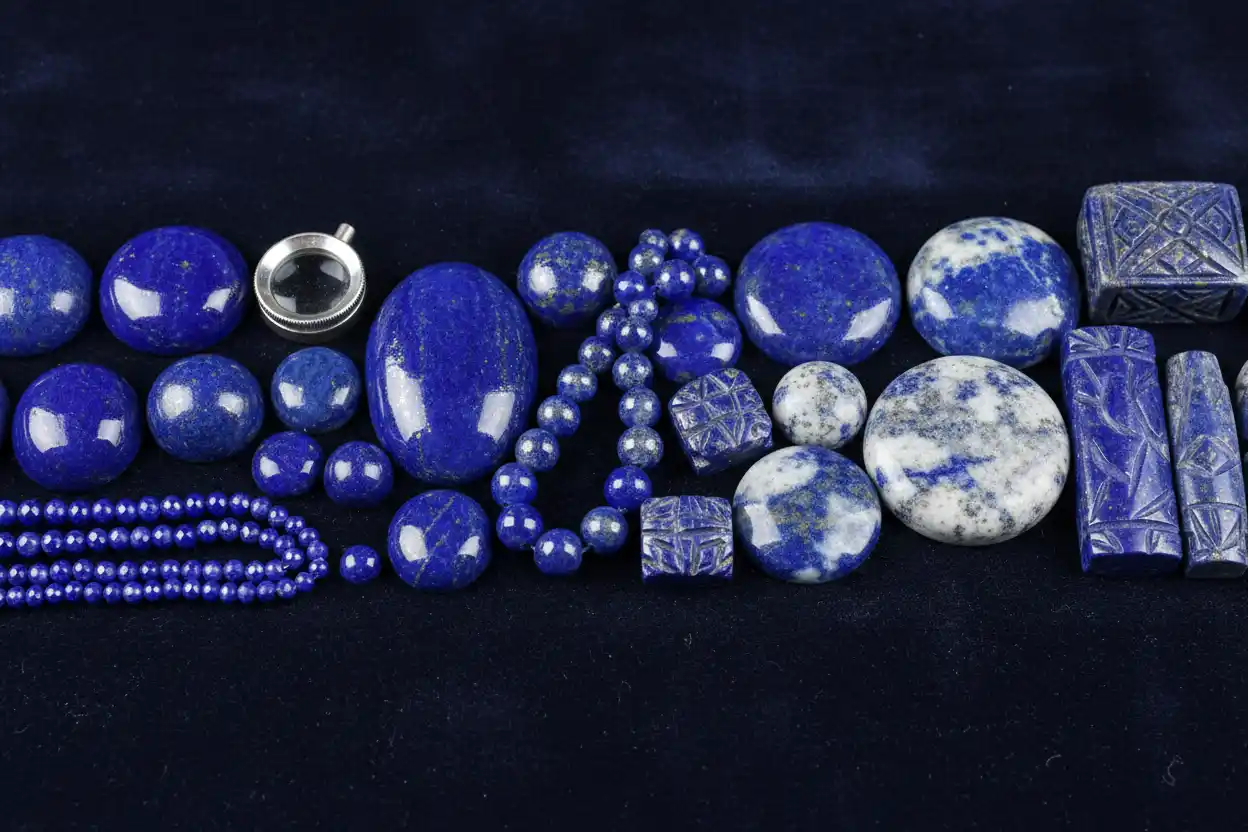
Lapis Lazuli Price: Value Benchmarks, Color, Quality & Market Demand
Lapis lazuli price is determined primarily by color quality, uniformity, calcite content, pyrite distribution, treatment, craftsmanship, size, form, provenance, and market context rather than by a universal dollars-per-carat schedule. Lapis is a rock made principally from lazurite, calcite, and pyrite rather than a single transparent mineral crystal, so the relative proportion and visual distribution of those components can change value dramatically. GIA identifies lazurite as the source of the prized royal-blue coloration, while calcite appears as white matrix and pyrite produces gold-colored metallic flecks.
The most prized lapis is intense and relatively uniform medium-to-dark blue or slightly violetish blue with no obvious calcite. Small, attractively distributed pyrite flecks can remain acceptable or desirable, whereas dense pyrite, weak greenish color, and conspicuous white calcite generally reduce value. Size has a weaker scarcity effect than many consumers expect because lapis rough can occur in blocks large enough for carvings, spheres, tablets, and architectural objects. A smaller exceptionally uniform untreated cabochon can consequently command more per unit of weight than a much larger decorative piece full of pale calcite matrix. Buyers should use the Gems Lore buy lapis lazuli guide to establish quality and treatment before interpreting lapis lazuli price.
Lapis Lazuli Price At a Glance
| Value Factor | What Usually Raises Lapis Lazuli Price | What Can Lower Lapis Lazuli Price |
|---|---|---|
| Blue Color | Intense royal blue to slightly violetish blue | Pale, grayish, greenish, or dull blue |
| Saturation | Strong rich color | Weak or washed-out appearance |
| Uniformity | Smooth consistent bodycolor | Patchy, mottled, highly variable blue |
| Calcite | Little or no visible white matrix | Obvious white veins, streaks, or patches |
| Pyrite | Fine attractive scattered gold flecks | Dense metallic areas overwhelming the blue |
| Lazurite Content | Rich lazurite-dominant appearance | Lower blue-mineral content and weak color |
| Treatment | Natural color and honest disclosure | Undisclosed dye, wax, oil, resin, or coating |
| Origin | Credible Afghan/Badakhshan provenance when valued by collectors | Unsupported geographic claim |
| Cut | Fine polish, attractive cabochon, matched beads, skilled carving | Weak polish or careless workmanship |
| Size | Larger fine-quality material retaining uniform blue | Large commercial material with extensive calcite |
| Matching | Consistent high-quality bead strands or pairs | Poorly matched color and pattern |
| Historical Value | Antique carving, documented provenance, important workmanship | Generic modern mass-produced object |
| Condition | Intact polish and carving | Chips, scratches, repairs, worn surfaces |
| Documentation | Useful identification/treatment evidence for valuable pieces | Seller-only grade or unsupported appraisal |
| Market Form | Fine jewelry, art object, collector specimen | Ordinary decorative rough |
Intense Blue Is the Core Value Driver
GIA describes lapis lazuli’s prized color as intense medium-to-dark blue or slightly violetish blue and explains that the richest appearance reflects the mineral composition of the aggregate, particularly lazurite.
Fine color should appear saturated without looking nearly black or muddy. Royal-blue and violetish-blue material can command strong demand when the hue remains consistent across the polished face.
Pale blue material can still be attractive and useful for carvings or affordable jewelry, but it belongs to a lower commercial tier when compared with deeply saturated fine lapis.
Uniformity Creates a Significant Premium
A large uninterrupted field of strong blue is more selective than ordinary mixed lapis containing obvious white and metallic areas. The highest jewelry qualities often emphasize smooth uniform bodycolor.
Uniformity becomes particularly important in simple cabochons, signet-ring tablets, watch dials, matched earrings, and bead strands because the material itself has few other features to distract the eye.
In a carved object, however, variation can become an artistic asset when the maker deliberately uses white calcite or pyrite to define part of the composition.
Calcite Is Usually the Strongest Negative Visual Factor
GIA repeatedly identifies visible white calcite as undesirable in top-quality lapis and states that the finest material can be free of obvious calcite.
Large white veins can break the visual continuity of the blue and signal a lower concentration of the components producing premium color.
This effect can be substantial enough that two pieces of similar dimensions differ greatly in value solely because one presents nearly uninterrupted royal blue while the other is heavily veined with white matrix.
Pyrite Has a More Complicated Value Effect
Golden pyrite is one of lapis lazuli’s most recognizable natural characteristics. Small fine specks distributed attractively across rich blue can enhance visual interest and do not necessarily reduce quality.
Dense pyrite can lower value when the metallic material becomes so abundant that it overwhelms the blue or contributes to dull greenish appearance.
The highest value therefore does not depend simply on whether pyrite is present but on how much appears, how it is distributed, and whether it complements or competes with the bodycolor.
Pyrite-Free Material Can Command a Traditional Fine-Grade Premium
GIA’s description of the finest traditional lapis emphasizes intense uniform blue with little or no visible pyrite and no calcite.
Collectors and jewelry buyers who prefer an uninterrupted saturated-blue field may therefore pay more for clean material.
Other buyers deliberately seek evenly sprinkled pyrite because they enjoy the starry appearance. Personal taste can modify the premium once the stone already has fine blue color.
Afghanistan Has the Strongest Historical Prestige
Afghanistan, particularly Badakhshan and Sar-e-Sang, has supplied fine lapis for thousands of years. GIA identifies Afghanistan as the traditional major source of the gem’s best color and documents the extraordinary antiquity of the mining region.
Documented Afghan provenance can add market interest when paired with exceptional color.
The origin premium should not override quality, however. Afghanistan produces variable material, and an unattractive pale piece remains lower quality regardless of its source.
“Afghan” Can Also Function as a Trade Grade
GIA lists Persian or Afghan as a traditional top trade-quality category characterized by intense uniform medium-dark slightly violetish blue with little or no pyrite and no calcite, but also warns that geographic-looking adjectives do not necessarily prove geographic origin.
This distinction is critical to lapis lazuli price. A seller charging more because the stone resembles traditional Afghan quality is making an appearance-based claim; a seller charging a provenance premium should provide evidence that the material actually came from Afghanistan.
The two claims should not be blended.
Chilean Lapis Is More Diverse Than Simplistic Trade Charts Suggest
Traditional trade descriptions often associate Chilean lapis with more calcite, greenish areas, and lower commercial value, but GIA’s geological study of the Coquimbo region reports that some Chilean material can approach fine Afghan quality.
The actual stone should therefore take priority over a national stereotype.
An exceptionally saturated low-calcite Chilean piece can be worth more than weak Afghan material despite traditional trade hierarchies.
Russian and Siberian Lapis Occupy Another Recognized Market
GIA identifies Lake Baikal in Siberia among the principal lapis sources and notes that Russian or Siberian trade grades often display varying blue tones with pyrite and some calcite.
Fine Russian lapis can be attractive and collectible, particularly when provenance is documented.
As with every source, color quality, treatment, workmanship, and condition remain more useful than locality name alone.
Dye Can Create an Artificial Color Premium
Because color is lapis lazuli’s central value factor, dyeing can alter the very characteristic responsible for much of its price. GIA states that lapis can be dyed specifically to improve blue color and conceal calcite inclusions.
A dyed stone can still be attractive and commercially legitimate when sold honestly.
It should not receive the same natural-color premium as comparable untreated intense blue material.
Treatment Can Make Low-Grade Rough Look Much More Uniform
Dye can penetrate porous or pale areas, reducing the visual contrast of white calcite and producing the impression of more consistent blue.
Wax or oil can then improve surface luster and deepen appearance further.
The combination can make inexpensive rough look substantially closer to premium material in photographs, which is why suspiciously uniform low-priced blue deserves treatment scrutiny.
Wax and Oil Affect Market Comparison
GIA notes that undyed lapis may be impregnated with wax or oil to enhance color and luster and classifies these treatments as having only fair stability.
A lightly waxed carving can remain perfectly suitable as a decorative object, but an untreated premium should not be charged when enhancement has materially improved appearance.
Treatment can also influence long-term maintenance because solvents and heat may degrade coatings or fillers.
Imitations Set a Lower Market Floor
Glass, plastic, ceramic, and manufactured lapis substitutes can produce a strong blue appearance at low cost. GIA identifies these products explicitly, including Gilson imitation lapis.
Their existence means unusually cheap flawless-looking material should be checked carefully.
Imitation pricing is not evidence that natural lapis is overpriced because the products do not share the same natural aggregate identity or provenance.
Size Has a Weaker Effect Than Many Buyers Expect
GIA states that lapis rough can be large enough for substantial carvings, spheres, and decorative objects.
This limits the usefulness of carat weight as a rarity measure. A one-kilogram object can be completely ordinary commercial material if its color is pale and calcite-rich.
Size becomes valuable when fine uniform color, minimal calcite, attractive pyrite distribution, good structural integrity, and high-quality workmanship survive across the larger volume.
Large Fine Uniform Lapis Is More Selective
While large rough is not unusual, finding a substantial block that remains richly saturated and relatively free from unwanted white matrix can be much more difficult.
This is particularly important for large matched tablets, fine bowls, boxes, sculptures, inlays, or statement jewelry requiring a broad uninterrupted field of blue.
The premium therefore belongs to quality maintained over size rather than size alone.
Bead Strands Can Carry a Matching Premium
Producing many beads with similar blue tone, saturation, pyrite distribution, calcite content, diameter, polish, and drill quality requires sorting.
A long strand of highly uniform deep-blue beads can therefore cost disproportionately more than the sum of mismatched commercial beads.
Large diameter raises the difficulty further when high quality must remain consistent throughout the strand.
Carvings Need a Dual Valuation
A lapis carving combines gemstone material with artistic labor. A master carver may deliberately orient pyrite, calcite, or color zoning to create clouds, stars, clothing, architecture, animal markings, or landscape effects.
Craftsmanship, complexity, age, artist attribution, cultural significance, provenance, and condition can therefore become more important than the theoretical value of the rough alone.
Price-per-carat is especially unsuitable for fine carvings.
Antique Lapis Can Belong to an Art Market
Lapis has been used for thousands of years in jewelry, inlays, seals, carvings, vessels, religious objects, furniture, mosaics, and pigment. GIA traces human use of lapis back more than six millennia and documents its major role in ancient civilizations.
A documented antique object can therefore derive substantial value from age and cultural history.
At that point, a gemological lapis lazuli price represents only one component of the object’s overall value.
Ultramarine History Adds Cultural Value but Not Automatic Gem Pricing
Purified lazurite from lapis was historically processed into natural ultramarine pigment, one of the most prized blue pigments in European painting. GIA documents this long artistic use and the rarity that once made natural ultramarine extremely costly.
That history contributes to lapis lazuli’s cultural prestige.
It should not be used to imply that an ordinary modern commercial cabochon automatically has museum-level monetary value.
Durability Affects Secondary-Market Condition
Lapis falls around 5 to 6 on the Mohs scale and has fair toughness.
Scratches, worn polish, chipped beads, damaged carving edges, and surface abrasion therefore become meaningful when valuing older jewelry.
A heavily worn stone may still be collectible in an antique object, but a modern loose cabochon should normally be discounted for avoidable damage.
Treatment Can Complicate Restoration
Because some lapis contains dye, wax, oil, plastic sealants, or other surface enhancement, aggressive cleaning during restoration can alter appearance.
GIA warns that dyes may react with solvents and that wax can deteriorate through heat or chemical exposure.
Professional conservators and jewelers should therefore understand treatment status before cleaning valuable historical or designer lapis objects.
GIA Identification Does Not Provide a Monetary Grade
GIA states explicitly that it evaluates lapis lazuli but does not grade it. Its Colored Stone Identification Report can document material characteristics and detectable treatments.
A GIA report can therefore improve confidence in identity or treatment status but does not state whether a stone is AAA, investment grade, or worth a specified dollar amount.
Monetary appraisal remains a separate market exercise.
AAA and 5A Lapis Are Seller-Defined Categories
Retailers use a wide variety of quality labels, often with no shared standard. One merchant’s AAA can contain pyrite and minor calcite, while another reserves AAA for pyrite-free uniform blue.
These labels are useful only when the seller defines them.
The actual comparison should rely on color, uniformity, calcite, pyrite, treatment, origin evidence, polish, size, craftsmanship, and condition.
Lapis Lazuli Price Versus Labradorite Price
Lapis and labradorite can both produce visually dramatic opaque-to-translucent jewelry, but their premium qualities differ. Labradorite value centers on labradorescence, flash coverage, viewing angle, pattern, and orientation, while lapis value centers on saturated blue bodycolor and the balance of lazurite, calcite, and pyrite.
The Gems Lore labradorite price guide illustrates why phenomenal feldspar should not be priced through the same quality system as lapis.
The comparison also shows why carat weight is weak across many opaque ornamental gems unless appearance is matched first.
Retail Asking Price and Resale Value Are Different
Retail lapis lazuli price can include sorting, cutting, carving, drilling, matching, metalwork, brand, shipping, warranty, and dealer margin.
A secondhand buyer must consider treatment uncertainty, condition, re-polishing, current supply, market demand, and resale margin.
The immediate resale offer can therefore be substantially below the original retail price even when the stone itself is genuine and attractive.
What Usually Raises Lapis Lazuli Price?
Lapis lazuli price generally rises when the material combines intense uniform royal to violetish blue, little or no visible calcite, minimal or attractively distributed fine pyrite, natural or fully disclosed color, fine polish, matched quality, skilled carving, larger size with color maintained, credible Afghan or other provenance, important age or historical context, and strong condition.
A top-quality piece succeeds because its visual and documentary factors reinforce each other rather than because of one label.
What Usually Lowers Lapis Lazuli Price?
Pale blue, grayness, greenish color, extensive white calcite, excessive pyrite, obvious mottling, poor polish, dye, unstable wax or oil, imitation material, reconstructed composites, weak craftsmanship, scratches, unsupported Afghan claims, seller-defined grades, and large size without fine color can all reduce value.
Lower-grade natural lapis still has legitimate decorative value when priced honestly.
How to Compare Lapis Lazuli Prices Fairly
Compare pieces by material identity, blue hue, saturation, uniformity, calcite content, pyrite distribution, treatment, provenance, dimensions, weight, cut form, matching, craftsmanship, historical significance, condition, and transaction type. A natural untreated Afghan-provenance cabochon, dyed commercial bead, Chilean carving, antique inlay, and ceramic imitation should never be collapsed into a single lapis lazuli price-per-carat average.
Conclusion
Lapis lazuli price is fundamentally a quality-of-blue valuation refined by mineral balance, treatment, provenance, workmanship, and object type. GIA identifies intense uniform medium-to-dark or violetish blue with little or no visible calcite as the most prized appearance and explains that fine scattered pyrite can remain attractive without reducing value.
The strongest natural premiums belong to material whose color arose from a favorable lazurite-rich composition rather than from dye, while wax or oil treatments should also be recognized because they can deepen appearance and improve luster. Afghan provenance carries exceptional historical prestige, but GIA cautions that appearance-based geographic trade terms do not necessarily prove actual origin.
Size should remain secondary because lapis rough can occur in large blocks. The premium comes from maintaining rich uniform blue, low calcite content, attractive pyrite balance, excellent craftsmanship, and sound condition across that size. A buyer who compares those characteristics rather than relying on AAA labels or generic price-per-carat charts can interpret lapis lazuli price much more accurately.
Frequently Asked Questions
How much is lapis lazuli worth per carat?
There is no universal lapis lazuli price per carat because color, calcite, pyrite, treatment, provenance, workmanship, size, and object type vary widely. Carat-based comparisons become useful only between similar polished material.
What color lapis lazuli is most valuable?
GIA identifies intense uniform medium-to-dark blue or violetish blue as the most prized range.
Does pyrite increase lapis lazuli price?
Fine attractively distributed pyrite can enhance appearance and does not necessarily reduce value. Dense pyrite that interferes with the blue bodycolor can lower quality.
Does calcite lower lapis value?
Generally, yes. The highest-quality lapis usually has little or no visible white calcite.
Is Afghan lapis more expensive?
Documented fine Afghan material can command strong demand because Afghanistan has historically supplied some of the world’s finest lapis. Individual color and quality still matter more than the source name alone.
Does “Afghan grade” mean the stone is from Afghanistan?
Not necessarily. GIA notes that geographic-looking trade descriptions can describe appearance without proving actual source.
Can dyed lapis be valuable?
Dyed lapis can have decorative and jewelry value when treatment is disclosed, but it should generally be compared with other treated material rather than naturally intense premium lapis.
Can waxed lapis be considered natural?
The underlying stone can be natural lapis even when wax or oil has been added as an enhancement. Treatment status and natural material identity are separate questions.
Why can large lapis still be inexpensive?
Lapis rough can occur in very large pieces, so size alone does not create strong rarity. Pale color, calcite, pyrite, treatment, and workmanship can matter far more.
Are lapis carvings priced by carat?
Fine carvings usually should not be valued by carat alone because artistry, design, size, provenance, age, maker, condition, and use of the natural stone pattern can dominate value.
Does GIA grade lapis lazuli?
GIA evaluates and identifies lapis lazuli but does not issue an overall commercial quality grade.
Is AAA lapis an official standard?
No. AAA and similar labels are seller-defined. The buyer should examine actual color, calcite, pyrite, treatment, polish, provenance, and craftsmanship.
Is lapis lazuli a guaranteed investment?
No. Fine material and important historical objects can be collectible, but future value depends on natural quality, treatment, provenance, condition, craftsmanship, fashion, transaction costs, and market liquidity.