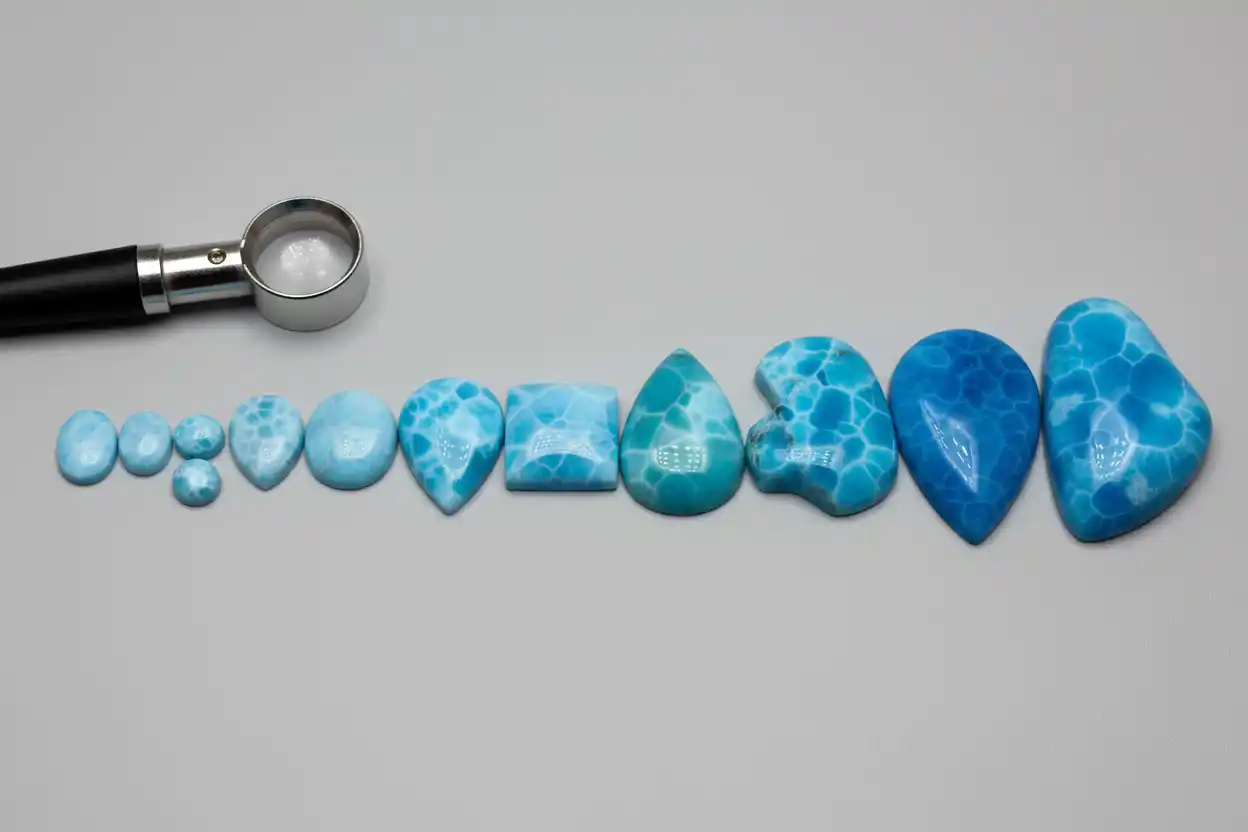
Larimar Price: What Buyers Pay For, Rarity, Demand & Treatments
Larimar commonly sells in the low double-digit dollars per carat for attractive untreated loose cabochons, although lower commercial grades can cost less and exceptional pieces can command much more. Current retail examples from the Dominican Republic range from about $9.69 to $12.94 per carat among the untreated stones checked for this article. Total prices range from roughly $43 for a 3.61-carat cabochon to more than $645 for a 58.94-carat stone.
Carat weight is only part of the pricing equation. Strong blue color, attractive white wave patterning, clean polish, Dominican Republic origin, cutting, condition, and authenticity usually matter more than size alone. Anyone comparing buy Larimar options should therefore compare similar color and quality rather than assuming a heavier stone must be worth more per carat.
Current Larimar Retail Price Benchmarks
Live loose-stone inventory provides a useful view of what buyers currently encounter in specialist retail channels. The following examples are natural Larimar cabochons identified as untreated and sourced from the Dominican Republic.
| Current retail example | Weight | Asking price | Approx. price per carat |
|---|---|---|---|
| Turquoise pear | 3.61 ct | $43.09 | $11.94 |
| Blue round | 6.89 ct | $78.70 | $11.42 |
| Light blue pear | 7.69 ct | $88.46 | $11.50 |
| Light blue pear | 9.34 ct | $111.64 | $11.95 |
| Blue marquise | 14.85 ct | $170.85 | $11.51 |
| Turquoise oval | 18.93 ct | $183.35 | $9.69 |
| Blue oval | 20.33 ct | $249.46 | $12.27 |
| Blue cushion | 58.94 ct | $645.76 | $10.96 |
These examples cluster within a surprisingly narrow band despite major differences in size. That pattern shows why Larimar price per carat should be interpreted alongside color, pattern, cutting, and overall visual appeal.
General seller guidance can place commercial blue or green Larimar below these selected examples, so lower prices are not automatically suspicious. The strongest comparison is always between stones of similar appearance and seller quality.
Blue Color Has the Greatest Influence on Price
Larimar appears in pale blue, sky blue, turquoise, blue-green, and deeper saturated blue. Strong blue generally receives the greatest buyer interest, particularly when the color covers a substantial part of the polished face.
A vivid blue cabochon can therefore cost more than a larger pale example. Color should still look balanced rather than artificially saturated in photography. Very dark editing, unusually intense studio lighting, or increased image saturation can make an ordinary stone appear significantly stronger online.
The most attractive pieces often combine clear blue areas with white wave-like structures that create the ocean appearance Larimar is known for. Pale gray zones, dull green areas, brown inclusions, or extensive weak color usually reduce market appeal.
Pattern Can Raise Value When It Complements the Blue
White branching, cloud-like, feathered, or wave patterns are a natural part of many Larimar cabochons. Buyers often seek stones where these white structures form distinctive patterns without covering most of the blue.
Pattern quality is difficult to reduce to a numerical grade because personal preference plays a major role. One buyer may prefer a nearly solid blue cabochon, while another may pay more for dramatic white waves resembling sunlight across water.
The Larimar quality grading therefore needs to account for color intensity, pattern distribution, cutting, polish, condition, size, and overall appearance together. Seller labels such as AAA or premium cannot replace visual comparison.
Larger Larimar Does Not Always Cost More Per Carat
Larimar is usually cut into cabochons, and substantial finished sizes are available. Current pricing demonstrates that a large stone may actually sell for less per carat than a smaller calibrated piece.
For example, the 58.94-carat cushion in the current sample works out to about $10.96 per carat, while a 3.61-carat pear is roughly $11.94 per carat. A 17.70-carat calibrated oval currently reaches about $12.94 per carat, showing that shape, calibration, color, and cutting can outweigh simple size.
Large size becomes more important when it is combined with exceptional blue color and attractive patterning. A big cabochon that maintains fine appearance across its full surface can be more difficult to produce from rough than a smaller piece with the same quality.
Dominican Republic Origin Supports Market Identity
Larimar is the trade name associated with blue pectolite from the Dominican Republic. Modern gemological research continues to identify Dominican origin as central to genuine Larimar.
This geographic limitation contributes to buyer interest, but origin should not be treated as a guarantee of high quality. Pale, fractured, greenish, or poorly polished Dominican Larimar can still sell for much less than an exceptional vivid blue cabochon from the same source.
Origin matters most when it is combined with attractive appearance and credible identification. A seller claiming Larimar from an unrelated country deserves additional scrutiny because genuine Larimar is associated with the Dominican Republic.
Rarity Is More Complicated Than Marketing Claims Suggest
Larimar has a restricted geographic source, which makes it unusual compared with gems found across many countries. That does not mean every Larimar cabochon is rare enough to command a high premium.
Current inventories still include many loose stones across a wide range of sizes, shapes, and shades. Commercial-quality supply is sufficient for buyers to compare multiple examples rather than accepting the first stone offered at a high price.
What becomes less common is the combination buyers want most: vivid blue, attractive white patterns, good polish, minimal unattractive inclusions, sound structure, and useful size. That combination can support much stronger pricing than simple origin alone.
Demand Favors Strong Ocean-Like Appearance
Larimar has a recognizable visual identity that differs from most other blue gemstones. Its blue and white patterns have created steady demand for pendants, rings, earrings, bracelets, cabochons, carvings, and collector pieces.
Demand tends to concentrate on stones that immediately show the appearance buyers associate with Larimar. Strong blue and clean wave patterns generally sell more easily than dull green-blue stones or pieces with extensive gray areas.
This preference can create noticeable price differences even when carat weight is nearly identical. Retailers also charge premiums for calibrated shapes because cutters must sacrifice more rough to meet standard jewelry dimensions.
Treatments Are Not a Major Feature of the Larimar Market
Current gemological guidance indicates that there are no known common treatments routinely used for Larimar. Many specialist retail listings identify their loose stones as untreated.
That makes treatment less central to normal Larimar pricing than it is for gems where heating, dyeing, filling, or diffusion is widespread. Buyers should still expect disclosure if any artificial process has altered color, appearance, or durability.
An unusual treatment claim should therefore be evaluated carefully. If a seller describes a stone as dyed, stabilized, filled, coated, or otherwise altered, compare it separately from untreated natural Larimar rather than assuming equivalent value.
Heat and Care Can Affect Larimar
Historic GIA research found Larimar’s blue color stable to normal light but responsive to strong heat and irradiation during testing. This makes careful handling important during jewelry repair.
A jeweler should know that the center stone is Larimar before using a torch near it. High heat can damage appearance, and the gemstone itself is softer than many common jewelry choices.
Existing heat damage, scratches, chipped edges, or worn polish can reduce value. A beautifully colored stone with obvious surface damage should not receive the same price as a comparable cabochon in excellent condition.
Imitations Can Distort Price Comparisons
Authenticity has become increasingly important because modern imitations can reproduce Larimar’s blue-and-white appearance convincingly. Recent gemological research documented partly crystallized glass that closely copied the characteristic white webbing and blue-green color.
Dyed chalcedony and other blue stones have also been documented as Larimar lookalikes. These products can appear convincing in photographs, particularly when buyers rely only on color and pattern.
The real vs fake Larimar distinction therefore becomes especially important when a seller offers unusually low prices, unclear origin, perfect repetitive patterns, or vague identification. A counterfeit product should not be included when calculating genuine Larimar market value.
Cut and Polish Create Legitimate Price Differences
Most Larimar is cut as cabochons because a polished curved face displays color and pattern well. Ovals, pears, rounds, cushions, freeforms, and larger decorative shapes are common.
A well-cut cabochon should show smooth symmetry where appropriate, a clean dome, attractive face-up proportions, polished edges, and a glossy surface. Scratches, pits, chips, uneven domes, flat spots, or poorly finished backs reduce value.
Calibrated sizes can also carry higher per-carat prices because cutters need to meet exact measurements. A large freeform cabochon may preserve more rough and cost less per carat than a smaller shape cut precisely for a commercial jewelry setting.
Condition Matters Because Larimar Is Not Extremely Hard
Larimar requires more careful wear than sapphire, ruby, or diamond. Surface scratches and edge damage can occur, particularly in rings or bracelets that receive frequent contact.
Natural internal features are not always a problem, but deep cracks or weak areas reaching the surface can reduce durability. Thin cabochons with fractures deserve particular attention before setting.
Good condition therefore carries real value. When two stones have similar color and pattern, the piece with cleaner polish, stronger edges, and fewer structural concerns is usually the safer purchase.
Jewelry Price Is Not the Same as Loose-Stone Price
A loose Larimar cabochon priced around $100 may become part of a finished piece costing several hundred dollars once silver or gold, setting work, design, labor, retailer margin, and brand recognition are included.
The reverse also matters. Dividing the full jewelry price by the stone’s carat weight does not produce a meaningful Larimar per-carat price because much of the retail total may come from the setting.
Buyers comparing value should estimate the gemstone and jewelry construction separately. This becomes particularly important with gold settings, complex handmade pieces, and signed designer jewelry.
Retail Price and Resale Value Are Different
Current retail asking prices show what sellers request for available stones, not what a dealer would necessarily pay to purchase the same stone from a consumer.
Ordinary Larimar has a limited secondhand market because retailers can source fresh inventory and buyers can compare many new pieces. Fine examples with exceptional color, unusual patterning, documented provenance, or notable jewelry workmanship may attract more interest.
Even then, original retail price, insurance replacement value, dealer offer, auction price, and private-sale price should be treated as different figures.
Seller Grades Should Not Control the Price
AAA, AAAA, Caribbean blue, volcanic blue, premium, collector grade, and similar labels are common in Larimar marketing. These descriptions are not part of one universally standardized grading scale.
A seller may use AAA for intense blue with strong white patterning, while another may apply it to average commercial inventory. This makes cross-store grade comparisons unreliable.
Actual color, pattern, polish, condition, size, treatment disclosure, origin, and authenticity provide a much stronger foundation for pricing. A premium grade should produce a visibly better stone, not merely a higher price tag.
Symbolic Claims Do Not Add Commercial Value
The Larimar benefits associated with crystal traditions may include ideas about calmness, reflection, communication, or personal balance. These beliefs do not establish a recognized market premium.
Likewise, Larimar healing properties discussed in wellness traditions are belief-based rather than proven medical effects. Commercial value is better judged through authentic identity, Dominican origin, color, pattern, cutting, condition, treatment disclosure, and current demand.
FAQs
How much is Larimar worth per carat?
Current untreated specialist retail examples checked for this article commonly sit around roughly $9.69 to $12.94 per carat. Lower commercial grades can sell for less, while exceptional stones can cost more.
Why is some Larimar more expensive?
Strong blue color, attractive white patterning, clean polish, good condition, useful shape, authentic Dominican origin, and high buyer demand can all raise price.
Is darker Larimar worth more?
Strong blue usually attracts a premium, but darkness alone is not enough. A vivid balanced blue with attractive patterning generally matters more than simply choosing the darkest stone.
Does large Larimar cost more per carat?
Not always. Current examples show that large stones can sell at similar or even lower per-carat prices than smaller calibrated cabochons.
Is Larimar rare?
Larimar has a restricted Dominican Republic source, but ordinary commercial stones remain available. Exceptional combinations of vivid color, pattern, size, and condition are much less common.
Is untreated Larimar more valuable?
Many current specialist stones are already sold as untreated, and routine treatment is not considered common. If an altered stone appears on the market, treatment disclosure should be included in the value comparison.
Can fake Larimar affect market prices?
Yes. Glass, dyed chalcedony, and other imitations can appear in low-cost listings. Their prices should not be used as benchmarks for genuine Dominican Larimar.
What does AAA Larimar mean?
AAA is generally a seller-defined grade rather than a universal standard. Inspect actual color, pattern, polish, condition, origin, and authenticity instead.
Does Dominican origin make every Larimar valuable?
No. Dominican origin establishes the expected source, but weak color, poor polish, cracks, or unattractive patterning can still reduce value significantly.
Does Larimar hold its value?
Resale depends on quality, authenticity, jewelry workmanship, condition, and buyer demand. Original retail asking price should not be treated as guaranteed future resale value.
Conclusion
Larimar price is driven primarily by blue color, pattern quality, cutting, condition, authentic Dominican origin, and current demand. The untreated retail examples reviewed here cluster around roughly $10 to $13 per carat, although commercial grades can fall lower and exceptional stones can rise higher. Size alone is a weak value signal, and authenticity has become increasingly important as convincing imitations enter the market.
Price ranges are market references only. Actual transaction, appraisal, dealer-buy, and resale values can differ.