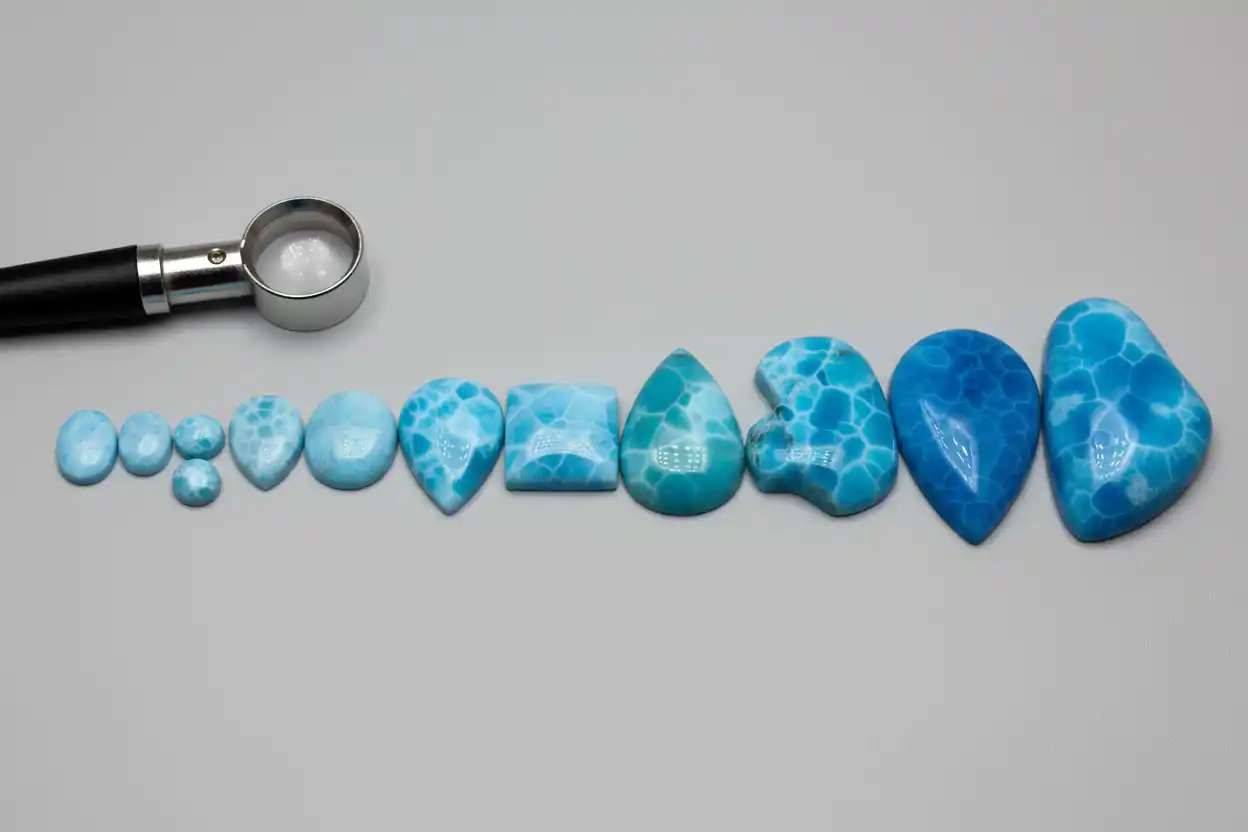
Larimar Price Guide: Value and Cost in 2026
Larimar prices in 2026 commonly range from approximately $2 to $100 per carat. Pale, white-dominant or commercial stones may cost less than $10 per carat, while vivid blue cabochons with attractive white ocean-like patterns can reach $30 to $100 per carat.
Exceptional deep-blue Larimar, rare patterning and high-end custom cuts may exceed $100 per carat. Nevertheless, most finished Larimar jewelry derives a substantial part of its price from silver, gold, craftsmanship and branding rather than the loose stone alone.
Larimar Price per Carat in 2026
The following ranges represent broad U.S. retail expectations for loose natural Larimar cabochons.
| Larimar quality | Typical characteristics | Approximate 2026 retail price |
|---|---|---|
| Entry commercial | Very pale blue, white-dominant, gray areas, weak pattern or rough polish | $2–$8 per carat |
| Good commercial | Light sky blue, moderate white pattern and competent cabochon cutting | $8–$20 per carat |
| Fine | Strong blue to turquoise-blue, attractive pattern and smooth polish | $20–$50 per carat |
| Premium | Deep blue, vivid contrast, broad ocean pattern and limited unattractive matrix | $50–$100 per carat |
| Exceptional or specialty | Rare saturated blue, dramatic pattern, custom carving or collector presentation | $100–$200+ per carat |
Large commercial cabochons may cost less per carat because sizable pale material is available. Conversely, a smaller stone with vivid color and a well-centered pattern can receive a much stronger price.
The general relationship among color, pattern, cutting and demand appears in How Gemstone Prices Are Determined.
What Is Larimar?
Larimar is the blue gem variety of pectolite associated exclusively with the Dominican Republic, particularly the Barahona region.
Its colors include pale sky blue, turquoise blue, greenish blue, deep volcanic blue and white. Copper contributes to the blue appearance, while the characteristic patterns reflect the material’s fibrous and aggregate structure.
Larimar usually forms as opaque to translucent masses rather than transparent crystals. Cutters therefore fashion it into cabochons, beads, tablets, carvings and decorative freeforms.
The completed Larimar guide owns the material’s geology, history and traditional symbolism. This page remains focused on value and cost.
Larimar Barahona Denomination of Origin
Larimar received international protection through the “Larimar Barahona” denomination of origin, strengthening formal recognition of its Dominican source.
The designation supports traceability and distinguishes genuine Barahona Larimar from blue imitations or loosely labeled pectolite-like products.
During 2025 and 2026, Dominican authorities also expanded oversight, export controls, miner protections and direct miner-to-artisan commercial initiatives.
These developments do not create a fixed retail price. However, better traceability and documented origin can strengthen buyer confidence, particularly for fine or high-value stones.
A seller using “Larimar” should be able to identify the Dominican source rather than treating the name as a generic term for any blue cabochon.
Blue Color Is the Strongest Value Factor
The market generally favors clear, saturated blue. Pale sky-blue Larimar remains attractive and affordable, while medium and deep blue material receives stronger prices.
Gray, brown and dull green modifiers usually reduce value. A greenish-blue stone can still be desirable when the color remains bright and recognizably Larimar.
The blue should appear throughout a useful portion of the face. A stone with only one small blue area surrounded by chalky white normally belongs to a lower tier.
Deep color should not appear artificially intensified through editing. Buyers should request neutral-background photographs and rotating video.
In addition, the blue should look appealing under both daylight-equivalent and normal indoor illumination. Strongly cool photography can make pale material appear much richer.
The broader blue-gem market appears in Blue Gemstones.
White Ocean Patterns
Larimar’s white patterning is one of its most recognizable visual traits. Fine material can resemble sunlight moving across shallow Caribbean water.
The most desirable patterns appear balanced and deliberate, with blue remaining the dominant color. White webbing, clouds, ripples and feather-like structures can all add value when they enhance the composition.
Too much white generally lowers value because it reduces the area of strong blue. However, a dramatic pattern can be more valuable than a plain stone of similar saturation.
Pattern placement matters. A centered wave or well-distributed web receives a stronger price than an attractive feature cut off at the edge.
Carvers may use the pattern to suggest waves, islands, dolphins or other marine themes. In those pieces, artistic integration can become more important than raw color percentage.
Red, Brown and Black Matrix
Larimar can contain red, brown, black or gray mineral areas. Small amounts may create natural contrast and reassure buyers that the stone has not been manufactured.
However, extensive dark matrix usually reduces value when it interrupts the blue and white composition.
Red-brown areas may come from iron-bearing minerals or host-rock associations. They can be attractive in rustic carvings but are generally less desirable in premium jewelry cabochons.
Black spots and open cavities deserve closer inspection. Some are harmless mineral features, while others may indicate fractures, pits or areas vulnerable to damage.
A seller should show the entire surface rather than positioning the stone so that unwanted matrix remains hidden under a prong.
Pattern vs Solid Blue Larimar
Solid blue Larimar can command high prices when the saturation is strong and the polish is excellent.
Nevertheless, many buyers specifically seek white ocean-like patterning because it creates Larimar’s distinctive identity. A plain blue cabochon may resemble Turquoise or another opaque blue material.
Neither style is universally superior. The market rewards a complete visual result: strong natural blue, balanced white structures, minimal unattractive matrix and a shape that uses the pattern intelligently.
A heavily patterned stone should not receive a premium merely because a seller describes it as “Atlantis,” “turtleback” or “volcano” pattern. These names lack standardized grading definitions.
Cut Quality and Orientation
Larimar is generally cut as a cabochon because a curved polished surface shows its color and internal pattern effectively.
A fine cabochon should have an even dome, balanced outline and smooth polish. Flat areas, scratches, pits and irregular edges reduce value.
Cutters must orient the rough to expose the best blue and pattern. The most attractive layer may be thin, creating a flat-backed stone or an unconventional freeform.
High domes can add unnecessary weight without improving the visible design. Thin cabochons may show good color but require careful setting to avoid cracks.
Calibrated ovals and rounds can cost more because cutters sacrifice additional rough to meet exact dimensions. Freeforms may preserve stronger patterns and offer better visual value.
Detailed inspection belongs to the Larimar Buying Guide.
Larimar Size and Price Premiums
Larimar occurs in pieces large enough for substantial cabochons, carvings and slabs. Therefore, weight alone creates modest price premiums.
| Example stone | Approximate price per carat | Approximate total price |
|---|---|---|
| 5 ct pale commercial cabochon | $2–$10 | $10–$50 |
| 10 ct good sky-blue Larimar | $8–$25 | $80–$250 |
| 20 ct fine patterned cabochon | $20–$50 | $400–$1,000 |
| 30 ct premium deep-blue stone | $50–$100 | $1,500–$3,000 |
| Exceptional carving or display gem | Not reliably priced by carat | Individually evaluated |
A large pale piece can cost less than a vivid five-carat cabochon. Moreover, oversized stones may have limited jewelry demand because they require heavy custom settings.
Dimensions, pattern coverage and visual balance provide more meaningful comparisons than weight alone.
Larimar Bead Prices
Small commercial Larimar bead strands may cost approximately $50 to $250. Better strands with stronger blue and improved matching commonly range from $250 to $1,000.
Fine large matched beads can cost several thousand dollars. Each bead must show comparable blue tone, white pattern, diameter and polish.
Round bead production creates substantial cutting waste. Therefore, large well-matched spheres receive a stronger premium than irregular chips or small rondelles.
Many inexpensive bead strands contain pale, white-heavy material. They may still be genuine Larimar but should not be priced like vivid blue jewelry-grade beads.
Drill holes should appear clean and free from severe cracking. Dark dye concentration or suspiciously uniform color deserves closer examination.
Larimar Carvings and Decorative Pieces
Larimar is frequently carved into hearts, waves, turtles, dolphins and freeform display pieces.
Commercial carvings may cost under $100, while large detailed pieces can reach hundreds or several thousand dollars.
The strongest carvings use natural blue-and-white patterning as part of the composition. A wave motif becomes more convincing when the cutter positions white pattern along the crest.
Artistic quality can outweigh price per carat. Two carvings of identical weight may differ dramatically because one uses fine material and skilled design while the other follows a mass-produced template.
Repairs, glue and filled cavities should be disclosed. A polished surface can conceal seams that become visible from the side or back.
Treatments and Appearance Enhancement
Larimar is commonly sold without routine color treatment, but dye, resin, coating and impregnation can occur in porous or fractured material.
Surface oil or wax may temporarily deepen color and improve polish. Resin can fill pits or stabilize weak areas.
Treated Larimar should cost less than comparable natural untreated material, especially when the treatment affects long-term appearance.
The stone’s blue may also become less attractive after exposure to strong heat or prolonged intense light. Therefore, sellers should not use hot repair methods near a mounted gem.
Complete treatment detection belongs to How to Spot Treated or Synthetic Larimar. The broader disclosure framework appears in Gemstone Treatments Explained.
Larimar Imitations
Dyed Chalcedony, ceramic, resin, glass, plastic, Howlite and other blue materials can imitate Larimar.
Some imitations reproduce blue-and-white patterning convincingly. Quench-crackled dyed Chalcedony, for example, can show blue color concentrated within networks of fractures.
Artificial products may look overly uniform or repeat the same pattern across multiple stones. Natural Larimar normally shows individual variation.
Low prices do not prove imitation because pale commercial Larimar can be affordable. However, large flawless deep-blue cabochons offered at a few dollars deserve skepticism.
The full authentication process belongs to Real vs Fake Larimar.
Larimar vs Turquoise Value
Larimar and Turquoise overlap in blue-to-greenish-blue color, yet they belong to different mineral systems and markets.
Fine natural Turquoise receives premiums for specific mine provenance, natural color, matrix character and lack of stabilization. Exceptional historic American or Persian material may cost much more than ordinary Larimar.
Larimar offers distinctive white ocean patterning and a single recognized Dominican source. Its market normally depends more on blue intensity and visual pattern than mine-specific color traditions.
The complete identification comparison belongs to Larimar vs Turquoise. Current Turquoise pricing appears in the Turquoise Price Guide.
Larimar Jewelry Prices in 2026
| Jewelry type | Broad U.S. retail range | Main price drivers |
|---|---|---|
| Small silver earrings or pendant | $50–$300 | Commercial Larimar, silver and production |
| Silver statement ring | $100–$600 | Blue quality, pattern and setting |
| Fine silver pendant or bracelet | $200–$1,200 | Stone size, craftsmanship and matching |
| Gold Larimar earrings or pendant | $500–$3,000 | Gold weight, fine stones and design |
| Gold Larimar ring | $700–$4,000 | Center quality, custom construction and brand |
| Designer or collector jewel | $2,000–$10,000+ | Exceptional Larimar, craftsmanship and provenance |
Silver dominates the ordinary Larimar jewelry market because it complements the blue color and keeps finished prices accessible.
Style-specific selection belongs to the Larimar Ring Guide, Larimar Earrings Guide, Larimar Necklace Guide and Larimar Bracelet Guide.
Durability and Condition
Larimar has moderate-to-low hardness and can scratch, chip or bruise during wear. Its fibrous aggregate structure may also contain pits or fractures.
Existing scratches reduce polish and make the blue appear dull. Open cavities, edge chips and repaired breaks lower value.
Rings and bracelets expose Larimar to more impact than earrings or pendants. A bezel or low protective setting can reduce damage risk.
Steam, ultrasonic cleaning, acids, bleach and harsh chemicals should be avoided. Gentle hand cleaning remains the safer approach.
Complete maintenance guidance belongs to How to Clean Larimar Jewelry Safely.
Certification and Origin Documentation
Most inexpensive Larimar does not need a major laboratory report. Nevertheless, meaningful purchases may benefit from independent identification.
A report becomes useful when the stone has unusually deep color, a high price, claimed premium origin documentation or possible imitation.
A laboratory can identify pectolite and separate Larimar from many ceramics, dyed stones and composites. However, the report does not assign a standardized pattern or color grade.
Formal Dominican provenance, authorized export documentation and the Larimar Barahona designation can provide additional confidence beyond mineral identification.
The Gemstone Certification Labs comparison explains laboratory scope. Online buyers should also use How to Buy Gemstones Online Without Getting Scammed.
Does Larimar Hold Its Value?
Fine Larimar has a recognizable specialist market because supply comes from one geographic region and strong blue material remains desirable.
Commercial pale stones usually resell below retail. Dealers can obtain new cabochons and may have little reason to pay strongly for an ordinary used piece.
Exceptional deep-blue stones, major carvings and signed Dominican jewelry may retain stronger demand. Documentation and condition become increasingly important at higher price levels.
Finished jewelry may also retain value through gold, silver workmanship or a respected maker rather than the loose stone alone.
The broader resale framework appears in Do Gemstones Hold Their Value?.
Price Guide vs Buying Guide
This page owns Larimar’s current price bands and value factors. Detailed authenticity checks, stone inspection and seller questions belong to the dedicated buying guide.
The completed Gemstones That Start With L and Crystals That Start With L directories connect Larimar with the site’s alphabetical structure.
The Buying & Value hub connects this guide with treatment, certification and resale content.
Frequently Asked Questions
1. How much is Larimar worth per carat in 2026?
Most Larimar costs approximately $2 to $50 per carat. Premium deep-blue and strongly patterned stones may reach $50 to $100 per carat or more.
2. What Larimar color is most valuable?
Vivid medium-to-deep blue generally receives the strongest price, particularly when paired with attractive white ocean-like patterning.
3. Is pale blue Larimar valuable?
Pale material is usually affordable, although an unusual pattern or skilled carving can add value.
4. Does white pattern increase Larimar value?
Balanced white webbing can enhance the stone. Excessive white that overwhelms the blue usually lowers the price.
5. Is Larimar found anywhere outside the Dominican Republic?
The recognized gem material comes from the Barahona region of the Dominican Republic.
6. Does large Larimar cost more per carat?
Not automatically. Large material is available, so vivid color and pattern coverage remain more important than weight alone.
7. Can Larimar be dyed?
Yes. Dye, coatings, resin and other appearance enhancements can occur and should reduce the price compared with similar untreated material.
8. Does Larimar fade in sunlight?
Strong prolonged light and heat can alter or weaken its appearance. It should not be stored in direct sun or exposed to jewelry-repair heat.
9. Is Larimar the same as Turquoise?
No. Larimar is blue pectolite, while Turquoise is a hydrated copper aluminum phosphate.
10. Does Larimar need a laboratory report?
Ordinary pieces usually do not. A report is useful for expensive stones or items that may be ceramic, dyed Chalcedony or another imitation.
11. Does Larimar jewelry have resale value?
Commercial jewelry often resells below retail. Exceptional stones, strong provenance and signed designs may attract greater secondary-market demand.
12. Is Larimar a good investment?
Fine material may retain collector interest, but liquidity remains limited. Larimar is better purchased for beauty and provenance than guaranteed appreciation.
Larimar Value Comes From a Complete Ocean-Like Composition
Deep blue attracts attention, but the highest-value Larimar also uses its white pattern, shape and polish effectively. A heavily edited dark-blue photograph should not command more than a stone whose natural pattern remains convincing in ordinary light.
In 2026, good value commonly lies between $8 and $50 per carat. Prices above that range should correspond to rare saturation, broad pattern coverage, skilled workmanship or documentation that strengthens the stone’s Dominican identity.