Malachite Price: Value Guide, Rarity, Demand & Treatments
Malachite is usually inexpensive by gemstone standards. Current untreated Congo cabochons commonly sell for roughly $0.75 to $2 per carat, while large decorative pieces can fall below $0.50 per carat. Recent specialist listings include stones around $3.58 to $19.68 in the 3.6 to 9.9-carat range, approximately $22 to $69 for pieces around 40 to 69 carats, and about $1,220 for a very large 3,000-carat polished piece.
The strongest malachite price premiums come from unusual patterning, exceptional polish, attractive matching pairs, chatoyancy, crystal specimens, rare formations, antique workmanship, artistic carving, or significant provenance rather than carat weight alone. Because malachite can occur in large masses, size usually does not create the steep price jumps seen in scarce transparent gems.
Current Malachite Price Benchmarks
Active specialist inventory provides a useful picture of ordinary loose retail pricing.
| Current retail example | Weight | Asking price | Approx. price per carat |
|---|---|---|---|
| Oval cabochon | 3.67 ct | $3.65 | $0.99 |
| Oval cabochon | 4.66 ct | $3.58 | $0.77 |
| Baguette cabochon | 7.26 ct | $9.15 | $1.26 |
| Oval cabochon | 9.88 ct | $19.68 | $1.99 |
| Baguette cabochon | 13.07 ct | $18.62 | $1.42 |
| Oval cabochon | 39.63 ct | $22.59 | $0.57 |
| Square cabochon | 68.84 ct | $68.57 | $1.00 |
| Large oval decorative piece | 3,000 ct | $1,220.10 | $0.41 |
These are asking prices rather than universal values. The wide range shows why malachite price per carat must be read alongside size, pattern, cutting, condition, and sales format.
Ordinary Cabochon Malachite Is Abundant
International Gem Society guidance describes malachite as abundant in its normal forms, which helps explain why even attractive polished stones remain modestly priced.
The Democratic Republic of the Congo currently supplies a large share of the banded rough seen in commercial jewelry. Large pieces are available, and cutters can produce substantial cabochons, beads, carvings, and ornamental objects.
This plentiful supply limits the effect of carat weight on value. A 40-carat polished cabochon can still sell for only a few tens of dollars.
Pattern Is a Major Price Driver
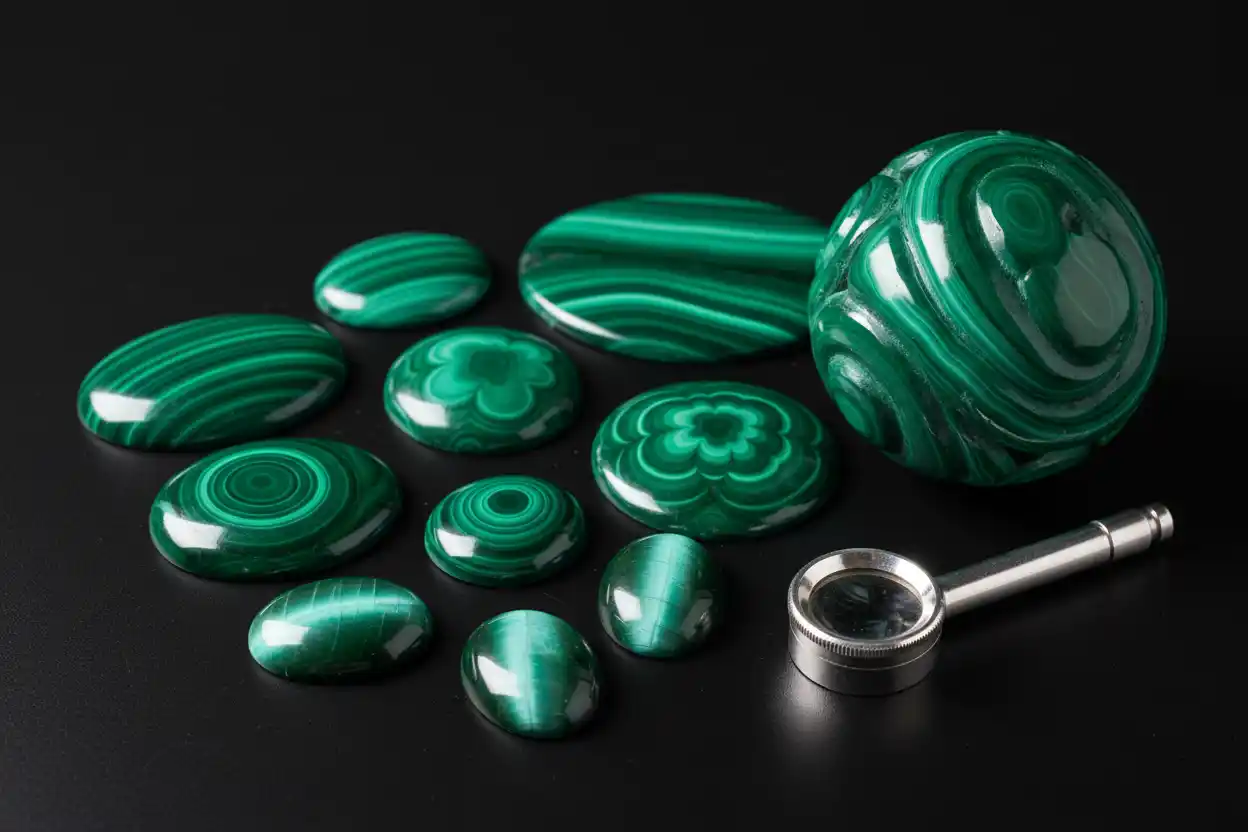
The strongest polished malachite often shows visually distinctive stripes, concentric circles, eyes, waves, or flowing bands. Pattern can create more value than additional weight because buyers choose malachite largely for its decorative appearance.
High-contrast dark and light green bands can command more interest than weak, muddy, or nearly featureless color. Book-matched pieces and well-matched earring pairs may also earn higher prices because cutting complementary patterns requires additional selection.
The malachite quality grading is therefore more meaningful when pattern, contrast, cutting, polish, condition, treatment, and authenticity are considered together.
Size Often Reduces the Per-Carat Rate
The current market shows a clear size effect. A 9.88-carat oval at $19.68 works out to about $1.99 per carat, while a 39.63-carat oval at $22.59 falls to roughly $0.57 per carat. A 3,000-carat polished piece is close to $0.41 per carat.
This does not mean every large malachite is cheap. A large piece with extraordinary concentric patterning, top polish, unusual crystal features, or exceptional carving can cost much more.
The point is that size by itself is not scarce enough to guarantee a premium.
Small Calibrated Stones Can Cost More Per Carat
Jewelry makers often need exact dimensions. Producing a 10 x 8 mm or 14 x 10 mm cabochon may require sacrificing rough to meet standardized measurements.
That extra cutting can raise the per-carat price even when the stone itself is not rare. Current calibrated stones commonly sit around $1 to $2 per carat, sometimes higher than much larger freeform or decorative pieces.
A buyer comparing value should therefore consider millimeter size and shape as well as weight.
Unusual Crystal Forms Can Be More Valuable
Most jewelry malachite is massive, banded, or botryoidal rather than transparent crystal. Well-formed crystals, fibrous formations, velvety surfaces, stalactitic growths, and other unusual natural structures appeal more strongly to mineral collectors.
International Gem Society guidance notes that unusual crystal habit and chatoyancy can raise value above ordinary polished malachite.
Collector specimens should not be priced using the same per-carat framework as basic cabochons. Condition, locality, aesthetics, crystal development, and specimen history often matter more than weight.
Artistic Workmanship Can Dominate the Price
Malachite has long been used for boxes, tabletops, architectural panels, carvings, inlays, beads, goblets, and decorative objects. In such pieces, craftsmanship may contribute more value than the rough stone.
A finely carved antique object can therefore sell for far more than an equal weight of loose malachite. The same applies to signed designer jewelry where gold, workmanship, brand reputation, and artistic importance shape the final price.
This is why loose-stone price benchmarks should never be applied directly to finished decorative art.
Natural Origin Matters More Than Many Buyers Realize
Synthetic malachite has existed for decades. GIA has documented laboratory-grown examples that closely resemble natural stone in color, chemistry, structure, density, hardness, and optical properties.
Recent GIA research continues to develop advanced ways to separate natural and synthetic malachite. That work matters because a high-priced collector stone should not receive a natural-origin premium without reasonable confidence in its identity.
The real vs fake malachite issue also includes glass and other imitations, not only synthetic malachite.
Glass Imitations Can Depress Low-End Pricing
Patterned glass can be manufactured to resemble malachite’s green stripes and swirls. GIA identifies glass as a common gemstone imitation and specifically shows glass made to resemble malachite.
Cheap imitation jewelry can therefore appear in search results beside genuine stones. Those prices should not be included when estimating natural malachite value.
A $3 imitation pendant and a $3 loose natural cabochon may have similar retail prices for completely different reasons. Identity needs to be established before comparing value.
Treatments Usually Have a Limited Role
Natural malachite rarely receives major treatment. Lower-quality, less compact pieces may be stabilized with resin, and wax may be used on the surface.
Because treatment is not routine across the entire market, an untreated cabochon does not automatically command an enormous premium. Most ordinary natural stones are already inexpensive.
Treatment becomes more important when it affects structural stability, polish, disclosure, or collector interest. A resin-stabilized piece should be compared with similar stabilized pieces rather than with high-quality compact untreated stone.
Congo Malachite Dominates Much Current Retail Supply
Many active loose-stone listings identify Congo as the source. The Democratic Republic of the Congo is well known for strong green banded malachite and remains a major contemporary supplier.
Historic Russian malachite has special cultural and decorative importance, while Namibia is known for notable crystals. Arizona and other localities can also interest mineral collectors.
For normal cabochons, however, locality usually has less influence than pattern, cutting, and polish. Origin premiums are strongest when the source itself has collector significance.
Color Contrast Matters More Than One Shade of Green
Malachite naturally offers a range of greens. Strong combinations of pale, medium, and dark bands often create more visual interest than uniform color.
The market does not operate on a simple rule that the darkest stone is the most valuable. A medium-green cabochon with exceptional concentric eyes may attract more demand than a dark stone with little pattern.
Buyers should therefore judge overall appearance rather than trying to assign a price from color depth alone.
Condition Can Lower Value Quickly
Malachite is relatively soft and somewhat brittle. Scratches, chips, open cracks, pits, edge damage, and dull polish can reduce both jewelry appeal and collector value.
Heat and acids can also damage the stone, while steam and ultrasonic cleaning are generally inappropriate.
A used cabochon with visible wear should therefore trade below an equivalent freshly polished stone unless age, maker, or historical importance adds separate value.
Retail and Resale Prices Are Not Equivalent
A retailer asking $50 for a polished malachite does not mean the same stone would receive a $50 dealer offer. Ordinary malachite is readily available, which limits secondhand demand.
Dealers need room for inspection, inventory, marketing, and profit. Common loose stones can therefore have weak resale percentages.
Exceptional mineral specimens, antiques, artistic carvings, signed jewelry, and historically important objects operate in different markets. Their value may depend less on the raw stone and more on rarity as an object.
Seller Grades Do Not Set Market Price
Terms such as AAA, AAAA, collector grade, royal green, top pattern, and museum quality do not belong to one universal malachite grading standard.
The same grade can mean different things at different shops. A high letter grade should therefore not justify a higher price unless the stone visibly offers stronger pattern, polish, condition, cutting, or another measurable advantage.
Current comparable sales and listings are more useful than grade language alone.
Personal Beliefs Do Not Raise Commercial Value
The malachite benefits discussed in cultural or personal traditions do not create a recognized market premium.
Likewise, malachite healing properties belong to belief-based wellness traditions rather than proven medical treatment. Commercial value comes from genuine identity, pattern, color, cutting, treatment, condition, provenance, workmanship, and demand.
FAQs
How much is malachite worth per carat?
Current ordinary untreated cabochons commonly fall around roughly $0.75 to $2 per carat. Very large decorative pieces can drop below $0.50 per carat.
Why is malachite inexpensive?
Natural malachite is relatively abundant in massive form and can occur in large pieces, which keeps ordinary cabochon prices modest.
Can malachite be expensive?
Yes. Exceptional crystals, unusual patterns, chatoyant pieces, antique objects, fine carvings, historically important examples, and designer jewelry can cost far more than standard cabochons.
Does large malachite cost more per carat?
Usually not. Per-carat rates often decline as size increases because large masses are available.
What pattern is most valuable?
Distinctive concentric rings, eyes, sharp banding, unusual waves, and visually balanced patterns can attract premiums, but there is no single universal top pattern.
Is Congo malachite more valuable?
Congo is a major source of attractive commercial malachite. Locality alone does not guarantee a premium for ordinary cabochons.
Is untreated malachite worth more?
Treatment is relatively uncommon, so untreated status alone usually does not create a dramatic premium. Quality, pattern, condition, and workmanship remain more important.
Does synthetic malachite exist?
Yes. Laboratory-grown malachite can closely resemble natural malachite and may require professional testing to separate in difficult cases.
Can glass imitate malachite?
Yes. Patterned glass can reproduce a convincing green-banded appearance.
Does malachite have good resale value?
Ordinary loose stones generally have modest resale potential because supply is plentiful. Exceptional specimens, antiques, or important jewelry can behave differently.
Conclusion
Malachite price is generally modest because ordinary natural stone is abundant and available in large sizes. Current untreated loose cabochons often sell around $0.75 to $2 per carat, while very large decorative pieces can fall below $0.50 per carat. Strong patterns, unusual crystal forms, chatoyancy, skilled cutting, artistry, provenance, and excellent condition create the strongest premiums. Weight alone is usually a weak measure of value.
Current asking prices are market references only. Actual transaction, appraisal, dealer-buy, and resale values can differ.