Malachite Healing Properties: 9 Claims, Ancient Uses, Evidence & Safe Care
Malachite healing properties are commonly associated with personal change, emotional awareness, confidence, courage, boundaries, relationship reflection, resilience, decision-making, and spiritual protection. Its vivid green banding and long historical use make malachite especially easy to surround with powerful symbolism, but symbolism should not be confused with medicine. Malachite has not been demonstrated to treat arthritis, inflammation, pain, menstrual problems, cardiovascular disease, anxiety, depression, liver disorders, immune conditions, or any other illness, and copper inside the mineral does not become a beneficial supplement by touching the skin. Scientifically, malachite is a basic copper carbonate mineral with the formula Cu₂CO₃(OH)₂. It crystallizes in the monoclinic system, usually measures Mohs 3.5 to 4, has perfect cleavage, brittle tenacity, and commonly occurs as banded, botryoidal, fibrous, stalactitic, or massive green aggregates. Its genuine ancient history as a pigment, cosmetic, copper ore, and decorative stone is well documented, while today’s nine wellness claims require a separate evidence standard.
9 Malachite Healing Claims
- Personal change and transformation
- Emotional awareness and reflection
- Confidence during difficult choices
- Courage when facing uncertainty
- Stronger personal boundaries
- Relationship awareness and communication
- Resilience after setbacks
- Clearer decision-making
- Spiritual protection and symbolic renewal
These nine themes can be used as different reflective practices without becoming nine scientifically verified healing effects. Many malachite benefits become more useful when translated into observable behavior such as reviewing a recurring pattern, preparing for a conversation, enforcing a boundary, or deciding what must change after a setback.
Malachite Mineral Facts
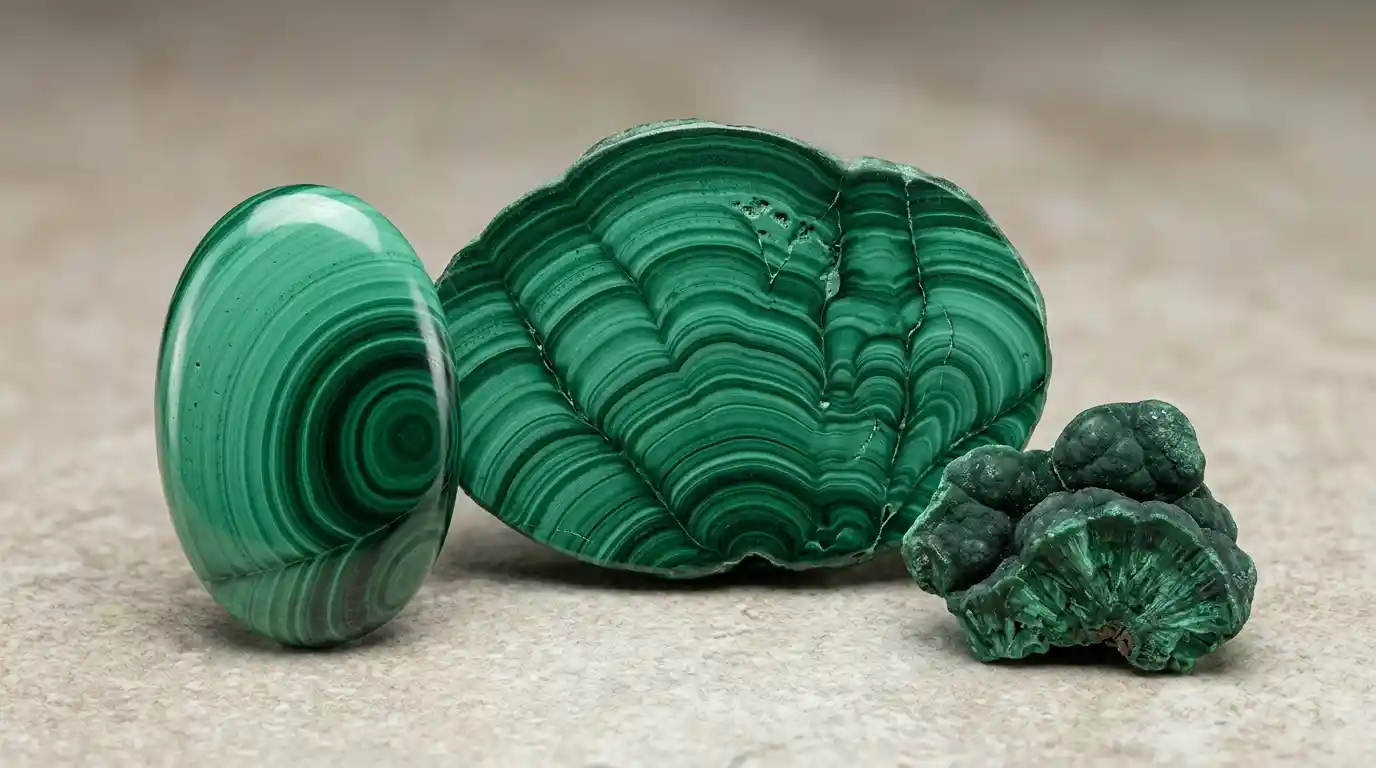
Malachite is a recognized copper carbonate hydroxide mineral with the formula Cu₂CO₃(OH)₂. Copper gives it the intense green color that can range from pale green to deep, nearly blackish green. Alternating growth zones commonly produce the curved, concentric, wavy, or eye-like bands that make polished malachite immediately recognizable.
The mineral belongs to the monoclinic crystal system. Distinct crystals do occur, but much gem and decorative malachite is found as massive, botryoidal, fibrous, radiating, crust-like, or stalactitic aggregates. When these structures are cut across and polished, their growth layers create dramatic stripes and circular patterns.
Luster can be silky, earthy, dull, or sub-vitreous depending on texture and surface. Fibrous aggregates may display a particularly silky sheen. Malachite is normally opaque, although tiny thin fragments or crystal edges can transmit green light.
Mohs hardness is only about 3.5 to 4. That makes malachite substantially softer than quartz, feldspar, topaz, garnet, sapphire, and many common jewelry stones. It also has perfect cleavage in one direction and fair cleavage in another, while tenacity is brittle. Polished cabochons can therefore scratch, chip, or crack more easily than their dense appearance suggests.
Malachite’s structural OH groups are part of its mineral formula, but it should not be treated as a stone that needs water exposure to remain stable. Care depends more on softness, carbonate chemistry, cleavage, treatments, and temperature than on keeping it hydrated.
Malachite History and Ancient Use
Malachite has one of the strongest verified ancient histories among green gemstones. Archaeological and historical evidence shows that people used malachite as a pigment, cosmetic, decorative stone, and copper-bearing ore thousands of years before modern crystal healing developed.
Ancient Egyptian use is particularly well documented. Ground malachite was used as green eye paint during the Predynastic period, and copper minerals also played an important role in early metallurgy and decorative arts. This places malachite firmly within ancient human technology and visual culture.
Its green pigment was also used historically in painting. Ground malachite provided a vivid mineral green long before modern synthetic pigments became available. The color could be visually striking but required careful preparation because mineral pigments behave differently depending on particle size, binding medium, and environment.
Malachite forms mainly in the oxidized zones of copper deposits. When primary copper sulfides weather in the presence of oxygen, water, and carbon dioxide, secondary copper minerals can develop. Malachite commonly occurs with azurite, chrysocolla, cuprite, native copper, and other minerals associated with copper oxidation.
The Democratic Republic of Congo is a major modern source of high-quality banded malachite and collector specimens. Important historical deposits also occur in Russia’s Ural Mountains, while Zambia, Namibia, Australia, Mexico, the United States, and other copper districts have produced notable specimens.
Malachite can also replace azurite, producing pseudomorphs that preserve earlier crystal shapes while changing mineral identity. This close relationship between blue azurite and green malachite is one of the mineral’s most interesting geological features.
Change and Emotional Awareness
Transformation Through Deliberate Change
Malachite is often called a stone of transformation because its intense banding and copper-mineral history make change an appealing theme. It cannot transform circumstances or personality through physical contact. A practical ritual is to identify one behavior that is no longer producing the desired result and choose a specific replacement action. Transformation becomes observable change rather than a gemstone effect.
Emotional Awareness Through Reflection
Some practitioners describe malachite as bringing hidden emotions to the surface. The mineral cannot uncover subconscious information. It can serve as a strong visual cue for journaling, however. Write what happened, what emotion appeared, what interpretation followed, and what pattern seems to repeat. Repeated observation can improve self-awareness without attributing insight to copper carbonate.
Confidence, Courage, and Boundaries
Confidence During Difficult Choices
Malachite’s bold green patterning often inspires symbolism involving personal strength. The stone cannot biologically increase self-esteem. Before an important decision, use it as a reminder to review what is known, what remains uncertain, and which consequences matter most. Confidence grows more reliably from preparation and clarity.
Courage When Facing Uncertainty
Malachite is also associated with courage and willingness to change. It cannot eliminate fear. A useful ritual is to define the risk accurately, reduce what can reasonably be reduced, and identify the first action that remains necessary even if discomfort is present.
Boundaries as Real Protection
Protection is one of malachite’s most persistent metaphysical themes. There is no evidence that it absorbs hostile energy or creates a protective field. A more practical interpretation connects protection with boundaries, safer environments, direct communication, and leaving situations that repeatedly violate personal limits.
Relationships, Resilience, and Decisions
Relationship Awareness and Communication
Malachite is sometimes described as revealing unhealthy relationship patterns. A stone cannot determine whether another person is trustworthy. It can become a prompt to examine behavior: Are promises followed by action? Are expectations communicated? Are boundaries respected? The answers come from observable patterns rather than from the gemstone.
Resilience After Setbacks
Transformation symbolism naturally extends to resilience. Malachite cannot make someone psychologically stronger through mineral energy. After disappointment, use it to identify what failed, what remains under personal control, and what lesson should change the next attempt. Resilience grows from adaptation.
Clearer Decision-Making
Modern crystal practice also links malachite with clarity around change. It does not predict outcomes or identify the correct future. A structured decision process can list options, likely benefits, realistic risks, reversibility, and missing information. The stone can mark the moment of review without replacing reasoning.
Malachite Protection and Spiritual Renewal
The ninth common claim centers on spiritual protection and renewal. Malachite’s vivid green bands can symbolize cycles, change, growth, or the decision to leave an earlier pattern behind. Someone may use it during meditation or reflection to mark the end of one stage and the beginning of another.
There is no evidence that malachite absorbs negative energy or physically cleanses an aura. Symbolic renewal becomes more meaningful when tied to an actual action, such as ending a repeated behavior, changing a routine, defining a boundary, or taking responsibility for a decision.
Malachite Chakra Meaning
Malachite is most commonly associated with the heart chakra in contemporary crystal systems because of its green color. Themes often include compassion, relationships, emotional openness, boundaries, forgiveness, and personal change. Some practitioners also connect darker pieces with lower chakras or general protection symbolism.
Chakras are a spiritual framework rather than anatomical structures. Malachite has not been demonstrated to affect the physical heart, circulation, lungs, endocrine glands, liver, reproductive system, or another organ through chakra placement.
Its genuine ancient cultural history should also be kept separate from modern chakra practice. Ancient Egyptian pigment and cosmetic use did not constitute the contemporary heart-chakra system.
Malachite Care and Copper Safety
Malachite requires careful handling because it is soft, brittle, and chemically sensitive. At Mohs 3.5 to 4, it can be scratched by fluorite, quartz, glass, steel, feldspar, and most common jewelry gemstones. Separate storage prevents harder stones from damaging the polish.
Its perfect cleavage and fibrous or banded aggregate structure also create impact risk. Rings and bracelets receive more frequent knocks than pendants or earrings, so protected settings are preferable for regular wear.
Routine cleaning should be gentle. A soft dry or slightly damp cloth is normally enough for polished malachite. Brief contact with plain lukewarm water is generally less concerning than acid exposure, but prolonged soaking is unnecessary and should be avoided, especially when stones are treated, stabilized, glued, fractured, or mounted.
Acids are particularly unsuitable because malachite is a carbonate mineral. Vinegar, lemon juice, acidic household cleaners, descalers, and similar products can attack the surface. Harsh ammonia-based or strongly alkaline cleaners should also be avoided.
Steam and ultrasonic cleaning are poor choices. Heat can affect the stone or its treatments, while ultrasonic vibration may exploit fractures, cleavage, or aggregate boundaries. Gentle manual cleaning provides far better control.
Malachite contains a high proportion of copper. Intact polished stones can be handled normally, but malachite powder and lapidary dust should not be inhaled or ingested. The stone should never be ground into a wellness powder or used directly to prepare drinking water. Cutting and polishing require wet methods, effective ventilation or extraction, eye protection, and suitable respiratory protection.
Treatment and authenticity also matter. Reconstituted malachite, resin composites, dyed imitations, polymer products, and stones assembled from fragments occur in the market. The workbook-verified buy malachite topic focuses on the quality and authenticity checks that matter before purchase.
Safe Ritual Cleansing
Malachite does not need to be soaked, salted, heated, or chemically treated for ritual cleansing. There is no scientifically demonstrated negative energy that must be physically removed.
Sound, intention-setting, quiet reflection, dry placement, or gently wiping the stone are safer choices. A transformation-themed ritual can involve identifying one behavior that is ending and one specific action that will replace it.
Avoid saltwater, vinegar, citrus, acids, steam, flame, abrasive salt, prolonged immersion, and direct crystal-water preparations intended for drinking. These methods add real physical or chemical risk without establishing a stronger spiritual effect.
Conclusion
Malachite already has a remarkable verified story: vivid copper chemistry, striking banded growth, ancient pigment and cosmetic use, an important role in copper deposits, and centuries of decorative work. Its nine healing claims can still support reflection on change, confidence, boundaries, relationships, resilience, and decision-making when symbolism remains separate from medical treatment.
FAQs
What are the main malachite healing properties?
Common claims include transformation, emotional awareness, confidence, courage, boundaries, relationship reflection, resilience, decision-making, and spiritual protection. These are traditional or contemporary beliefs rather than scientifically proven therapeutic effects.
What is malachite made of?
Malachite is a basic copper carbonate mineral with the formula Cu₂CO₃(OH)₂.
How hard is malachite?
Malachite is approximately Mohs 3.5 to 4. It scratches much more easily than quartz and most familiar jewelry gemstones.
Does malachite have genuine ancient history?
Yes. Malachite was used thousands of years ago as a pigment, cosmetic, decorative stone, and copper-bearing substance, including documented use in ancient Egypt.
Does ancient malachite use prove healing properties?
No. Archaeology confirms cultural and practical use, but it does not demonstrate modern medical claims involving pain, inflammation, hormones, circulation, or emotional healing.
Is malachite safe to touch?
Normal handling of intact polished malachite is generally appropriate. The greater concern is inhaling or ingesting dust generated by cutting, grinding, or intentionally powdering the stone.
Can malachite go in water?
Brief contact with plain water is usually less problematic than acid exposure, but soaking is unnecessary. A soft dry or slightly damp cloth is safer for routine care.
Can malachite be used to make crystal drinking water?
Direct immersion for drinking-water preparations is not recommended. Malachite is copper-rich, and the stone should not be powdered, ingested, or used as a substitute for medically regulated supplements.
Which chakra is malachite associated with?
Modern crystal practice most commonly associates malachite with the heart chakra and themes involving relationships, compassion, boundaries, and transformation. These are spiritual associations rather than anatomical effects.
How should malachite be cleaned?
Use a soft dry or slightly damp cloth. Avoid acids, vinegar, citrus, steam, ultrasonic cleaning, harsh chemicals, and abrasive products.
Crystal healing claims are traditional or personal beliefs and should not replace qualified medical or mental health care.