Malachite Benefits: 9 Hidden Uses, Deep Symbolism & Verified Facts, Safe Limits
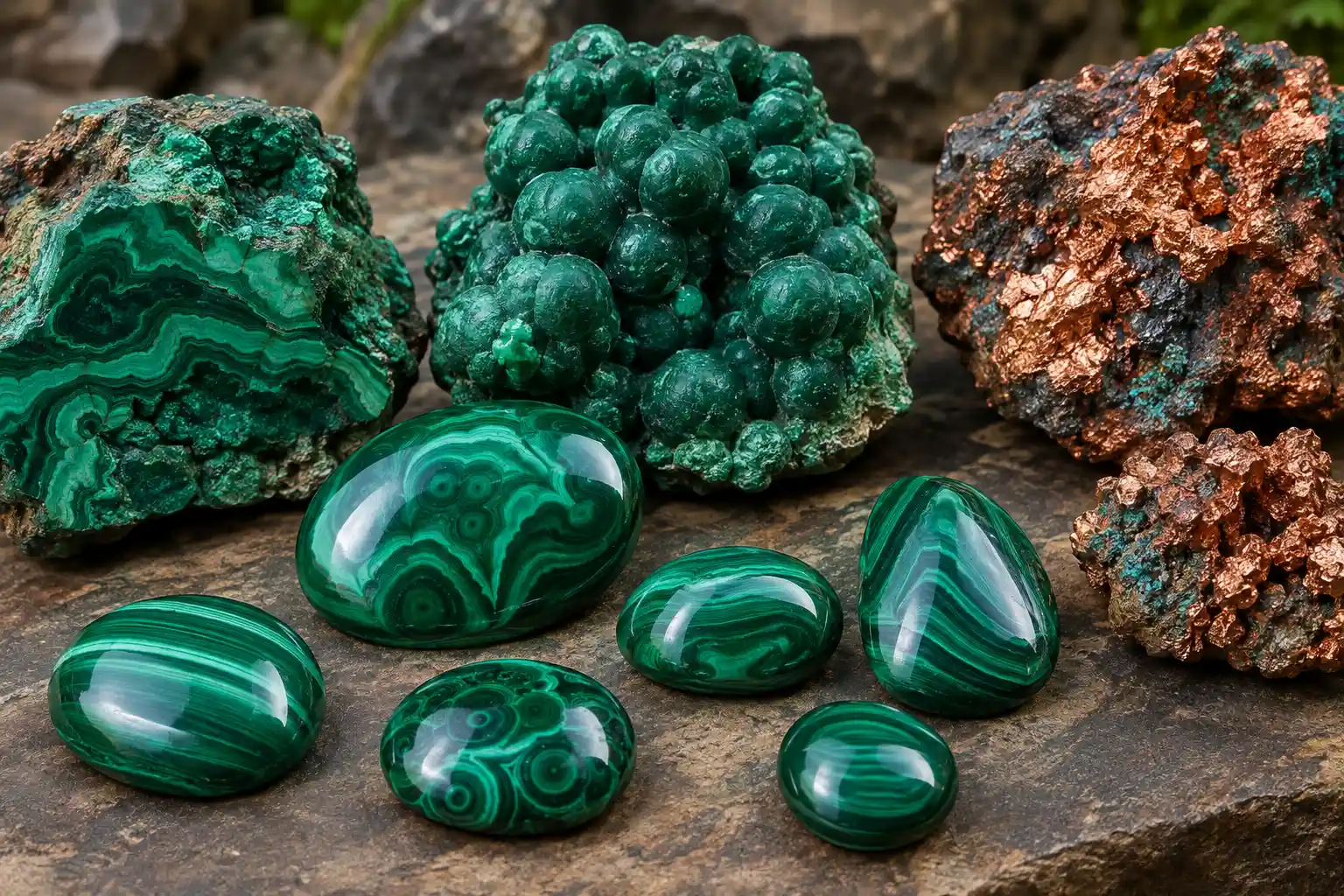
Malachite benefits begin with an extraordinary physical appearance. Malachite is a copper carbonate hydroxide mineral with the formula Cu₂CO₃(OH)₂ and a monoclinic crystal structure. Its vivid greens range from pale through emerald-like shades to extremely dark green, often arranged in concentric bands, waves, eyes, stripes, or rounded botryoidal structures that make polished pieces immediately recognizable.
The mineral commonly forms in the oxidized zones of copper deposits, where copper-bearing minerals interact with oxygen-rich groundwater and carbonate-bearing conditions near the surface. It frequently occurs with other secondary copper minerals such as azurite, chrysocolla, cuprite, and various copper oxides. These geological relationships make malachite useful for mineral collecting and for understanding how copper deposits change through weathering and oxidation.
Malachite benefits also include jewelry, carving, decorative art, mineral education, collecting, and historical significance. Ancient and later societies used malachite for ornaments, pigment, decorative objects, and copper-related purposes, although specific practices differed greatly across place and time. Modern spiritual traditions add meanings involving transformation, protection, emotional growth, and change, but those themes should remain separate from medical claims. Malachite contains copper, yet wearing the stone does not provide a safe or controlled therapeutic copper treatment.
9 Malachite Benefits at a Glance
- Intense natural green color and banding create exceptional visual appeal.
- Cabochons, beads, inlays, boxes, carvings, and decorative objects can display complex natural patterns.
- Copper-mineral geology makes malachite useful for studying oxidation zones in copper deposits.
- Collector specimens can show botryoidal surfaces, stalactitic forms, fibrous textures, crystals, and associations with other copper minerals.
- Historical use connects malachite with ancient ornament, pigment, decorative art, and copper-producing regions.
- Pattern variation gives cutters and designers opportunities to create highly individual pieces.
- Modern symbolism can connect malachite with growth, change, protection, resilience, and personal transition.
- Care awareness is valuable because malachite is relatively soft and sensitive to acids, heat, abrasives, and rough wear.
- Safe handling distinguishes polished finished stones from malachite dust or powder, which should not be inhaled or consumed.
Vivid Green Banding Is the Most Obvious Malachite Benefit
Color is one of the strongest malachite benefits. Few familiar ornamental stones show such an unmistakable range of green bands, circular eyes, sweeping curves, stripes, and concentric patterns. Different layers can vary from pale mint-like green to almost black-green, creating a natural design that often looks deliberately drawn.
The color is closely connected with copper in the mineral’s chemistry. Unlike gemstones whose color depends on tiny amounts of trace elements, malachite is fundamentally a copper mineral. Copper is an essential part of the chemical formula, which helps explain the strength and consistency of its green coloration.
Pattern depends on growth form and the way the stone is cut. A slice across a botryoidal or stalactitic structure can reveal concentric rings, while a cut along another direction may produce long wavy bands. Skilled lapidaries study rough pieces before cutting because orientation can determine whether the finished surface displays dramatic eyes, flowing lines, or relatively simple color fields.
These patterns make malachite attractive even when the stone is opaque and relatively soft. It does not need transparency or diamond-like brilliance. Its identity comes from color, texture, and natural geometry.
Jewelry and Decorative Art Showcase Malachite Patterns
Malachite has a long history in decorative work because broad polished surfaces show its banding beautifully. Cabochons, beads, pendants, earrings, brooches, rings, bracelets, inlays, boxes, bowls, table objects, small sculptures, and architectural decoration can all use the stone effectively.
Durability places important limits on design. Malachite has a Mohs hardness around 3.5 to 4, making it substantially softer than quartz, topaz, corundum, or diamond. It can scratch during ordinary wear and is not ideal for jewelry expected to endure constant abrasion.
Pendants and earrings are relatively practical because they receive fewer impacts. Rings can be worn, but protected settings and occasional rather than rough daily use make more sense. Edges and raised surfaces deserve particular protection.
These practical considerations should influence anyone planning to buy malachite. Strong color and attractive banding matter, but polish, structural stability, setting design, treatment disclosure, craftsmanship, and suitability for the intended use are just as important.
Copper Deposit Geology Gives Malachite Scientific Value
Another important area of malachite benefits is geology. The mineral commonly develops in oxidized portions of copper deposits, often closer to the surface than primary copper sulfide minerals. Groundwater, oxygen, carbon dioxide, host-rock chemistry, and existing copper minerals contribute to the formation of secondary copper minerals.
This geological setting explains why malachite can occur beside azurite. Both are copper carbonate minerals, although their compositions and colors differ. Changing chemical conditions can favor one mineral over another, and specimens sometimes show blue azurite associated with vivid green malachite.
Collectors may also encounter malachite with chrysocolla, cuprite, calcite, limonite, or other minerals from weathered copper deposits. Such association specimens provide information about how the original ore body was altered.
For students, malachite therefore offers more than attractive color. It demonstrates secondary mineral formation, oxidation, chemical weathering, copper mobility, and the way mineral assemblages record changing environmental conditions.
Collector Specimens Reveal More Than Polished Green Bands
Polished malachite is famous, but natural specimens can be even more varied. Botryoidal surfaces resemble clusters of rounded grapes or bubbles, while stalactitic forms may create cylindrical or branching shapes. Fibrous structures can produce silky textures, and crystalline coatings may appear on associated minerals.
Some specimens are valued for aesthetics rather than lapidary potential. A velvety botryoidal crust on contrasting host rock may be more interesting to a mineral collector than if it were cut into cabochons. Another specimen may be important because it preserves malachite with azurite or another copper mineral.
Locality can also add value. Famous copper districts in Africa, Europe, Asia, Australia, North America, and elsewhere have produced distinctive malachite specimens, although quality varies within every region. Good provenance makes a specimen more scientifically useful because it ties the minerals to a specific deposit.
Collector value and jewelry value therefore overlap only partly. A polished cabochon is judged heavily on pattern and finish, while a natural specimen may be prized for crystal form, mineral association, locality, or geological context.
Historical Use Adds Cultural and Artistic Malachite Benefits
Malachite has been known for a very long time because copper deposits were important to early societies and the mineral’s green color is difficult to overlook. It has been used for beads, amulets, inlays, carved objects, decorative surfaces, and pigments in different cultures and historical periods.
Ground malachite was historically used as a green pigment. This reflects a direct relationship between mineralogy and art: the same copper chemistry responsible for the stone’s color could be used to produce green in painted surfaces.
Historical use should still be described carefully. Different civilizations used malachite for different purposes, and modern crystal symbolism should not automatically be projected backward onto every ancient artifact. An ancient bead demonstrates ornamentation; it does not by itself prove a specific modern belief about emotional transformation.
The genuine cultural history is already substantial. Malachite connects mining, metallurgy, pigment technology, jewelry, art, architecture, and decorative craft, making historical context one of the strongest real malachite benefits.
Lapidary Cutting Turns Natural Growth Into Visual Design
Malachite is particularly rewarding for lapidaries because cutting direction can transform the visible pattern. Concentric growth can become eyes, spirals, or repeated rings when sliced across its structure, while lengthwise cuts through layered growth can create sweeping lines and parallel bands.
Large pieces may allow cutters to plan several matching cabochons, beads, or inlay sections. Matching is still difficult because natural banding changes from one area to another, but careful cutting can preserve visual continuity across earrings or jewelry sets.
Softness makes cutting easier in some respects but creates polishing challenges. The stone can undercut where different textures occur, and excessive pressure or careless abrasives can damage edges. A high-quality polish should enhance color without erasing crisp pattern boundaries.
Because craftsmanship influences appearance significantly, malachite price reflects more than the size of the stone. Pattern quality, color contrast, polish, cutting, specimen form, treatment, provenance, and workmanship can all affect market value.
Transformation Is a Natural Modern Symbolic Theme
Modern crystal traditions commonly describe malachite as a stone of transformation. This symbolism is understandable because its patterns appear to grow in layers, while its geology reflects chemical transformation in oxidizing copper deposits.
Someone entering a new stage of life may choose malachite as a reminder that change can occur gradually. A person beginning a new job, moving to another place, ending an old habit, or learning a demanding skill might connect the stone with intentional transition.
The stone itself does not cause transformation. Its role is symbolic, much as a ring, photograph, medal, or written phrase can represent a decision or milestone.
Green also contributes to the symbolism. Many people associate green with growth, vegetation, renewal, nature, or fresh beginnings. These cultural responses reinforce modern malachite benefits related to change without requiring a supernatural mechanism.
Protection and Emotional Growth Are Belief-Based Uses
Protection has been associated with malachite in different historical and modern contexts, although the meaning varies. Contemporary crystal traditions may describe it as protecting energy, absorbing negativity, supporting emotional release, or encouraging personal growth.
There is no established evidence that malachite creates an invisible shield or removes harmful emotional energy. A person can still use it as a symbolic reminder to establish boundaries or recognize patterns that need to change.
The same distinction applies to emotional growth. A polished stone beside a journal may remind someone to reflect before reacting. Wearing a malachite pendant could symbolize a commitment to communicate more thoughtfully or leave an unhealthy situation.
Claims described under malachite healing properties should remain separate from clinical care. The stone is not a treatment for anxiety disorders, depression, trauma, neurological illness, pain, or other medical conditions.
Copper Content Requires Responsible Interpretation
Malachite contains copper as an essential part of its chemical composition, and this fact sometimes leads to incorrect wellness claims. Copper is indeed an essential nutrient in human biology, but a copper mineral worn as jewelry is not a safe nutritional delivery system.
The copper in malachite is chemically bound within the mineral. Ordinary contact with a polished stone should not be described as supplying beneficial copper through the skin. Likewise, malachite should not be placed in drinking water for consumption or ground into homemade remedies.
Powder and dust deserve greater caution than an intact polished piece. Lapidary work that grinds, sands, drills, or cuts malachite can create fine copper-bearing dust, so appropriate dust control, ventilation, wet-working procedures, eye protection, and suitable respiratory protection are important. Loose powder should not be inhaled or swallowed.
This safety distinction is essential to responsible malachite benefits. Enjoying a polished stone and processing raw mineral dust are not the same exposure situation.
Malachite Needs Gentle Care Because It Is Soft and Chemically Sensitive
Malachite’s beauty comes with important care requirements. Its hardness of roughly 3.5 to 4 means that many everyday substances and harder gemstones can scratch it. Storing malachite separately in a soft pouch or lined compartment helps preserve the polish.
Acids are particularly inappropriate because malachite is a carbonate-bearing mineral and reacts with acidic substances. Harsh household chemicals, abrasive cleaners, steam, strong ultrasonic cleaning, and excessive heat should also be avoided.
For uncomplicated polished jewelry, conservative cleaning with a soft damp cloth is often preferable to aggressive washing. If mild soap is used, the piece should be rinsed carefully and dried without prolonged soaking. Jewelry containing adhesives, coatings, fillers, or other sensitive stones may require additional caution.
Rings and bracelets should be removed before household cleaning, gardening, exercise, or work involving repeated contact with hard surfaces. Malachite is beautiful enough to justify careful wear rather than being treated as an indestructible daily-use stone.
What Malachite Benefits Do Not Include
Malachite benefits are substantial without claiming that the stone acts as medicine. It offers exceptional color and pattern, decorative versatility, geological interest, collecting value, historical importance, artistic connections, and meaningful personal symbolism.
There is no established evidence that wearing malachite treats arthritis, pain, inflammation, infection, heart disease, menstrual problems, pregnancy complications, anxiety disorders, depression, digestive illness, hormonal conditions, or other medical concerns.
The presence of copper does not validate those claims. Nutritional and medical copper exposure involves biological pathways, measured doses, and specific chemical forms, not ordinary contact with a polished mineral.
Malachite is best treated as a fascinating copper mineral and ornamental stone rather than a therapeutic device.
Conclusion
Malachite benefits begin with genuine mineralogical and artistic qualities. Its Cu₂CO₃(OH)₂ chemistry, intense green color, natural banding, copper-deposit geology, lapidary potential, collector appeal, historical pigment use, and long decorative tradition give it unusual depth.
Modern symbolism involving growth, transformation, protection, resilience, and personal change can add emotional significance when presented as interpretation. Responsible ownership also requires respect for malachite’s softness, acid sensitivity, and copper-bearing dust during cutting or grinding. The stone’s real qualities are compelling without unsupported medical claims.
FAQs
What are the main malachite benefits?
The strongest malachite benefits include vivid natural green color, distinctive banding, jewelry and decorative use, lapidary versatility, collector interest, geological value as a secondary copper mineral, and significant artistic and historical use. Modern crystal traditions also associate malachite with transformation and protection, but those ideas are symbolic rather than medically established effects.
What is malachite made of?
Malachite is a copper carbonate hydroxide mineral with the formula Cu₂CO₃(OH)₂. Copper is an essential part of its chemistry and produces the characteristic green coloration. It crystallizes in the monoclinic system but commonly occurs as botryoidal, fibrous, massive, stalactitic, or banded growth rather than as large isolated crystals.
Why does malachite have bands and circles?
Malachite often grows in successive layers within cavities, fractures, and weathered zones of copper deposits. Cutting through these layered structures reveals concentric circles, eyes, stripes, waves, and other patterns. The exact design depends on growth history and cutting orientation, which is why individual polished pieces can look dramatically different.
Is malachite durable enough for jewelry?
Malachite can be used successfully in jewelry but requires care because its Mohs hardness is only about 3.5 to 4. Pendants, earrings, and protected pieces are generally easier to maintain than exposed rings or bracelets. Hard impacts, abrasive surfaces, acids, harsh chemicals, steam, and aggressive ultrasonic cleaning should be avoided.
Is malachite really a copper mineral?
Yes. Copper is fundamental to malachite’s chemical composition and green color. The mineral commonly forms in oxidized portions of copper deposits and may occur with azurite, chrysocolla, cuprite, and other secondary copper minerals. Its copper content is geologically important but does not mean wearing malachite provides therapeutic copper to the body.
Was malachite used historically?
Yes. Malachite has been used for ornaments, beads, carvings, decorative objects, inlays, pigments, and other artistic purposes across different historical periods. Its vivid green color made it particularly noticeable around copper-producing regions. Specific beliefs differed among cultures, so modern metaphysical interpretations should not automatically be attributed to every ancient use.
Does malachite symbolize transformation?
Transformation is one of the most common modern symbolic themes. The stone’s layered growth, changing green patterns, and formation through alteration in copper deposits make transformation an intuitive metaphor. A person may use malachite to represent a life transition or new commitment, but the mineral itself has not been scientifically shown to cause psychological change.
Is malachite safe to touch?
Normal handling of intact, polished malachite is very different from exposure to mineral dust. The greatest practical concern arises when cutting, grinding, drilling, or sanding creates fine copper-bearing particles that should not be inhaled or swallowed. Appropriate lapidary safety controls are important, and malachite should not be consumed or used to make drinking-water remedies.
Can malachite heal physical or emotional conditions?
There is no established scientific evidence that malachite diagnoses, treats, cures, or prevents physical or mental-health conditions. Modern beliefs involving emotional healing, protection, transformation, pain relief, or copper-related wellness are spiritual or symbolic interpretations. Medical concerns require qualified health care rather than gemstone treatment.
Malachite benefits involving healing, protection, energetic transformation, or emotional wellness describe cultural, spiritual, or personal interpretations and should not replace qualified physical or mental-health care.