

Malachite prices in 2026 commonly range from less than $1 to approximately $50 per carat. Ordinary beads and commercial cabochons may cost only a few dollars per carat, while fine orbicular, eye-patterned or chatoyant stones can reach $20 to $75 per carat.
Exceptional crystal specimens, historic Russian objects and master carvings follow separate collector markets. Their value depends on form, provenance, craftsmanship and condition rather than a standard per-carat rate.
Malachite Price per Carat in 2026
The following ranges represent broad U.S. retail expectations for loose polished Malachite.
| Malachite quality | Typical characteristics | Approximate 2026 retail price |
|---|---|---|
| Entry commercial | Weak pattern, abundant dark matrix, uneven polish or reconstructed material | $0.50–$3 per carat |
| Good commercial | Clear green banding, competent polish and useful jewelry shape | $3–$10 per carat |
| Fine | Strong contrast, attractive eyes or waves, clean surface and balanced cutting | $10–$30 per carat |
| Premium | Rare orbicular or chatoyant pattern, vivid color and superior polish | $30–$75 per carat |
| Exceptional lapidary or specimen quality | Collector crystal, stalactitic structure, historic provenance or master carving | $75–$150+ per carat equivalent |
Large ordinary cabochons often cost less per carat than small premium stones because Malachite occurs in sizable masses. Therefore, pattern quality and workmanship matter more than weight.
The universal relationship among rarity, appearance, cutting and demand appears in How Gemstone Prices Are Determined.
What Is Malachite?
Malachite is a green copper carbonate hydroxide mineral. It commonly forms in the oxidized zones of copper deposits.
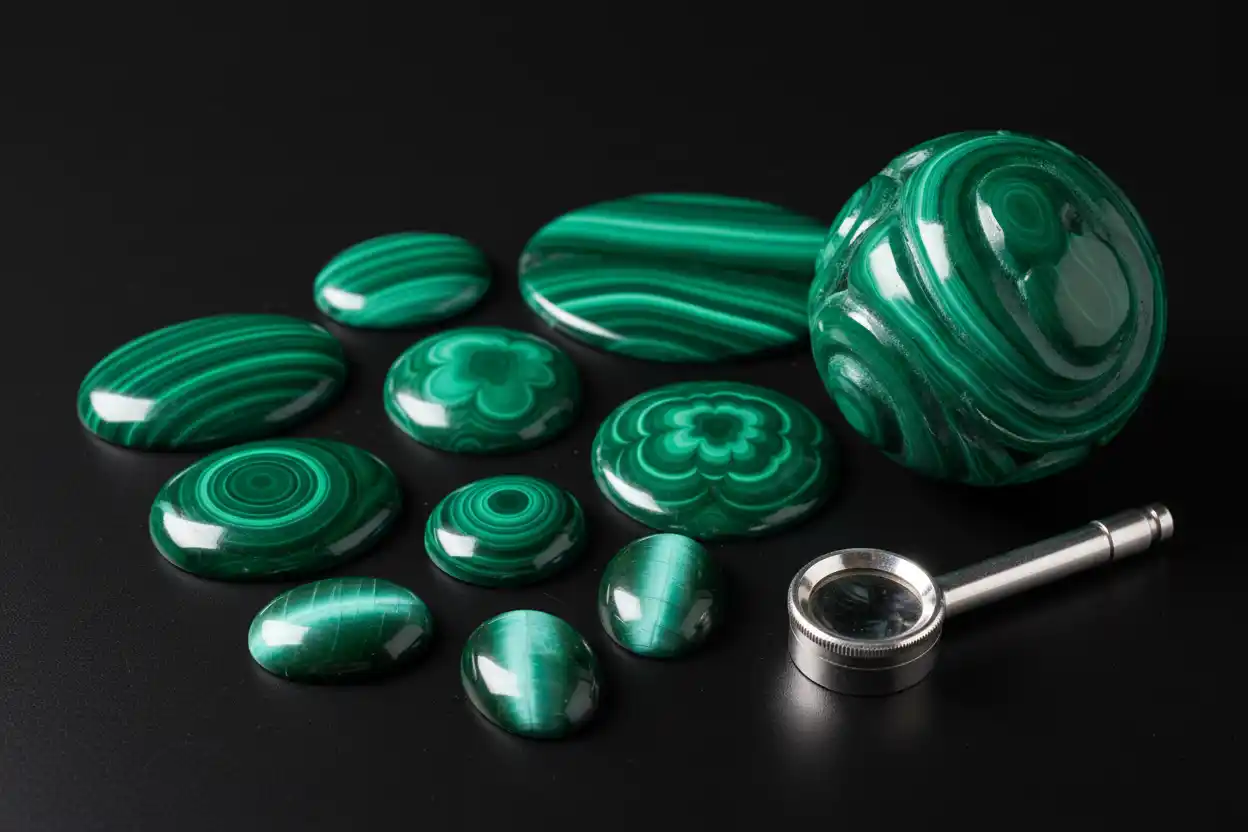
The material is normally opaque and displays light-to-dark green bands, curves, eyes, waves and fibrous structures. Those patterns reflect layered mineral growth rather than artificial painting.
Malachite frequently occurs with Azurite, Chrysocolla and other secondary copper minerals. Mixed material may produce blue-green combinations valued as cabochons or decorative stone.
The completed Malachite guide owns the mineral’s formation, properties and symbolic traditions. Copper’s broader geological context appears in the completed Copper guide.
Pattern Is Malachite’s Primary Value Factor
Malachite’s value depends more on pattern than one uniform green color. Fine material displays strong contrast and visual movement.
Concentric eyes, scallops, waves and ribbon-like bands attract the strongest jewelry demand. The pattern should occupy the face intentionally rather than appearing cut off or disorganized.
Plain green material remains affordable because it lacks the distinctive structures that make Malachite recognizable.
A stone with vivid pattern but poor polish may still underperform. The surface must remain smooth enough for light to reveal the banding clearly.
Collectors may prefer unusual asymmetry, while jewelry buyers often favor balanced central eyes or flowing horizontal bands. Consequently, aesthetic judgment matters more than a rigid grading formula.
The broader family of green materials appears in Green Gemstones.
Malachite Color and Contrast
Malachite ranges from pale mint green to vivid emerald-like green and nearly black-green.
The strongest commercial appearance normally combines several greens with enough contrast to show the structure clearly. A single flat dark tone usually costs less.
Very pale zones can weaken saturation, although they may create attractive contrast within orbicular patterns.
Brown matrix, cavities and dull gray-green areas generally reduce jewelry value. However, they can remain desirable in natural mineral specimens when they show geological context.
Color should look natural rather than neon. Excessively bright uniform green may indicate dye, reconstructed material or imitation.
Eye and Orbicular Malachite
Eye-pattern Malachite displays circular or oval structures resembling eyes, targets or bubbles. These patterns come from cross-sections through layered or stalactitic growth.
Fine examples can command strong premiums because the cutter must position the pattern carefully. A centered eye commonly costs more than a partial ring cut off at the edge.
Multiple small eyes may create a complex collector pattern, while one large symmetrical orb can dominate a statement cabochon.
The finest stones combine clear concentric bands, strong green contrast and a smooth polish without open cavities.
Terms such as “bull’s-eye,” “peacock eye” or “orbicular” describe appearance rather than standardized quality grades.
Banded and Ribbon Malachite
Banded Malachite shows parallel, curved or folded stripes. Fine ribbon patterns can resemble topographic maps, flowing water or wood grain.
The market rewards crisp boundaries and strong contrast. Blurred or irregular banding may still be attractive but generally belongs to a lower tier.
Cut orientation creates much of the final result. A slab cut across growth can show eyes, while a cut along the same formation may display long ribbons.
Consequently, lapidary skill can transform the same rough into very different market products.
Matching ribbon patterns across earrings or cuff links creates an additional premium because the cutter must use related slices from the same piece.
Chatoyant and Fibrous Malachite
Fibrous Malachite can produce a silky, moving light effect resembling chatoyancy.
Fine chatoyant stones are less common than ordinary banded cabochons and may reach the premium price tier.
The effect should move smoothly across the face rather than appear as a static bright patch. Correct orientation and polish are essential.
Some fibrous mineral specimens show a velvety surface and should not be polished. Their collector value depends on natural texture, color, crystal development and damage-free condition.
Handling fibrous rough requires caution because grinding or breaking it can release mineral dust.
Congo Malachite Prices
The Democratic Republic of the Congo supplies a large share of the Malachite used in modern jewelry, carvings and decorative objects.
Congolese material can show exceptional banding, eyes, stalactitic structures and vivid green color. Commercial supply also includes ordinary slabs and low-pattern rough.
Good polished Congo cabochons commonly occupy the $3-to-$30-per-carat range. Rare patterns, large matched material and specimen-grade formations can cost considerably more.
Origin alone does not create premium quality. A weakly patterned Congo stone may be worth less than a fine piece from another locality.
Specific mine claims should be supported when they materially affect price or specimen provenance.
Russian and Historic Malachite
Russia’s Ural region produced important Malachite used in imperial decorative arts, architecture, tables, columns and large ornamental objects.
Historic Russian Malachite objects can be extremely valuable because craftsmanship, age and provenance dominate the raw material value.
Modern sellers sometimes use “Russian-style” to describe mosaic work assembled from thin patterned pieces. The phrase does not establish antique origin or Russian material.
An old-looking box or inlay panel should receive professional decorative-arts evaluation. Natural Malachite identification alone cannot determine when or where the object was made.
Repairs, missing inlay, replacement panels and aggressive restoration can substantially reduce antique value.
Other Sources
Malachite also occurs in Zambia, Namibia, Australia, Mexico, the United States and other copper-mining regions.
Namibian and Zambian specimens can show attractive botryoidal or crystalline development. Arizona and other American localities attract mineral collectors through classic mine associations.
Country of origin usually matters less for commercial cabochons than pattern and polish. For natural specimens, however, locality labels and mine provenance can create a meaningful premium.
A collector specimen should retain its original matrix and formation when those features contribute to geological interest.
Size and Price Premiums
Malachite occurs in large masses, so ordinary price per carat generally decreases as weight increases.
| Example | Approximate price per carat | Approximate total price |
|---|---|---|
| 5 ct commercial cabochon | $1–$5 | $5–$25 |
| 20 ct good banded stone | $3–$12 | $60–$240 |
| 50 ct fine eye-pattern cabochon | $10–$30 | $500–$1,500 |
| 100 ct premium orbicular stone | $20–$60 | $2,000–$6,000 |
| Major carving or crystal specimen | Not reliably priced by carat | Individually evaluated |
Many large cabochons trade below these totals because ordinary material remains available. A premium applies only when strong pattern and polish continue across the large surface.
Dimensions are more useful than weight for evaluating wearable size. Malachite’s density allows a thick cabochon to accumulate substantial carat weight.
Malachite Bead Prices
Commercial bead strands may cost approximately $10 to $100. Better matched strands with clear banding can range from $100 to $500.
Large round beads require greater rough loss, so premium matched necklaces can cost several hundred or several thousand dollars.
Matching involves more than diameter. The beads should share green tone, banding intensity, polish and drill-hole quality.
Reconstituted Malachite is common in low-cost beads. It may contain ground Malachite mixed with resin, or it may consist entirely of patterned polymer.
A strand showing identical repeated bands across every bead may deserve closer examination.
Malachite Slabs, Boxes and Decorative Objects
Malachite’s broad bands make it popular for boxes, bowls, tabletops, mosaics and inlaid decorative pieces.
Commercial boxes may cost $50 to $500, while finely matched large objects can reach thousands of dollars.
Thin slices are sometimes assembled over a base material to create a continuous pattern. This technique is legitimate when disclosed, but the object should not be priced as one solid block.
Craftsmanship matters greatly. Tight seams, intelligent pattern matching, smooth corners and even polish add more value than raw weight.
Modern decorative pieces should not be represented as antique Russian work without credible documentation.
Carvings and Lapidary Value
Malachite is soft enough for detailed carving yet capable of taking an attractive polish.
A small commercial carving may cost less than $50. Larger artistic pieces commonly range from hundreds to several thousand dollars.
The cutter must position bands so they complement the design. Faces, feathers, leaves and animal forms become more compelling when the pattern follows their contours.
Thin elements can be fragile, and internal cavities may complicate carving. Chips, glue repairs and poorly finished recesses reduce value.
A signed work by a recognized lapidary can cost far more than an unsigned object of similar weight.
Azurite-Malachite Material
Malachite frequently occurs with blue Azurite, producing striking blue-and-green cabochons and specimens.
The mixed material follows a separate aesthetic market. Value depends on the balance between blue and green, pattern, stability and cutting.
Azurite can be softer and more sensitive than Malachite. Consequently, mixed stones require careful polishing and cleaning.
The complete material distinction belongs to Malachite vs Azurite, while the completed Azurite guide owns the blue mineral’s identity.
A composite blue-green appearance should not be used to price the entire piece as pure premium Malachite.
Synthetic, Reconstituted and Imitation Malachite
Synthetic Malachite has been produced, although it remains less common than resin imitation and reconstructed material.
Reconstituted products may combine Malachite powder or fragments with resin. Artificial banding can also be printed, poured or layered into plastic.
Warning signs include perfectly repeated stripes, identical patterns among multiple stones, unnatural black lines, very low density or a plastic-like surface.
Natural Malachite typically shows organic variation and complex boundaries. Nevertheless, high-quality imitations can require microscopic or chemical analysis.
A low price does not automatically prove imitation because commercial Malachite is affordable. The full identification process belongs to Real vs Fake Malachite.
Treatments
Natural Malachite may receive wax, oil, resin or surface coatings to improve luster or stabilize porous areas.
Dyed material also occurs, although Malachite’s natural green is usually strong enough that routine dyeing provides less benefit than it does for pale porous stones.
Treatment should be disclosed because resin and wax alter care requirements and resale value.
A repaired cavity or resin-filled fracture can improve appearance but should reduce value compared with an intact natural stone.
The dedicated How to Spot Treated or Synthetic Malachite page owns detection details. The broader enhancement framework appears in Gemstone Treatments Explained.
Malachite Jewelry Prices in 2026
| Jewelry type | Broad U.S. retail range | Main price drivers |
|---|---|---|
| Silver earrings or pendant | $30–$250 | Commercial Malachite, silver and production |
| Silver statement ring | $75–$500 | Pattern, cabochon size and setting |
| Gold earrings or pendant | $400–$2,500 | Gold weight, matched stones and design |
| Gold Malachite ring | $500–$3,500 | Center pattern, protective construction and brand |
| Fine bead necklace | $200–$3,000+ | Bead size, matching, clasp and material quality |
| Designer or antique object | Highly variable | Maker, craftsmanship, age and provenance |
In most Malachite jewelry, the stone itself remains affordable relative to gold and labor.
The tracker assigns jewelry-specific selection to the Malachite Earrings Guide and Malachite Necklace Guide.
Green-jewelry alternatives appear in Green Gemstones for Engagement Rings.
Durability and Care
Malachite has a Mohs hardness of approximately 3.5 to 4, so it scratches more easily than Quartz, Sapphire or Diamond.
Acids, ammonia and many household chemicals can attack the surface. Heat may also damage wax, resin or other treatment.
Rings and bracelets face greater risk than pendants or earrings. Bezel settings can protect cabochon edges from direct impact.
Steam and ultrasonic cleaning should be avoided. Gentle cleaning with a soft damp cloth remains the safer approach.
Complete maintenance guidance belongs to How to Clean Malachite Jewelry Safely.
Safety During Cutting and Handling
Normal handling of polished Malachite jewelry does not present the same risk as cutting, grinding or ingesting the material.
Lapidary work can release copper-bearing dust. Cutters should use appropriate wet methods, ventilation and personal protective equipment rather than grinding Malachite dry.
Acids should not be used for cleaning because they damage the mineral and can mobilize copper compounds.
Children and pets should not place loose Malachite in their mouths. Likewise, the stone should not be used to prepare drinking water or homemade elixirs.
Certification and Appraisal
Most commercial Malachite does not require a laboratory report. Visual pattern and workmanship commonly determine more value than formal certification.
Testing becomes more useful when:
The piece may be synthetic or reconstructed, a major specimen carries an important locality claim, a historic object requires documentation, or a high-value cabochon may contain extensive resin.
A laboratory can confirm Malachite and detect many synthetic or treated products. It does not assign a universal pattern grade.
The Gemstone Certification Labs comparison explains report scope. Online buyers should also use How to Buy Gemstones Online Without Getting Scammed.
Does Malachite Hold Its Value?
Commercial Malachite usually has limited resale strength because new material remains widely available.
Fine orbicular stones, chatoyant pieces, classic mineral specimens and signed carvings can attract collectors. Historic Russian decorative objects follow a much stronger antiques market when provenance is credible.
Finished gold jewelry may retain more value through metal and designer authorship than through its Malachite cabochon.
Condition has a major effect. Scratches, acid damage, broken carvings and resin repairs can reduce secondhand demand.
The wider resale framework appears in Do Gemstones Hold Their Value?.
Price Guide vs Buying Guide
This page owns Malachite’s 2026 price ranges and value factors. Detailed pattern inspection, authenticity checks and seller questions belong to the Malachite Buying Guide.
The completed Gemstones That Start With M and Crystals That Start With M directories connect Malachite to the alphabetical site structure.
The Buying & Value hub connects this guide with treatment, certification and resale content.
Frequently Asked Questions
1. How much is Malachite worth per carat in 2026?
Commercial Malachite may cost less than $1 to $10 per carat, while fine eye-pattern or chatoyant stones commonly range from $10 to $75 per carat.
2. What makes Malachite valuable?
Strong banding, centered eyes, rare chatoyancy, vivid green contrast, smooth polish, workmanship and provenance create the strongest premiums.
3. Is Congo Malachite expensive?
Commercial Congo material can be affordable. Fine orbicular stones, matched patterns and collector specimens can cost substantially more.
4. Does large Malachite cost more per carat?
Usually not. Large masses are available, so price rises mainly when rare pattern and fine polish continue across the larger surface.
5. What is eye-pattern Malachite?
It is Malachite cut across layered or stalactitic growth to reveal concentric rings resembling eyes or targets.
6. Is chatoyant Malachite valuable?
Fine silky or cat’s-eye-like material can receive a strong premium because correct fibrous structure and cutting are less common.
7. Is synthetic Malachite available?
Yes. Synthetic, reconstructed and resin imitation products exist, although ordinary natural Malachite is also widely available.
8. How can reconstructed Malachite affect price?
Reconstructed material should cost much less than a comparable natural patterned stone because resin and manufactured structure contribute to the finished product.
9. Is Malachite safe to wear?
Polished jewelry is generally suitable for normal wear. Cutting dust, ingestion and exposure to acids require greater caution.
10. Is Malachite suitable for a ring?
It can be worn in a protective setting, but its softness makes it vulnerable to scratches, chemicals and impact.
11. Does Malachite need a laboratory report?
Ordinary cabochons generally do not. Testing becomes useful for expensive specimens, historic objects or suspected synthetic and reconstructed material.
12. Is Malachite a good investment?
Commercial material is not generally an investment. Fine specimens, signed carvings and important antiques may retain specialist demand.
Malachite Value Lies in the Pattern, Not the Weight
Malachite’s appeal comes from mineral growth recorded as eyes, waves, ribbons and shifting green bands. A large plain cabochon should not cost more than a smaller stone whose pattern creates a complete visual composition.
In 2026, attractive jewelry material commonly falls between $3 and $30 per carat. Prices above that range should correspond to rare patterning, chatoyancy, exceptional workmanship or provenance that separates the piece from readily available commercial Malachite.
Safety note: Polished Malachite jewelry can be handled normally. Avoid ingesting the stone, soaking it for drinking-water preparations, exposing it to acids or grinding it dry. Lapidaries should control copper-bearing dust with wet cutting, ventilation and suitable protective equipment.