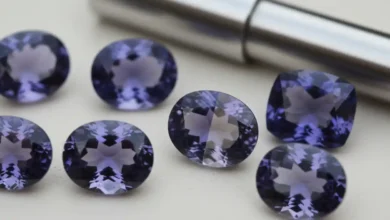

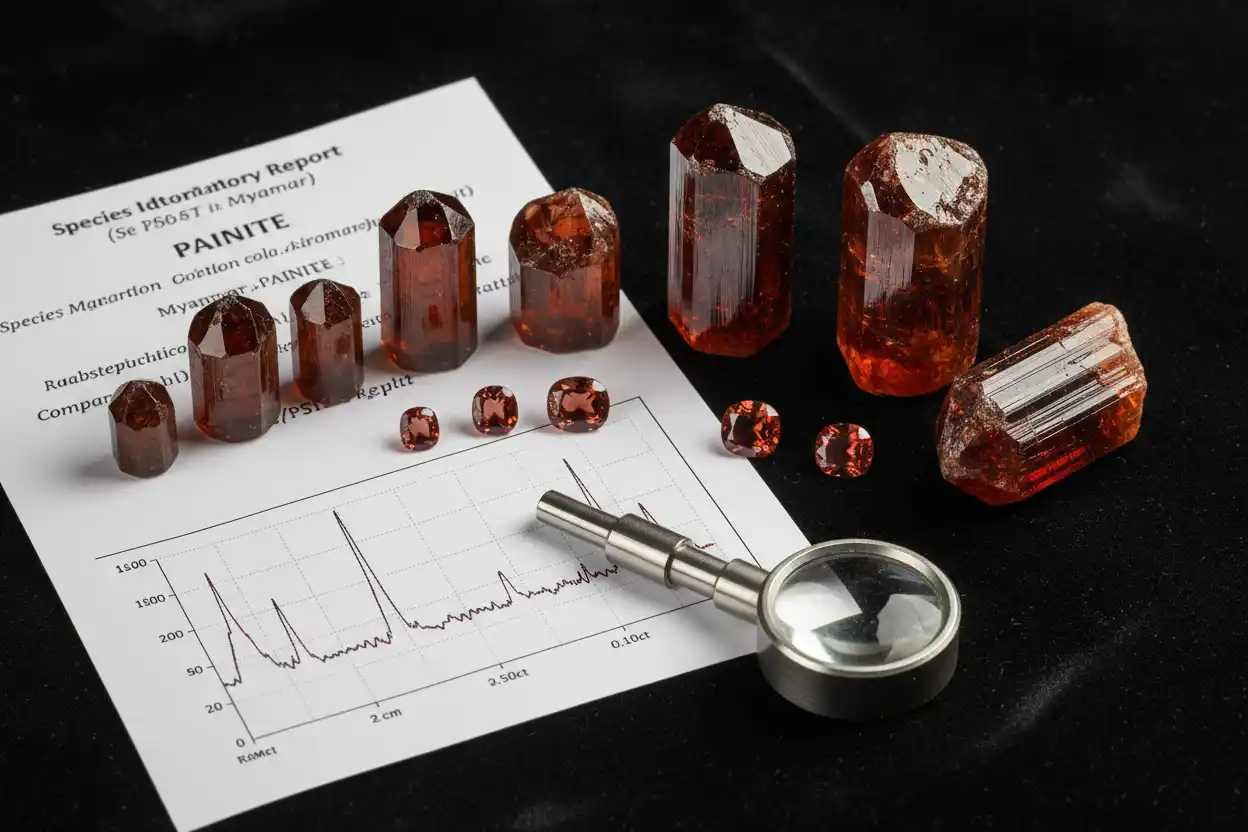

Painite prices in 2026 range from approximately $100 per carat for heavily included commercial material to more than $30,000 per carat for exceptional transparent gems. Historic claims of $50,000 to $60,000 per carat apply only to rare top-quality stones rather than every piece of Painite.
Most Painite now seen in specialist inventories is small, brownish, included or translucent. Consequently, genuine specimens and modest faceted stones can cost hundreds rather than tens of thousands of dollars.
Painite Price per Carat in 2026
The following ranges represent broad collector-market expectations for natural Painite from Myanmar.
| Painite quality | Typical characteristics | Approximate 2026 retail price |
|---|---|---|
| Commercial specimen or heavily included material | Opaque to translucent, fractured, pale pink or dark brown | $100–$600 per carat |
| Included faceted Painite | Small, brown to reddish-brown, visible fractures and modest brilliance | $500–$2,500 per carat |
| Good transparent collector gem | Reddish brown, orange-brown or red-orange, acceptable clarity and report | $2,500–$10,000 per carat |
| Fine transparent Painite | Attractive pleochroic color, good brilliance, rare size and respected documentation | $8,000–$20,000 per carat |
| Exceptional collector quality | Vivid red-orange, minimal inclusions, rare size above 1–3 ct and major report | $20,000–$50,000+ per carat |
The market contains large differences between asking prices and completed transactions. Because so few directly comparable gems are available, every serious Painite requires individual evaluation.
The principles behind rarity, liquidity, color and size appear in How Gemstone Prices Are Determined.
Why Painite Is No Longer Always $60,000 per Carat
For decades, only a few Painite crystals were known. That extreme scarcity led to repeated descriptions of Painite as the world’s rarest gemstone and generated headline values as high as $50,000 or $60,000 per carat.
New discoveries in Myanmar during the early 2000s produced more than a thousand crystals and fragments.
Most of the new material is included, fractured, opaque or unsuitable for fine faceting. Even so, the greater supply created a lower commercial tier that did not exist when only a few museum specimens were known.
Small faceted stones now appear in specialist inventories for hundreds of dollars. These gems remain rare by ordinary gemstone standards but should not be priced like the finest historical examples.
The highest figures still apply when a stone combines transparency, desirable color, rare size and major laboratory documentation.
What Is Painite?
Painite is a rare calcium-zirconium-aluminum borate mineral. It was identified as a distinct mineral species in the 1950s after a reddish crystal from Myanmar had initially been mistaken for another gem.
Its colors include reddish brown, brownish red, orange-red, pinkish brown and dark brown.
Chromium and vanadium contribute to the red and orange components. Iron and the mineral’s strong absorption can create darker brown areas.
Painite commonly shows pleochroism, displaying different red, orange or brown tones when viewed from different crystal directions.
The completed Painite guide owns its composition, history, physical properties and traditional symbolism.
Myanmar Is Painite’s Established Source
Confirmed Painite comes from Myanmar, particularly the Mogok region and deposits around Nanyaseik.
The original material came from the Mogok Stone Tract, an area renowned for Ruby, Sapphire, Spinel and many rare collector minerals.
Later discoveries at Wetloo, Kyauk-Pyat-That and other deposits increased the known supply.
A seller claiming Painite from Pakistan, Sri Lanka, Africa or another unsupported origin should face additional scrutiny. Such stones may be misidentified Garnet, Tourmaline, Sapphire or glass.
Geographic origin should not be used as a substitute for mineral identification. The first requirement is a laboratory report that specifically names natural Painite.
Color and Painite Value
Fine Painite generally shows red-orange, reddish brown or brownish red with visible pleochroism.
Bright red-orange receives the strongest premium because much Painite appears dark or brown.
An excessively dark stone may look nearly black face-up and reveal color only under strong transmitted light. Such material belongs to a lower tier even when it is transparent around thin edges.
Pale pink Painite from Nanyaseik can be collectible but normally receives less market demand than vivid red-orange material.
Color should be viewed under diffuse daylight-equivalent illumination. Concentrated backlighting can make an opaque crystal look more gem-like than it is.
A rotating video helps reveal whether the stone has attractive pleochroic shifts or simply becomes dark from most angles.
Transparency Creates the Largest Price Difference
Most recovered Painite is not facetable. Crystals may contain dense fractures, clouds, inclusions and opaque regions.
Opaque and translucent pieces are often preserved as mineral specimens. Their prices depend on crystal form, color, locality, matrix and damage rather than faceted-gem standards.
Transparent Painite is much scarcer. Even small faceted gems can command significant premiums when they transmit light and show reasonable brilliance.
A transparent half-carat gem can be worth more than a ten-carat opaque fragment.
Sellers sometimes describe backlit translucent material as transparent. Buyers should request photographs under ordinary reflected light as well as transmitted light.
Clarity and Fractures
Painite rough is commonly included and fractured. Cutters often have to produce small or shallow stones to avoid serious internal damage.
Minor inclusions are accepted because genuinely clean material is rare. However, open fractures, dense clouds and large black inclusions still reduce value.
A fracture near the girdle can create setting risk. Likewise, a shallow stone with a surface-reaching fissure may be unsuitable for jewelry despite its rarity.
Fine collector gems should remain bright enough for the red-orange color to be appreciated without extreme lighting.
Clarity should be compared within Painite rather than against abundant eye-clean materials such as Aquamarine or Topaz.
Size Premiums
Faceted Painite is usually below one carat. Larger transparent stones are exceptionally scarce.
| Example stone | Approximate price per carat | Approximate total price |
|---|---|---|
| 0.20 ct included faceted Painite | $500–$2,000 | $100–$400 |
| 0.50 ct good transparent stone | $2,500–$8,000 | $1,250–$4,000 |
| 0.75 ct fine red-brown Painite | $6,000–$15,000 | $4,500–$11,250 |
| 1.25 ct premium transparent Painite | $10,000–$25,000 | $12,500–$31,250 |
| Exceptional 3 ct-plus gem | $20,000–$50,000+ | Individually negotiated |
A large advertised Painite should trigger more verification, not automatic excitement. Large transparent material is rare enough that an implausibly low price strongly suggests misidentification or misleading quality description.
Painite Crystals and Mineral Specimens
Natural crystals are often more available than transparent faceted gems.
Small incomplete fragments may cost tens or hundreds of dollars. Better terminated crystals with strong form and locality documentation can cost hundreds or thousands.
Specimen value depends on:
- Crystal termination
- Surface condition
- Transparency or gemminess
- Color
- Association with Ruby or matrix minerals
- Locality label
- Collection provenance
- Repairs or restoration
A specimen should not be priced simply by carat weight. Mineral collectors value natural form, while cutting destroys the original crystal morphology.
A fine Painite crystal associated with Rubies can be more desirable than a poorly cut faceted stone.
Cut Quality
Painite’s rarity encourages maximum weight retention.
Many stones are cut as shallow rectangles, step cuts or irregular mixed shapes because the cutter must work around fractures.
A shallow cut may reduce brilliance, while a deep pavilion can make the stone appear overly dark.
The ideal cut should reveal pleochroic red-orange color, preserve structural integrity and avoid a large window.
Rounds are extremely uncommon because they require substantial rough loss. Ovals and cushions may provide better brilliance but remain dependent on the rough’s shape.
An irregular outline is acceptable when it preserves rare transparent material. However, poor polish and severe asymmetry should still affect the price.
Detailed purchasing criteria belong to the Painite Buying Guide.
Painite Identification
Painite can overlap visually with Ruby, Garnet, Tourmaline, Hessonite, Spinel and other red-brown gemstones.
Its high density, refractive properties, birefringence, absorption spectrum and chemical composition help separate it from lookalikes.
A loupe is not sufficient for a high-value conclusion. Laboratories may use refractometry, spectroscopy, Raman analysis, X-ray methods and chemical testing.
A seller-issued card should not be accepted as proof. The report must come from an independent laboratory capable of identifying rare mineral species.
A surprisingly large or vivid “Painite” accompanied only by a generic local certificate is a high-risk purchase.
Painite vs Musgravite Prices
Musgravite is another rare collector gem whose prices can reach tens of thousands of dollars per carat.
Fine Musgravite commonly offers gray, greenish-gray or purple color, while Painite usually appears red-orange to brown.
Current Musgravite pricing appears in the Musgravite Price Guide.
Both stones require advanced laboratory confirmation, although Musgravite’s identification challenge often involves separation from Taaffeite.
Neither mineral has a highly liquid public market. Their prices depend on finding specialized buyers who understand the reports and rarity.
Painite vs Jeremejevite
Jeremejevite can occur in colorless, yellow and pale-blue transparent gems.
Current Jeremejevite prices generally remain below the highest Painite headline values, although exceptional blue stones can cost thousands per carat.
Its separate market appears in the Jeremejevite Price Guide.
Painite normally offers darker, warmer color and a longer history as the supposed “world’s rarest gemstone.” Jeremejevite may be more visually transparent and wearable.
Painite vs Grandidierite
Transparent Grandidierite is valued for teal-blue and greenish-blue color. Its market includes inexpensive opaque material as well as rare transparent gems.
The Grandidierite Price Guide owns those separate tiers.
Both minerals illustrate why a rare name does not create one fixed price. An opaque Painite fragment and a transparent Grandidierite cannot be compared through rarity rankings alone.
Painite vs Taaffeite and Serendibite
Taaffeite is a rare purple, gray or near-colorless collector gem. Its current market appears in the Taaffeite Price Guide.
Serendibite commonly appears deep blue-green, gray-blue or nearly black. Current pricing belongs to the Serendibite Price Guide.
Painite may receive a stronger public rarity premium because of its historic reputation. However, actual prices depend on transparency, color, size and available buyers.
Painite vs Benitoite
Benitoite is a blue collector gem known for strong dispersion and a famous California source.
Fine Benitoite has a broader established jewelry and collector market than Painite. Its color is also more immediately recognizable.
Current ranges appear in the Benitoite Price Guide.
Painite remains scarcer in transparent quality, but scarcity does not automatically make every specimen more valuable than a fine Benitoite.
Is Painite Still One of the Rarest Gemstones?
Painite remains rare, especially in transparent facetable quality.
However, the statement that only two or three crystals exist is outdated. New finds have produced many more specimens, although most remain unsuitable for fine jewelry.
The broader context belongs to Rarest Gemstones in the World.
Painite also appears in Most Expensive Gemstones in the World, but maximum-price lists should not be used as appraisals.
A $60,000-per-carat headline typically refers to an exceptional theoretical or historic top tier rather than ordinary current inventory.
Painite Jewelry Prices
Painite jewelry is extremely uncommon. Collectors often prefer loose gems or natural crystals because mounting can conceal identifying features and make future testing more difficult.
| Jewelry type | Broad specialist-market range |
|---|---|
| Silver pendant with included commercial Painite | $300–$1,500 |
| Gold pendant with a small verified stone | $1,500–$7,500 |
| Ring with a 0.25–0.50 ct transparent stone | $3,000–$15,000 |
| Fine one-carat collector jewel | $15,000–$50,000+ |
| Exceptional designer Painite piece | Individually negotiated |
A protective setting is advisable because the stone may contain fractures despite its good hardness.
Replacement can also be difficult. Insurance documentation should include the report, dimensions, photographs and detailed setting description.
Durability and Wear
Painite has a Mohs hardness of approximately 8, giving it good resistance to ordinary scratches.
However, many stones contain fractures and can be brittle. Practical durability depends on the individual gem’s clarity and cut.
Pendants and earrings expose Painite to less impact than rings. A low-profile protective ring setting can reduce risk, but it cannot eliminate the vulnerability of an included stone.
Steam and ultrasonic cleaning should be avoided when fractures are present. Gentle professional cleaning is safer for a rare collector gem.
Certification Is Essential
Any meaningful Painite purchase should have an independent laboratory report.
The report should specifically state natural Painite. A document saying only “rare red gemstone” or “natural crystal” is inadequate.
Useful documentation includes:
- Identity
- Natural origin
- Weight and dimensions
- Shape and cutting style
- Color
- Relevant spectroscopy
- Treatment findings
- Geographic origin when the laboratory can support it
Laboratory services are compared in Gemstone Certification Labs Compared.
Does Painite Hold Its Value?
Fine Painite has genuine collector appeal, but the resale market is extremely thin.
A stone can be rare and valuable without being easy to sell. Dealers may need months or years to find a collector willing to pay a specialist price.
Included commercial material has weaker resale prospects because more examples entered the market after the Myanmar discoveries.
The strongest secondary-market position belongs to transparent, attractively colored stones with major reports, rare size and credible provenance.
Even then, auction commissions, dealer margin and limited competition reduce the seller’s net return.
The broader resale discussion appears in Do Gemstones Hold Their Value?.
Price Guide vs Buying Guide
This page owns Painite’s 2026 price tiers and explains why low-quality material trades far below historic headlines.
The complete verification process belongs to the dedicated buying guide. Online purchasers should insist on report verification, multiple lighting videos and a return period that allows independent examination.
The broader process appears in How to Buy Gemstones Online Without Getting Scammed.
The Buying & Value hub connects Painite with certification, rare-gem pricing and resale content.
Frequently Asked Questions
1. How much is Painite worth per carat in 2026?
Included commercial material may cost $100 to $2,500 per carat. Fine transparent stones can reach $8,000 to $30,000 per carat, while exceptional gems may cost more.
2. Is Painite still worth $60,000 per carat?
Only exceptional top-quality stones might justify that level. Most current Painite is included, translucent or small and costs far less.
3. Why did Painite prices fall?
New Myanmar discoveries increased the number of known crystals and introduced lower-quality commercial material to the market.
4. What Painite color is most valuable?
Transparent red-orange, orangy red and attractive reddish-brown generally receive the strongest demand.
5. Is every Painite from Myanmar?
Confirmed natural Painite is associated with Myanmar. Unsupported claims of other origins require exceptional caution.
6. How much is a half-carat Painite?
A half-carat stone may cost a few hundred dollars when heavily included or several thousand dollars when transparent and well documented.
7. Are large Painites rare?
Yes. Transparent faceted stones above one carat are rare, while clean multi-carat gems are exceptional.
8. Is Painite suitable for jewelry?
Its hardness is good, but fractures and brittleness can make individual stones vulnerable. Protective settings are advisable.
9. What gemstones resemble Painite?
Ruby, Garnet, Hessonite, Tourmaline, Spinel and brownish-red glass can overlap visually.
10. Does Painite need a laboratory report?
Yes. The financial difference between genuine Painite and a lookalike is too large to rely on seller identification.
11. Does Painite hold its value?
Fine documented stones may retain collector demand, but resale is slow and lower-grade material has weaker liquidity.
12. Is Painite a good investment?
It is a speculative collector purchase rather than a liquid investment. Verification, purchase price and rarity within the quality tier are critical.
Painite Value Must Be Separated From Its Old Reputation
Painite remains rare, but the market now contains opaque fragments, included faceted stones and true transparent collector gems. Applying one historic $60,000-per-carat figure to all three categories creates serious overpricing.
In 2026, modest genuine Painite can cost hundreds of dollars, while fine transparent material still reaches five figures per carat. The defensible price begins with an independent report and continues with a realistic assessment of transparency, color, size and resale liquidity.