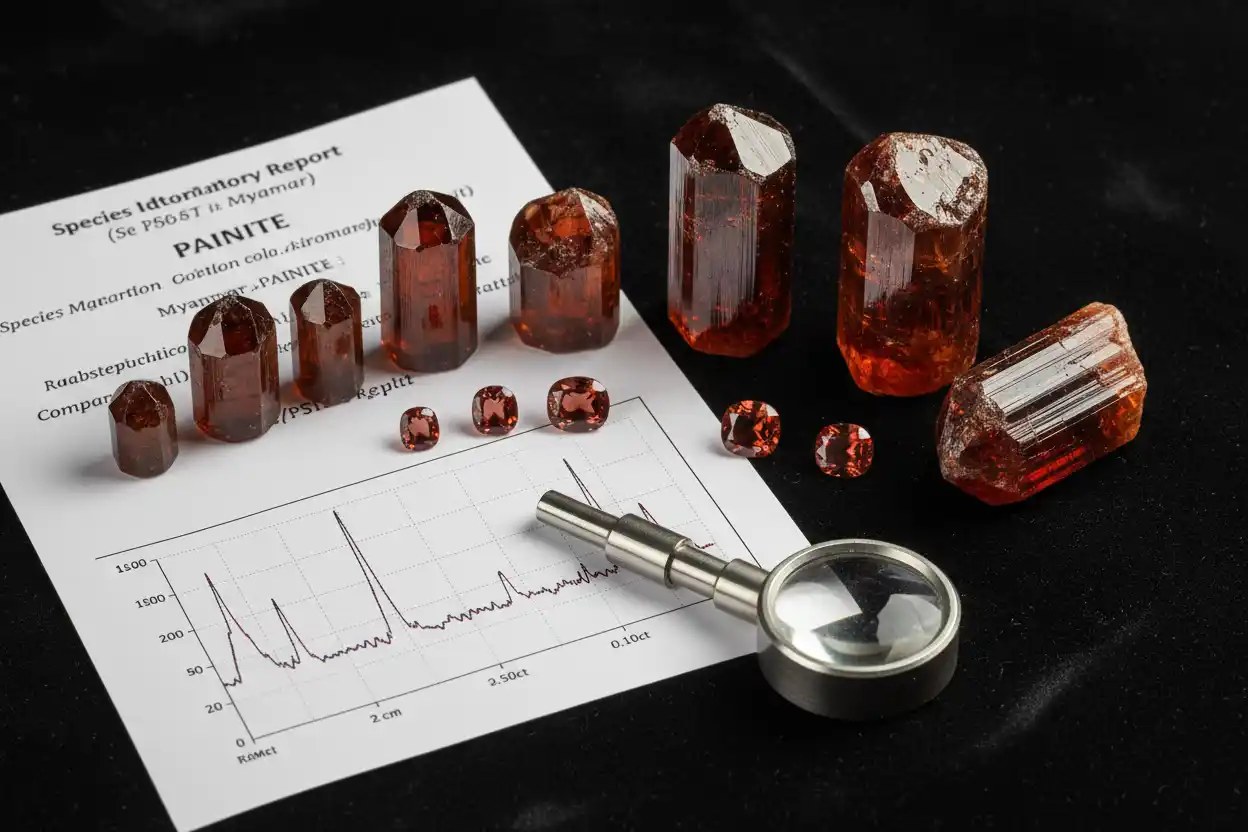
Painite Price: Quality & Value, Rarity, Demand & Treatments
Painite price is unusually difficult to summarize because the market is small, quality varies sharply, and public transactions are limited. Current retail asking prices reviewed for this article range from about $1,128 per carat for a certified 0.39-carat Mogok stone to approximately $10,000 per carat for two other current verified-seller examples. A 0.77-carat stone is currently offered near $5,195 per carat.
Those current listings sit between very different reference points. A 1.07-carat Painite sold at Bonhams in 2022 for $3,570 including premium, equal to about $3,336 per carat. At the high end, current secondary market research citing GemGuide places fine faceted Painite around $50,000 to $60,000 or more per carat. These figures describe different quality tiers and should never be averaged into one universal number.
Current Painite Price Benchmarks
The strongest way to understand the market is to separate current asking prices from realized auction results and high-end guide estimates.
| Price evidence | Weight or tier | Total or quoted price | Approx. price per carat |
|---|---|---|---|
| Current certified Mogok listing | 0.39 ct | $440 | $1,128 |
| Bonhams realized sale, 2022 | 1.07 ct | $3,570 | $3,336 |
| Current Myanmar listing | 0.77 ct | $4,000 | $5,195 |
| Current Burma listing | 0.24 ct | $2,400 | $10,000 |
| Current Burma listing | 0.54 ct | $5,400 | $10,000 |
| Fine faceted high-end guide estimate | Top quality | Not a single listing | About $50,000 to $60,000+ |
The Painite price per carat therefore depends heavily on what kind of evidence you are using. An active seller’s asking price, a completed auction result, and a high-end wholesale guide are not the same thing.
Historical Rarity Still Influences Price
Painite became famous when only a handful of specimens were known. GIA reported that for years only two crystals were recognized, with a third discovered later.
That scarcity story changed after major discoveries beginning around 2001 and accelerating in 2005. More than a thousand crystals and fragments were recovered from Myanmar deposits, although only a small fraction were suitable for faceting.
This shift explains an important pricing fact: Painite remains rare, but the old assumption that almost no specimens exist is no longer accurate.
The strongest premiums now belong more logically to fine transparent cut stones, larger gems, unusual specimens, and well-documented examples rather than every piece carrying the Painite name.
Gem Quality Is Much Rarer Than Rough Painite
Raw crystal abundance and faceted gem abundance are different questions.
GIA’s report on the newer Myanmar discoveries noted that most of more than 167 known faceted stones in one dataset were only about 0.05 to 0.30 carats. That means clean usable rough was still scarce even after new deposits were found.
Poor transparency, fractures, dark tone, and unsuitable crystal portions reduce cutting yield.
As a result, a small bright faceted gem can command far more per carat than a larger rough specimen that cannot produce an attractive cut stone.
Transparency Can Create Large Price Differences
Current retail evidence illustrates how inconsistent pricing becomes once clarity changes.
A current 0.39-carat certified Mogok Painite with good reported transparency is listed at $440, approximately $1,128 per carat. Meanwhile, other current included faceted stones are offered near $5,000 to $10,000 per carat.
This does not mean clarity has no effect. It means seller strategy, rarity claims, documentation, inventory position, cutting, and market expectations can create very different asking prices.
The Painite quality grading is therefore more useful than assuming every clearer stone must appear at a fixed premium.
Color Affects Demand, but There Is No Mature Price Grid
Painite commonly appears red, orangy red, brownish red, burgundy, or dark red-brown.
Collectors generally prefer stones whose color remains visible face-up rather than gems that appear nearly black until strongly backlit.
Strong attractive red or red-orange color can therefore support a premium, especially when the stone is also transparent.
However, the Painite market is too thin to support a reliable published table such as deep red equals one rate and brown-red equals another. Individual comparison remains essential.
Size Can Produce Nonlinear Pricing
Fine Painite above 1 carat is much more difficult to replace than small sub-carat examples.
GIA’s historical report documented that most faceted gems were very small, although examples up to 1.32 carats and a reported 2.02-carat stone had been cut.
That distribution explains why high-quality large stones can move into a completely different value category.
Still, a 1-carat included dark gem should not automatically receive a major size premium. Size only becomes powerful when desirable color, transparency, cutting, and condition remain strong.
Asking Prices Can Be Much Higher Than Realized Prices
A current listing around $10,000 per carat shows what one seller is willing to ask. The Bonhams 2022 result around $3,336 per carat shows what one buyer actually paid for a specific auction stone.
Neither figure invalidates the other.
Auctions involve competition, timing, provenance, condition, reserve structure, and buyer interest. Retail listings include seller margin, carrying cost, negotiation room, and inventory strategy.
This is why buy Painite decisions should compare both completed-sale evidence and active asking prices when possible.
The $50,000 to $60,000 Figure Describes the Top End
Painite is often quoted online at $50,000 to $60,000 per carat.
Current research tracing that figure to GemGuide and other rare-gem commentary places it in the fine faceted or exceptional top-quality category. It should not be treated as a normal rate for every red-brown Painite.
The gap between roughly $3,336 per carat at a documented auction and $50,000 or more for top-end quoted gems can be explained only by major differences in quality, rarity, size, transparency, and market setting.
Repeating the highest figure without these qualifiers exaggerates ordinary value.
Treatment Is Not the Main Price Driver
Painite does not have a mature treatment hierarchy comparable with ruby, sapphire, emerald, or some forms of opal.
Current listings frequently state no treatment, and the available gemological literature does not describe routine large-scale enhancement as a defining feature of the Painite market.
That means color, transparency, size, cut, condition, provenance, and identity usually have much greater pricing importance.
A treatment claim still needs proper disclosure if applicable. No treatment should not be assumed simply because Painite is rare.
Provenance Can Add Collector Appeal
Myanmar, especially the Mogok region, dominates Painite history.
Documented localities include areas around Mogok such as Wetloo and Thurein-taung, while other Painite occurrences have been reported elsewhere in Myanmar.
A credible locality history can make a specimen more interesting to collectors, particularly when it connects the gem with a known deposit or older discovery period.
Provenance becomes most valuable when it is documented. A country name copied into a marketplace title carries much less weight than a traceable collection record or respected report.
Cut Quality Matters More Than Rarity Headlines Suggest
Painite is rare enough that cutters may preserve weight aggressively. This can lead to deep or irregular cuts.
Even so, brilliance, symmetry, polish, windowing, face-up size, and darkness all affect what buyers are willing to pay.
A 0.50-carat Painite with a lively face-up appearance can be more desirable than a heavier gem that looks black and dull.
Carat weight should therefore be read alongside actual millimeter dimensions and photographs.
Condition Can Reduce Value Quickly
Chipped corners, abraded facet edges, surface-reaching fractures, and scratches matter because replacement stones are difficult to find.
A damaged Painite can still be scientifically or historically interesting, but jewelry and collector pricing should reflect the condition.
Mounted stones deserve particularly careful inspection because prongs may conceal edge damage.
If a stone is expensive, request photographs before mounting and keep them with the purchase records.
Certification Can Affect Market Confidence
A laboratory report does not create beauty or rarity, but it can reduce uncertainty.
That has economic importance in a market where Painite’s name itself carries a strong premium. A future buyer may be much more comfortable with a stone whose identity has already been established by a recognized laboratory.
Reports should match the exact weight, dimensions, and shape.
Seller-issued cards can provide useful records, but they should not be treated automatically as equivalent to independent gemological identification.
Demand Is Stronger Among Collectors Than Mainstream Jewelry Buyers
Painite has name recognition among rare-gem collectors but remains unfamiliar to many ordinary jewelry buyers.
This limited audience creates an unusual market. Extreme rarity can support high asking prices while resale liquidity remains modest because only a small number of buyers actively seek the species.
A dealer may therefore offer much less than a retail listing suggests, even when the gem is genuine.
Rarity does not guarantee rapid resale.
Retail and Resale Value Can Be Very Different
The current $440, $2,400, $4,000, and $5,400 listings are seller asking prices. A future dealer offer may be substantially lower.
The same is true of top-end guide estimates. A stated $50,000-per-carat high-end benchmark does not mean a private owner can immediately find a buyer at that price.
Auction timing, documentation, provenance, condition, and collector demand all affect realized value.
Insurance replacement figures, retail asks, wholesale quotes, auction results, and dealer cash offers should be treated as separate valuation contexts.
Symbolic Interest Does Not Set Price
The Painite meaning may include modern associations with transformation, rarity, perseverance, or discovery. These interpretations can add personal significance but do not create a recognized commercial grade.
The Painite benefits discussed in personal traditions are also separate from gemstone valuation. Price should remain tied to identity, color, transparency, clarity, size, cut, condition, provenance, documentation, and collector demand.
FAQs
How much is Painite worth per carat?
Current examples reviewed here range from about $1,128 to $10,000 per carat in active retail listings. A documented 2022 Bonhams sale realized about $3,336 per carat.
Can Painite really cost $60,000 per carat?
Yes, high-end guide estimates place exceptional fine faceted Painite around $50,000 to $60,000 or more per carat. That is not a normal price for every Painite.
Why is there such a large price range?
Transparency, color, size, cutting, documentation, provenance, seller positioning, and market setting can vary enormously.
Is Painite still extremely rare?
Fine faceted Painite remains very scarce, although far more rough specimens are known today than before the major Myanmar discoveries of the early 2000s.
Does large Painite cost more per carat?
It can when the stone remains transparent, attractive, well cut, and well documented. Large included or dark stones may not receive the same premium.
What color Painite is most valuable?
There is no standardized universal scale, but transparent attractive red to red-orange examples generally draw more interest than very dark stones with weak face-up color.
Is untreated Painite worth more?
Treatment is not a dominant feature of the current Painite market. Identity, transparency, color, size, and quality usually matter more.
Does Mogok origin add value?
Documented Mogok provenance can add collector appeal because the area is central to Painite’s discovery and mining history.
Is a current asking price the same as market value?
No. Asking prices show seller expectations. Completed auction results provide a different form of evidence.
Does Painite have strong resale value?
Resale can be difficult because the buyer pool is small. High rarity does not guarantee liquidity or recovery of the original retail price.
Conclusion
Painite price spans a very wide market because each high-quality stone is difficult to compare. Current active listings reviewed here range from about $1,100 to $10,000 per carat, while a documented 2022 auction result was about $3,336 per carat and high-end guide estimates for exceptional gems reach roughly $50,000 to $60,000 or more. Verified identity, transparency, color, size, cut, condition, provenance, and documentation determine where an individual stone belongs within that range.
Current asking prices, auction results, and high-end estimates are reference points only. Actual transaction, appraisal, dealer-buy, and resale values can differ.