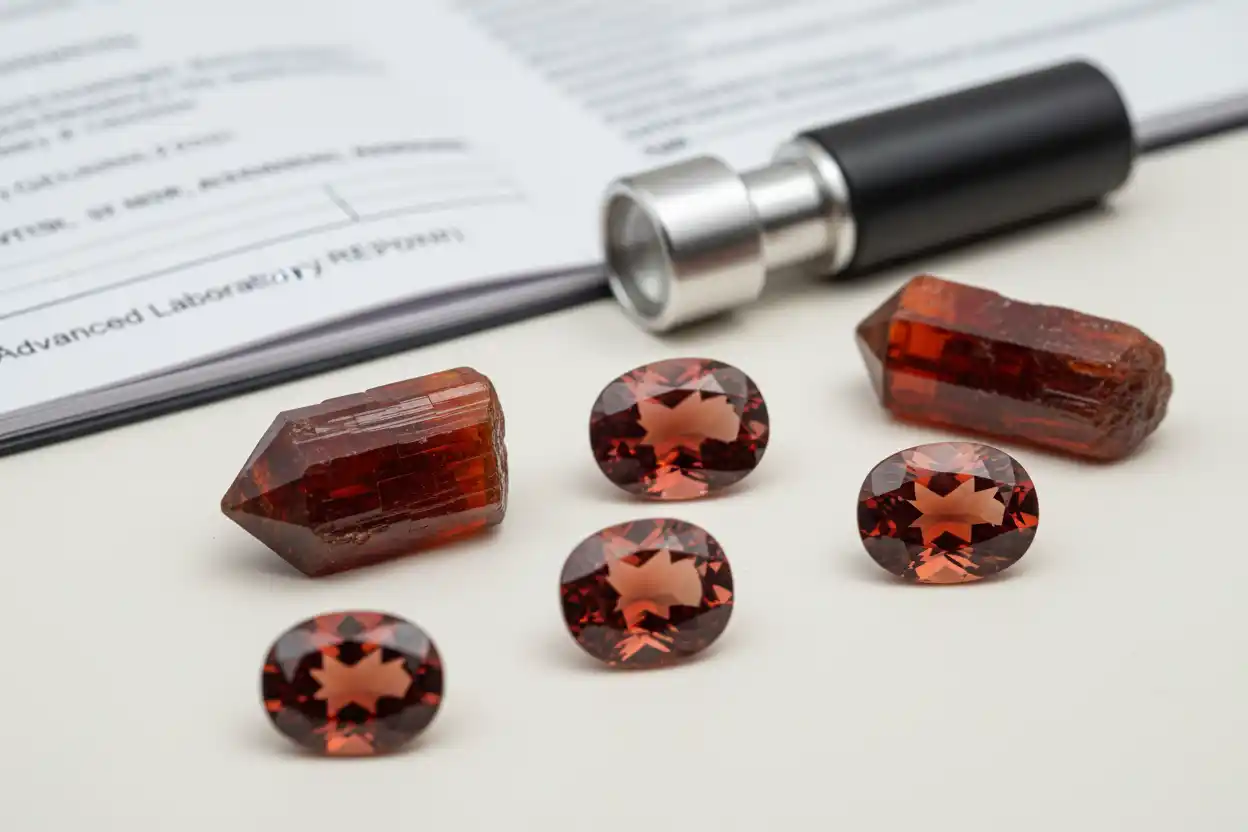
Buy Painite: Buyer Checks, Provenance, Treatments & Returns
To buy painite responsibly, make confirmed mineral identity the first requirement because rarity is responsible for much of the stone’s collector premium and an attractive reddish-brown gem that merely resembles painite cannot inherit that value. Painite is a valid rare borate mineral with the ideal formula CaZrAl₉O₁₅(BO₃), typically occurring in red, brownish, and orange-red colors, with Mohs hardness around 8, measured density approximately 4.01–4.03, and a hexagonal crystal system. Its type locality is Ohngaing in Myanmar’s famous Mogok gem region, and additional confirmed occurrences are concentrated around the Mogok Stone Tract.
Painite’s legendary reputation originated when only a tiny number of crystals were known, but later discoveries in Myanmar expanded the number of specimens available substantially. That historical change is important because old descriptions calling painite essentially unobtainable should not be converted automatically into modern retail price claims. GIA’s reporting on Mogok still identifies painite among the region’s rare collector minerals, while documented occurrences now include Ohngaing, Wet-loo, Kyauk-Pyat-That, Baw-lon-gyi, Hinthar-taung, Myan Gyi, and other Mogok-area localities.
Buy Painite At a Glance
| Buying Factor | What to Check | Why It Matters |
|---|---|---|
| Identity | Independent confirmation that the stone is painite | Rarity premium is meaningless without correct species identification |
| Formula/Species | Natural painite rather than another red-brown gem | Similar appearance alone cannot establish mineral identity |
| Color | Attractive red, orange-red, reddish brown, or brownish red | Color affects beauty and collector demand |
| Transparency | Transparent faceting material versus translucent crystal | Transparent gem material generally has stronger jewelry appeal |
| Clarity | Fractures, feathers, crystals, clouds, surface-reaching features | Inclusions influence beauty, durability, and collector interest |
| Cut | Brilliance, symmetry, polish, windowing, extinction | Rare rough can still be cut poorly |
| Carat Weight | Weight considered with quality and authenticity | Larger genuine faceted stones can be more selective |
| Natural Crystal Form | Complete crystal, terminations, surface preservation | Mineral collectors value natural morphology differently from faceted gems |
| Mogok Provenance | Specific locality records where credible | Locality can add scientific and collector significance |
| Treatment | Disclosure of any known heat, filling, coating, or other modification | Routine treatment should not be assumed present or impossible |
| Report | Laboratory capable of reliable rare-gem identification | Seller cards are weaker than independent analytical evidence |
| Condition | Chips, abrasions, fractures, repaired damage | Damage matters strongly in a difficult-to-replace gem |
| Seller Grade | Ignore undefined AAA/AAAA labels | No universal painite commercial grading scale exists |
| Return Policy | Inspection period long enough for independent verification | Rare-gem purchases should allow authentication |
| Resale Context | Specialist collector demand | Rarity does not guarantee immediate liquidity |
Painite Is a Distinct Mineral Species
Painite is not a ruby variety, garnet, spinel, sapphire, or tourmaline despite overlapping reddish and brownish colors. Mindat lists painite as a valid mineral species with an IMA formula based on calcium, zirconium, aluminum, boron, and oxygen and places it within the hexagonal crystal system. The mineral’s high density and refractive properties also differ from many visually similar gems, but these characteristics should be used by trained gemologists rather than treated as simple home-authentication tests.
This species-level distinction is economically essential because the buyer is paying partly for mineralogical scarcity. A beautiful red spinel or garnet can be more attractive than an individual painite and may even have greater mainstream market value, yet it cannot be sold as painite merely because the colors overlap. The first question should therefore be “What is this stone?” before the buyer asks how rare its color, size, or source may be.
The Type Locality Is in the Mogok Region
Mindat identifies Ohngaing in the Mogok Valley of Myanmar as painite’s type locality, while confirmed records extend through several nearby gem districts including Kyauk-Pyat-That, Wet-loo, Hinthar-taung, Baw-lon-gyi, and Myan Gyi. Several of these occurrences are associated with corundum, including ruby, reflecting the remarkable mineral diversity of the Mogok Stone Tract.
GIA likewise identifies Mogok as home to rare collector minerals including painite, reinforcing the region’s importance in the gem’s history. A credible specific locality can add collector interest, particularly for natural crystals accompanied by old specimen labels or mine records, but locality should not replace species identification. A seller’s claim that a reddish stone came from Mogok does not prove that it is painite because the same region produces ruby, spinel, sapphire, garnet, zircon, scapolite, and many other minerals.
Painite Is Rare, but Old Rarity Claims Need Context
Painite became famous because only a few specimens were known for decades after its discovery, creating an enduring reputation as one of the world’s rarest gemstones. Later finds in Myanmar changed the supply picture by bringing additional crystals and facetable material into circulation, although painite remains an uncommon collector species rather than a mass-market gemstone. GIA’s modern field reporting still treats painite as one of Mogok’s noteworthy rare minerals rather than as a routine jewelry stone.
The buyer should therefore avoid two opposite errors. Painite should not be dismissed as common simply because more material has been discovered, but sellers should not quote an obsolete “only two stones exist” narrative as though it describes the present market. Current value depends on the individual specimen’s identity, beauty, size, transparency, condition, provenance, and market demand rather than on an old headline repeated without context.
Color Usually Ranges Through Red and Brownish Tones
Modern mineral references describe painite in red, brownish, and orange-red colors, while gem references also note deep garnet-red material and strong dichroism that can shift appearance between yellow-brown and red to brown-violet directions. These colors can be attractive but are generally subtler than the vivid pigeon-blood reds associated with fine ruby or the brilliant scarlets of some spinels.
A buyer should evaluate the stone in neutral lighting because dark red-brown gems can become nearly black under weak illumination. Pleochroism can also make the hue change with orientation, meaning two stones cut from similar rough may show noticeably different face-up color depending on how the cutter positioned the crystal.
Brightness Matters More Than a Dramatic Color Name
Retail descriptions such as blood red, cognac, mahogany, garnet red, ruby red, or collector red are not standardized painite grades. The useful questions are whether the stone remains visibly colored rather than blackish face-up, whether the hue is attractive in ordinary light, how strongly brown modifies the red, and whether the cut returns enough light to prevent the gem from appearing dead.
A medium-dark orange-red stone with lively brilliance can therefore be a stronger purchase than a nominally deeper-red stone that looks opaque or heavily extinct. Color must be judged in combination with transparency and cutting rather than from seller terminology alone.
Transparent Facetable Painite Occupies a Different Market From Mineral Specimens
Painite exists both as natural collector crystals and as fashioned gemstones, and those categories follow different value priorities. A natural crystal can be desirable because of complete shape, terminations, associated minerals, surface preservation, locality, and specimen aesthetics even when it is too included to facet. A transparent cut stone sacrifices the original crystal morphology and is valued instead for color, clarity, brilliance, cutting, weight, and documentation.
Buyers should decide which category they want before comparing prices. A magnificent matrix specimen with ruby association cannot be evaluated reasonably against a clean faceted painite on a dollars-per-carat basis because one is primarily a mineralogical collectible and the other is a gemstone.
Clarity Needs Realistic Expectations
Painite can show feather-like inclusions, hexagonal crystals, fractures, and other internal features, while gem references describe transparent material suitable for faceting. Because painite is rare, buyers may tolerate more inclusions than they would in abundant transparent gems, but rarity should not erase the effect those inclusions have on beauty and durability.
A small internal crystal that remains invisible without magnification can have little commercial consequence, while a large central fracture or dense cloud can suppress brilliance considerably. Surface-reaching cracks deserve particular attention because they can create structural risks during setting or future wear.
Painite Has Useful Hardness but Should Still Be Protected
Painite has Mohs hardness around 8, placing it above quartz and below corundum in scratch resistance. That hardness makes faceted painite physically capable of jewelry use, but replacement difficulty changes the practical risk calculation because a damaged rare collector stone may be extremely difficult to match.
Pendants, earrings, and protected ring settings reduce exposure to impact, while high-set rings and sharp exposed corners increase risk. Hardness should also not be confused with toughness: a hard gemstone can still chip or fracture along a pre-existing fissure if struck sharply.
Cut Quality Can Add or Destroy Face-Up Value
Rare rough often encourages cutters to retain every possible fraction of a carat, but weight preservation can produce deep pavilions, narrow face-up dimensions, windows, asymmetry, or excessive extinction. A larger badly cut painite may therefore look less impressive than a smaller gem whose proportions allow the red-orange color to remain bright.
Compare dimensions with weight and examine the gemstone from normal viewing distance. A very deep stone may carry hidden weight that contributes little to visible presence, while a shallow stone can develop a transparent window through the center.
The best cut balances scarcity-conscious yield with beauty rather than maximizing weight at any cost.
Larger Confirmed Faceted Painite Can Be More Selective
Size can matter strongly because gem-quality transparent rough is not abundant, but no universal threshold converts every painite above one or two carats into a fixed premium category. A larger stone whose color becomes almost black, whose pavilion is excessively deep, or whose fractures dominate the face may be less compelling than a smaller lively gem.
The important word is confirmed. An undocumented large reddish stone should not receive a painite size premium until identification has been established independently.
A thin market also means that individual large stones may have few close comparables, making expert appraisal more useful than generic online price charts.
Provenance Can Add Collector Value
A painite accompanied by a credible old Mogok collection label, mine record, institutional history, or documented chain of ownership can appeal strongly to specialist collectors. Specific locality information may also distinguish specimens from type-locality material or later discoveries elsewhere in the Mogok region.
Provenance should be proportional to the claim. A handwritten card created recently by the seller is less persuasive than an old collection label supported by acquisition records, and “Myanmar” is broader than a specific verified mine or collecting site.
The provenance premium should never survive a failed species identification. A stone documented as coming from Mogok can still be another mineral.
Treatment Is Not the Defining Painite Market Story
The authoritative painite sources reviewed for this guide focus primarily on mineral identification, chemistry, physical properties, localities, and rarity rather than on a standardized commercial treatment industry. That makes routine treatment unlike sapphire heating or jade impregnation, where enhancement is central to market classification. The absence of a widely documented routine treatment market should nevertheless not be converted into an absolute statement that painite can never be treated or modified.
GIA’s general treatment guidance emphasizes that known treatments affecting color, clarity, or durability should be disclosed and that some gem treatments require expert testing to detect. A valuable painite purchase should therefore include an explicit treatment statement from the seller and appropriate laboratory examination rather than a blanket “painite is always untreated” claim.
Independent Identification Is More Useful Than a Seller Certificate
A rare-gem certificate is only as useful as the laboratory or expert issuing it. A seller-generated document may record weight and description accurately but remains financially interested in the transaction, while an independent gemological laboratory provides stronger separation between sales and identification.
A useful report should identify the material clearly and record weight, measurements, color, shape, and other relevant observations. If the stone is exceptionally valuable, the buyer should choose a laboratory with experience in unusual mineral species rather than relying solely on equipment designed for common diamonds and major colored stones.
AAA Painite Is Not a Universal Grade
There is no widely recognized standardized AAA, AAAA, 5A, museum grade, or investment-grade painite system. Those labels can function as seller shorthand, but they should be translated into actual characteristics before comparison.
Ask for exact weight, dimensions, face-up color, transparency, clarity, cut, condition, provenance, laboratory identity, and treatment disclosure. A detailed stone with no exaggerated grade can be easier to value than a vaguely described “AAAA collector painite” whose documentation provides little mineralogical evidence.
Painite Versus Musgravite
Painite and musgravite both occupy ultra-rare collector markets, but their identification problems and mineralogy differ. Gems Lore’s buy musgravite guide explains why musgravite can require advanced separation from closely related taaffeite, while the musgravite price guide emphasizes thin-market valuation.
Painite has its own distinctive chemistry, Mogok history, red-brown color range, and supply development. One rarity should not be priced by copying another rare gemstone’s per-carat asking price.
Painite Versus Jeremejevite
The Gems Lore buy jeremejevite guide and jeremejevite price guide cover another collector stone whose limited supply, unusual chemistry, documentation, and thin market make generic price tables unreliable.
Painite typically occupies reddish-brown to orange-red colors, whereas jeremejevite can occur colorless, yellowish, or blue. Their rarity narratives overlap culturally, but their optical character and buyer bases differ.
A collector should therefore compare quality within the same species before comparing relative rarity across species.
Painite Versus Ruby
Painite has been found in close geological association with ruby in the Mogok area, and some painite localities list corundum as an associated mineral. Yet rarity does not mean painite should automatically be worth more than fine ruby. Ruby has far deeper global jewelry demand, more established auction history, and a broader luxury market.
Gems Lore’s buy ruby guide is therefore not a painite valuation template. Species rarity and market value are separate concepts.
Common Red Flags When You Buy Painite
Major warning signs include a high-value stone with no independent identification, outdated claims that only a handful of painites exist today, a seller identifying the stone solely from reddish-brown color, unsupported Mogok mine stories, enormous size combined with suspiciously low price, obvious windowing hidden by dark photography, fractures omitted from listing photographs, AAAA presented as an official laboratory grade, vague treatment-free guarantees, or an appraisal used as proof of immediate resale value. Painite is genuinely rare enough that documentation should become stronger—not weaker—as the asking price increases.
How to Compare Painite Listings Fairly
Compare only stones with credible identity confirmation, then align natural crystal versus faceted form, weight, dimensions, hue, tone, transparency, visible clarity, inclusions, cut, condition, locality evidence, provenance, treatment disclosure, laboratory issuer, seller reputation, return terms, and transaction type. A natural matrix crystal, one-carat transparent faceted gem, heavily included large crystal, and undocumented reddish glassy stone cannot be combined into one meaningful painite price-per-carat category.
Conclusion
To buy painite well, treat rarity as something that must be documented rather than merely advertised. Painite is a valid calcium-zirconium-aluminum borate mineral with a hexagonal crystal system, Mohs hardness around 8, high density near 4.0, and a typical red-to-brownish-orange color range. Its historical and modern occurrence is closely tied to Myanmar’s Mogok Stone Tract, with the type locality at Ohngaing and additional confirmed sites around the district.
Its supply is greater than the earliest rarity stories suggest, yet gem-quality transparent material remains unusual enough to attract specialist collectors. The strongest purchase combines independent identity confirmation, attractive color, useful transparency, manageable inclusions, competent cutting, appropriate size, sound condition, credible provenance, and a seller who allows adequate verification.
A buyer who separates historical rarity mythology from current gemological evidence will be far better equipped to judge painite than someone purchasing the word “rarest” alone.
Frequently Asked Questions
Is painite really one of the rarest gemstones?
Painite remains an unusually rare collector mineral, although more specimens are known today than during the decades when only a few examples had been documented. GIA still identifies painite among Mogok’s rare collector minerals.
What color is natural painite?
Mindat describes painite as red, brownish, and orange-red, while gem references also describe deep garnet-red material and strong red-brown pleochroism.
Where does painite come from?
The type locality is Ohngaing in the Mogok Valley of Myanmar, with additional confirmed occurrences across nearby Mogok-area localities.
What is painite made of?
Painite is a calcium-zirconium-aluminum borate with the ideal IMA formula CaZrAl₉O₁₅(BO₃).
How hard is painite?
Painite has Mohs hardness around 8, giving it good scratch resistance for a collector gemstone.
Can painite be worn in jewelry?
Yes, its hardness is suitable for jewelry, but valuable stones should still be protected from sharp impacts and existing fractures because exact replacements can be difficult to source.
Is dark red painite automatically more valuable?
No. Attractive hue matters, but excessive darkness can produce extinction and make a gem appear nearly black. Transparency, brilliance, cut, clarity, size, and documentation also influence value.
Is every Mogok reddish gem painite?
No. Mogok produces ruby, sapphire, spinel, garnet, zircon, and many other minerals alongside painite. Provenance cannot replace species identification.
Is painite commonly treated?
Routine treatment is not a defining feature of the authoritative painite literature reviewed here, but buyers should still require disclosure of any known treatment rather than assuming treatment is impossible.
Does painite have an official AAA grade?
No universal laboratory AAA or AAAA painite scale exists. Evaluate identity, color, transparency, clarity, cut, size, condition, provenance, and treatment instead.
Do I need a laboratory report for painite?
A meaningful rarity premium should be supported by credible independent identification, particularly when the stone is expensive. The rarer the claimed gem, the less sensible it is to rely only on seller opinion.
Does larger painite always cost more?
Larger confirmed gem-quality material can be more selective, but poor color, heavy inclusions, weak cutting, damage, or uncertain identity can outweigh size.
Is painite a guaranteed investment?
No. Genuine rarity can support collector demand, but resale depends on authentication, beauty, size, provenance, market recognition, transaction costs, and finding a specialist buyer.