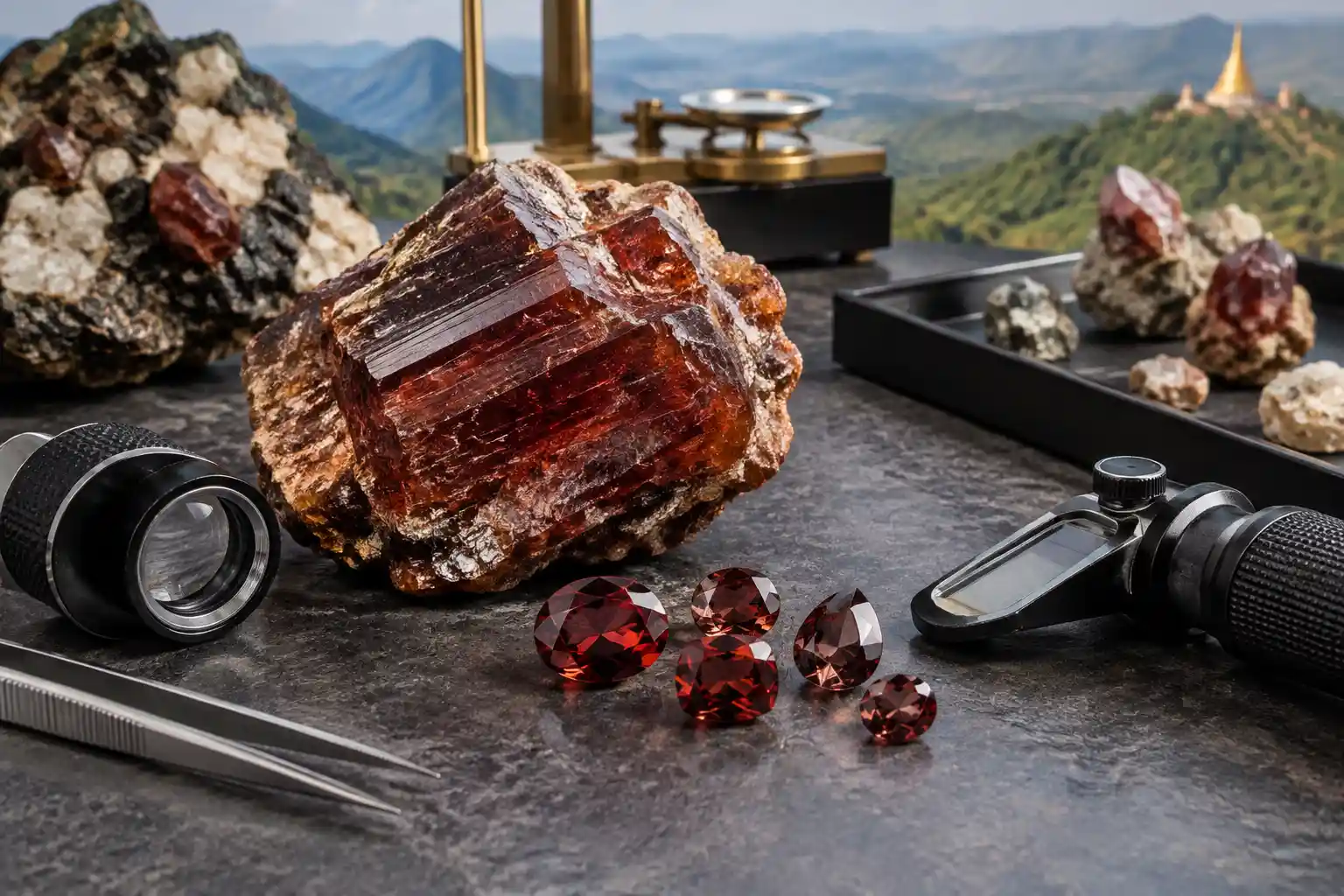
Painite Benefits: 7 Popular Uses, Gentle Symbolism & Verified Facts, Safe Limits
Painite benefits begin with one of mineralogy’s most remarkable rarity stories. Painite is a borate mineral with the formula CaZrAl₉(BO₃)O₁₅, containing calcium, zirconium, aluminum, boron, and oxygen. It crystallizes in the hexagonal system, commonly appears red, brownish red, or orange-red, and has a Mohs hardness around 8, making transparent specimens physically suitable for faceting and jewelry when their extreme collector importance is considered.
The mineral was recognized in Myanmar in the early 1950s after British gemologist and mineralogist Arthur Charles Davy Pain encountered unusual crystals from the Mogok region. Painite was subsequently named in his honor. For decades only a tiny number of crystals were known, giving the mineral an extraordinary reputation for rarity. Additional discoveries in Myanmar during the early twenty-first century increased the known supply substantially, although transparent gem-quality Painite remains highly unusual.
Real Painite benefits therefore include rare-mineral collecting, scientific study, gemological identification, provenance research, faceting, jewelry use, and a fascinating lesson in how apparent rarity can change when new deposits are found. Modern symbolism involving discovery, patience, persistence, rarity, and individuality can add personal value, but Painite has no credible ancient named healing tradition because its mineral identity was established only in modern times.
7 Painite Benefits at a Glance
- Exceptional rarity gives Painite major appeal to specialist mineral and gemstone collectors.
- Mohs hardness around 8 provides good resistance to ordinary scratching in transparent gem-quality stones.
- Complex borate chemistry offers substantial mineralogical and educational value.
- Myanmar origin and Mogok discovery history give documented specimens strong geographic context.
- Facetable crystals can produce rare red to brownish-red gemstones with genuine jewelry potential.
- Modern symbolism can connect Painite with discovery, persistence, individuality, and appreciation of difficult-to-find things.
- Professional identification and provenance protect buyers from misidentification, exaggerated scarcity claims, and unjustified price premiums.
Exceptional Rarity Is the Most Famous Painite Benefit
Rarity dominates almost every discussion of Painite benefits because the mineral spent decades known from extraordinarily few specimens. This historical situation made Painite famous among gemologists and rare-mineral collectors long before most jewelry buyers had heard of it.
The picture later changed when additional occurrences were discovered around Myanmar’s Mogok region. More crystals became available, meaning older statements implying that only two or three Painites exist are no longer accurate.
This change provides an important lesson about rarity itself. A mineral can genuinely be exceptionally scarce in known collections while additional geological sources remain undiscovered. New mining and better recognition can alter the market without changing the underlying mineral species.
Gem-quality scarcity remains significant. Many Painite crystals are small, included, opaque, translucent, fractured, or unsuitable for faceting. Transparent stones with attractive color, usable size, and reliable documentation occupy a much narrower segment.
For collectors, rarity therefore needs to be described precisely rather than through outdated superlatives.
Painite Chemistry Makes the Mineral Scientifically Distinctive
Painite benefits include substantial educational value because its chemistry differs from many familiar jewelry gems. Its formula includes calcium, zirconium, aluminum, boron, and oxygen, placing it among complex borate minerals.
The mineral has been reported in red, brownish, orange-red, and related hues. Trace chromium, vanadium, iron, and related compositional variations can influence color.
Painite’s hexagonal crystal system and high specific gravity also contribute to identification. Its density is much greater than that of quartz or beryl, and the combination of optical, chemical, structural, and physical properties helps distinguish it from visually similar reddish stones.
For students of mineralogy, Painite demonstrates why gemstone appearance alone can be misleading. Several completely different minerals can be red or brown, while accurate identification depends on a combination of measurable properties.
Mohs Hardness 8 Gives Gem-Quality Painite Useful Durability
Painite has hardness around 8 on the Mohs scale, providing one of the most practical Painite benefits for transparent stones suitable for jewelry.
This hardness places Painite above quartz and beryl in scratch resistance, though below sapphire and diamond. A well-cut stone can therefore preserve polished facets reasonably well during careful wear.
Rarity may matter more than hardness when choosing a setting. Even if a Painite can physically tolerate jewelry use, an important collector gem may be difficult to replace if chipped or lost.
Pendants and earrings offer relatively protected options, while rings require a secure setting and thoughtful wear. Exposed corners, thin girdles, and projecting points should be protected from severe impact.
The question is therefore not simply whether Painite is hard enough for jewelry. It is whether the owner wants to expose a scarce, documented specimen to the risks of frequent wear.
Myanmar Provenance Gives Painite Strong Collector Context
Painite is closely associated with Myanmar, especially the Mogok region, one of the world’s most famous gem-producing areas. The type locality and later discoveries give the mineral a strong geographic identity.
Mogok is already known for ruby, sapphire, spinel, and numerous other minerals, so Painite adds another unusual species to an exceptionally diverse geological environment.
For collectors, documented locality can increase scientific and historical interest. A specimen accompanied by credible information about the mine, recovery area, previous collection, or laboratory identification preserves context that may otherwise disappear.
The history behind Painite price is also closely connected with scarcity and provenance. A confirmed faceted stone with good transparency and documentation belongs to a very different market from a small opaque crystal fragment with uncertain identification.
Geographic stories should still be supported by evidence. A reddish crystal cannot be assigned confidently to Mogok merely because the color resembles known Painite.
Faceted Painite Gives Rare-Gem Jewelry Genuine Individuality
Transparent Painite can be faceted into attractive red, orange-red, brownish-red, or deep reddish gems. Finished stones may show vitreous luster and a subdued but distinctive appearance.
The visual effect is often less immediately dramatic than ruby, spinel, or brightly colored sapphire. Painite’s appeal comes primarily from mineralogical identity and rarity rather than from competing for maximum saturation or brilliance.
This makes Painite jewelry highly individual. Someone choosing the stone may be interested in geology or collecting rather than following traditional engagement-ring conventions.
Anyone planning to buy Painite should place identification ahead of novelty. Rarity makes laboratory confirmation more important, not less, because an incorrect identity can change the value proposition completely.
A modest-looking stone with strong documentation may be much more meaningful to a specialist than a larger, more vivid gem whose identity is uncertain.
Painite Benefits Collectors More Than the Average Jewelry Buyer
Collector appeal is probably the most important real-world use among Painite benefits. Mineral enthusiasts may seek crystals showing natural faces, documented locality, associated minerals, unusual transparency, or historically significant provenance.
A collector specimen and a faceted gemstone should not be evaluated by identical criteria. Natural crystal form may be more important than clarity in a mineral collection, while transparent rough is necessary for successful faceting.
Specimens associated with significant discoveries can also preserve part of mineralogical history. Older labels, laboratory reports, collection notes, and photographs may increase contextual value even when the crystal itself is small.
This illustrates why weight alone is a poor measure of significance. A tiny crystal with exceptional provenance can be more scientifically interesting than a heavier specimen lacking reliable locality information.
Painite’s Rarity Story Makes Discovery a Natural Symbol
Modern symbolism is one of the gentler Painite benefits. Because the mineral was scientifically recognized only in the twentieth century and additional deposits were discovered much later, themes of discovery, persistence, curiosity, and looking beyond first impressions fit naturally.
Someone completing a long research project may use Painite as a symbol of patience. A geologist may value it as a reminder that important discoveries can remain hidden despite decades of investigation.
Individuality is another intuitive theme because Painite remains uncommon in ordinary jewelry. Choosing it can represent appreciation for unusual paths rather than following familiar categories.
The future Painite meaning can therefore be built around real discovery history without claiming that ancient civilizations recognized the mineral under its modern name.
Painite Identification Requires More Than Color
A reddish-brown stone should never be identified as Painite simply because its color looks similar. Ruby, spinel, garnet, zircon, tourmaline, and several other minerals can overlap visually.
Professional testing may include refractive index, specific gravity, spectroscopy, microscopic examination, and advanced analytical techniques when necessary. For an important rare gem, a reputable laboratory report can be essential.
This is especially relevant because Painite’s historical reputation creates marketing opportunities. Sellers may repeat outdated rarity claims or attach the name to insufficiently tested specimens.
The safest approach is to treat extraordinary identity and provenance claims as questions requiring documentation. Rarity should increase scrutiny rather than reduce it.
Painite Is Not an Ancient Healing Crystal
Painite benefits are sometimes expanded online into chakra healing, emotional transformation, physical vitality, pain reduction, detoxification, or other wellness claims.
The historical problem is immediate. Painite was recognized as a distinct mineral only in modern mineralogy, so claims of a named ancient Painite healing tradition are not credible without extraordinary evidence.
There is also no established scientific evidence that wearing the mineral treats physical or mental-health conditions. Calcium, zirconium, boron, aluminum, or trace elements within the crystal do not become therapeutic nutrients through normal skin contact.
A person may still use Painite during meditation or reflection as a symbol of rarity, patience, or discovery. That use remains personal rather than medical.
Care and Storage Should Reflect Both Hardness and Scarcity
Painite’s Mohs hardness around 8 means polished stones resist many ordinary scratches, but high hardness does not eliminate the possibility of fractures or edge damage.
Warm water, mild soap, and a soft brush are appropriate for many uncomplicated stones when treatment and inclusion characteristics are understood. Aggressive heat, impact, and unnecessary chemical exposure should be avoided.
Separate storage is particularly sensible. Diamond, sapphire, and a few other harder gems can potentially scratch Painite, while Painite itself can scratch many softer stones.
For valuable collector pieces, minimizing handling can preserve both the specimen and any natural crystal faces. A protective display box is often more appropriate than frequent loose handling.
What Painite Benefits Do Not Include
Painite benefits do not include scientifically established treatment for pain, depression, anxiety, neurological conditions, inflammation, hormonal disorders, fertility problems, immune conditions, or other illnesses.
Its rarity does not imply unusual biological power, and its chemical elements do not transfer therapeutic benefits through normal contact.
Painite is already extraordinary as a rare Myanmar borate mineral, a landmark in modern gemological discovery, a challenging identification subject, a collector stone, and occasionally a faceted gem.
Conclusion
Painite benefits come primarily from rarity, modern discovery history, distinctive borate mineralogy, Mohs hardness around 8, Myanmar provenance, collector value, and genuine faceting potential. Additional discoveries have made outdated claims about only a handful of existing crystals inaccurate, yet fine transparent Painite remains distinctly uncommon.
Discovery, patience, persistence, and individuality can provide meaningful modern symbolism without inventing ancient traditions or medical effects. For buyers, professional identification and documented provenance remain more important than dramatic rarity language.
FAQs
What are the main Painite benefits?
The strongest Painite benefits include exceptional collector rarity, unusual borate mineralogy, Mohs hardness around 8, Myanmar provenance, scientific interest, gemological identification value, and occasional use as a faceted gemstone. Modern symbolism can include discovery, persistence, curiosity, and individuality.
What is Painite made of?
Painite is a complex borate mineral with the formula CaZrAl₉(BO₃)O₁₅. It contains calcium, zirconium, aluminum, boron, and oxygen. Minor trace elements can contribute to its characteristic reddish, orange-red, or brownish coloration.
Where was Painite discovered?
Painite was identified from Myanmar, particularly the Mogok region. British gemologist and mineralogist Arthur Charles Davy Pain recognized the unusual crystals in the early 1950s, and the mineral was later named after him.
Is Painite still the rarest gemstone in the world?
Painite was once famous for being known from only a tiny number of specimens, but additional discoveries in Myanmar increased the known supply substantially. It remains a rare mineral, especially in transparent facetable quality, but old statements based on only two or three known crystals are outdated.
How hard is Painite?
Painite has a Mohs hardness around 8. This gives it good resistance to normal scratching and makes transparent stones physically suitable for careful jewelry use. Severe impacts can still damage a gem.
Is Painite valuable?
Fine Painite can be valuable because of rarity, collector demand, transparency, color, size, cutting, provenance, and laboratory confirmation. Opaque or heavily included specimens occupy a different market. Rarity alone does not guarantee a particular price or resale value.
Does Painite have healing powers?
There is no established scientific evidence that Painite diagnoses, treats, cures, or prevents physical or mental-health conditions. Claims involving pain relief, emotional healing, chakras, detoxification, or physical wellness belong to modern metaphysical interpretation rather than established medicine.
Painite benefits involving healing energy, emotional treatment, pain relief, or spiritual wellness reflect modern personal or metaphysical interpretation and should not replace qualified physical or mental-health care.