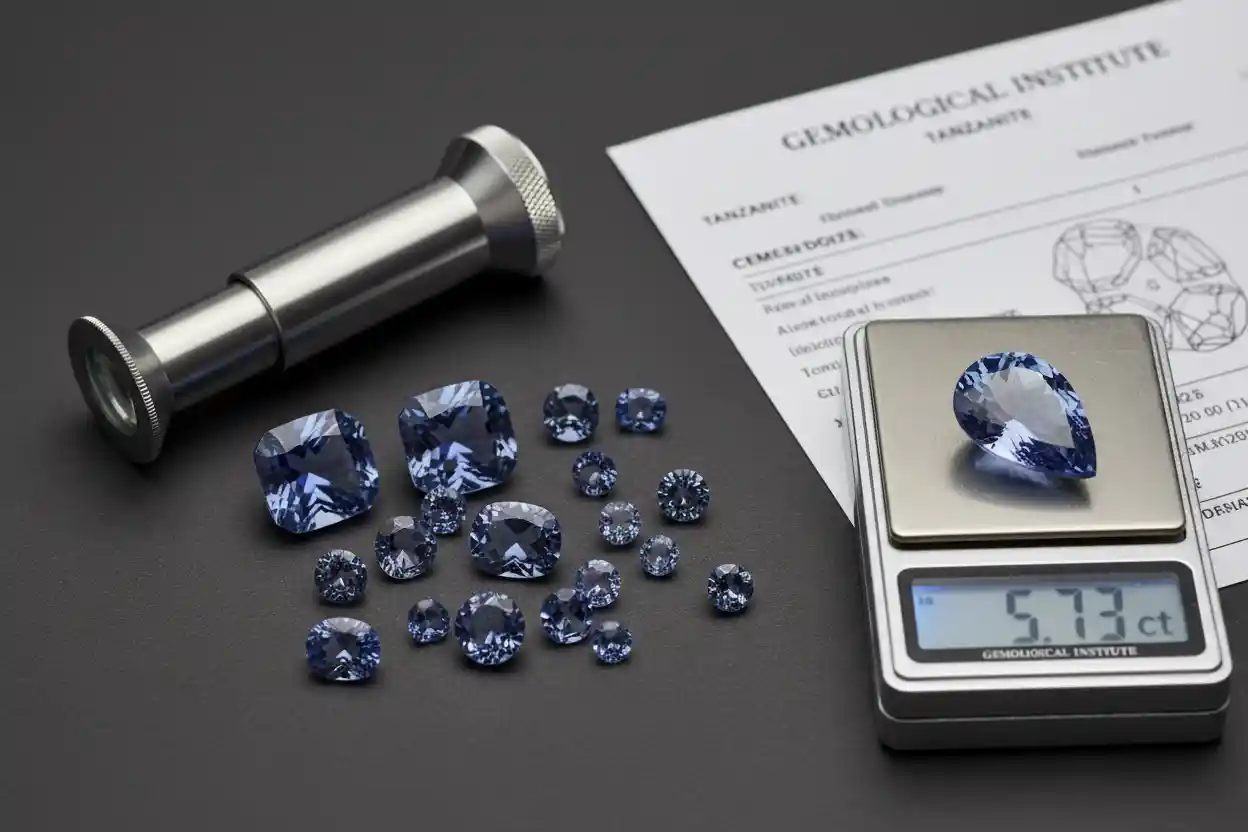
Tanzanite Price: 7 Essential Value Factors, Smart Buying & Costly Mistakes
Tanzanite price commonly ranges from roughly $70 to $500 per carat across many light, medium, and deep-color stones around one to two carats, while larger deeply saturated gems can move from about $400 to $1,500 per carat. Current individual listings show strong 1.5-to-3-carat stones near roughly $290 to $350 per carat, while several deep blue or deep violet-blue eye-clean stones around five to six carats are currently priced close to $750 per carat.
The size of the gap is mainly explained by color saturation, face-up hue, clarity, cutting orientation, carat weight, treatment presentation, and overall appearance. Pale calibrated stones and commercial parcels can cost only a fraction of what a large intensely saturated center stone commands. Tanzanite value therefore changes quickly when fine color and larger size occur together.
Tanzanite Price Per Carat by Color and Size
Current market guidance separates tanzanite by both color depth and weight. Light-color stones around one to two carats commonly fall near $70 to $150 per carat, while medium-color stones of similar size range around approximately $110 to $350 per carat. Deep-color 1-to-2-carat stones can reach roughly $150 to $500 per carat.
As size increases, stronger color becomes more common and the price ceiling rises. Deep-color stones between roughly two and three carats can reach around $700 per carat, while deep stones above three carats can move into approximately $400 to $1,500 per carat.
Current individual gems show the same pattern. A 1.64-carat blue VVS oval offered at $485 works out to roughly $296 per carat. A 2.88-carat blue VVS cushion listed near $1,004 reaches about $349 per carat. Deep blue and deep violet-blue eye-clean stones around 5.5 to 5.9 carats are currently listed near $747 per carat.
| Current tanzanite example | Total price | Approx. price per carat | Quality signal |
|---|---|---|---|
| 0.37 ct blue VS pear | $22.11 | $60/ct | Small lighter commercial stone |
| 1.64 ct blue VVS oval | $485.02 | $296/ct | Clean jewelry-quality center stone |
| 1.73 ct blue VVS pear | $511.64 | $296/ct | Clean blue stone |
| 2.88 ct blue VVS cushion | $1,003.97 | $349/ct | Larger clean faceted gem |
| 3.03 ct blue VS marquise | $875.19 | $289/ct | Three-carat blue stone |
| 5.49 ct deep violet-blue eye-clean trillion | $4,101.03 | $747/ct | Large deep-color premium stone |
| 5.66 ct deep blue eye-clean trillion | $4,228.02 | $747/ct | Large saturated blue stone |
| 5.87 ct deep violet-blue eye-clean oval | $4,384.89 | $747/ct | Large premium oval |
The tanzanite price per carat rises most convincingly when deeper color, eye-clean clarity, strong cutting, and larger size occur together.
Tanzanite Color Price: Why Deep Blue and Violet-Blue Cost More
Color usually has the largest influence on tanzanite value. Deep saturated violet-blue and blue-violet stones sit at the top of the normal market because pale blue and lavender colors are much easier to find.
A predominantly blue face-up appearance can receive an additional premium. Tanzanite’s pleochroism means cutters can orient the rough to emphasize different colors, and obtaining a strongly blue face can require more weight loss than producing a violet-dominant stone. That cutting sacrifice contributes to scarcity.
Tone matters alongside saturation. A medium-dark blue-violet stone with strong brilliance can be more desirable than an extremely dark gem that loses brightness. Fine color should remain visible across most of the face and should not depend on one narrow viewing angle.
The tanzanite quality grading process is therefore more useful than color labels such as AAA or AAAA. Those seller-created grades do not have one universal definition across the trade.
Tanzanite Size Premiums: Why Five Carats Changes the Price Structure
Size and color are closely linked in tanzanite. Smaller stones commonly show lighter saturation, while deep blue and violet-blue colors are easier to achieve in larger gems. This makes five carats an important visual threshold in the market, even though there is no fixed price jump at exactly that weight.
A clean 5-to-6-carat stone with deep saturated color can move toward roughly $700 to $1,000 per carat or more, while lighter stones of similar weight can remain far less expensive. Fine stones with exceptional color can approach the upper end of the $400-to-$1,500-per-carat range cited for deeper larger tanzanite.
The relationship is not linear. A 6-carat gem does not automatically cost twice as much per carat as a 3-carat stone. The premium becomes strongest when larger size preserves intense color, eye-clean clarity, attractive face-up spread, and skilled cutting.
Compare dimensions carefully because a deep stone may hide significant weight below the girdle. A well-proportioned 4.5-carat gem can look larger from the top than a deep 5-carat alternative.
Tanzanite Clarity Price: Eye-Clean Stones Set the Standard
Faceted tanzanite is commonly expected to appear eye-clean. Because clean stones are widely available in normal jewelry sizes, obvious inclusions can create a noticeable discount, particularly when they occur in lighter stones where internal features are easier to see.
Fine larger stones combine scarcity of size with high transparency. This is one reason a large eye-clean gem can command a stronger price per carat than a similarly colored stone with visible fractures or clouds.
Not every microscopic inclusion reduces value. Tiny internal features visible only under magnification are normal in natural gems and may have little effect. The important distinction is whether the inclusion can be seen face up, reduces brilliance, or creates a durability concern.
Fractures deserve the greatest price adjustment because tanzanite already has cleavage and only fair-to-poor toughness. A fracture reaching the surface can affect both long-term durability and setting risk.
Tanzanite Cut Price: Orientation Can Trade Carat Weight for Better Blue
Tanzanite’s pleochroism creates a direct financial connection between cut orientation and color. A cutter can often retain more rough by producing a stone with stronger violet or purple face-up color. Orienting the same rough for a stronger blue appearance can require greater weight loss.
This means a smaller deeply blue gem can be worth more per carat than a larger violet stone cut from comparable rough. The buyer is paying partly for a rarer face-up color and partly for the weight sacrifice required to produce it.
Cut quality also affects brightness. Windowing, excessive depth, large extinction zones, weak symmetry, and poor polish all reduce visual appeal. A gem that preserves extra weight but loses brilliance may represent weaker value than a smaller stone with efficient proportions.
Cushions, ovals, trillions, pears, rounds, and custom cuts can all be valuable. Shape itself is less important than the way the cut presents color and returns light.
Heated Tanzanite Price: Why Routine Heat Has Little Effect
Most blue and violet tanzanite offered in jewelry has been heated from naturally brownish zoisite. Heating produces the familiar blue-to-violet appearance and is accepted as a standard treatment.
Because heating is expected, heated stones do not usually suffer the type of large price reduction associated with certain treatments in other gem categories. Strong color after stable heating can still command premium prices.
Claims of naturally blue unheated tanzanite may attract collector attention, but determining heating can be difficult. An unheated claim should not justify an enormous premium unless the buyer understands exactly what evidence supports it.
Coating and fracture filling are different issues. Those treatments should be disclosed clearly because they can affect durability, care, and buyer confidence.
The gemstone certification decision becomes particularly important when treatment claims play a major role in the price.
Tanzanite Origin and Supply: One Mining Region Supports the Rarity Premium
Tanzanite comes from a restricted area in northern Tanzania near Mount Kilimanjaro. This geographic concentration gives the gem a supply profile very different from sapphire, garnet, tourmaline, or topaz, which occur across many countries.
Limited geographic supply contributes to collector interest, but it should not be used to justify the same premium for every stone. Pale commercial tanzanite remains much more abundant than large deeply saturated examples.
The tanzanite vs sapphire comparison also matters because some buyers choose between these two blue gems. Sapphire generally offers far greater hardness and toughness, while tanzanite offers distinctive pleochroic violet-blue color and a single geographic source.
Supply arguments should never replace quality analysis. The market still pays much more for intense color, high clarity, good cutting, and impressive size than for an ordinary pale stone simply because both came from the same deposit.
Tanzanite Jewelry Price vs Loose-Stone Price
Finished tanzanite jewelry includes much more than the value of the center stone. Gold or platinum, accent diamonds, craftsmanship, setting difficulty, design, brand positioning, and retail service can all add significantly to the final price.
A 5-carat loose tanzanite priced near $750 per carat would place the center gem around $3,750 before any setting, accent stones, or labor are added. A finished ring using the same quality of tanzanite can therefore cost considerably more without implying that the gemstone itself has a higher per-carat value.
Durability also influences setting cost. Tanzanite has cleavage and requires careful handling, so an experienced jeweler and protective design can be worth paying for.
For buyers specifically interested in jewelry, December birthstone jewelry provides a natural comparison among ring, pendant, and earring styles where tanzanite is commonly used.
Tanzanite Condition and Durability Can Affect Price
Tanzanite ranks about 6 to 7 on the Mohs scale and has cleavage, making chips, bruised edges, worn facet junctions, and impact damage important when valuing previously mounted stones.
The crystal hardness chart explains why tanzanite needs more careful wear than sapphire or spinel. A pristine loose stone should be worth more than an otherwise equivalent gem with a chipped girdle or repolished corner.
Recutting can remove damage but also reduces carat weight. If a valuable stone sits close to a size threshold, losing weight during repair can affect both total value and market appeal.
Warm soapy water is the safest cleaning method. Ultrasonic and steam cleaning should be avoided, particularly when fractures are present.
Tanzanite Retail and Resale Value
Fine tanzanite has a strong consumer identity and an established jewelry market, but resale value still depends heavily on quality and transaction conditions. Deep saturated large stones with clean appearance and good documentation are easier to distinguish from commercial stock than pale mass-market gems.
The do gemstones hold value question becomes more important as purchase price rises. A buyer paying several thousand dollars should preserve laboratory reports, invoices, photographs, dimensions, and treatment information so the stone can be identified and compared accurately later.
Condition also matters in resale. A deeply colored stone with chipped edges or damaged polish may lose appeal despite its carat weight.
How to Judge Whether a Tanzanite Price Is Fair
Start with color depth and face-up hue, then compare stones in the same size bracket. Match clarity, dimensions, cut quality, treatment disclosure, and overall brightness as closely as possible.
A 1.5-carat pale violet stone should not be compared directly with a 1.5-carat intensely blue eye-clean gem. Likewise, a 6-carat deep blue IF stone belongs in a different price category from a 6-carat pale transparent cabochon.
The buy tanzanite process becomes much more reliable when the stone is evaluated before the price is judged. Strong color, clean transparency, efficient cutting, and usable face-up size should explain the premium.
Conclusion
Tanzanite price is shaped primarily by color, size, clarity, and cut. Many lighter stones fall in the low hundreds of dollars per carat or below, while fine deeper stones can move into several hundred dollars per carat, and large saturated examples may reach approximately $400 to $1,500 per carat. Current 5-to-6-carat deep blue and deep violet-blue eye-clean stones near $750 per carat show how strongly premium color and size can raise value together.
FAQs
How much does tanzanite cost per carat?
Light and medium stones may range from roughly $70 to $350 per carat across common jewelry sizes, while deep-color gems can reach several hundred dollars per carat. Fine larger stones can move toward $1,500 per carat.
How much is a 1-carat tanzanite worth?
Quality changes the answer considerably. Light stones can sit below $150 per carat, while stronger blue or violet-blue eye-clean examples can reach several hundred dollars per carat.
How much is a 5-carat tanzanite worth?
A fine 5-carat stone can cost several thousand dollars. Current deep blue and violet-blue eye-clean examples around five to six carats are listed near roughly $750 per carat.
What color tanzanite is most expensive?
Deep saturated blue-violet and violet-blue are generally the strongest price categories, with predominantly blue stones often receiving additional attention.
Does tanzanite price rise sharply with size?
It can, especially when deep color and eye-clean clarity remain strong. Larger stones are more capable of displaying the saturation associated with fine tanzanite.
Is heated tanzanite worth less?
Routine heat treatment has little effect on normal value because most blue and violet tanzanite in the market has been heated.
Does clarity affect tanzanite price?
Yes. Fine faceted tanzanite is usually expected to appear eye-clean, so obvious inclusions and fractures can lower value.
Is blue tanzanite more expensive than violet tanzanite?
Predominantly blue stones can command stronger prices because cutting for blue may require greater loss of rough. Overall saturation, brightness, clarity, and size still matter.
Does a laboratory report increase tanzanite value?
A respected report can improve confidence in identity and detectable treatments. It is particularly useful for expensive stones or purchases involving unusual treatment claims.
Is tanzanite more expensive than sapphire?
Either gem can be more expensive depending on quality. Fine sapphire often reaches much higher price levels, while premium tanzanite can still cost hundreds or more than a thousand dollars per carat.
Can tanzanite hold its value?
Fine large stones with strong color, clean clarity, good cutting, and documentation may remain desirable, but resale depends on condition, market demand, and the price paid initially.