Watermelon Tourmaline Price Guide: Value and Cost in 2026
Watermelon Tourmaline prices in 2026 commonly range from approximately $20 to $500 per carat. Commercial slices and included cabochons usually sit below $100 per carat, while transparent faceted stones with clear pink-and-green zoning commonly reach $100 to $500 per carat.
Exceptional gems with vivid colors, balanced zoning, strong clarity and skilled cutting may exceed $500 per carat. Watermelon Tourmaline must be evaluated by cut style because a flat crystal slice and a transparent faceted gemstone follow different quality standards.
Watermelon Tourmaline Price per Carat in 2026
| Watermelon Tourmaline category | Typical characteristics | Approximate 2026 retail price |
|---|---|---|
| Entry commercial slice or cabochon | Pale, heavily included, uneven zoning or weak polish | $10–$40 per carat |
| Good commercial material | Recognizable pink-green zoning and acceptable cutting | $40–$100 per carat |
| Fine slice or faceted gem | Strong pink and green, attractive separation and good transparency | $100–$300 per carat |
| Premium faceted Watermelon Tourmaline | Vivid balanced zoning, strong clarity and excellent cut | $250–$600 per carat |
| Exceptional collector quality | Rare symmetry, saturated colors, clean large size or precision cutting | $500–$1,000+ per carat |
Wholesale parcels and heavily included slices may trade below these ranges. Conversely, fine jewelry retailers and recognized lapidaries may charge more for distinctive one-of-a-kind cuts.
The broader relationship among color, cutting and demand appears in How Gemstone Prices Are Determined.
What Is Watermelon Tourmaline?
Watermelon Tourmaline is naturally zoned Tourmaline that combines pink or red with green.
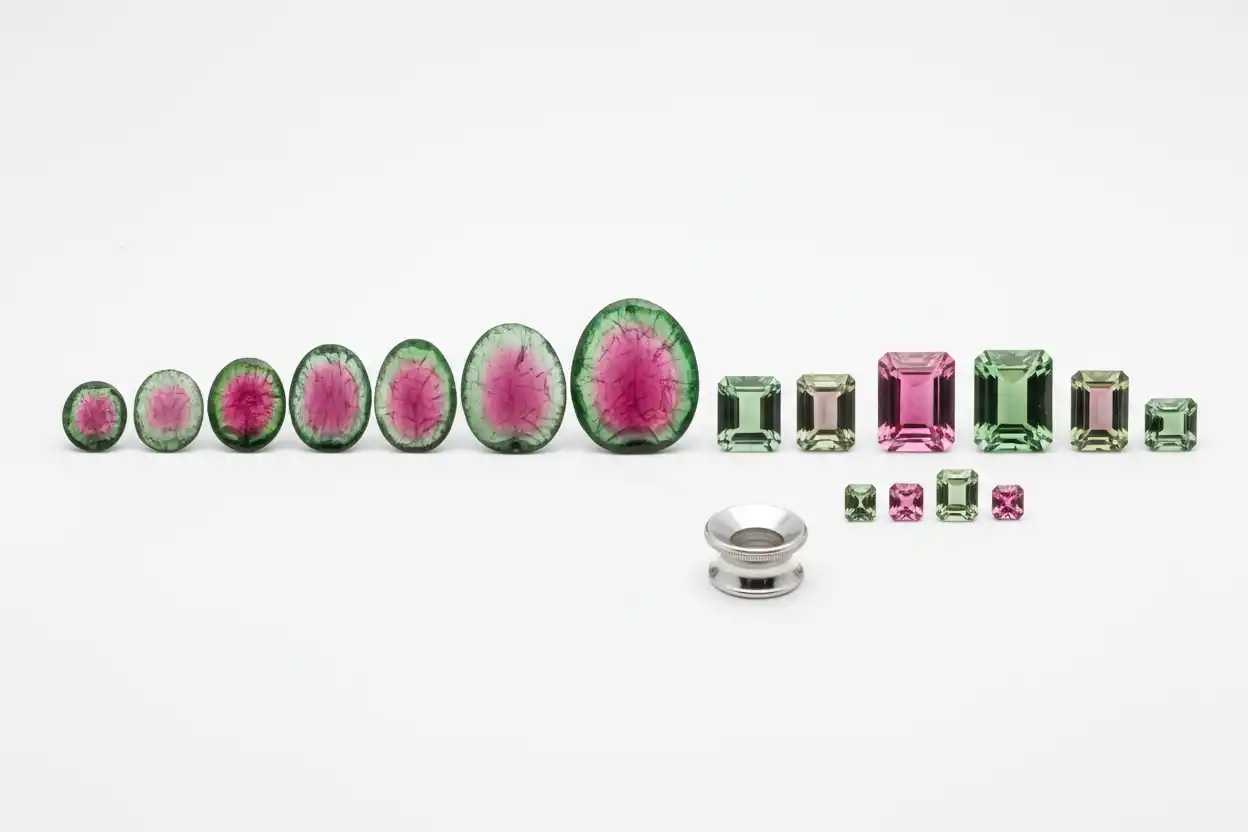
The classic crystal structure has a pink center surrounded by a pale or colorless transition and a green outer rim. When cut across the crystal, it resembles a slice of watermelon.
Not every commercially labeled stone follows that exact radial pattern. The market also includes pink-green bicolor and tricolor gems cut lengthwise through the crystal.
Most Watermelon Tourmaline belongs to the elbaite species, though Tourmaline-group chemistry can vary.
The completed Watermelon Tourmaline guide owns its mineral identity, formation and traditional symbolism.
The completed Types of Tourmaline page explains its place within the wider mineral group.
Watermelon Slices vs Faceted Gems
A Watermelon Tourmaline slice is cut perpendicular to the crystal’s length to reveal concentric zoning.
Slices are frequently thin, irregular and included. Their value depends on pattern, color, usable surface and structural integrity rather than brilliance.
Faceted Watermelon Tourmaline may be cut lengthwise as an emerald cut, rectangular step cut, long oval or freeform. Its value depends more heavily on transparency, light return and zoning visible through the crown.
A fine slice with vivid concentric rings can be more valuable than a poorly cut transparent stone whose colors disappear face-up.
Likewise, a clean faceted bicolor gem may command more per carat than a thick commercial slice because transparent, well-oriented rough is harder to obtain.
Color Saturation
Fine Watermelon Tourmaline should display clearly recognizable pink or red and green.
Pale pastel zoning can be attractive but normally costs less. Gray, brown and muddy modifiers reduce value.
The pink center should not appear beige or nearly colorless. Likewise, the green rim should remain visible rather than turning black or weak olive.
Strong saturation is valuable only when the stone remains bright. Extremely dark green can conceal the internal pattern.
Some buyers prefer a bright bubblegum-pink center, while others seek deeper Rubellite-like red. Both can be valuable when the green creates a balanced contrast.
The completed Pink Tourmaline guide provides context for the pink component, while the Rubellite Price Guide owns the separate saturated red market.
Zoning Quality
The quality and arrangement of color zones create the Watermelon identity.
The most valuable slices commonly show:
- A recognizable pink or red center
- A clear transition band
- A green outer rim
- Reasonable balance around the slice
- Minimal blank or brown sections
- Enough thickness for durability
Perfect symmetry is rare and not always necessary. An artistic irregular pattern can remain valuable when its colors are vivid.
Faceted gems require the zones to remain visible face-up. A beautiful side-view pattern has limited value if the table shows only one color.
The cutter may sacrifice weight to position the color boundary where it contributes most to the finished design.
Transparent Faceted Watermelon Tourmaline
Transparent faceted material commonly receives the highest per-carat prices.
Good stones may cost approximately $100 to $300 per carat. Fine gems with strong color separation and eye-clean appearance can reach $300 to $600 per carat.
Exceptional large stones with vivid pink and green, minimal extinction and precision cutting may exceed $600 per carat.
Step cuts are common because they preserve elongated crystals and display color bands clearly.
However, an excessively shallow step cut may create a broad window. A deep stone can show stronger color but contain substantial hidden weight.
The dimensions and face-up zoning must therefore be evaluated together.
Watermelon Tourmaline Slice Prices
Commercial slices commonly cost approximately $10 to $60 per carat.
Fine polished slices with bright concentric zoning may range from $50 to $200 per carat.
Exceptional large slices with strong symmetry, vivid color and minimal fractures can cost more.
Thin slices are often sold by piece because carat weight alone does not capture their visible size.
Drill holes, edge chips and open fractures reduce value. Many slices are used in pendants, where one polished face and graphic zoning matter more than conventional faceting.
A slice that has been filled, backed or repaired should be described accurately.
Cabochons and Carvings
Included or translucent Watermelon Tourmaline may be cut into cabochons, tablets, beads and carvings.
Commercial cabochons often range from approximately $20 to $100 per carat.
Fine stones with a strong pink-green pattern, good polish and limited open fractures may reach $100 to $250 per carat.
Carvings are normally priced by piece. Craftsmanship, pattern placement and structural soundness may matter more than raw weight.
The cutter may use natural crystal shape to create leaves, shields, hearts or asymmetric forms that preserve valuable zoning.
Reverse Watermelon and Bicolor Tourmaline
Reverse Watermelon Tourmaline usually describes a crystal with green in the center and pink or red toward the outside.
The pattern is less familiar but can be collectible when clearly developed.
Bicolor Tourmaline may show pink and green in adjacent lengthwise zones without a radial watermelon structure.
Retailers sometimes label every pink-green Tourmaline as watermelon. The usage is commercially common, though buyers seeking the classic pattern should examine the cut orientation carefully.
A sharp bicolor division can be valuable in a faceted stone even when the crystal does not show a pink center and green rind.
Price should follow visible beauty rather than a rigid label alone.
Clarity and Inclusions
Watermelon Tourmaline is commonly included.
Growth tubes, liquid inclusions, healed fissures, crystals and fractures can form near changing color zones.
The market accepts more inclusions than it does in ordinary clean green Tourmaline because the pattern itself is scarce.
However, open fractures and dense clouds still reduce value. They may interfere with polishing, collect dirt or create setting risk.
Slices often contain natural cracks that developed during growth or cutting. A structurally unstable slice should be discounted even when the colors are beautiful.
Transparent faceted gems should generally show better clarity than decorative slices.
Cut Orientation
Watermelon Tourmaline rough can be cut in several directions, each emphasizing different features.
Cross-cut slices reveal concentric zoning. Lengthwise cuts create stripes or longitudinal bands.
Faceters may orient the darker green direction through the side to prevent the face from becoming too dark.
A skilled design should show both colors without excessive windowing.
Freeform cutting is common because strict calibrated shapes can remove the most valuable sections of pink or green.
Precision cutting may add a substantial premium when the finished stone combines artistic color placement with strong brilliance.
Detailed inspection belongs to the Watermelon Tourmaline Buying Guide.
Watermelon Tourmaline Prices by Size
| Carat weight | Commercial slice or cabochon | Fine faceted or patterned quality | Exceptional quality |
|---|---|---|---|
| Under 2 ct | $20–$100 per carat | $100–$300 per carat | $250–$600 per carat |
| 2–5 ct | $20–$120 per carat | $100–$350 per carat | $300–$700 per carat |
| 5–10 ct | $15–$100 per carat | $100–$400 per carat | $350–$800 per carat |
| 10–25 ct | $10–$80 per carat | $75–$300 per carat | $300–$700 per carat |
| Above 25 ct | Often priced by piece | Pattern and cutting dominate | Collector evaluation required |
Large slices may cost less per carat because their weight includes thick, fractured or weakly colored material.
Large transparent faceted gems receive stronger premiums when both pink and green remain vivid.
Brazil and Watermelon Tourmaline
Brazil is one of the most important sources of Watermelon Tourmaline.
Pegmatites in Minas Gerais have produced large multicolored crystals suitable for slices, faceting and mineral specimens.
Brazilian material ranges from commercial pale slices to exceptional transparent gems.
The country name alone does not establish quality. Color, zoning and transparency remain more important.
Natural crystal specimens from classic deposits may be worth more intact than as cutting rough, particularly when they show complete terminations and dramatic color zoning.
Afghanistan and Pakistan
Afghanistan and Pakistan produce attractive pink-green Tourmaline crystals from pegmatite regions.
Fine specimens may display transparent green exteriors, pink interiors and well-formed crystal faces.
Cut stones can show pastel or vivid zoning, although clarity varies.
Mineral collectors may pay premiums for undamaged crystals on Albite or Quartz matrix.
Provenance becomes important because locality names can influence specimen value even when the faceted-gem market focuses primarily on appearance.
Mozambique, Nigeria and Madagascar
Mozambique, Nigeria and Madagascar also produce pink, green and multicolored Tourmaline.
Some rough yields long bicolor stones rather than classic radial slices.
Fine faceted gems can compete with Brazilian material when their color and cutting are superior.
Origin generally creates less price difference than it does for Paraíba Tourmaline. A well-cut Mozambican Watermelon Tourmaline can be worth more than an ordinary Brazilian slice.
Treatments
Heat and irradiation can alter colors in Tourmaline.
Heat may lighten overly dark green or modify secondary colors. Irradiation may intensify pink or red.
Oil or resin may enter surface-reaching fractures, particularly in included slices and valuable transparent material.
Treatment can be difficult to detect. Sellers should disclose known enhancement rather than rely only on the word natural.
Natural origin means the crystal formed geologically; it does not prove that every color and fracture remained untouched after mining.
The general treatment framework appears in Gemstone Treatments Explained.
Imitations and Assembled Products
Glass, resin and synthetic materials can imitate pink-green zoning.
Some products consist of separate pink and green pieces joined together. Others use coatings, backing or colored resin.
Dyed quartz and low-cost Tourmaline fragments may also be assembled into slice-like products.
Natural zoning should continue through the stone rather than appearing only as a surface layer.
Magnification can reveal glue lines, bubbles, coating damage and unnatural boundaries.
Independent testing becomes useful when a large clean stone is represented as premium natural Watermelon Tourmaline.
Watermelon Tourmaline Jewelry Prices
| Jewelry type | Broad U.S. retail range |
|---|---|
| Silver pendant with a commercial slice | $75–$500 |
| Gold pendant with a fine slice | $500–$3,000 |
| Gold ring with a faceted bicolor stone | $1,000–$6,000 |
| Fine matched earrings | $1,500–$10,000+ |
| Precision-cut or designer collector jewel | $5,000–$25,000+ |
Matched pairs can command premiums because the pink-green balance, dimensions and cutting must align.
Style-specific guidance belongs to the Watermelon Tourmaline Ring Guide, Watermelon Tourmaline Earrings Guide, Watermelon Tourmaline Necklace Guide and Watermelon Tourmaline Bracelet Guide.
The family-level market appears in the Tourmaline Price Guide.
Durability and Care
Tourmaline has good hardness but can be brittle, especially when heavily included.
Thin Watermelon slices are more vulnerable than compact faceted stones. Drill holes and natural fractures create common break points.
Warm water, mild soap and gentle wiping are safer than prolonged soaking.
Ultrasonic and steam cleaning should be avoided for fractured, filled or thin material.
Complete maintenance guidance belongs to How to Clean Watermelon Tourmaline Jewelry Safely.
Certification and Resale Value
Most inexpensive slices do not need a major laboratory report.
Documentation becomes more useful when:
- A stone is unusually clean or expensive
- Treatment or filling is suspected
- Natural zoning is uncertain
- The product may be assembled
- A valuable collector crystal has important provenance
- Insurance documentation is required
A laboratory can identify natural Tourmaline and detect many assembled or treated products.
Commercial slices generally resell below retail. Fine transparent faceted stones and important crystals have stronger collector potential, though the market remains specialized.
The broader framework appears in Do Gemstones Hold Their Value?.
Online shoppers should request videos showing the complete stone, side views and return terms through How to Buy Gemstones Online Without Getting Scammed.
The Buying & Value hub connects this guide with Tourmaline pricing, treatment and certification content.
Frequently Asked Questions
1. How much is Watermelon Tourmaline worth per carat in 2026?
Most material costs approximately $20 to $500 per carat. Exceptional transparent and precision-cut stones may exceed $500 per carat.
2. What makes Watermelon Tourmaline valuable?
Vivid pink and green, clear zoning, good transparency, attractive pattern placement and strong cutting create the largest premiums.
3. Are Watermelon Tourmaline slices valuable?
Commercial slices are affordable, while fine concentric slices with vivid color and few fractures can be worth $50 to $200 per carat or more.
4. Is faceted Watermelon Tourmaline more valuable than a slice?
Often, because transparent faceting-quality rough is scarcer. However, an exceptional slice can be worth more than a poorly cut faceted stone.
5. How much is a five-carat Watermelon Tourmaline?
A five-carat stone may cost approximately $100 to $2,500 in total, depending on whether it is a commercial slice or premium faceted gem.
6. Does large Watermelon Tourmaline cost more per carat?
Not automatically. Large slices are common enough that pattern and structural quality matter more than weight.
7. Does perfect zoning increase value?
Balanced zoning creates a premium, but artistic irregular patterns can also be valuable when the colors remain vivid.
8. Is reverse Watermelon Tourmaline valuable?
It can be collectible when green and pink zoning are clear, attractive and naturally developed.
9. Is Watermelon Tourmaline normally treated?
Some material may be heated, irradiated or fracture filled. Known treatment should be disclosed.
10. Can Watermelon Tourmaline be fake?
Yes. Glass, resin, coated products and assembled pink-green pieces can imitate natural zoning.
11. Does Watermelon Tourmaline need a certificate?
Commercial slices usually do not. A report is useful for premium transparent, treated, assembled or collector-quality material.
12. Is Watermelon Tourmaline a good investment?
Exceptional faceted gems and mineral specimens may retain collector interest, but ordinary slices have limited resale liquidity.
Watermelon Tourmaline Value Is Created by the Cut Through the Color
The same crystal can produce an inexpensive slice, an exceptional bicolor gem or an important mineral specimen depending on where and how it is cut.
In 2026, most jewelry-quality Watermelon Tourmaline falls between $50 and $300 per carat. Prices above that level should correspond to vivid balanced zoning, strong transparency, limited structural damage and cutting that makes both colors visible from the intended viewing direction.