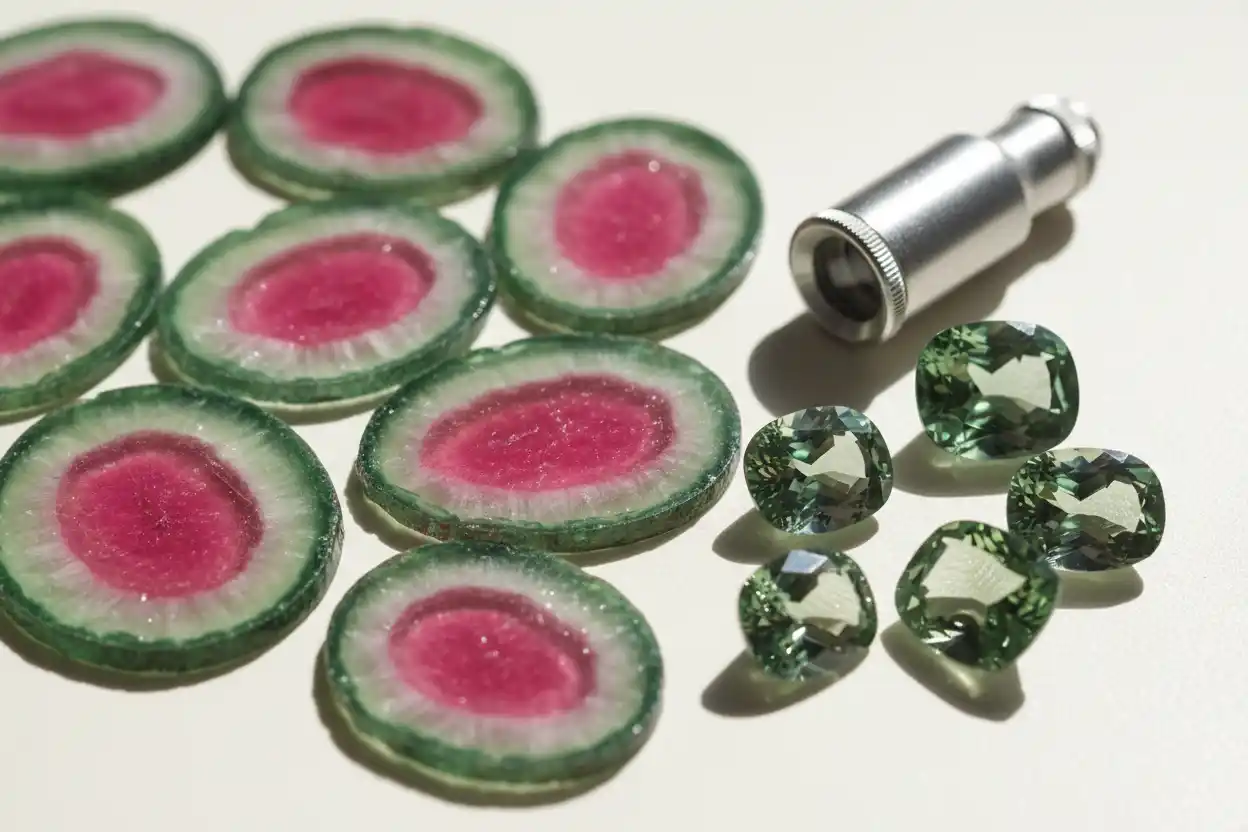
Buy Watermelon Tourmaline: Smart Buying Tips & Red Flags
When you buy watermelon tourmaline, the most important feature is not simply the presence of pink and green. The value comes from how those colors formed and how successfully the cutter preserved their natural relationship, because genuine watermelon tourmaline is a color-zoned tourmaline in which a pink or reddish interior is surrounded by a green outer zone, often with a pale or nearly colorless transition between them. A stone with pink at one end and green at the other can still be natural multicolored tourmaline, but it is more accurately described as bicolor or parti-colored material rather than the classic concentric watermelon pattern.
That distinction becomes especially important when you buy watermelon tourmaline online, where almost any pink-and-green gem can acquire the watermelon label. Cross-sectional slices, longitudinal slices, faceted gems, cabochons, beads, polished crystals, assembled pieces, glass, resin, dyed quartz, and other imitations can all produce superficially similar photographs while belonging to very different commercial categories.
The strongest way to buy watermelon tourmaline is therefore to establish the color-zoning structure first, determine how the rough was cut, judge the pink and green zones independently, inspect transparency and fractures, examine the complete front, back, and edge, investigate treatment or assembly, and only then decide whether carat weight, locality, designer cutting, or a seller-created grade justifies a premium.
The broader mineral and formation profile appears in watermelon tourmaline meaning, while the wider tourmaline family explains why one crystal can record dramatic chemical changes as it grows. For buying purposes, however, the key question remains practical: is the actual stone displaying attractive natural zoning in a form worth owning?
What Should You Judge First When You Buy Watermelon Tourmaline?
When you buy watermelon tourmaline, use a hierarchy built around zoning rather than applying the same checklist used for one-color faceted gemstones. Begin with identity and pattern, then evaluate color balance, cutting orientation, transparency, inclusions, structural condition, polish, treatment, dimensions, provenance, documentation, and intended use.
Most gem-quality watermelon material belongs to elbaite or related tourmaline compositions, while some particularly complex zoned material can belong to liddicoatite. Exact species cannot always be determined visually, and species-level chemistry is rarely necessary for ordinary jewelry purchases unless the seller is using a specialized mineralogical identification to justify an additional premium.
The commercial variety itself is better understood within types of tourmaline, where watermelon zoning is separated from ordinary bicolor and multicolored tourmaline.
| Priority | What to evaluate | Stronger choice | Main red flag |
|---|---|---|---|
| 1 | Identity | Natural pink-and-green color-zoned tourmaline | Color combination used as the only proof |
| 2 | Pattern | Distinct pink/red interior with meaningful green outer zone | Tiny green or pink patch exaggerated by the listing |
| 3 | Color | Attractive saturation in both main zones | Gray, muddy, brown, or extremely pale color sold as premium |
| 4 | Cut orientation | Design deliberately displays the natural zoning | Cut hides most of one color |
| 5 | Transparency | Appropriate openness for the cut style | Heavy cloudiness priced as fine faceting material |
| 6 | Fractures | Stable structure with manageable natural inclusions | Major open fissure crossing a thin slice |
| 7 | Polish | Clean surfaces and protected edges | Scratches, chips, pits, or poorly finished perimeter |
| 8 | Treatment | Heat, irradiation, filling, coating, or assembly disclosed where relevant | “Natural” used instead of treatment detail |
| 9 | Dimensions | Useful size and thickness for the design | Large carat figure created mostly by unnecessary thickness |
| 10 | Documentation | Evidence proportionate to value and rarity claims | Generic seller certificate treated as laboratory proof |
Following this order when you buy watermelon tourmaline prevents an unusually symmetrical pattern or dramatic size from distracting you from weak color, structural damage, or manufactured construction.
Understand What Classic Watermelon Zoning Actually Looks Like
Classic watermelon tourmaline forms when the chemical environment changes as the crystal grows. Earlier growth develops a pink or red center, while later growth forms green material around the outside. A pale, colorless, white, or yellowish transitional band may occur between the two.
When you buy watermelon tourmaline in cross section, the result can resemble a watermelon slice: pink interior, lighter transition, and green rind.
The pattern does not need to be mathematically centered.
Natural tourmaline crystals frequently have rounded triangular cross sections rather than perfect circles, and the pink core can be offset, asymmetric, irregular, or surrounded by green of unequal thickness.
That natural irregularity can be part of the appeal.
Not Every Pink-and-Green Tourmaline Is Watermelon Tourmaline
This is one of the most important boundaries when you buy watermelon tourmaline.
A crystal that is pink at one end and green at the other is more accurately described as bicolor or parti-colored tourmaline. A lengthwise cut can also show pink and green running beside each other without reproducing the classic pink-center and green-rim architecture.
Both materials can be beautiful and valuable.
The problem is not selling bicolor tourmaline. The problem is applying a stronger watermelon premium without explaining how the color is arranged.
When you buy watermelon tourmaline specifically for the iconic pattern, ask to see how the zones continue through the stone rather than relying on a front photograph.
Cross-Sectional Slices Show the Pattern Most Directly
The classic way to buy watermelon tourmaline is as a slice cut perpendicular to the long axis of the original crystal.
This orientation exposes the growth zones as a cross section. The pink core becomes visible near the center, with green around the outside and sometimes a colorless transitional layer between them.
Slices can retain the crystal’s rounded triangular outline or be reshaped into oval, round, shield, free-form, or other designs.
For this category, pattern quality matters more than conventional faceted brilliance.
A strong slice should make the zoning obvious immediately.
Longitudinal Slices Need a Different Quality Standard
A lengthwise slice can expose the crystal from one end toward the other.
When you buy watermelon tourmaline in this form, the colors may appear as parallel pink and green bands, a pink interior bordered by green sides, or a more complex multicolored arrangement.
This can be completely natural even when the finished stone does not resemble a literal watermelon cross section.
Judge whether the cutter used the zoning successfully rather than penalizing the stone for being lengthwise.
The description should simply be accurate.
Faceted Watermelon Tourmaline Is a Separate Premium Category
Faceting can create brilliance that a flat slice cannot provide, but it also changes how color zones appear.
When you buy watermelon tourmaline as a faceted gemstone, pavilion reflections can mix the pink and green visually, move one color into another part of the face, or make the original concentric pattern difficult to recognize.
A fine faceted stone should still show both colors intentionally.
One half should not disappear unless the design was specifically cut for a more subtle bicolor effect.
Transparent faceted watermelon tourmaline can command stronger premiums because good clarity, useful zoning, attractive saturation, and competent cutting all need to survive in the same piece of rough.
Pattern Quality Matters More Than Perfect Symmetry
A perfectly centered pink core surrounded by an even green rind is visually striking, but natural growth does not require geometric perfection.
When you buy watermelon tourmaline, consider whether the complete pattern looks balanced rather than whether every green border has identical thickness.
An asymmetric crystal with vivid pink and emerald-like green can be far more attractive than a perfectly centered but pale specimen.
Symmetry should support color.
It should not replace it.
The Pink Zone Should Be Meaningful
Some stones are marketed as watermelon tourmaline even though the pink area is tiny, extremely pale, or visible only from one particular angle.
When you buy watermelon tourmaline, judge how much of the face the pink zone occupies.
A strong center can range from soft blush through rose, raspberry, magenta, and reddish pink. Saturation should be considered alongside transparency and pattern balance.
A pale center can still produce a beautiful pastel stone, but it should not receive the same color premium as a vivid pink or red center simply because the word watermelon appears in the listing.
The Green Zone Should Be Clearly Visible
The outer green zone is equally important when you buy watermelon tourmaline for the classic appearance.
Green can range from pale mint and yellow-green through medium green, forest green, blue-green, and extremely dark green.
The best rind is not necessarily the darkest.
If the outer zone becomes almost black, much of its green character can disappear in normal lighting. A somewhat lighter but clearly green border may frame the pink center much more effectively.
Judge the green while the stone is away from intense spotlighting.
A Pale Transitional Band Can Improve the Pattern
Many natural crystals show a colorless or lightly colored band between the pink core and green exterior.
When you buy watermelon tourmaline, do not treat this transitional zone as a defect.
It can visually separate the two saturated colors and make the pattern resemble watermelon even more strongly.
The intermediate zone can also reveal the growth sequence clearly, which adds mineralogical interest.
A thin white-looking or transparent band is therefore often desirable when it contributes to the overall design.
Multiple Color Bands Can Be Highly Collectible
Some crystals contain much more complicated zoning than one pink core and one green rind.
When you buy watermelon tourmaline, you may encounter alternating bands of pink, green, yellow, colorless, white, or darker material.
These stones can be highly attractive even when they depart from the simplest two-color definition.
Judge the entire architecture.
Complex natural zoning should look related to growth rather than like unrelated colored pieces joined together.
Color Should Be Evaluated Under Neutral Lighting
Pink and green are both vulnerable to photographic manipulation.
When you buy watermelon tourmaline online, request images against a neutral white or gray background. Warm light can intensify pink and make green more yellow, while cool lighting can push green toward teal and pink toward purple.
Look at surrounding objects.
If white paper appears pink or green, the camera settings are influencing the gemstone too.
The strongest stone should remain appealing without an entire photograph being color-shifted.
Backlighting Can Make Weak Material Look Exceptional
Thin slices often become dramatically more transparent and colorful when photographed with light shining through from behind.
This can produce beautiful images, but it can also make pale colors appear much stronger than they look in ordinary reflected light.
When you buy watermelon tourmaline slices, ask for both reflected-light and transmitted-light views.
Backlighting tells you about transparency and internal zoning.
Front lighting tells you how the jewelry will usually look when worn.
You need both.
Inspect Both Front and Back
A front photograph alone is insufficient when you buy watermelon tourmaline at meaningful value.
The back can reveal whether:
- The zoning continues naturally through the stone.
- A surface coating is present.
- The colors differ substantially through thickness.
- A crack crosses the entire slice.
- Resin fills a fracture.
- Another material is attached.
- A backing hides weakness.
- The polish is incomplete.
- The piece has been assembled.
For slices, the back is almost as informative as the face.
Side Views Are Essential for Detecting Assemblies
A pink center and green outer appearance can be imitated by joining different materials.
When you buy watermelon tourmaline, request a clean side or edge photograph. Look for whether the pink, transitional, and green regions continue naturally through the thickness.
A straight glue line, abrupt material boundary, trapped bubbles in adhesive, or obvious laminated layers can indicate an assembled product.
Natural zone boundaries can also be sharp, so visual observation alone is not always decisive.
The important point is to inspect the construction rather than assuming every perfect pattern grew naturally.
Natural Color Zoning Should Have Three-Dimensional Continuity
A genuine zoned tourmaline crystal formed in three dimensions.
When you buy watermelon tourmaline, the pattern should therefore make sense as part of a crystal rather than as a painted surface design.
Turn the stone over.
Tilt it.
Inspect the edge.
Observe whether the green rind wraps naturally around the pink interior and whether transitional bands maintain logical relationships.
A surface-only pattern deserves additional scrutiny.
Watermelon Tourmaline Can Be Transparent, Translucent, or Heavily Included
There is no single clarity standard for every form.
When you buy watermelon tourmaline as a transparent faceted gemstone, high transparency and good clarity generally deserve a premium.
When you buy watermelon tourmaline as a natural slice, some tubes, healed fractures, crystals, clouds, and internal breaks are expected because the cutter is preserving the growth pattern rather than selecting only perfectly clean sections.
For mineral specimens, inclusions can be completely natural and scientifically interesting.
The standard must follow the product category.
Fluid Inclusions Are Common in Tourmaline
Tourmaline develops in fluid-rich geological environments, which means internal liquid-bearing cavities and growth tubes are common.
When you buy watermelon tourmaline, elongated tubes running roughly parallel with crystal growth can be natural.
Some inclusions may contain fluid and gas bubbles.
This is why simplistic advice that every bubble means glass is unreliable.
A trained observer evaluates the shape, orientation, surrounding features, and relationship to the host crystal.
White Reflective Fractures Can Distract From the Pattern
A fine slice may contain fractures without being structurally unacceptable.
However, when you buy watermelon tourmaline, rotate the stone and determine whether any fissure reflects strongly enough to dominate the face.
A white-looking fracture crossing the pink center can become more visually distracting than a darker enclosed mineral inclusion.
The fracture should affect the price according to how much it interrupts the pattern.
Surface-Reaching Fractures Need More Attention
Tourmaline has useful hardness but only fair toughness, so cracks reaching the polished surface deserve practical consideration.
When you buy watermelon tourmaline, inspect fissures reaching:
- Thin slice edges.
- Drill holes.
- Girdles.
- Pointed corners.
- Facet junctions.
- Pendant attachment areas.
A surface-reaching fracture can extend after impact and may also contain filling material.
It should not be dismissed merely because fractures are common in multicolored rough.
Thin Slices Are Particularly Vulnerable
A broad slice can be visually dramatic while remaining only a few millimeters thick.
When you buy watermelon tourmaline in this form, thickness becomes an important durability factor.
Very thin edges can chip during drilling, bezel setting, shipping, or accidental impact.
Examine whether the perimeter tapers into fragile points.
A slightly thicker slice may transmit less light but survive jewelry use more reliably.
Natural Triangular Outlines Can Be Desirable
Tourmaline crystals frequently develop rounded triangular cross sections.
When you buy watermelon tourmaline slices, that natural triangular shape can provide evidence of how the original crystal grew and can make the piece visually distinctive.
Do not assume that every irregular triangular outline reflects poor cutting.
Sometimes the cutter deliberately preserves the natural crystal perimeter to retain the complete color pattern.
Recutting a Natural Slice Can Destroy Value
A cutter can round a triangular slice into a conventional oval or circle, but doing so may remove part of the green rind.
When you buy watermelon tourmaline, decide whether calibrated jewelry dimensions matter more than preservation of the natural pattern.
A free-form slice with a complete rind may offer more collector appeal than a perfectly round cabochon that lost much of its outer green zone.
Faceted Stones Need Windowing Checks
A window is a pale or transparent face-up region where light passes through the pavilion instead of returning effectively toward the viewer.
When you buy watermelon tourmaline as a faceted gem, check the center over a neutral background.
A broad window can make one color zone appear weak and can reduce the visual relationship between pink and green.
A slight amount of light leakage can be acceptable in unusually difficult zoned rough.
A large stationary transparent area should still reduce the price.
Extinction Can Hide One of the Colors
Extinction appears as dark regions where little useful light returns.
When you buy watermelon tourmaline in a faceted design, one zone can become much darker than another because of body color, orientation, and pavilion geometry.
A dark green section can easily turn almost black while the pink remains bright.
Rotate the gemstone and evaluate whether the green becomes visible through ordinary movement.
If one half remains dead, the zoning may be technically present but visually ineffective.
Pleochroism Adds Another Layer of Complexity
Tourmaline commonly shows directional color differences.
When you buy watermelon tourmaline, those pleochroic effects interact with the already complex growth zoning.
The green area can appear darker from one direction, while the pink may shift toward red or purple depending on orientation and illumination.
This is another reason continuous video is much more informative than one still photograph.
Cutters Sometimes Sacrifice Weight to Preserve the Pattern
Zoned tourmaline creates unusual lapidary challenges.
When you buy watermelon tourmaline, a well-cut stone may weigh less than another piece from similar rough because the cutter removed material to center the pink zone, expose the green rind, eliminate a fracture, or create better light return.
That loss of weight can be evidence of better craftsmanship rather than poor value.
Carats are useful only when the finished design succeeds.
Carat Weight Is Especially Misleading for Slices
A broad thick slice can weigh substantially more than a thinner slice with almost identical visible dimensions.
When you buy watermelon tourmaline, compare width, height, and thickness rather than relying solely on carat weight.
A thick commercial slice should not automatically cost dramatically more if the extra mass contributes nothing to the visible pattern.
The relationship among pattern quality, transparency, cut form, size, and market value is examined separately in watermelon tourmaline price.
Large Size Does Not Automatically Mean Rarity
Tourmaline can form substantial crystals, and watermelon slices can therefore reach impressive dimensions.
When you buy watermelon tourmaline, large commercial slices may remain moderately included, pale, thick, or structurally fractured.
Large transparent faceted gems showing strong pink and green simultaneously belong to a much scarcer category.
The rarity premium should follow quality within size—not size by itself.
A Smaller Complete Pattern Can Beat a Larger Weak Pattern
Suppose one large slice has a tiny pale pink core and broad dark green exterior, while a smaller slice has vivid raspberry pink, a clean pale transition, and a balanced medium-green rind.
When you buy watermelon tourmaline primarily for the pattern, the smaller stone can easily provide greater visual value.
Large surface area magnifies whatever qualities are present.
It does not create quality.
Treatment Is Less Routine Than Many Buyers Assume
Tourmaline can be heated, irradiated, fracture filled, or less commonly coated, but most watermelon tourmaline is valued primarily for natural growth zoning rather than a standardized treatment process.
When you buy watermelon tourmaline, do not assume treatment merely because the colors are vivid.
At the same time, do not assume that every pink-green stone is automatically untreated.
Treatment should be evaluated in the context of the individual gemstone.
Heat Can Modify Some Tourmaline Colors
Heating can alter certain tourmaline colors, particularly by lightening undesirable tones or changing the balance of color-causing centers.
When you buy watermelon tourmaline, treatment history may matter if the seller is charging a substantial premium for supposedly completely untreated color.
Heating can be difficult to establish reliably in some tourmaline.
Therefore, an absolute untreated claim deserves more caution than a seller’s confidence alone.
Irradiation Can Influence Pink and Red Tourmaline
Irradiation can intensify or create pink and red colors in suitable tourmaline.
When you buy watermelon tourmaline with an unusually vivid pink core, the appearance alone cannot establish whether that pink is untreated.
Some irradiation-related tourmaline colors can also be sensitive to heat or prolonged intense light.
This does not mean vivid pink automatically indicates treatment.
It means treatment should not be diagnosed—or dismissed—solely from color.
Fracture Filling Is the More Practical Treatment Concern
Because natural watermelon slices frequently contain fractures, filling deserves specific attention.
When you buy watermelon tourmaline with a surface-reaching crack, ask whether resin, polymer, oil, or another substance has been used to reduce its visibility.
A filled fissure can look much less reflective than it would otherwise.
The treatment can influence:
- Value.
- Cleaning.
- Heat resistance.
- Repair.
- Long-term appearance.
- Structural interpretation.
Filled material can still be attractive when disclosed.
Dyed Material Needs Careful Identification
Natural tourmaline itself is not the only material that can receive dye.
When you buy watermelon tourmaline at very low prices, dyed quartz, dyed stone, resin composites, and other materials can imitate the pink-green effect.
Color concentrated in cracks, drill holes, pores, or only near the surface deserves scrutiny.
Do not attempt to remove the dye with solvents or abrasives.
Professional identification is safer.
Coatings Can Create Artificial Green or Pink Zones
A thin coating can modify surface color on a natural gem or imitation.
When you buy watermelon tourmaline, inspect facet junctions, scratches, chips, edges, and the back for differences between surface and interior color.
A green perimeter that exists only as a surface layer is fundamentally different from a naturally grown green outer zone.
Do not scratch the stone intentionally.
Assembled Pink-and-Green Slices Are a Serious Misrepresentation Risk
A manufacturer can combine pink and green materials to reproduce a convincing watermelon pattern.
When you buy watermelon tourmaline, inspect for:
- Straight internal junctions.
- Glue lines.
- Bubbles in adhesive.
- Separate layers.
- Inconsistent luster.
- Different refractive appearance across boundaries.
- Color that fails to continue through the thickness.
An assembled piece can be decorative and wearable when represented honestly.
It should not receive the geological rarity premium of one naturally zoned tourmaline crystal.
Resin Composites Can Look Almost Too Perfect
Pink and green fragments can be embedded in resin, molded, or arranged into attractive patterns.
When you buy watermelon tourmaline and encounter repeated pieces with nearly identical zoning, identical shapes, and improbably perfect color boundaries, investigate the construction.
Natural tourmaline from one parcel can certainly share similar colors.
Exact clone-like repetition is more suspicious.
Glass Can Reproduce Pink and Green Easily
Glass is one of the most versatile imitations because manufacturers can layer or mix colors in almost any arrangement.
When you buy watermelon tourmaline, possible glass clues can include round bubbles, flow structures, unusual color swirls, lower apparent hardness, or a molded appearance.
However, natural tourmaline itself can contain fluid inclusions, so the presence of a bubble-like feature should not become a simplistic authenticity rule.
The wider identification sequence appears in real vs fake tourmaline.
True Synthetic Gem Tourmaline Is Not the Main Consumer Risk
Laboratory-grown tourmaline is not a routine mainstream jewelry material.
When you buy watermelon tourmaline and encounter a listing for “lab-created watermelon tourmaline,” ask exactly what material was created.
It may actually be:
- Glass.
- Synthetic spinel.
- Synthetic corundum.
- Colored resin.
- Cubic zirconia.
- An assembled product.
- Another manufactured imitation.
A pink-and-green laboratory-made material is not synthetic tourmaline simply because it copies tourmaline colors.
Do Not Use Scratch Tests
Tourmaline ranks approximately 7–7.5 on the Mohs scale, but scratching a finished slice is still an inappropriate authentication method.
When you buy watermelon tourmaline, a scratch test can damage the polish, chip a thin edge, or worsen an existing fracture without proving natural origin or treatment.
Several imitation materials can also overlap enough in practical behavior to make amateur hardness testing inconclusive.
Use nondestructive identification.
Do Not Use Hot-Needle Tests
A hot needle might damage resin, plastic, glue, coatings, fillers, or backing.
That does not make it an acceptable identification technique.
When you buy watermelon tourmaline, preserve the stone and use magnification, optical testing, spectroscopy, or laboratory analysis when construction remains uncertain.
Authentication should not require damaging the item you are trying to evaluate.
Brazil Is One of the Most Important Sources
Brazilian pegmatites have produced substantial quantities of pink, green, bicolor, and watermelon tourmaline.
When you buy watermelon tourmaline represented as Brazilian, the origin is plausible, but the country name should not function as a quality grade.
Brazil produces commercial slices and exceptional transparent gems.
Color, pattern, transparency, cutting, condition, and treatment remain more important for most jewelry purchases.
Minas Gerais Is Closely Associated With Fine Multicolored Tourmaline
Pegmatite regions in Minas Gerais have produced important multicolored crystals suitable for slicing, faceting, and mineral collections.
When you buy watermelon tourmaline with a precise Brazilian mine or district premium, ask what supports the provenance.
A pink center and green rind cannot establish one locality by appearance.
Source documentation matters more as the location claim becomes more specific.
Madagascar Is Important for Complex Zoning
Madagascar is particularly associated with liddicoatite and other tourmalines displaying complicated triangular and concentric color patterns.
When you buy watermelon tourmaline from Madagascar, the stone may contain pink, green, yellow, colorless, and darker zones in much more elaborate arrangements than the classic simple watermelon pattern.
Collectors often value that complexity.
Do not downgrade a naturally sophisticated color architecture merely because it does not look like a perfect red circle surrounded by one green ring.
Afghanistan and Pakistan Produce Attractive Zoned Crystals
Pegmatite districts in Afghanistan and Pakistan can produce elongated pink, green, blue, and multicolored tourmaline crystals.
When you buy watermelon tourmaline represented from either region, transparent natural crystals with attractive zoning can appeal strongly to both gem and mineral collectors.
Exact valley or mine claims need better provenance than general regional appearance.
A crystal should not receive a famous-locality premium from color alone.
Nigeria and Mozambique Also Produce Multicolored Tourmaline
Both countries are important tourmaline sources and can produce pink, green, bicolor, and more complex material.
When you buy watermelon tourmaline represented as African material, judge the individual stone rather than assuming that Brazil automatically produces superior quality.
Fine zoning is a property of the crystal.
Country of origin does not guarantee it.
Origin Matters More for Mineral Specimens Than Many Jewelry Stones
A faceted watermelon tourmaline is usually valued primarily for appearance, transparency, cut, size, and condition.
A natural crystal specimen can derive much more of its value from exact locality, crystal habit, complete termination, associated minerals, matrix, and provenance.
When you buy watermelon tourmaline as a mineral specimen, preserve source labels and collection records carefully.
Once provenance is lost, reconstructing it can be difficult.
Specimen Repairs Must Be Disclosed
Natural crystals can break during mining, extraction, transport, cleaning, or collection handling.
When you buy watermelon tourmaline specimens, examine for:
- Reattached terminations.
- Glued crystals.
- Reconstructed matrix.
- Filled cracks.
- Polished damage.
- Artificially flattened bases.
- Chemical cleaning.
- Stabilized matrix.
A repaired specimen can remain highly collectible.
The repair simply belongs in the value assessment.
Laboratory Reports Are Not Necessary for Every Slice
A small commercial slice with obvious natural-looking zoning, moderate price, actual-item photography, and sensible return rights may not justify substantial laboratory expense.
When you buy watermelon tourmaline at greater value, testing becomes more useful when:
- The stone is unusually clean.
- The faceted gem is unusually large.
- Treatment is disputed.
- Assembly is suspected.
- The material could be glass or another imitation.
- Exact mineral species affects collector value.
- Significant provenance is being claimed.
- The seller is charging an exceptional natural-color premium.
The threshold should follow the cost of being wrong.
A Report Should Answer the Question You Actually Have
When you buy watermelon tourmaline, different reports solve different problems.
An identification report can establish that the material is natural tourmaline and address detectable treatments within the laboratory’s service.
More advanced analysis may be required if exact tourmaline species matters.
Geographic origin may not be determinable for ordinary watermelon material.
Do not assume one report automatically proves natural zoning, untreated status, exact mine, species, and monetary value simultaneously.
Read what the laboratory actually concluded.
Report Versus Appraisal
A laboratory report and an appraisal perform different functions.
When you buy watermelon tourmaline, a laboratory report addresses material identity and supported characteristics.
An appraisal estimates monetary value for a stated purpose.
A high replacement-value appraisal does not prove that a pink-green slice is one naturally zoned tourmaline crystal.
Likewise, a laboratory report does not prove that the seller’s price is competitive.
Match the Report to the Exact Stone
Before you buy watermelon tourmaline with documentation, compare:
- Weight.
- Dimensions.
- Shape.
- Color arrangement.
- Pattern.
- Photograph.
- Report number.
- Treatment information.
Color-zoned tourmaline can often be matched visually with unusual confidence because the natural pattern acts almost like an identifying fingerprint.
A report for another similar slice from the same crystal does not necessarily describe yours.
Seller Certificates Are Not Independent Evidence
A retailer can provide a useful authenticity card or provenance document, but it remains seller-issued unless independent testing was actually performed.
When you buy watermelon tourmaline at significant value, ask who identified the material and what methods were used.
A decorative certificate containing the words natural, untreated, Brazilian, AAAA, or investment grade does not prove those claims by itself.
Seller Grades Are Not Universal
AAA, AAAA, premium watermelon, museum grade, collector grade, investment grade, perfect rind, and similar labels do not form one standardized grading system.
When you buy watermelon tourmaline with a proprietary grade, ask what the criteria actually measure.
Does the grade evaluate:
- Pink saturation?
- Green saturation?
- Pattern completeness?
- Symmetry?
- Transparency?
- Fractures?
- Thickness?
- Cut quality?
- Treatment?
- Origin?
If the seller cannot define the grade, evaluate the gemstone without it.
Actual-Stone Photography Is Mandatory
Zoning makes representative stock photographs particularly unsuitable.
When you buy watermelon tourmaline online, every individually priced stone should be shown as itself.
A useful image set includes:
- Front view.
- Back view.
- Side or edge.
- Reflected light.
- Transmitted light.
- Neutral background.
- Macro image of fractures.
- Continuous rotating video.
A seller who shows only the most colorful side is withholding important information about a three-dimensional gem.
Transmitted-Light Photography Is Useful but Should Not Stand Alone
Holding a slice in front of a light can reveal zoning beautifully.
When you buy watermelon tourmaline, use transmitted-light photographs to judge transparency, internal fractures, color transitions, and inclusion patterns.
Then request ordinary reflected-light photography.
A jewelry stone will not spend most of its life held in front of a bright light source.
Edge Photography Reveals Thickness
When you buy watermelon tourmaline slices, thickness affects both durability and weight.
A very thick slice may carry many extra carats without looking larger from the front.
A very thin slice can be visually elegant but more vulnerable around the perimeter.
The ideal thickness depends on the jewelry design, size, fracture pattern, and setting.
Check Drill Holes Carefully
Some slices are drilled directly for pendants, beads, and earrings.
When you buy watermelon tourmaline with a drilled attachment, inspect the hole for:
- Chips.
- Radiating cracks.
- Rough edges.
- Resin.
- Dye concentration.
- Excessively thin surrounding material.
A drilled hole can become the weakest structural point in the piece.
A Protective Frame Is Better for Valuable Thin Slices
A thin cross section suspended directly from a drill hole can experience concentrated stress at one point.
When you buy watermelon tourmaline of meaningful value, a full frame, bezel, or protected mounting can distribute stress more effectively.
The metal should support the perimeter without forcing pressure into existing cracks.
Rings Need the Most Structural Caution
Tourmaline’s Mohs hardness around 7–7.5 provides useful resistance to ordinary scratching, but its toughness is only fair, and slices may contain numerous fractures.
When you buy watermelon tourmaline for a ring, avoid assuming that the hardness number makes a thin slice suitable for unrestricted daily impact.
Choose:
- Adequate thickness.
- Limited open fractures.
- Protected perimeter.
- Low setting profile.
- No exposed drilled hole.
- Sensible daily-wear expectations.
A faceted structurally clean stone can generally handle ring use better than a fragile broad slice.
Earrings Are an Excellent Format for Slices
When you buy watermelon tourmaline for earrings, thin slices can work particularly well because ears experience much less impact than hands.
Matching becomes the main challenge.
A strong pair should coordinate in:
- Pink saturation.
- Green rim.
- Pattern balance.
- Dimensions.
- Thickness.
- Outline.
- Transparency.
- Polish.
Perfect mirror-image matching is rare in natural material and is not always necessary.
Pendants Let the Pattern Remain Visible
Pendants are another practical way to buy watermelon tourmaline in cross-sectional form.
The broad surface can display the complete pattern without the repetitive impacts associated with a ring or bracelet.
A protective frame is preferable when the slice contains thin corners or significant fractures.
Long pendants can still strike countertops or sinks when the wearer bends forward, so jewelry format reduces risk rather than eliminating it.
Bracelets Create More Impact and Drill-Hole Stress
When you buy watermelon tourmaline beads or slices for bracelets, inspect drill holes and stringing particularly carefully.
Beads can strike neighboring beads repeatedly.
Flat slices can twist against metal components.
Elastic strands can place pressure around drill holes during stretching.
A beautiful pattern does not compensate for weak construction.
Cleaning Should Be Gentle
For a sound untreated or conventionally treated tourmaline, warm water, mild soap, and gentle manual cleaning are the preferred approach.
The complete procedure appears in how to clean tourmaline jewelry.
When you buy watermelon tourmaline with fractures, filling, glue, backing, or a thin slice, use even more conservative handling.
Avoid Ultrasonic Cleaning
Ultrasonic vibration is not recommended for tourmaline as a general cleaning method.
When you buy watermelon tourmaline, the risk is especially relevant because naturally zoned slices frequently contain liquid inclusions and fractures.
Vibration can aggravate a structural weakness.
Gentle hand cleaning provides sufficient benefit without unnecessary mechanical stress.
Avoid Steam Cleaning
Steam introduces heat and abrupt temperature changes.
When you buy watermelon tourmaline, this is an unnecessary risk because tourmaline can fracture through thermal shock and some treatments may respond poorly to heat.
Warm—not hot—manual cleaning is the more conservative option.
High Heat Can Alter Color or Damage Inclusions
Tourmaline can contain liquid inclusions, fractures, and treatment-sensitive color centers.
When you buy watermelon tourmaline jewelry that may later require soldering or repair, tell the jeweler exactly what the stone is before heat is applied nearby.
A thin slice should often be removed or protected carefully during metalwork.
Irradiation-Related Color Can Need Additional Light Caution
Some irradiated tourmaline colors can be less stable under intense light or heat.
When you buy watermelon tourmaline with disclosed irradiation, follow care guidance appropriate to the exact treatment.
Ordinary brief wear in normal environments is different from deliberately leaving the gemstone under intense artificial or direct light for extended periods.
Do not attempt to test color stability yourself.
Value Trade-Off: Perfect Pattern Versus Stronger Color
Suppose one slice has a nearly perfect centered pink core and even green rind, but both colors are pale. Another is asymmetric yet displays vivid raspberry pink and strong green.
When you buy watermelon tourmaline, the second stone may provide much greater visual impact.
Pattern symmetry is only one quality factor.
Color can easily outweigh geometric perfection.
Value Trade-Off: Transparency Versus Pattern Completeness
A very transparent stone can show exceptional brilliance and internal openness, yet cutting for transparency may remove part of the outer green rind.
A more included cross-sectional slice can preserve the complete watermelon architecture.
When you buy watermelon tourmaline, decide which feature matters more to you.
Gem collectors may choose transparency.
Pattern collectors may choose completeness.
Value Trade-Off: Thin Slice Versus Durability
A thin slice transmits more light and can make the colors look luminous.
A thicker slice provides more structural support but may look darker and weigh more.
When you buy watermelon tourmaline, choose thickness according to intended use.
A framed pendant can tolerate a thinner slice than a bracelet component exposed to repeated impact.
Value Trade-Off: Better Cut Versus More Carat Weight
A cutter can preserve extra mass by leaving a stone thick, deep, or irregular.
When you buy watermelon tourmaline, determine whether that additional weight improves the pattern or simply increases the number on the scale.
A lighter precision-cut gem or well-proportioned slice can provide much stronger visible value.
Value Trade-Off: Natural Irregularity Versus Calibrated Shape
A calibrated oval can fit a standard mounting easily.
A natural triangular slice may preserve more of the green rind and original crystal architecture.
When you buy watermelon tourmaline, choose according to whether jewelry convenience or natural-pattern preservation matters more.
Neither approach is automatically superior.
Value Trade-Off: Brazilian Provenance Versus Better Stone
Brazil has an important reputation, but a weaker Brazilian slice does not automatically outperform an exceptional gemstone from Afghanistan, Pakistan, Madagascar, Nigeria, Mozambique, or another legitimate source.
When you buy watermelon tourmaline for jewelry, visible quality should normally come first.
If locality collecting is your goal, provenance can rank much higher.
Value Trade-Off: Report Versus Better Quality
A modest commercial slice may not benefit enough from expensive documentation to justify sacrificing visible quality.
For an unusually clean, large, precisely cut, treatment-sensitive, or high-value gemstone, an independent report can reduce important uncertainty.
When you buy watermelon tourmaline, ask what financial risk the report is solving.
Testing should be proportionate.
Value Trade-Off: Loose Stone Versus Finished Jewelry
A loose stone allows you to inspect the front, back, edge, fractures, thickness, and zoning much more easily.
Finished jewelry may conceal part of the perimeter, backing, glue, or fractures beneath metal.
When you buy watermelon tourmaline at substantial value, examining the loose gem before mounting can provide much greater confidence.
Resale Expectations Should Remain Realistic
Fine watermelon tourmaline has genuine collector and designer-jewelry appeal, particularly when the color arrangement is vivid, the zoning is attractive, transparency is strong, the cutting is distinctive, and condition is excellent.
That does not make every slice a liquid investment.
When you buy watermelon tourmaline at retail, the price may include designer cutting, jewelry fabrication, precious metal, artistic authorship, laboratory testing, and dealer margin.
A secondary buyer may value those components differently.
Buy the gemstone primarily because its natural color zoning is worth owning to you.
Practical Buy Watermelon Tourmaline Decision Matrix
| Factor | Strong candidate | Reasonable compromise | Serious concern |
|---|---|---|---|
| Identity | Natural color-zoned tourmaline | Modest stone with strong seller disclosure and returns | Pink-green appearance used as proof |
| Pattern | Clear pink/red center and meaningful green exterior | Natural asymmetric zoning | Tiny second color exaggerated by marketing |
| Pink color | Attractive rose, raspberry, pink-red, or pastel tone | Pale but balanced center | Gray, brown, or digitally oversaturated |
| Green color | Clearly visible green rind | Pale or dark green that still reads as green | Nearly black outer zone |
| Transition | Natural pale/colorless band supports pattern | No obvious intermediate zone | Artificial-looking laminated boundary |
| Transparency | Appropriate to cut style | Included slice with excellent zoning | Cloudy material priced as fine faceted gem |
| Fractures | Stable internal features | Modest cracks in protected slice | Open fracture crossing a thin perimeter |
| Cut | Zoning intentionally displayed | Free-form shape preserving crystal | Cut removes or hides most of one color |
| Thickness | Appropriate to use | Thin protected pendant slice | Fragile edge or unnecessary hidden mass |
| Treatment | Clear disclosure | Treatment uncertainty at modest price | Filling, dye, coating, or assembly concealed |
| Origin | Credible provenance when premium matters | Country not important | Mine or country assigned from pattern |
| Photos | Front, back, edge, neutral and transmitted light | Strong actual-item imagery | Stock image or front-only view |
| Documentation | Appropriate to transaction risk | No report for modest commercial piece | Generic seller certificate used as conclusive proof |
| Setting | Protected edges and sensible pressure | Careful occasional use | Exposed cracked slice in high-impact jewelry |
| Returns | Meaningful inspection opportunity | Reasonable disclosed restrictions | High-value final sale with little recourse |
The purpose of this matrix is not to manufacture another grade. It is to make every buy watermelon tourmaline trade-off visible before you pay for it.
Stone-Specific Red Flags When You Buy Watermelon Tourmaline
One of the clearest red flags is a pink-and-green stone automatically described as watermelon even though the colors sit at opposite ends of an elongated gem rather than forming the classic radial pattern.
Another warning is a supposedly natural cross-sectional slice shown only from the front. A seller should be willing to show the back and edge so you can evaluate whether the zoning continues naturally through the stone.
Be cautious with unusually perfect patterns repeated across many pieces. Natural crystals from one parcel can resemble one another, but clone-like zoning can suggest glass, resin, assembled material, or manufactured composites.
Other important warning signs include:
- A green rim that looks painted onto the edge.
- A straight glue line between pink and green material.
- Bubbles trapped along a junction.
- Vivid pink concentrated only in fractures.
- One color visible only under strong backlighting.
- A massive carat figure with no thickness measurement.
- A very thin slice with cracks radiating from the perimeter.
- Drilled pieces with chips around the hole.
- A broad open fracture with no filling disclosure.
- An expensive “Brazilian” claim based only on pattern.
- A species claim based only on visual appearance.
- Stock images used for individually priced stones.
- AAAA grading without defined criteria.
- A seller appraisal presented as laboratory authentication.
- A report whose pattern, dimensions, or weight do not match the gemstone.
- “Lab-grown watermelon tourmaline” without identifying the actual manufactured material.
- High-value final-sale terms that prevent reasonable inspection.
A Better Way to Buy Watermelon Tourmaline
Begin your buy watermelon tourmaline comparison by separating the products into comparable cutting categories. Cross-sectional slices should be compared with cross-sectional slices, faceted gemstones with faceted gemstones, and mineral specimens with mineral specimens.
Next, verify the color arrangement. Determine whether the pattern is genuinely concentric or radial, longitudinal, or simply bicolor. Choose the category you actually want rather than paying for a name that does not match the structure.
Then judge both colors independently. Look for a pink or reddish zone that remains attractive under neutral light and a green zone that remains visibly green rather than black. Consider whether a pale transitional band improves the visual separation.
Inspect transparency and inclusions according to the cut style. A slice can contain natural internal features without being poor quality, while a premium transparent faceted gem should meet a stronger clarity standard.
After that, examine the front, back, and edge. When you buy watermelon tourmaline, this three-dimensional inspection is one of the most effective ways to identify structural weaknesses and questionable assembly.
Study the cutting and dimensions. Determine whether the pattern is centered effectively, whether the thickness makes sense, whether a faceted stone has a window or excessive extinction, and whether extra weight contributes anything visible.
Then investigate heat, irradiation, filling, coatings, dye, and assembly according to the stone’s price and appearance. Do not assume vivid zoning proves either treatment or lack of treatment.
For significant purchases, consider independent identification when the cost of being wrong is substantial, particularly for unusually clean or large material, suspected assemblies, expensive provenance, or a disputed treatment claim.
Finally, examine jewelry construction, return rights, invoice wording, and long-term care requirements.
The broader Buying & Value section applies similar evidence-first principles across gemstone purchases, but the smartest way to buy watermelon tourmaline is uniquely dependent on understanding how natural zoning, cutting orientation, transparency, fractures, and treatment interact.
Frequently Asked Questions
What should I check first when I buy watermelon tourmaline?
When you buy watermelon tourmaline, first verify that the material is natural color-zoned tourmaline and understand whether the zoning is truly watermelon-style, longitudinal bicolor, or another parti-colored arrangement. Then evaluate color, pattern, clarity, cut, fractures, treatment, and construction.
What is real watermelon tourmaline?
Classic watermelon tourmaline has a pink or reddish interior surrounded by a green outer zone, often separated by a pale or colorless transitional band.
Is watermelon tourmaline a separate mineral species?
No. Watermelon is a trade description for a particular color arrangement within tourmaline rather than a distinct mineral species.
What species is watermelon tourmaline?
Many examples belong to elbaite, while liddicoatite and related tourmaline compositions can also produce complex pink-green zoning. Exact species may require chemical analysis.
Does every pink-and-green tourmaline count as watermelon tourmaline?
No. A stone with pink at one end and green at the other is more accurately described as bicolor or parti-colored tourmaline. Classic watermelon zoning has a pink or red interior surrounded by green.
Why is watermelon tourmaline triangular?
Tourmaline crystals commonly have rounded triangular cross sections. Cross-sectional slices can preserve that natural outline.
Is a triangular slice more authentic than a round slice?
Not necessarily. A genuine tourmaline slice can be reshaped into an oval or circle. The triangular outline simply preserves more of the original crystal form in many examples.
What color should the center be?
The center can range from pale pink through rose, raspberry, magenta, and reddish pink. Stronger attractive saturation can increase demand, but pastel material can also be beautiful.
What color should the green rind be?
The outer region can range from pale mint through medium green, forest green, blue-green, and very dark green. When you buy watermelon tourmaline, the strongest rind should remain recognizably green rather than appearing black.
Is a white band between pink and green normal?
Yes. A pale, colorless, white, or yellowish transitional zone can occur naturally between the pink center and green outer growth.
Is perfectly centered zoning better?
It can be visually desirable, but natural irregularity is normal. When you buy watermelon tourmaline, strong color and an attractive overall pattern can matter more than exact symmetry.
Are watermelon tourmaline slices valuable?
Fine slices can be desirable when they show strong pink-green zoning, good transparency, attractive natural outlines, stable structure, and strong polish. Commercial pale or heavily fractured slices occupy a different value tier.
Are faceted watermelon tourmalines more valuable?
Fine transparent faceted material can command stronger premiums because good zoning, clarity, color, and cutting must occur together. A fine slice can still be more desirable than a poorly faceted gem.
Why does faceted watermelon tourmaline look less like a watermelon?
Pavilion reflections can blend and reposition color zones visually, while faceting can remove portions of the original green rind.
Should watermelon tourmaline be eye-clean?
It depends on the cutting category. Fine faceted stones benefit strongly from high clarity, while slices commonly contain tubes, healed fractures, crystals, and other natural features.
Are fractures normal in watermelon tourmaline?
They are relatively common in zoned tourmaline crystals, but their severity matters. Large surface-reaching cracks and fractures crossing thin edges should reduce value and durability.
Can watermelon tourmaline be fracture filled?
Yes, surface-reaching fractures can potentially contain oil, resin, polymer, or another filler. Significant filling should be disclosed.
Is watermelon tourmaline usually heat treated?
Routine treatment is not central to the variety, but heat can modify some tourmaline colors. When you buy watermelon tourmaline with an important untreated premium, treatment should be considered separately from identity.
Can watermelon tourmaline be irradiated?
Suitable pink or red tourmaline can be affected by irradiation, so treatment is possible. Color alone cannot establish irradiation history.
Can watermelon tourmaline be dyed?
Natural tourmaline or imitations can potentially involve dye, although dye is especially relevant in lower-cost imitation or composite products. Suspicious color concentration deserves investigation.
Can watermelon tourmaline be coated?
A coating can artificially change a gemstone’s surface color. When you buy watermelon tourmaline, surface-only green or pink color should receive additional scrutiny.
Can watermelon tourmaline be assembled?
Yes. Separate pink and green materials can be joined to imitate the natural pattern. Edge and back views can help reveal suspicious junctions.
Can glass imitate watermelon tourmaline?
Yes. Glass can reproduce pink-green zoning and can be manufactured in slice-like forms.
Does a bubble prove the stone is glass?
No. Natural tourmaline can contain fluid inclusions with gas bubbles. Inclusion interpretation requires more context.
Does synthetic watermelon tourmaline exist?
True synthetic gem tourmaline is not a routine commercial jewelry material. Listings described as lab-grown watermelon tourmaline should identify the actual manufactured substance.
How can I tell real watermelon tourmaline from fake material?
Inspect the color architecture through the front, back, and edge, look for natural zoning continuity, examine inclusions and possible assembly, and use gemological testing when value justifies it. The wider authentication process is covered in the real-versus-fake tourmaline guide.
Should I use a scratch test?
No. Scratch testing can damage tourmaline and does not establish natural origin, treatment, or color zoning reliably.
Should I buy watermelon tourmaline by carat weight?
Not by weight alone. For slices, visible dimensions, thickness, color pattern, transparency, fractures, polish, and construction can matter far more.
Why can a large watermelon slice be inexpensive?
Tourmaline can form substantial crystals, and large slices may be pale, thick, heavily included, fractured, or commercially cut. Large size alone is not equivalent to fine gem quality.
What makes a premium watermelon tourmaline?
A premium stone usually combines compelling pink and green color, an attractive zoning arrangement, suitable transparency, limited distracting fractures, strong polish, skilled cutting, and appropriate documentation.
Is Brazilian watermelon tourmaline better?
Brazil is an important source, but origin alone does not establish quality. When you buy watermelon tourmaline, judge the exact gemstone before paying for the country name.
Does Madagascar produce watermelon tourmaline?
Yes. Madagascar is particularly notable for complex color-zoned tourmaline, including liddicoatite with triangular and concentric patterns.
Do Afghanistan and Pakistan produce watermelon tourmaline?
Both regions produce multicolored pegmatite tourmaline, including pink-green zoned crystals and related material.
Can color prove where watermelon tourmaline came from?
No. Similar zoning occurs in multiple pegmatite regions. Geographic provenance requires stronger evidence than appearance.
Do I need a laboratory report when I buy watermelon tourmaline?
Not for every commercial slice. A report becomes more useful for expensive faceted gems, unusually large clean stones, suspected assemblies, treatment disputes, or important provenance claims.
Does a report prove mine origin?
Not automatically. Laboratory capabilities for exact geographic origin vary, and many ordinary tourmalines cannot be assigned to one mine from standard testing alone.
Is an appraisal proof that the stone is genuine?
No. An appraisal estimates value. Material identity and treatment require appropriate gemological examination.
What photographs should I request before I buy watermelon tourmaline online?
Request front, back, and edge photographs, neutral reflected-light images, transmitted-light views, close-ups of fractures, dimensions, thickness, and continuous rotating video.
Is watermelon tourmaline good for rings?
Faceted and structurally sound stones can work in rings. Thin fractured slices require much more protection and are often better suited to earrings or pendants.
Are watermelon tourmaline earrings practical?
Yes. Earrings expose thin slices to much less impact than rings or bracelets, making them one of the more practical ways to wear delicate cross-sectional material.
Are watermelon tourmaline pendants practical?
Yes. Pendants allow the complete color pattern to remain visible while limiting much of the impact experienced by hand jewelry.
How hard is watermelon tourmaline?
Tourmaline generally ranks approximately 7–7.5 on the Mohs scale.
Is watermelon tourmaline tough?
Tourmaline’s toughness is generally considered fair. Thin slices and heavily fractured stones can chip despite respectable scratch resistance.
Can watermelon tourmaline go in an ultrasonic cleaner?
Ultrasonic cleaning is not recommended, particularly for fractured, filled, drilled, glued, or thin material.
Can watermelon tourmaline be steam cleaned?
Steam cleaning should be avoided because heat and thermal shock can damage tourmaline or affect treatments.
How should watermelon tourmaline be cleaned?
Use warm water, mild soap, and gentle manual cleaning for a structurally sound stone, then rinse carefully and dry with a soft cloth.
Does watermelon tourmaline hold its value?
Fine transparent gems, exceptional natural slices, recognized designer cuts, and important specimens can attract specialist demand, but resale is not guaranteed.
What is the biggest red flag when I buy watermelon tourmaline?
A major warning is an expensive pink-and-green stone whose natural zoning cannot be examined from the back and edge, especially when the seller relies on a perfect front-facing pattern, unsupported origin claim, proprietary grade, or no-return policy instead of clear material evidence.
Final Buy Watermelon Tourmaline Checklist
Before you buy watermelon tourmaline, determine whether the gemstone actually displays the color arrangement you want. Classic material has a pink or red interior surrounded by green, while lengthwise pink-green stones may be more accurately categorized as bicolor or parti-colored tourmaline.
Judge both main colors independently. The pink center should be attractive rather than merely present, and the green exterior should remain recognizably green rather than turning almost black. A pale transitional band between the two can be completely natural and may strengthen the pattern visually.
Then evaluate the cutting orientation. Cross-sectional slices preserve the classic watermelon architecture most directly, longitudinal slices reveal different growth relationships, and faceting can produce stronger brilliance while partially blending or removing the original zones.
Inspect transparency and inclusions according to the cut style. When you buy watermelon tourmaline as a fine faceted gemstone, expect stronger transparency and clarity. When you buy a natural slice, some tubes, crystals, healed fissures, and internal fractures can be acceptable when they do not dominate the pattern or threaten structural integrity.
Study every surface. Request front, back, side, and edge photographs so you can confirm that the zoning continues naturally through the stone and look for glue lines, coatings, backing, resin, open fractures, or other evidence of assembly or treatment.
Compare dimensions with weight. For slices, width, height, and thickness often tell you more than carat weight. A thick piece may weigh substantially more without displaying a larger or better pattern.
Ask specifically about heat, irradiation, fracture filling, coatings, dye, and assembled construction rather than relying on the word natural. Treatments are not automatically disqualifying, but they should influence price and care when present.
Treat geographic origin as a separate factor. Brazil, Madagascar, Afghanistan, Pakistan, Nigeria, Mozambique, and other regions can produce attractive multicolored tourmaline, so appearance alone cannot establish a country or mine.
For substantial transactions, use laboratory testing when the cost of being wrong justifies it, particularly for unusually large clean faceted stones, suspected assemblies, disputed treatment, important mineral-species claims, or valuable provenance.
When you buy watermelon tourmaline online, require actual-item photography, neutral-light views, transmitted-light images, continuous video, thickness measurements, fracture close-ups, clear treatment disclosure, and meaningful return rights.
Finally, match the stone to its intended use. Tourmaline provides respectable Mohs 7–7.5 scratch resistance, but fair toughness, thin edges, drilling, liquid inclusions, and natural fractures can make a cross-sectional slice much more vulnerable than a sound faceted gemstone.
The strongest way to buy watermelon tourmaline is to pay first for correctly represented natural zoning, compelling pink and green color, a cut that displays the growth pattern effectively, suitable transparency, structurally sound material, strong polish, and clear treatment disclosure. Perfect symmetry, large carat weight, Brazilian provenance, proprietary grades, and rarity stories should increase the price only after the exact gemstone—and the evidence supporting it—has genuinely earned that premium.