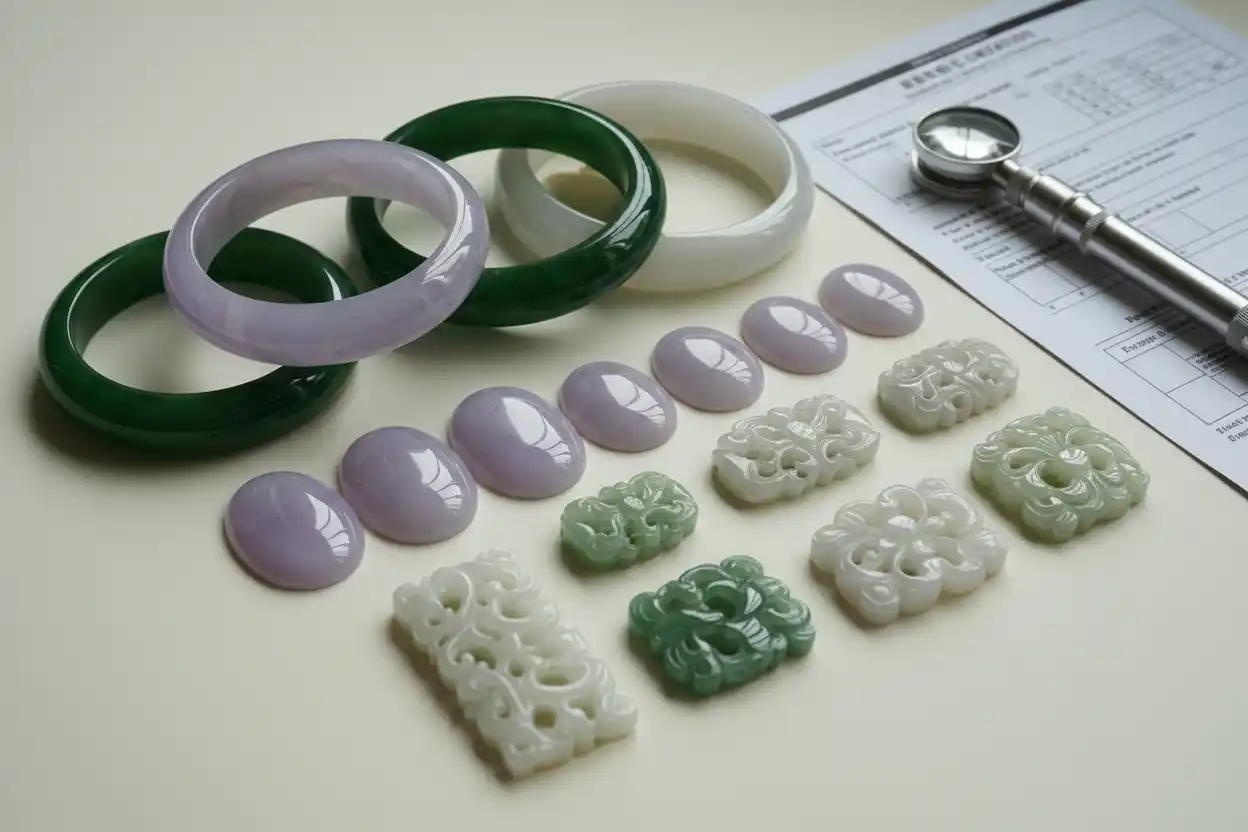
Buy Jade: Buyer Essentials, Value Factors & Seller Claims
To buy jade confidently, begin by determining what material the seller means by the word jade, because jade is not one single mineral with one universal value scale. Modern gemological usage includes jadeite and nephrite, and GIA also recognizes some green omphacite under the broader jade or fei cui framework. Jadeite, nephrite, and omphacite differ in mineral composition, typical colors, transparency, texture, treatment concerns, geographic sources, and market demand, so a listing that says only “natural jade” leaves one of the most important buying questions unanswered.
For fine jadeite, color, transparency, and texture are the three most important quality factors, with color having the strongest influence on value. GIA identifies vivid, highly translucent emerald-like green jadeite—traditionally called Imperial jade—as the most valuable category, while lavender, white, orange, yellow, black, gray, and multicolored jadeite can also be attractive and commercially important. Treatment status is equally important because jadeite can be bleached, polymer impregnated, dyed, waxed, coated, or otherwise modified, and the A/B/C terminology commonly used in the jade trade describes treatment category rather than overall beauty or quality.
Buy Jade At a Glance
| Buying Factor | What to Check | Why It Matters |
|---|---|---|
| Material Identity | Jadeite, nephrite, or qualifying green omphacite | Different jade materials follow different rarity and pricing structures |
| Color | Hue, tone, saturation, evenness, attractive mottling | Color is the leading jadeite value factor |
| Transparency | Opaque, translucent, semitransparent | Fine jadeite becomes especially valuable when strong color combines with translucency |
| Texture | Fine, medium, or coarse grain | Fine texture improves luster and contributes to the classic smooth jade appearance |
| Treatment Class | A, B, C, or combinations such as B+C | Treatments can materially change appearance, durability, and market category |
| Dye | Artificial color concentration or laboratory evidence | Dyed jade should not be compared directly with natural-color jade |
| Polymer Impregnation | Acid bleaching followed by resin impregnation | B jade belongs to a different value category from untreated A jade |
| Construction | Solid hololith, assembled piece, composite, backed material | One-piece bangles and carvings can require far more valuable rough |
| Cut & Carving | Symmetry, thickness, polish, carving quality, waste of rough | Craftsmanship can add substantial value |
| Size | Millimeter dimensions rather than carat alone | Jade is commonly sold by piece and form rather than weight |
| Fractures | Surface-reaching cracks, healed fractures, structural flaws | Fractures can reduce both beauty and value substantially |
| Origin | Myanmar, Guatemala, or other provenance | Origin can influence demand but requires evidence |
| Documentation | Laboratory identification, treatment findings, origin when available | Critical for expensive jadeite because treatment and origin can be difficult to judge visually |
| Condition | Chips, scratches, repairs, polish wear | Important in bangles, beads, carvings, and antique jewelry |
First Determine Whether the Jade Is Jadeite or Nephrite
Jadeite and nephrite have both been called jade for centuries, but they are mineralogically different. GIA lists jadeite as a sodium-aluminum pyroxene and nephrite as a calcium-magnesium-iron amphibole aggregate; their interlocking microscopic crystal structures help explain why both materials are exceptionally tough despite only moderate Mohs hardness. This distinction matters commercially because the very highest jade prices are generally associated with exceptional jadeite rather than ordinary nephrite, while fine nephrite has its own important collector, cultural, carving, and jewelry markets.
A seller should therefore state the material clearly. “Green jade,” “real jade,” and “genuine jade” are incomplete descriptions when the price depends on whether the object is jadeite or nephrite. Some inexpensive green materials such as serpentine, quartz, aventurine, calcite, glass, and other ornamental stones have historically been sold under jade-like trade names, which makes independent identification particularly useful for higher-value purchases. GIA notes that the term jade has often been applied incorrectly to a range of natural and manufactured materials that merely resemble jade.
The issue has become even more nuanced because some green omphacite can qualify under modern jade or fei cui usage. GIA notes that certain omphacite material can closely resemble fine green jadeite in color and gemological properties and may require Raman spectroscopy or other advanced testing for accurate identification. A buyer should therefore avoid assuming that every vivid green translucent jade-like piece is pure jadeite simply because it resembles traditional Imperial jade.
Jadeite Color Is the First Major Quality Factor
GIA identifies color as jadeite’s most important value factor. Fine jadeite occurs in many colors, but the most highly prized green combines strong saturation, attractive tone, good uniformity or visually pleasing distribution, and enough transparency to create depth and an internal glow. Imperial-quality green is described as vivid, penetrating, and nearly transparent to semitransparent rather than dark, muddy, or grayish.
The commercial preference for vivid green does not mean that every greener piece is automatically better. A dark opaque green jadeite can contain stronger color concentration yet look less lively than a slightly lighter semitransparent piece because light cannot penetrate the darker material effectively. Conversely, pale transparent jadeite can possess excellent texture and clarity but still lack the saturation required for the strongest green-color premium. Color, transparency, and texture should therefore be evaluated together rather than as independent checkboxes.
Lavender jadeite is another important market category, and GIA notes that lavender is generally the next most highly valued jadeite color after fine green. Strong, even lavender with good translucency can command substantial demand, while orange, reddish, white, black, yellow, and multicolored material can also be valuable when color, texture, transparency, and craftsmanship combine attractively. Buyers should judge the actual stone rather than assuming that any green jade must outrank every non-green example.
Transparency Can Transform the Value of Jadeite
Jadeite transparency ranges from opaque through translucent to semitransparent, and GIA identifies semitransparency as especially desirable because light penetrates below the surface and gives fine jadeite a luminous, almost glowing appearance. This characteristic is why two jadeite pieces with similar green color can differ enormously in desirability when one looks dense and opaque while the other appears lively and internally illuminated.
Transparency should be judged across the entire piece. Cloudy zones, opaque patches, fractures, mineral inclusions, and uneven texture can interrupt the passage of light even when other portions look translucent. A dealer may illuminate jade strongly from behind to make the color appear more vivid, so buyers should inspect the piece under normal reflected lighting as well as transmitted light.
Thickness also affects apparent transparency. A thin pendant may appear more translucent than a thick bangle carved from comparable material simply because light travels through less jade. The buyer should therefore compare pieces with similar form and thickness rather than concluding that the thinner object automatically comes from superior rough.
Texture Is a Core Jadeite Quality Factor
Jadeite is a polycrystalline aggregate composed of interlocking grains, and the size and arrangement of those grains produce textures ranging from fine to coarse. GIA explains that fine-grained jadeite has a smoother texture and higher luster, while coarser material can appear less refined.
Fine texture can also improve the apparent transparency and polish of a piece. A vivid green cabochon with coarse granular texture may lack the sleek, almost watery appearance associated with top jadeite, while finer material can produce cleaner reflections and a more elegant surface.
Trade expressions such as old mine, relatively old mine, and new mine are sometimes used for texture categories, but they should not be interpreted literally as reliable geological age or mine provenance. The visible and gemological texture of the jade is more useful than romantic terminology.
Clarity and Fractures Have Different Effects on Value
Jadeite can contain mineral inclusions, darker spots, white areas, compositional variation, and fractures. Some mottling or veining can be aesthetically attractive, particularly in carved material where the artisan incorporates natural color variations into the design. Fractures are more serious because they can affect both structural integrity and the uninterrupted appearance prized in fine jadeite. GIA identifies fractures as one of the most severe jadeite clarity defects and notes that they can have a major impact on value.
Inspect bangles especially carefully because a fracture extending across the wall can substantially reduce security even though jade itself is exceptionally tough. Fine hairlines should be distinguished from harmless color boundaries or mineral veins through magnification and, for valuable pieces, professional examination.
A filled or polymer-treated fracture creates another layer of complexity. An area can appear visually cleaner after treatment while belonging to a lower treatment category than comparable untreated jadeite.
Understand What A Jade Means
In the widely used treatment terminology, A jade refers to jadeite that is natural or has only received traditional surface waxing associated with normal finishing. GIA distinguishes this from B jade, which has undergone acid bleaching and polymer impregnation, and C jade, which has been artificially dyed.
The letter A is not a quality grade. An unattractive opaque A-jade piece can be much less valuable than another untreated jadeite with exceptional color, translucency, and texture, while the A designation simply indicates treatment category.
This distinction is crucial because sellers sometimes describe A jade as though the A meant “highest grade.” It does not. It answers a treatment question rather than a beauty or rarity question.
Understand What B Jade Means
B jade refers to jadeite that has been chemically bleached, typically with acid, and subsequently impregnated with polymer resin. The bleaching removes unwanted brown or gray components and opens voids or fractures, while polymer impregnation fills those spaces and can improve apparent clarity and stability. GIA research describes this two-stage process and notes that infrared spectroscopy is particularly useful for identifying polymer impregnation.
B jade remains jadeite; it is not automatically imitation material. The underlying mineral aggregate is natural jadeite, but its appearance and structure have been significantly modified.
The important buying issue is disclosure. B jade should be valued within the treated-jade market rather than priced as equivalent untreated A jade of comparable apparent color and transparency.
Understand What C Jade Means
C jade refers to dyed jadeite. GIA’s buyer guidance distinguishes dyed C jade from untreated A jade and polymer-impregnated B jade. Artificial coloring can intensify green, lavender, or other hues, especially in lighter or porous areas, creating a more attractive visual effect than the original material possessed.
Dyed jade can make attractive jewelry and carvings when sold honestly, but artificial color does not carry the same rarity basis as comparable natural coloration.
The buyer should also be aware that combinations occur. Material can be both bleached/polymer impregnated and dyed, often described commercially as B+C jade, so a simple A/B/C framework may need additional detail for some pieces.
Treatment Can Be Difficult to Detect With the Eye Alone
Jade treatment is one of the strongest reasons to use a reputable laboratory for expensive purchases. Polymer impregnation can be subtle, dye can be carefully distributed, and visual tests promoted online are often unreliable.
GIA’s historical research on B jade demonstrated that common gemological observations can help but that infrared spectroscopy provides conclusive evidence for polymer impregnation in difficult cases. Modern laboratories can also use Raman spectroscopy, FTIR, microscopy, fluorescence, and other methods to distinguish mineral identity and treatment.
A seller’s verbal statement should not be treated as equivalent to an independent laboratory conclusion when treatment category represents a major portion of the price.
Waxing Is Not the Same as Polymer Impregnation
Traditional jade finishing can include wax applied to the surface after polishing. In the A/B/C system, ordinary waxing associated with normal finishing can still fall within the A-jade category, while polymer impregnation after acid bleaching belongs to B jade.
This distinction matters because both processes involve foreign substances but have very different effects on the jade. Wax is largely a surface finishing treatment, while polymer impregnation enters openings created or exposed through bleaching and changes the internal appearance and structural behavior more substantially.
Buyers should not reject every mention of wax as though it means the jade is B jade.
Jadeite and Nephrite Have Exceptional Toughness
Jade is famous for toughness rather than extreme hardness. GIA reports jadeite at approximately 6.5 to 7 on the Mohs scale and nephrite around 6 to 6.5, yet both materials resist breaking and chipping exceptionally well because of their interlocking crystal structures.
This distinction explains why jade was historically used for tools, weapons, ritual objects, bangles, and thin carvings. A stone can be softer than sapphire yet substantially tougher under impact because hardness measures scratch resistance while toughness measures resistance to breaking.
Owners should still protect polished jade from abrasive contact because quartz-containing dust and harder gemstones can scratch the surface over time.
Bangles Require a Different Buying Framework From Cabochons
A fine jadeite bangle can be extraordinarily valuable because the cutter must find a large enough section of rough with suitable color, texture, transparency, and structural integrity to carve a complete ring from one piece. GIA notes that hololith bangles carved from a single piece of jadeite involve substantial rough loss and can command more than joined constructions.
Inspect a bangle for uniformity around the full circumference rather than judging only the most attractive green section shown in a product photograph. Look for fractures, repaired breaks, weak spots, changes in texture, significant color concentrations, and signs that separate sections have been joined.
Fit also matters because jade bangles are traditionally worn close to the wrist and may have smaller openings than metal bracelets. A piece can be beautiful but commercially unsuitable for a buyer if the internal diameter does not fit safely.
Cabochons Should Be Judged for Shape, Thickness, and Color Distribution
Fine jadeite is commonly fashioned into cabochons. GIA explains that buyers evaluate cabochon symmetry, proportion, thickness, color, transparency, texture, and polish, while top material is often cut to preserve quality rather than to standardized calibrated dimensions.
A very thin cabochon can appear more transparent but may lack the depth and richness expected from a valuable piece. Excessive thickness can make material look darker and reduce apparent translucency.
Side-view photographs are therefore valuable because they reveal whether the shape and thickness support the face-up appearance honestly.
Beads and Strands Add a Matching Premium
Fine jadeite bead strands can command substantial premiums because producing many beads with matching color, transparency, texture, size, and polish is difficult. GIA notes that matching becomes increasingly challenging as bead size and strand length increase.
A necklace should therefore be judged both bead-by-bead and as a complete matched set. One or two significantly darker, coarser, or more opaque beads can disrupt the uniform appearance.
Drill holes deserve inspection as well because treatment concentration, chips, or cracks may become visible around drilled areas.
Carvings Need Both Gem and Artistic Evaluation
Jade has an exceptionally important carving tradition, and a carved object cannot be valued solely by raw material quality. GIA notes that cutters and carvers often use uneven color distribution creatively, incorporating green veins, white areas, or contrasting colors into the subject.
Craftsmanship therefore becomes a separate value factor. Fine carving should show intentional design, smooth polish, controlled undercutting, good proportions, and intelligent use of natural color.
A mediocre carving in high-quality jadeite may destroy part of the rough’s potential value, while masterful carving can elevate material whose color pattern might be less suitable for a plain cabochon.
Size Is Usually Expressed More Usefully in Millimeters Than Carats
GIA notes that jadeite is commonly sold by the piece and that size is often expressed in millimeters rather than simply by carat weight. This makes sense because a bangle, bead, carving, cabochon, or saddle ring has a functional and aesthetic form that cannot be captured adequately by weight alone.
With top-quality Imperial jadeite, relatively small increases in dimensions can produce large jumps in value because sufficiently large areas of uniformly fine rough are difficult to obtain.
Nephrite generally behaves differently because larger sizes are more readily available in many qualities, so a large nephrite carving does not automatically carry the same size-driven premium as fine Imperial jadeite.
Myanmar Remains an Important Jadeite Source
Myanmar has historically been the most important source of fine gem-quality jadeite, and GIA describes its deposits as the principal traditional source of top-grade material. The market therefore places strong cultural and commercial importance on Burmese or Myanmar jadeite, particularly at the highest quality levels.
A Myanmar label still does not guarantee quality. The source produces a broad spectrum from low-grade commercial material to extraordinary translucent green jadeite.
Buyers should treat geographic origin as an additional provenance factor rather than allowing the country name to replace color, transparency, texture, treatment, and craftsmanship.
Guatemala Is an Increasingly Important Source
Guatemala is a historically important jade region and a major modern source of jadeite and jadeite-omphacite material. GIA notes that Guatemala has become the second-largest producer of jadeite jade and documents material ranging from traditional blue-green colors to highly translucent vivid green stones resembling fine Myanmar jade visually.
Recent GIA observations show that some high-quality Guatemalan jadeite-omphacite can be remarkably similar in appearance to fine Myanmar material, reinforcing why origin should not be guessed from color alone.
This expanding market gives buyers more choices, but it also makes reliable origin documentation more important when a seller attaches a large premium specifically to Myanmar provenance.
GIA Can Now Provide Geographic-Origin Reporting for Eligible Jade
GIA’s current Colored Stone Identification & Origin Report includes jade among eligible gem types. GIA has specifically developed country-of-origin determination for untreated jadeite jade and omphacite jade from Myanmar and Guatemala when origin can be determined.
That does not mean every jade item can receive a definitive country result. Origin determination depends on material type, treatment condition, available reference data, and whether the laboratory can reach a supportable conclusion.
For an expensive untreated jadeite piece whose price relies heavily on Burmese or Guatemalan provenance, a proper origin report can provide much stronger evidence than a dealer assertion.
Nephrite Should Not Be Priced as Jadeite
Nephrite is genuine jade, but its market structure differs from fine jadeite. GIA identifies nephrite as a separate jade material with generally more muted colors and a different mineral composition.
Fine nephrite can be extremely desirable, particularly white, creamy, spinach-green, historically important, or artistically carved material, but its value drivers should be evaluated within the nephrite market.
A buyer should not pay Imperial-jadeite pricing for nephrite merely because both are authentic jade.
Be Careful With Jade-Like Trade Names
Terms such as Malaysian jade, new jade, Korean jade, mountain jade, serpentine jade, or similar commercial names can refer to materials that are not jadeite or nephrite.
GIA notes that many materials have historically been incorrectly described using jade terminology. A seller may be using an established ornamental-stone trade name rather than deliberately trying to mislead, but the buyer still needs the actual mineral identity before deciding what the item is worth.
For valuable purchases, insist on a mineralogical conclusion rather than a color-based trade label.
Laboratory Identification Is Especially Important for High-Value Jade
GIA’s Colored Stone Identification Report can identify polished loose or mounted material, state whether it is natural or laboratory-grown where applicable, and disclose detectable treatments. Its Identification & Origin Report can add geographic origin for eligible jade when determinable.
A report should be read carefully rather than summarized loosely by the seller. “Jadeite jade” is not the same statement as “untreated jadeite from Myanmar,” and a treatment disclosure can materially change the appropriate price comparison.
Laboratory documentation is not a monetary appraisal. It establishes what the material is and how it has been treated; fair price still requires market comparison.
Care Depends on Treatment Status
GIA states that untreated jadeite and nephrite can tolerate ultrasonic and steam cleaning, but treated jade may be vulnerable because dye, polymer impregnation, coatings, and other enhancements can respond differently. Warm soapy water remains the safest general cleaning method.
Heat from a jeweler’s torch can damage jade, so repair work on mounted pieces should be performed by someone familiar with the material and its treatment status.
B jade in particular deserves conservative care because polymer impregnation introduces a substance with different heat and chemical resistance from the jadeite aggregate itself.
Common Red Flags When You Buy Jade
Be cautious when:
A seller says only “real jade” but will not specify jadeite, nephrite, or omphacite.
“A jade” is described as an overall quality grade rather than a treatment category.
A vivid green piece carries a major natural-color premium without independent treatment testing.
B jade is represented as untreated.
C jade is represented as naturally colored jadeite.
Myanmar origin is asserted solely from appearance.
A GIA identification report is described as proving an origin it does not state.
A bangle fracture is dismissed merely because jade is “unbreakable.”
Bright backlighting is used to conceal how dark or opaque the jade looks normally.
Carat weight is emphasized while dimensions, thickness, and form are ignored.
A jade-like trade name is used without identifying the actual material.
Guaranteed appreciation is used to justify the purchase.
A higher price should bring stronger disclosure, better documentation, clearer photography, and more generous independent inspection rights.
How to Compare Jade Listings Fairly
Compare jade only after aligning the material type, color, transparency, texture, treatment category, fractures, cut or carving form, dimensions, craftsmanship, condition, geographic provenance, laboratory documentation, and transaction type. A fine untreated jadeite cabochon should not be compared directly with dyed nephrite, B-jade bangles, carved serpentine, or an antique jade object whose value comes partly from history and craftsmanship. Once the categories are matched properly, numerical price comparisons become much more meaningful.
Conclusion
To buy jade well, first determine what the material actually is and how it has been treated. Jadeite, nephrite, and qualifying green omphacite can all fall within modern jade usage, yet their mineralogy and market behavior differ substantially. For fine jadeite, GIA identifies color, transparency, and texture as the three leading value factors, while fractures, cutting, size, treatment, and craftsmanship further refine quality.
Treatment disclosure is especially important because A, B, and C jade describe fundamentally different enhancement categories. B jade has been acid bleached and polymer impregnated, while C jade has been dyed; neither should be valued as equivalent untreated natural-color jadeite solely because the final appearance is attractive.
For important jadeite purchases, laboratory documentation can now go beyond identity and treatment to include geographic-origin determination for eligible untreated jade from Myanmar or Guatemala when determinable. Combining that evidence with careful evaluation of the actual piece provides a far more defensible buying decision than relying on seller grades, famous locality names, or color alone.
Frequently Asked Questions
What is the first thing to check when I buy jade?
Determine whether the material is jadeite, nephrite, or another material. Modern gemology recognizes jadeite and nephrite as the principal jade materials and also includes some green omphacite under certain conditions. Knowing the material type is essential before treatment, quality, origin, or price can be compared properly.
Which type of jade is usually the most valuable?
Exceptional jadeite generally reaches the highest prices, particularly vivid semitransparent Imperial-green material with fine texture. GIA identifies color, transparency, and texture as the three most important jadeite value factors. Fine nephrite can also be valuable, but it belongs to a different market.
What is A jade?
A jade refers to natural jadeite or jadeite that has only received ordinary waxing associated with polishing. It does not mean “grade A” quality. A low-quality opaque piece can still be A jade if it has not undergone the treatments associated with B or C material.
What is B jade?
B jade is jadeite that has been chemically bleached and then impregnated with polymer resin. The treatment can remove brownish material and improve apparent clarity, but it places the jade in a different market category from untreated A jade.
What is C jade?
C jade is dyed jadeite. Artificial coloring can create stronger green, lavender, or other colors, so dyed material should be disclosed and compared with other treated jade rather than natural-color jadeite.
Is darker green jade always better?
No. The finest jadeite combines vivid attractive green with transparency, fine texture, and good overall appearance. A very dark opaque piece can be less valuable than a somewhat lighter semitransparent stone because light penetration creates much of fine jadeite’s prized glow.
Is jade hard to break?
Jadeite and nephrite are exceptionally tough even though their Mohs hardness is only moderate. GIA lists jadeite at roughly 6.5 to 7 and nephrite around 6 to 6.5, while both are highly resistant to chipping and breaking because of their interlocking structures.
Can GIA identify jade treatments?
Yes. GIA colored-stone reports identify jade material and list detectable treatments. This is especially useful for distinguishing untreated jade from dyed or polymer-impregnated material.
Can GIA confirm Burmese or Guatemalan jade origin?
For eligible untreated jadeite jade and omphacite jade, GIA currently offers geographic-origin determination for Myanmar or Guatemala when the evidence supports a conclusion.
Is nephrite fake jade?
No. Nephrite is genuine jade and has been recognized as jade for centuries. It is mineralogically different from jadeite and usually follows a different market structure.
Should I buy jade without a laboratory report?
For inexpensive decorative jade from a trusted seller, a laboratory report may not always be economically necessary. For costly jadeite, especially material sold as untreated Imperial quality or with a prestigious geographic origin, independent identification and treatment testing can significantly reduce risk.
Is jade a guaranteed investment?
No. Exceptional jadeite can be rare and highly valuable, but future resale depends on material type, treatment, color, transparency, texture, size, condition, provenance, demand, transaction costs, and market liquidity. No A-jade label, origin claim, or retailer grade guarantees appreciation.