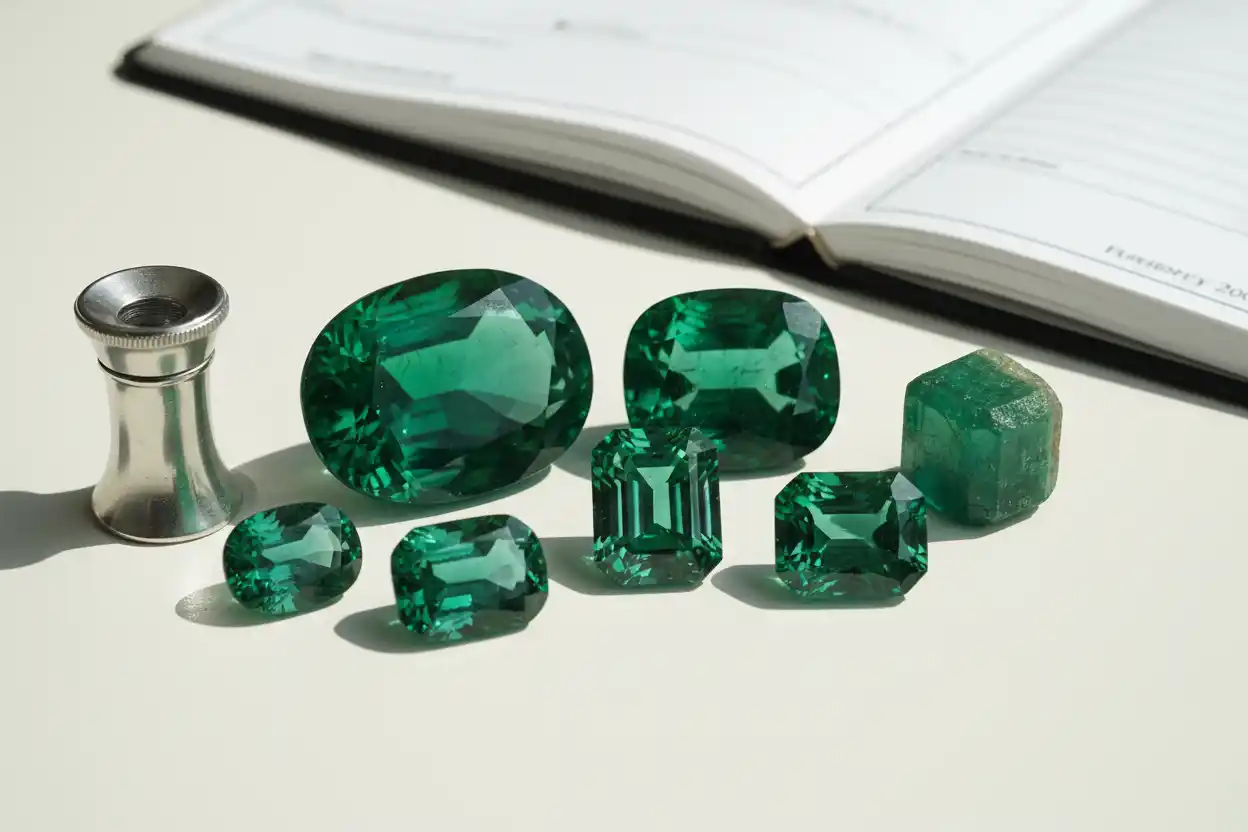
Buy Lab Emerald: How to Evaluate Stones, Origin, Quality & Red Flags
To buy lab emerald confidently, first establish that the gemstone is genuinely laboratory-grown emerald rather than green glass, synthetic spinel, cubic zirconia, dyed material, or another emerald simulant. A laboratory-grown emerald is synthetic emerald—man-made beryl grown with the material characteristics of emerald rather than a visually similar substitute. GIA colored-stone reports can determine whether a submitted gemstone is natural or synthetic and identify detectable treatments, which is particularly useful for larger or more expensive synthetic emeralds where a visual mistake could materially affect the price.
Laboratory-grown emerald can be produced by established synthetic-crystal methods including flux and hydrothermal growth, and the resulting stones can contain microscopic growth features that trained gemologists use to distinguish manufactured emerald from natural material. Regardless of growth method, the finished gem should still be evaluated for emerald’s most important visible characteristics: attractive bluish-green to pure-green color, vivid saturation, controlled tone, good transparency, effective cutting, and structural condition. GIA identifies color as emerald’s defining quality factor and notes that the most desirable emerald colors are bluish green to pure green with vivid saturation and tone that is not excessively dark.
Buy Lab Emerald At a Glance
| Buying Factor | What to Check | Why It Matters |
|---|---|---|
| Identity | Laboratory-grown emerald rather than a green simulant | Similar appearance does not establish emerald identity |
| Growth Method | Hydrothermal or flux-grown when known | Both are established synthetic emerald processes |
| Color | Bluish green to pure green, saturation, tone, evenness | Color remains emerald’s leading visual quality factor |
| Transparency | Bright transparent appearance | Excess cloudiness reduces brilliance |
| Clarity | Growth features, inclusions, fractures, zoning | Synthetic emerald is not necessarily flawless |
| Cut | Windowing, depth, symmetry, polish, color presentation | Poor cutting can waste excellent synthetic rough |
| Carat Weight | Weight together with millimeter dimensions | Manufacturing changes size rarity assumptions |
| Post-Growth Treatment | Fracture filling, coating, dye, or other modification | Synthetic origin and treatment are separate questions |
| Report | Natural/synthetic determination and detectable treatments | Useful for valuable stones |
| Geographic Claims | Avoid mined-origin language such as Colombian unless clearly qualified | Manufacturing provenance is not geological origin |
| Manufacturer | Producer and process information when available | Can improve traceability |
| Durability | Fractures and setting protection | Emerald remains beryl regardless of growth origin |
| Care | Treatment-specific cleaning requirements | Heat, steam, and ultrasonics can be risky in filled stones |
| Seller Grade | Actual characteristics behind AAA or AAAA | No universal GIA quality grade exists for emerald |
| Return Policy | Inspection and refund conditions | Screen color can differ from real-life appearance |
Laboratory-Grown Emerald Is Not Green Glass
A synthetic emerald and a simulant can both be manufactured, but they are not the same thing. The synthetic emerald is grown as beryl with emerald characteristics, while a simulant is another material chosen because it resembles emerald visually.
This distinction matters because material identity affects hardness, refractive behavior, durability, inclusions, optical character, care, and market value.
FTC guidance allows laboratory-created gemstone terminology when the manufactured material possesses essentially the same optical, physical, and chemical characteristics as the named natural stone, while requiring disclosure so consumers understand that it is not mined.
“Created Emerald” Is a Laboratory-Grown Emerald Term
GIA notes that laboratory-grown emeralds are often marketed with manufacturer names and the term created rather than only the word synthetic, and FTC guidance permits wording such as laboratory-grown, laboratory-created, and manufacturer-name-created when used appropriately.
The terminology should still make origin unmistakable. A listing that calls a stone emerald in the headline while hiding laboratory-created status deep in the description creates unnecessary ambiguity.
Clear disclosure protects the buyer without reducing the legitimacy of the product.
Flux-Grown Emerald and Hydrothermal Emerald Are Both Valid Synthetic Emerald
Flux growth and hydrothermal growth are established methods for producing synthetic emerald. They use different growth environments, can produce different characteristic inclusions and zoning, and may require different production times and equipment.
Neither method should be treated automatically as better. A beautifully colored hydrothermal emerald can be excellent, while a fine flux-grown stone can be equally attractive for a buyer who values its appearance or historic manufacturing method.
The correct comparison focuses on the individual gemstone rather than assuming growth method alone determines quality.
Color Remains the Leading Quality Factor
GIA identifies the most desirable emerald color as bluish green to pure green with vivid saturation and tone that is not too dark. The same visual framework is useful when comparing laboratory-grown emerald, even though the economic rarity of that color differs from natural emerald.
A synthetic emerald that appears nearly black except under intense lighting is not automatically better because its green is technically deeper. Likewise, a very pale green stone can be attractive but may not deliver the classic emerald appearance expected by the buyer.
Compare color under neutral lighting and request video that shows the stone without excessive saturation enhancement.
Uniformity Matters, but Perfect Uniformity Is Not Required
Laboratory growth can create remarkably even green color, yet zoning can still occur. Some buyers prefer uniform color, while others appreciate visible growth character.
Uneven color becomes a value problem when large areas appear washed out, yellowish, excessively blue, or significantly darker than the rest of the stone.
A skilled cutter can sometimes orient the crystal to make the most attractive color dominate face-up.
Transparency Adds Life to the Green
GIA states that the most prized emeralds are highly transparent and that clarity and transparency interact strongly in determining appearance. A laboratory-grown emerald can often provide better visual cleanliness than typical natural emerald because controlled crystal growth can reduce some of the geological fractures and inclusions common in mined material.
That does not mean every synthetic emerald is crystal-clear. Growth structures, inclusions, seed-related features, veils, or fractures can still occur.
The buyer should judge whether the finished stone looks lively and transparent to the unaided eye rather than demanding microscopic emptiness.
Lab Emerald Can Have Inclusions
One of the most persistent misconceptions is that laboratory-grown gemstones must be flawless. Synthetic crystals grow through real crystallization processes, and those processes can create characteristic internal features.
Inclusions can help professional gemologists identify synthetic growth and sometimes even distinguish production methods.
A seller advertising every inclusion as proof that the emerald must be natural should therefore be treated cautiously because synthetic emeralds can contain convincing internal features as well.
Extremely Clean Lab Emerald Is Not Automatically Suspicious
Natural emerald is famous for its inclusions, and GIA notes that eye-clean natural emeralds are rare and especially valuable. Laboratory-grown production changes that rarity equation, making cleaner material much more accessible.
A clean synthetic emerald can therefore be completely legitimate.
The buyer should appreciate the visual cleanliness without assuming that the same level of clarity would command natural-emerald pricing.
Cut Still Controls Beauty
An emerald with strong green color can still look weak if the cut produces a large central window or excessive extinction. GIA explains that emerald cutters use proportions and facet arrangement to influence apparent tone and saturation, sometimes cutting pale material deeper and dark material shallower to manage color.
The same optical principles apply to synthetic emerald.
Check the stone face-up for brightness, even color, symmetry, polished surfaces, and a center that looks alive rather than transparent and empty.
The Emerald Cut Is Not Mandatory
The rectangular step cut became closely associated with emerald because truncated corners can reduce vulnerability and the broad facets show the stone’s color beautifully. GIA notes that emerald cut remains a common fashioning style.
Laboratory-grown emerald can also be cut into ovals, cushions, rounds, pears, radiants, and custom designs.
Choose shape according to appearance and jewelry design rather than assuming only a rectangular stone can be a legitimate emerald.
Compare Dimensions With Carat Weight
Emerald’s density differs from diamond, so equal carat weights do not translate into equal visible dimensions. GIA notes that a one-carat emerald can appear larger than a one-carat diamond because emerald is less dense.
Within synthetic emerald itself, cut depth also changes visible size.
A deep five-carat stone may face up smaller than a well-proportioned four-carat alternative, making length, width, and depth essential buying information.
Large Lab Emerald Does Not Carry Natural Emerald’s Geological Size Premium
A large fine natural emerald can command an enormous premium because nature must produce a large crystal with strong color, sufficient transparency, manageable inclusions, and useful cutting yield.
Laboratory-grown emerald comes from controlled crystal manufacture, so its size economics are based on growth time, reactor or crucible capacity, yield, defects, cutting loss, and production success rather than geological scarcity.
A ten-carat lab emerald can still cost more than a two-carat one, but it should be compared with other synthetic emeralds rather than priced from the natural-emerald market.
Synthetic Origin and Treatment Are Separate Questions
A laboratory-grown emerald can potentially undergo treatment after growth. The word synthetic describes where the crystal formed; it does not answer every later treatment question.
GIA’s Colored Stone Identification Report states whether the submitted material is natural or synthetic and lists detectable treatments.
A seller who answers treatment questions only by repeating “lab-grown” has not necessarily addressed whether fractures were filled, the surface was coated, or another modification occurred.
Fracture Filling Can Affect Care
Emerald treatment commonly involves oils, resins, or polymers used to reduce the appearance of fractures, and GIA notes that heat, chemicals, steam, and ultrasonic cleaning can affect fracture-filled emeralds.
A laboratory-grown emerald with no significant fractures may not need the same treatment, but the buyer should follow the actual stone’s report rather than assume all synthetic emeralds are unfilled.
Warm soapy water remains a conservative cleaning method when treatment status or structural condition is uncertain.
Lab Emerald Still Has Emerald’s Basic Durability Profile
Emerald is beryl and measures about 7.5 to 8 on the Mohs hardness scale, while toughness is fair to good rather than exceptional. A laboratory-grown emerald shares that basic material framework.
Hardness protects reasonably well against scratching but does not make the stone immune to chipping or breaking.
A structurally sound synthetic emerald can work well in a ring, yet protective setting design remains sensible for frequent wear.
Hydrothermal Does Not Automatically Mean Untreated
Hydrothermal describes the growth environment. It does not guarantee that no subsequent process has occurred.
The same principle applies to flux-grown emerald.
Growth method, natural-versus-synthetic origin, and detectable treatments should be treated as three separate descriptive questions.
“Colombian Lab Emerald” Can Be Misleading
Colombia is famous as a geological source of natural emerald. A laboratory-grown emerald does not acquire Colombian geological origin because it resembles Colombian color or because a seller uses the phrase Colombian green.
A manufacturer could operate physically in Colombia, but that would describe manufacturing location rather than mine origin.
For natural emerald, the Gems Lore buy emerald guide and emerald price guide explain the distinct importance of treatment, locality, and natural rarity.
Geographic-Origin Reports Are for Natural Emerald
GIA’s current Identification & Origin Report provides geographic origin for eligible natural emerald when determinable, while its general Colored Stone Identification Report can identify synthetic material and detectable treatments.
A laboratory-grown emerald therefore should not be sold with the implication that it has a Colombian, Zambian, Brazilian, or Afghan mining origin.
Its meaningful provenance is the laboratory, producer, growth method, and manufacturing history.
Manufacturer Provenance Can Still Be Valuable
A recognized producer can provide useful traceability, consistent color ranges, known growth methods, guarantees, and manufacturing documentation.
Vintage synthetic emerald from historically important producers can also interest collectors because the object documents the technological history of gem synthesis.
This is a different form of provenance from natural mine origin but can still be meaningful.
GIA Can Confirm Natural Versus Synthetic Origin
GIA’s Colored Stone Identification Report identifies gemstone type, states whether material is natural or synthetic, and lists detectable treatments for polished loose or mounted gemstones.
That service can be particularly valuable for expensive synthetic emerald because many low-cost green materials can imitate its appearance.
The laboratory report does not assign the gemstone a retail value or a universal quality grade.
GIA Does Not Issue AAA Lab Emerald Grades
GIA states that it evaluates emerald but does not grade it in a universal overall-quality sense.
AAA, AAAA, 5A, premium Colombian color, investment quality, and similar labels therefore need seller-defined criteria before they can be compared.
Ask what the grade actually represents in terms of hue, saturation, transparency, inclusions, cut, treatment, and dimensions.
Lab Emerald Versus Natural Emerald
A natural emerald’s price reflects geology, mine origin, natural color, inclusions, treatment, size, cut, and established collector demand. Synthetic emerald’s price reflects manufacturing, growth quality, color, transparency, cutting, size, brand, treatment, documentation, and retail competition.
Visual appearance can be remarkably similar while economic rarity remains entirely different.
The strongest reason to choose lab emerald is usually access to larger, cleaner, richly colored emerald material at a substantially more accessible budget, not the expectation that it should carry the same monetary value as natural emerald.
Lab Emerald Versus Other Green Simulants
Green glass, synthetic spinel, cubic zirconia, YAG, and other materials can be cut to imitate emerald.
Those products can be attractive in their own right, but they should not be labeled laboratory-grown emerald unless they possess emerald’s material characteristics.
This makes laboratory identification especially useful when a low selling price seems inconsistent with the size and apparent quality being offered.
Environmental Claims Need Their Own Evidence
Synthetic growth eliminates mining of the emerald crystal, but it uses equipment, electricity, water or solvents, chemicals, growth vessels, polishing, transportation, and jewelry manufacturing.
A seller describing laboratory-grown emerald as automatically zero-impact or carbon-neutral should provide the methodology behind the claim.
Laboratory-grown tells the buyer how the gem originated, not the complete environmental footprint of the finished jewel.
Return Rights Are Important Because Emerald Color Is Hard to Photograph
Green gemstones can shift considerably in photographs because cameras and screens alter white balance, saturation, brightness, and blue-versus-yellow balance.
A synthetic emerald that looks vivid bluish green on a website may appear darker or more yellowish in ordinary indoor light.
A reasonable return or inspection period gives the buyer time to assess the stone under realistic lighting before committing to permanent customization.
Common Red Flags When You Buy Lab Emerald
Be cautious when:
Green glass or another simulant is called laboratory-grown emerald.
Synthetic origin is hidden in fine print.
“Colombian lab emerald” is used to imply mined Colombian provenance.
Hydrothermal is marketed as automatically superior without discussing the actual stone.
Every lab emerald is described as flawless.
A seller refuses to discuss treatment after growth.
AAAA is presented as an official GIA quality grade.
Natural emerald prices are used to imply equal financial value.
A report is presented as a monetary appraisal.
Environmental claims come without supporting evidence.
Future appreciation is guaranteed.
How to Compare Lab Emerald Listings Fairly
Compare laboratory-grown emeralds by confirmed synthetic identity, growth method where known, hue, saturation, tone, transparency, inclusions, fractures, cut, carat weight, dimensions, post-growth treatment, producer information, laboratory report, setting craftsmanship, warranty, and return terms. Do not compare a clean five-carat synthetic emerald directly with a five-carat natural Colombian emerald as though equal appearance implied equal rarity.
Conclusion
To buy lab emerald confidently, establish identity first and then evaluate the finished gemstone on its own merits. GIA can determine whether colored-stone material is natural or synthetic and identify detectable treatments, giving buyers an independent route to confirm that a valuable green stone is genuinely laboratory-grown emerald rather than a simulant.
Color remains the dominant visual factor. GIA identifies bluish green to pure green, vivid saturation, appropriate tone, strong transparency, and good color distribution as hallmarks of desirable emerald appearance. Laboratory growth can make those qualities more accessible in larger and cleaner stones without reproducing the geological rarity of fine natural emerald.
The strongest purchase therefore combines clear synthetic disclosure, attractive green color, transparency, good cutting, sensible dimensions, treatment transparency, durable setting, reliable documentation, and fair synthetic-market pricing. Natural-mine prestige, undefined AAA labels, and misleading geographic terminology should not substitute for those qualities.
Frequently Asked Questions
Is a lab-grown emerald a real emerald?
A laboratory-grown emerald is synthetic emerald rather than an imitation. It is grown artificially as emerald material, while glass and other green simulants merely resemble emerald.
What does created emerald mean?
GIA notes that laboratory-grown emeralds are commonly marketed using “created” terminology, and FTC guidance permits terms such as laboratory-grown, laboratory-created, and manufacturer-name-created for appropriate man-made gemstone material.
Is hydrothermal emerald better than flux-grown emerald?
Not automatically. Both are established synthetic emerald growth approaches. Finished color, transparency, inclusions, cut, treatment, manufacturer quality, and price matter more than assuming one method is universally superior.
What color should a good lab emerald have?
GIA identifies bluish green to pure green with vivid saturation and tone that is not too dark as the most desirable emerald color range.
Can laboratory-grown emerald have inclusions?
Yes. Synthetic crystal growth can produce internal growth features, seed-related structures, zoning, fractures, or other inclusions. Laboratory-grown does not mean inclusion-free.
Is an eye-clean lab emerald rare like an eye-clean natural emerald?
No. Eye-clean natural emerald is rare because geological emerald commonly contains inclusions, while laboratory growth can produce cleaner material more consistently. The visual result can be similar without the same rarity basis.
Can a lab emerald be fracture filled?
Synthetic origin and post-growth treatment are separate issues. GIA reports state whether a colored stone is natural or synthetic and list detectable treatments.
Is lab emerald durable?
Emerald is beryl with a Mohs hardness around 7.5 to 8 and fair-to-good toughness. Fractures and fillings can reduce practical durability, so careful wear remains appropriate.
How should lab emerald be cleaned?
Warm soapy water is a conservative cleaning method, especially when fractures or treatment status are uncertain. GIA warns that steam and ultrasonic cleaning can be risky for fracture-filled emeralds.
Can GIA identify laboratory-grown emerald?
Yes. GIA’s Colored Stone Identification Report states whether material is natural or synthetic and identifies detectable treatments.
Can a lab emerald receive Colombian origin?
A laboratory-grown emerald has manufacturing origin rather than a natural mining origin. GIA geographic-origin reporting applies to eligible natural emerald, not to assigning a mine country to synthetic emerald.
Does GIA grade synthetic emerald AAA?
No. GIA evaluates emerald but does not provide a universal AAA or AAAA overall quality grade.
Is lab emerald a guaranteed investment?
No. Laboratory-grown emerald supply depends on manufacturing technology and market demand. Future resale can be influenced by producer competition, condition, brand, cutting, and secondary-market liquidity.