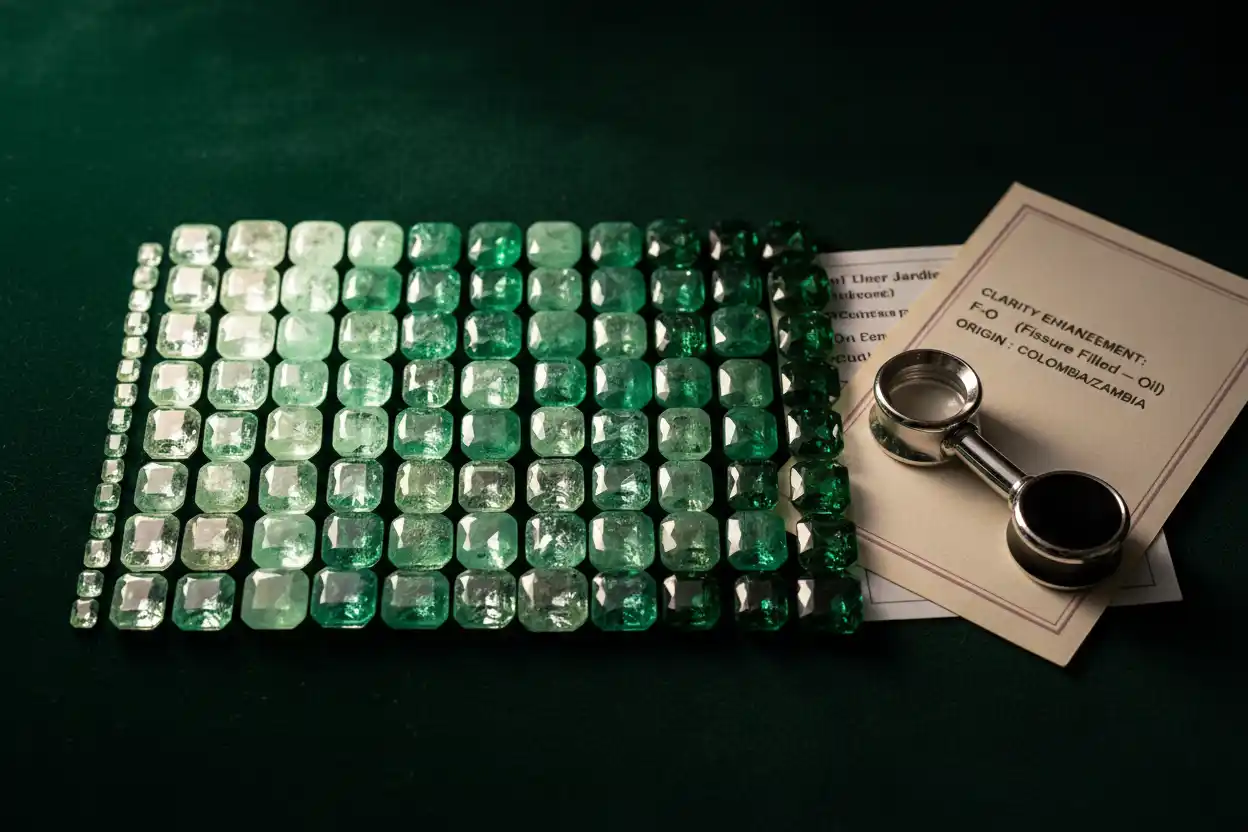
Emerald Price: Market Value, Condition, Quality & Rarity
Emerald price varies dramatically because emeralds occupy an unusually broad quality range in color, transparency, inclusion character, treatment extent, cut, size, origin, condition, and provenance. Emerald is the bluish green to green variety of beryl, and GIA identifies color as the most important quality factor, with the strongest demand generally centered on vivid bluish green to pure green stones whose tone is not excessively dark and whose color is distributed evenly. The same carat weight can therefore correspond to very different values when one stone is bright, transparent, minimally enhanced, finely cut, and well documented while another is dark, heavily fractured, significantly filled, or poorly proportioned.
Emerald also differs from many other transparent gems because eye-visible inclusions are expected rather than exceptional. GIA notes that eye-clean natural emeralds are particularly rare and that clarity treatment is common enough for its laboratory reports to quantify enhancement as minor, moderate, or significant. This makes universal emerald price-per-carat tables unreliable unless the stones being compared are aligned closely in color, transparency, treatment, size, origin, cut, and condition. Buyers preparing to enter the market should first read the Gems Lore buy emerald guide, because treatment disclosure and identity are inseparable from valuation.
Emerald Price At a Glance
| Value Factor | Stronger Value Signals | Factors That Can Lower Value |
|---|---|---|
| Color | Vivid bluish green to pure green, balanced tone, even distribution | Too pale, overly dark, strongly yellowish, grayish, uneven color |
| Transparency | Bright, lively stone with good transmission of light | Heavy inclusions or fissures reducing transparency |
| Clarity | Attractive natural inclusion pattern without major visual disruption | Dense inclusions, dark crystals, severe fissuring |
| Enhancement | None or minor enhancement when other quality remains fine | Moderate or significant filling can reduce comparability with minimally enhanced stones |
| Cut | Strong color presentation, brightness, limited windowing | Excessive depth, large window, poor symmetry, weak polish |
| Carat Weight | Larger fine stone retaining color, transparency, and cut | Large size combined with weak quality or excessive hidden depth |
| Origin | Credibly documented provenance valued by the market | Unsupported prestigious locality claim |
| Natural/Lab-Grown Status | Natural emerald in natural-gem market | Laboratory-grown emerald belongs to a separate supply and pricing category |
| Condition | Crisp polish, intact girdle, stable fissures | Chips, abrasion, fractures, damaged corners, poor repair |
| Documentation | Independent identification, treatment assessment, origin opinion | Unverifiable certificate or seller-only quality claims |
| Jewelry Context | Important maker, antique provenance, exceptional design | Generic setting adds less independent value |
| Transaction Type | Proper comparison within retail, auction, appraisal, or resale market | Mixing unlike value definitions creates misleading conclusions |
Color Usually Has the Greatest Influence on Emerald Price
Emerald has served as a benchmark for green gemstones for centuries, and GIA states that color is its leading quality factor. The most desirable range is bluish green to pure green with vivid saturation and enough brightness to prevent the stone from looking excessively dark.
Hue alone is not enough. Tone and saturation interact strongly, so an intensely colored stone can become unattractive if it is too dark, while a bright pale stone may fail to display the depth of green expected in fine emerald. Transparency also affects the apparent color because dense inclusions can make a strongly colored stone look dull or opaque.
This explains why one emerald can command a major premium even when another weighs more. Fine color that remains vivid across the face is difficult to replace and can dominate the buyer’s perception more than a modest difference in carat weight or clarity.
Color Uniformity Matters Alongside Saturation
GIA describes the most-prized emeralds as having evenly distributed color without obvious eye-visible color zoning. A stone with attractive green concentrated only along an edge or surface may face up much lighter than photographs of the rough would suggest.
Cutters can influence perceived color through depth, table size, facet arrangement, and orientation. GIA notes that a cutter may deepen a pale emerald to strengthen apparent color or use shallower proportions to lighten a dark one. These choices mean that color and cutting cannot be priced independently.
A heavier emerald created through excessive depth may therefore carry more carats while delivering weaker face-up value than a slightly lighter stone cut to show its green effectively.
Transparency Can Separate Fine Emerald From Merely Dark Emerald
Emerald buyers often focus so heavily on saturation that they overlook transparency. GIA specifically states that the most prized emeralds are highly transparent, even though eye-visible inclusions remain common.
A transparent gem allows its green color to appear luminous rather than flat. Inclusions can be visible and still coexist with attractive transparency when they are fine, well distributed, or positioned away from the most important viewing area.
When inclusions and fractures become dense enough to interfere with light transmission, value can decline sharply even if the nominal color remains deep green. The best market comparisons therefore distinguish saturated transparent material from dark heavily included material instead of grouping them by color alone.
Eye-Clean Emerald Commands a Scarcity Premium
GIA notes that natural emeralds without eye-visible inclusions are particularly rare. A clean-looking stone with excellent green color can consequently achieve an important premium because it combines two attributes that rarely occur together.
That does not mean the market demands diamond-like clarity. The presence of jardin is normal and can be completely acceptable in fine material. What matters is the effect of the inclusions on beauty, transparency, and structural integrity.
An emerald with minor visible inclusions but exceptional color can be more valuable than a cleaner stone with weak color. Emerald valuation remains color-led rather than clarity-led.
Clarity Enhancement Can Change the Correct Price Comparison
Fracture filling is a central part of the emerald market because surface-reaching fissures are common. Oils, resins, polymers, waxes, and related substances can reduce the visibility of those fissures and improve apparent clarity. GIA recognizes this treatment as widespread and warns that filling substances vary in durability.
A treated stone should be compared with other emeralds having similar enhancement levels. A minimally enhanced emerald and a significantly filled emerald may look similar in a photograph yet belong to different value categories because treatment has contributed different amounts to the face-up appearance.
This is one reason a laboratory report becomes especially useful when an emerald price is high.
Minor, Moderate, and Significant Enhancement Are Not Overall Grades
GIA categorizes emerald clarity enhancement as minor, moderate, or significant, also represented as F1, F2, and F3. Minor enhancement has only a slight effect on face-up appearance, while significant enhancement creates an obvious visual improvement.
These terms describe treatment extent rather than total gem quality. An F1 emerald can have ordinary color and poor cutting, while an F2 stone can possess exceptional hue, size, transparency, and craftsmanship.
Price differences should therefore reflect the complete stone. Enhancement level helps establish comparable groups but does not replace evaluation of color, cut, origin, size, and condition.
Untreated Status Can Create a Premium Without Guaranteeing Beauty
An emerald with no detectable clarity enhancement can be particularly appealing to collectors because untreated material is less common in the commercial market. GIA confirms that untreated emerald can be identified through its colored-stone reporting services.
The premium should remain rational. A dull, dark, heavily included untreated stone does not become a top gem merely because no filler was detected. Likewise, a beautiful minimally enhanced emerald can be much more desirable for jewelry than a technically untreated but visually inferior specimen.
Treatment status is consequently best understood as a multiplier applied to an already attractive stone rather than as an independent guarantee of value.
Cut Can Raise or Lower Emerald Price Significantly
Emerald crystals present cutting challenges because inclusions and fissures affect durability, color is extremely important, and dichroism influences orientation. GIA notes that cutters must manage all of these factors while trying to retain valuable weight.
A fine cut should make the stone look bright, evenly colored, and appropriately proportioned without exposing fragile areas unnecessarily. Windowing can make the center appear pale or transparent, while excessive depth can preserve weight without adding visible size.
The classic rectangular emerald cut can help protect vulnerable corners and works well with many emerald crystal shapes, but quality should be judged by execution rather than shape name. A poorly cut emerald cut remains poor, while a well-designed oval or cushion can be excellent.
Carat Weight Can Produce Dramatic Price Escalation in Fine Quality
GIA states that, quality-for-quality, emerald price can rise dramatically as size increases. Large fine emeralds combine multiple forms of scarcity: the rough crystal must be sufficiently large, strongly colored, transparent enough, and stable enough to survive cutting while producing an attractive finished stone.
This relationship is not linear. A fine five-carat emerald does not necessarily cost five times as much as a comparable one-carat stone because large examples maintaining equivalent quality can occupy a much scarcer market tier.
The phrase quality-for-quality remains essential. A large dark, heavily treated, poorly cut emerald can be less valuable than a smaller stone with vivid color and strong transparency.
Emerald Can Look Larger Than Diamond at the Same Carat Weight
Emerald has lower density than diamond, so a one-carat emerald can occupy more physical volume and appear larger than a one-carat diamond depending on the cutting style. GIA specifically notes this difference.
This makes millimeter dimensions particularly useful when comparing emeralds. Weight alone does not describe finger coverage, visible surface area, or how efficiently the cutter used the rough.
The same principle is discussed more generally in Gems Lore’s diamond price guide: carat is a mass measurement rather than a direct measure of visual size or beauty.
Origin Can Add Value, but Quality Comes First
Colombia has an exceptional historic reputation for emerald, and laboratory-confirmed Colombian origin can add provenance to a fine stone. GIA nevertheless emphasizes that every mine produces a wide range of quality and that origin alone should not be treated as proof of superiority.
Zambia is another major modern source, while Brazil, Pakistan, Afghanistan, and other countries also produce important emerald material. A fine emerald from any source should be evaluated according to actual color, transparency, cut, treatment, size, and condition.
The strongest origin premium generally applies when exceptional gem quality and prestigious provenance occur together.
Laboratory Origin Reporting Can Support a Premium
Emerald is currently eligible for GIA’s Colored Stone Identification & Origin Report, which adds a geographic-origin opinion when the laboratory can determine one.
This is more defensible than simply repeating a supplier’s country name, particularly when origin accounts for a meaningful portion of the asking price. GIA bases origin conclusions on gemological properties, inclusions, spectroscopy, and chemical analysis, and reports may be inconclusive when the evidence does not support a firm opinion.
A laboratory origin conclusion still does not determine value. It establishes provenance information that the market may then price according to quality and demand.
Colombian Origin Does Not Override Treatment Level
A Colombian emerald with significant filling should not automatically be compared with a minimally enhanced Colombian stone of similar weight as though origin made them equivalent. Treatment extent can change visible clarity substantially and therefore alter the appropriate market category.
Likewise, a fine minimally enhanced Zambian emerald may be more desirable than a heavily enhanced Colombian example. The prestige of a locality and the physical quality of the stone are separate components of value.
Buyers should insist on seeing both origin and treatment information when the seller uses origin as a major selling point.
Natural and Laboratory-Grown Emerald Prices Belong to Separate Markets
Laboratory-grown emerald can be produced through flux and hydrothermal growth methods and can resemble natural material closely enough that professional testing may be required.
Laboratory-grown emerald is genuine synthetic beryl rather than green glass, but artificial production creates a different scarcity structure from mined natural emerald. Similar color and clarity therefore do not imply equivalent market pricing.
A listing should state natural or laboratory-grown origin explicitly. GIA colored-stone reports identify whether the material is natural or synthetic.
Condition Can Matter Greatly in Emerald Jewelry
Emerald has a Mohs hardness of about 7.5 to 8 but only fair to good toughness, and existing fractures can make individual stones vulnerable to chipping or damage.
Pre-owned emeralds should be inspected for abraded facet junctions, chipped corners, girdle damage, old repairs, repolishing, and changes in fracture filling. A once-attractive emerald can lose visual clarity if filler deteriorates or leaves the fissures over time.
Condition should therefore be valued separately from original clarity. Natural internal inclusions and later physical damage are not the same feature.
Treatment Stability Can Affect Long-Term Value
Heat, chemicals, solvents, and aggressive cleaning can alter or remove some filling substances. GIA advises against ultrasonic and steam cleaning because vibrations and heat can affect both fractured emeralds and their fillers.
A stone requiring re-oiling or restoration may remain perfectly suitable for jewelry, but that maintenance history can affect resale discussions, especially at the higher end of the market.
Buyers should keep laboratory reports and treatment documentation because future service work may need that information.
Retailer AAA and AAAA Emerald Grades Are Not Universal
GIA evaluates emerald but does not assign an overall quality grade. Terms such as AAA, AAAA, vivid premium, commercial fine, collector grade, and investment grade are therefore seller-defined unless the merchant explains a specific methodology.
One seller’s AAA may be another seller’s AA because their systems can weight color, clarity, enhancement, origin, and size differently.
The best price comparison replaces grade names with actual observations and independent report information.
Laboratory Report Is Not the Same as Appraisal Value
A GIA emerald report establishes identity, natural or laboratory-grown status, measurements, color, detectable treatments, and—under the appropriate service—geographic origin.
It does not assign a retail price, insurance replacement value, dealer purchase value, or guaranteed resale figure. Monetary valuation requires market comparables and a clearly stated valuation purpose.
A seller who presents a laboratory report as proof that the asking price is automatically fair is confusing gemology with appraisal.
Retail Asking Price, Auction Price, and Resale Value Are Different
Retail emerald price may include sourcing, laboratory costs, specialist expertise, inventory risk, return rights, luxury-brand margin, jewelry craftsmanship, and customer service. An auction result reflects competition for one particular lot under one particular set of conditions, while a dealer resale offer must leave room for verification, repair, inventory holding, marketing, and profit.
Insurance replacement appraisals can be different again because they estimate what it may cost to replace an equivalent item through an appropriate market.
These figures can all be legitimate while differing substantially. The type of transaction must therefore accompany every meaningful emerald price comparison.
Famous Auction Emeralds Do Not Establish Everyday Prices
Extraordinary emeralds can achieve exceptional prices because they combine remarkable size, color, transparency, provenance, historic ownership, and elite competition. Those results belong to a different market from ordinary commercial emerald jewelry.
Gems Lore’s most expensive gemstones provides broader context for why record-setting sales should not become universal per-carat benchmarks. The rarest gemstones in the world similarly explains why geological rarity alone does not establish monetary value.
A routine one-carat retail emerald should be valued using comparable retail emeralds, not a famous auction specimen.
Supply and Demand Affect Different Emerald Categories Unequally
The emerald market is segmented. Small commercial stones, calibrated melee, fine one- to three-carat centers, large collector gems, trapiche emeralds, untreated stones, famous-origin stones, and important antique jewels can each attract different buyers.
A temporary shortage of fine minimally enhanced Colombian material may not affect lower-quality commercial emeralds in the same way. Likewise, strong demand for large Zambian gems can influence one market segment more than another.
Generic statements that “emerald prices are rising” or “emerald prices are falling” therefore need context. The quality category matters.
Trapiche Emeralds Follow a Specialized Value Logic
Some emeralds contain radiating inclusion patterns that create a spoke-like or star-shaped trapiche appearance. GIA documents trapiche emeralds as a distinct inclusion phenomenon and illustrates how cabochon cutting can display the structure effectively.
These stones should not be valued strictly according to conventional faceted-emerald clarity preferences because the inclusion pattern itself creates the collector appeal.
Pattern symmetry, contrast, completeness, color, transparency, size, and provenance can matter more than conventional ideas of “cleanliness.”
What Usually Raises Emerald Price?
Emerald price tends to rise when several desirable factors occur together:
- Vivid bluish green to pure green color.
- Balanced tone with strong saturation.
- Good transparency.
- Limited inclusions that do not dominate face-up appearance.
- None or minor clarity enhancement when otherwise fine.
- Larger size while retaining excellent quality.
- Strong cutting and useful face-up spread.
- Excellent condition.
- Credible laboratory documentation.
- Desirable documented geographic origin.
- Important provenance, antique significance, or designer workmanship.
The most valuable stones are combinations of exceptional attributes rather than stones that excel in only one category.
What Usually Lowers Emerald Price?
Pale or excessively dark color, strong yellowish or grayish appearance, poor transparency, large fractures, significant clarity enhancement, poor cutting, large windows, excessive depth, chips, abrasion, unstable filling, uncertain identity, unsupported origin claims, or weak documentation can all reduce demand.
A lower price does not necessarily indicate a bad purchase. A buyer may deliberately accept moderate enhancement or visible inclusions to obtain stronger color or larger size within a defined budget.
Value depends on whether the compromise is understood and priced appropriately.
How to Compare Emerald Prices Fairly
Compare:
- Natural versus laboratory-grown identity.
- Hue, tone, saturation, and uniformity.
- Transparency.
- Clarity characteristics.
- Degree of fracture filling.
- Carat weight and dimensions.
- Cut proportions and windowing.
- Condition.
- Geographic origin.
- Laboratory report.
- Loose stone versus finished jewelry.
- Antique or designer value.
- Retail, auction, appraisal, or resale context.
Price per carat becomes useful only after those characteristics are aligned closely enough to make the comparison meaningful.
Conclusion
Emerald price is driven first by the quality of the green color, then refined by transparency, inclusions, treatment, cut, size, provenance, condition, and market context. GIA’s guidance makes clear that fine emeralds combine vivid bluish green to pure green color with useful transparency, while eye-clean stones remain rare and clarity enhancement is common enough to require its own laboratory classification.
Large fine stones can rise dramatically in value as size increases, but carat weight creates a premium only when the quality survives. Country of origin can add provenance, particularly for exceptional Colombian or other notable material, yet every mine produces a quality range and current laboratory origin reporting should be distinguished from seller provenance claims. Buyers who compare equivalent treatment levels, color quality, size, cut, and origin evidence can understand emerald price far more accurately than those relying on universal per-carat charts.
Frequently Asked Questions
How much does emerald cost per carat?
There is no universal emerald price per carat. Color, transparency, inclusion character, clarity enhancement, size, cut, origin, natural or laboratory-grown status, condition, and documentation can create enormous differences between stones of equal weight.
What is the most important emerald value factor?
Color is generally the leading factor. GIA identifies vivid bluish green to pure green with balanced tone and strong saturation as the most desirable range. Transparency and the rest of the quality profile still matter.
Why are eye-clean emeralds expensive?
Natural emerald commonly contains eye-visible inclusions, making eye-clean stones unusually rare. When eye-clean appearance occurs together with fine color and transparency, scarcity can increase substantially.
Does oil treatment reduce emerald value?
Clarity enhancement changes the appropriate comparison group, and the amount matters. GIA reports enhancement as minor, moderate, or significant. A minimally enhanced stone may command a different premium from a significantly filled stone of otherwise similar quality.
Is untreated emerald always expensive?
No. Untreated status can add rarity, but poor color, weak transparency, small size, or poor cutting can still limit value. The greatest premiums generally occur when untreated status accompanies exceptional overall quality.
Are Colombian emeralds the most expensive?
Colombian provenance can attract strong demand, especially in exceptional gems, but GIA states that every mine produces a wide range of quality. Fine Zambian, Brazilian, Afghan, Pakistani, and other emeralds can also be highly valuable.
Can GIA confirm Colombian emerald origin?
GIA currently offers geographic-origin reporting for natural emerald when the laboratory can determine an origin. The report provides an origin opinion rather than a monetary valuation.
Does AAA emerald have an official meaning?
No universal laboratory meaning exists. GIA evaluates emerald but does not issue an overall emerald quality grade. AAA and similar labels are retailer-defined.
Is laboratory-grown emerald worth the same as natural emerald?
No. Laboratory-grown and natural emerald belong to different supply and market categories even though laboratory-grown material can reproduce emerald’s mineral identity. GIA laboratory testing can distinguish natural from synthetic material.
Does a bigger emerald always cost more?
Fine larger emeralds can rise dramatically in value, but only quality-for-quality. GIA specifically states that emerald price can increase sharply as size rises when comparable quality is maintained. A larger inferior stone can still be worth less than a smaller exceptional one.
Does a GIA report tell me what my emerald is worth?
No. A GIA report establishes gemological information such as identity, treatment, and potentially geographic origin. Monetary appraisal is a separate process.
Is retail emerald price the same as resale value?
No. Retail price includes seller costs and margin, while resale depends on buyer demand, condition, treatment, documentation, transaction costs, and liquidity. Dealer offers, auction results, and insurance appraisals can all differ.
Is emerald a guaranteed investment?
No. Exceptional natural emeralds can be rare and valuable, but future prices depend on quality, treatment, provenance, demand, condition, liquidity, and market conditions. No origin or seller grade guarantees appreciation.