Buy Lapis Lazuli: Quality Checks, Treatments & Value
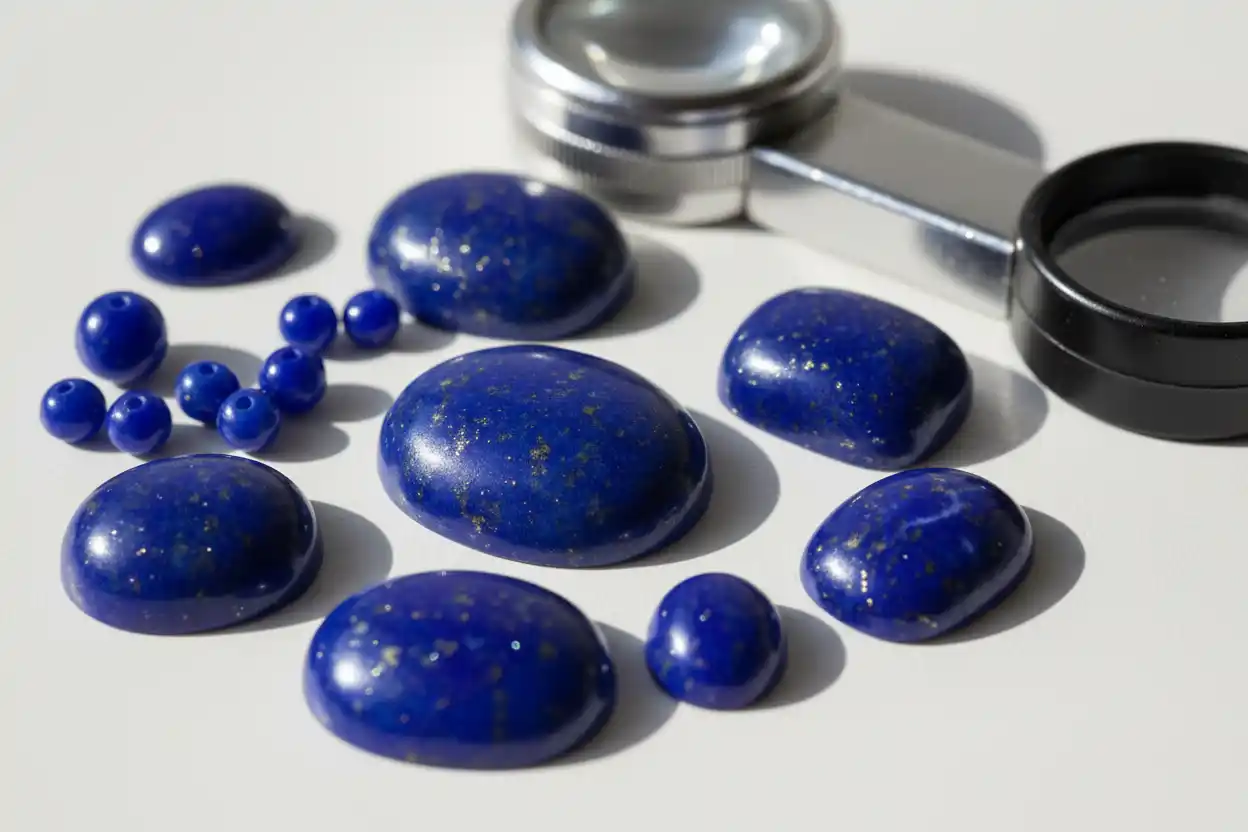
If you want to buy lapis lazuli confidently, inspect the blue color first, then look at calcite, pyrite, treatment disclosure, polish, condition, origin claims, and price. Fine lapis usually shows an intense, even medium-dark to dark blue or slightly violetish blue. White calcite generally lowers quality when it becomes prominent, while small, attractively scattered gold-colored pyrite flecks can remain desirable. Large amounts of pyrite, greenish areas, patchy color, or obvious white streaks usually place a stone lower in the market.
Treatment deserves particular attention because lapis lazuli is commonly dyed to deepen blue color and hide pale calcite. Wax or oil can also be used to improve color and luster. Current loose retail examples show dyed Afghan lapis selling around roughly $0.80 to $2.10 per carat in many ordinary cabochon listings, but untreated fine lapis with strong natural color can command a premium. The lapis lazuli price therefore makes sense only when treatment and visible quality are compared along with size.
Know What Good Lapis Lazuli Looks Like
Lapis lazuli is a rock made up of several minerals, with lazurite providing the characteristic blue color. Calcite often appears as white areas, while pyrite can create metallic gold-colored specks or veins. These features are part of the stone’s natural appearance, but their proportions have a major effect on value.
GIA identifies intense, uniform, medium-dark, slightly violetish blue as the most desirable appearance. Fine examples may contain little or no visible pyrite and no obvious calcite. Small, evenly distributed pyrite flecks can still look attractive and do not automatically reduce value.
Lower-quality lapis often appears pale, mottled, heavily streaked with calcite, or greenish because of excessive pyrite or other components. The lapis lazuli quality grading becomes more useful when these visual differences are assessed together instead of relying on seller labels such as AAA or premium.
Current Lapis Lazuli Retail Price Examples
Current active retail listings show how inexpensive ordinary dyed lapis can be. The examples below are Afghan stones specifically disclosed as dyed, so they should not be interpreted as prices for untreated top-quality lapis.
| Current loose lapis example | Weight | Asking price | Approx. price per carat |
|---|---|---|---|
| Dark blue oval | 5.00 ct | $10.32 | $2.06 |
| Very deep blue oval | 6.50 ct | $13.42 | $2.06 |
| Medium blue oval | 8.88 ct | $18.32 | $2.06 |
| Deep blue baguette | 9.14 ct | $18.86 | $2.06 |
| Dark blue oval | 13.19 ct | $19.44 | $1.47 |
| Dark blue oval pair | 23.26 ct total | $39.85 | $1.71 |
| Dark blue octagon | 29.69 ct | $53.34 | $1.80 |
| Bright blue square | 88.61 ct | $73.55 | $0.83 |
These prices show why the lapis lazuli price per carat often falls as stones become larger. Lapis occurs in pieces large enough for substantial cabochons, beads, carvings, boxes, and decorative objects, so weight alone does not create a steep rarity premium.
They also demonstrate why treatment disclosure matters. A deep blue dyed stone around $2 per carat should not be compared directly with a naturally saturated, carefully selected untreated specimen.
Color Should Be Your First Quality Check
Fine lapis should look richly blue without appearing unnaturally flat or excessively black. Slight violet influence can be desirable, especially when the color remains strong and even across the polished surface.
Uniformity matters. Large pale areas, gray patches, strong greenish zones, or obvious unevenness usually lower quality. A buyer should also inspect photographs under neutral lighting because heavy editing can make ordinary lapis appear much darker and more saturated than it really is.
When shopping online, compare the stone in several images rather than relying on one close-up. A photograph taken under strong directional light or against a dark background can exaggerate saturation. Video can reveal whether the color remains attractive as the stone moves.
Calcite Usually Lowers Value
White calcite is one of the easiest features to see in lapis lazuli. Fine trade quality generally has little or no visible calcite because white patches interrupt the deep blue appearance.
Some buyers enjoy a natural marbled look, particularly in carvings or decorative pieces. That can make heavily patterned lapis visually appealing even when it would not receive the highest traditional trade grade.
For jewelry, however, large white streaks or patches normally place the stone below uniform deep-blue examples. If a seller uses a premium grade for lapis with extensive calcite, compare it carefully with competing stones rather than accepting the grade at face value.
Pyrite Can Help or Hurt the Appearance
Pyrite gives lapis its familiar gold-colored metallic flecks. Small, scattered specks can create an attractive contrast against rich blue and may be highly desirable to some buyers.
Too much pyrite can work against the stone. Dense metallic patches, large veins, or an overall greenish cast can make lapis appear less saturated and lower its traditional quality ranking.
The effect should therefore be judged visually rather than with a simple rule that pyrite is either good or bad. A few elegant flecks can add character. Heavy concentrations can dominate the surface and reduce the depth of the blue.
Dyeing Is One of the Most Important Treatment Questions
Lapis lazuli may be dyed to make pale stones look more intensely blue and to conceal visible calcite. This treatment is well established in the trade, and current loose retail inventory includes many stones openly sold as dyed.
Dye is not automatically unacceptable when the seller discloses it and the price reflects the treatment. The problem appears when dyed lapis is represented as naturally deep blue, untreated, or exceptionally rare.
GIA notes that gemologists can detect dye, including concentrations in porous areas or fractures. Buyers should avoid destructive home tests on valuable jewelry because chemicals can affect the finish or other parts of the piece. If treatment status has financial importance, professional identification is safer.
Wax and Oil Can Also Improve Appearance
Undyed lapis may be impregnated with wax or oil to deepen the apparent color and improve luster. These treatments can make the surface look richer and smoother, particularly on porous stones.
GIA describes such treatments as having only fair stability. Heat and chemicals can affect wax or oil, which means treatment disclosure matters for both value and care.
A heavily polished surface should therefore not be assumed to represent untreated natural color. Ask whether the stone has been dyed, waxed, oiled, coated, or otherwise enhanced if you are paying a premium.
Authenticity Needs More Than a Color Check
Several imitations can resemble lapis lazuli, particularly when viewed only in photographs. Dyed stones, glass, reconstructed products, and other blue gems can be sold under confusing descriptions.
Natural lapis usually shows some variation in its blue structure, calcite, or pyrite distribution, although very fine examples can look remarkably uniform. Perfectly even color by itself does not prove imitation, and the presence of metallic-looking flecks does not prove authenticity either.
The real vs fake lapis lazuli comparison becomes most useful when color, inclusions, texture, treatment, density, microscopy, and seller disclosure are considered together. For an expensive specimen, professional identification is more reliable than internet home tests.
Afghan Origin Can Add Interest, but Do Not Buy the Name Alone
Afghanistan has a long historical association with fine lapis lazuli, particularly deposits in the Badakhshan region. GIA’s trade-quality framework commonly uses Afghan or Persian as descriptions for intense, uniform, medium-dark, slightly violetish blue lapis with little or no pyrite and no calcite.
A quality description is not always proof of geographic origin. GIA specifically notes that regional adjectives may sometimes describe appearance rather than the actual source.
If a seller charges substantially more because a piece is claimed to be Afghan, ask how that origin was established. Current retail listings often state Afghanistan as origin, but origin should still be viewed together with natural color, treatment, polish, condition, and actual appearance.
Large Size Does Not Automatically Mean High Value
Lapis lazuli is available in pieces large enough for beads, cabochons, carvings, spheres, tabletops, boxes, and sculptures. Large weight is therefore much easier to obtain than it would be for many transparent faceted gems.
Current inventory illustrates this clearly. An 88.61-carat dyed Afghan stone is listed for about $73.55, while 3,000-carat lapis spheres are offered at around $1,775 each. Those large totals may seem impressive, but the price per carat remains modest.
A smaller stone with exceptional untreated color can therefore be more desirable than a much larger dyed or calcite-heavy example.
Cut and Polish Affect Value More Than Many Buyers Expect
Lapis is commonly fashioned into cabochons because a smooth polished surface displays the blue color effectively. Beads, tablets, inlays, carvings, and decorative objects are also common.
Good workmanship should produce smooth contours, even polish, clean edges, and a pleasant shape. Scratches, pits, poorly finished drill holes, uneven domes, or chipped edges reduce value even when the underlying blue color is attractive.
For jewelry, check how the stone fits the setting. Lapis is relatively soft compared with sapphire or diamond, so protective mounting and sensible wear can improve longevity.
Jewelry Buyers Should Separate Stone Price From Setting Price
A loose lapis cabochon may cost only $10 to $50, yet a finished gold pendant or ring can cost hundreds or thousands of dollars. The difference can come from precious metal, craftsmanship, design, accent gems, brand reputation, and retail service rather than from the lapis alone.
This distinction is especially important when evaluating resale. A high retail jewelry price does not mean the loose center stone would command the same amount if removed.
For value comparison, estimate the lapis quality first, then consider the setting and workmanship separately.
Seller Grades Are Not Universal
AAA, AAAA, royal grade, Afghan grade, museum grade, and similar terms appear frequently in online listings. These labels do not create one standardized international grading system.
GIA evaluates lapis lazuli but does not assign it an overall quality grade. Its identification service can describe the stone and identify detectable treatments.
That makes seller grades useful only as internal categories within a particular shop. If two retailers both offer “AAA lapis,” their stones may differ greatly in natural color, calcite, pyrite, treatment, polish, and price.
Return Terms Matter When Buying Online
Online lapis purchases are easier to judge when the seller provides actual photographs, dimensions, weight, treatment disclosure, origin information when known, and a reasonable return window.
Once the stone arrives, inspect it under ordinary daylight and indoor light. Compare its actual blue color with the listing, look for calcite that was hidden by photography, examine pyrite distribution, and check the polish for scratches or pits.
Return protection is especially valuable for expensive supposedly untreated lapis because color can look dramatically different between edited images and real-world lighting.
Keep Personal Beliefs Separate From Commercial Quality
The lapis lazuli benefits discussed in cultural or crystal traditions may include personal associations with communication, reflection, confidence, or wisdom. These ideas do not establish gemstone grade or market value.
Likewise, lapis lazuli healing properties belong to belief-based wellness traditions rather than established medical treatment. Buying value should remain connected to identity, natural color, calcite and pyrite content, treatment, polish, condition, provenance, craftsmanship, and current market comparison.
FAQs
How much does lapis lazuli cost per carat?
Ordinary retail lapis commonly costs only a few dollars per carat. Current dyed Afghan cabochons reviewed for this article range from about $0.83 to roughly $2.06 per carat. Fine untreated lapis can cost more.
What color lapis lazuli is most valuable?
Intense, uniform medium-dark to dark blue or slightly violetish blue is traditionally the most prized appearance, especially when there is little visible calcite.
Does pyrite make lapis lazuli more valuable?
Small, attractively scattered pyrite flecks can enhance appearance. Heavy pyrite or greenish areas may lower value.
Is white calcite bad in lapis lazuli?
Visible calcite usually lowers traditional trade quality because it interrupts the blue color. Some buyers still enjoy strongly marbled pieces for their natural pattern.
Is dyed lapis lazuli real?
A dyed piece can still be natural lapis lazuli. The treatment changes its color appearance and should be disclosed.
Is untreated lapis worth more?
Untreated lapis with naturally deep, uniform blue can command a premium because the color did not need dye enhancement. Actual quality and market demand still matter.
Is Afghan lapis the best?
Afghanistan is historically associated with very fine lapis, but a country name should not replace inspection of the individual stone. Color, treatment, calcite, pyrite, polish, and condition still determine quality.
What does AAA lapis lazuli mean?
There is no universal AAA lapis grading standard. Sellers define these categories themselves, so compare the actual stone rather than relying on the label.
Is large lapis lazuli rare?
Not generally. Lapis can occur in large pieces suitable for carvings and decorative objects, so large carat weight alone does not establish rarity.
Is lapis lazuli good for everyday jewelry?
It can be worn regularly with reasonable care, but it is softer than many common jewelry gems. Avoid hard impacts, harsh chemicals, strong heat, and aggressive cleaning, especially when treatment is present.
Conclusion
To buy lapis lazuli well, prioritize natural-looking rich blue color, limited calcite, attractive pyrite distribution, good polish, sound condition, and clear treatment disclosure. Current ordinary dyed loose stones often sell for around $1 to $2 per carat, but fine untreated lapis can occupy a higher price tier. Large size and seller-created grades should not determine the purchase by themselves. Compare color, treatments, authenticity, workmanship, provenance, and current like-for-like prices before paying a premium.