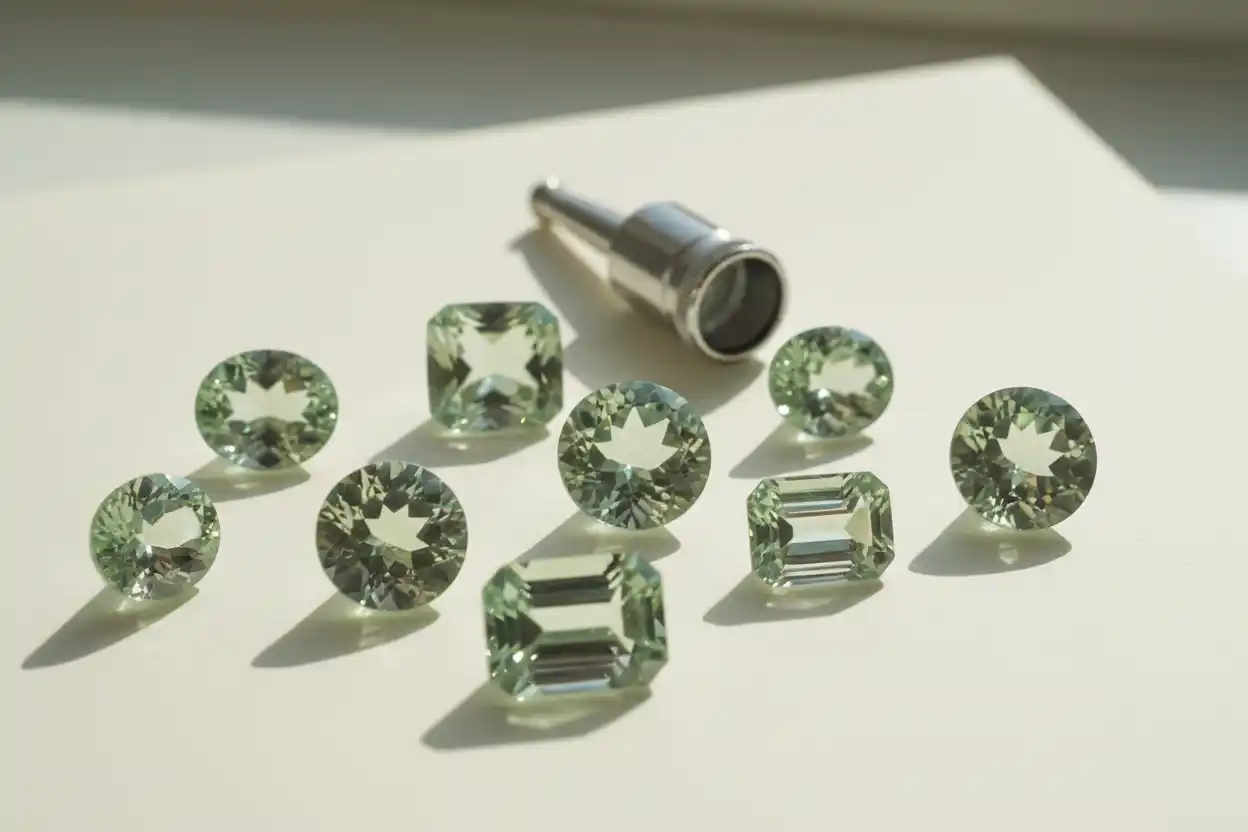
Buy Prasiolite: Quality & Authenticity, Treatments & Value
To buy prasiolite intelligently, begin with an accurate understanding of what the market usually means by the name. Prasiolite is transparent green macrocrystalline quartz with the chemical composition SiO₂, but most commercial material sold as prasiolite is not naturally green straight from the ground. Mindat states that most prasiolite is produced artificially by heating amethyst or irradiating colorless quartz, while genuine naturally green quartz does exist at a small number of documented occurrences. This makes treatment disclosure more important than rarity language because a large clean faceted green quartz can be entirely legitimate jewelry material while still belonging to a treatment-created commercial category.
Terminology also deserves care. The retail phrase “green amethyst” is widespread, but Mindat describes it as a highly confusing and officially discouraged trade name for artificially colored green quartz or prasiolite. Once amethyst is converted from purple to green, the finished material should be described as prasiolite or green quartz rather than implying that it remains purple amethyst in a different shade. Buyers should judge the stone as quartz on its actual color, transparency, cut, size, treatment history, durability, and price instead of paying a premium because a seller makes green amethyst sound like an exceptionally rare natural amethyst variety.
Buy Prasiolite At a Glance
| Buying Factor | What to Examine | Why It Matters |
|---|---|---|
| Material Identity | Transparent green quartz | Confirms the basic gem species |
| Color Origin | Natural green, heat-treated amethyst, irradiated quartz, or combination treatment | Most commercial prasiolite owes its color to treatment |
| Terminology | Prasiolite or green quartz | “Green amethyst” can obscure the treatment-created category |
| Hue | Mint, leek green, yellowish green, grayish green | Attractive balanced green drives appearance |
| Tone | Usually light to medium | Very dark material deserves authenticity/treatment scrutiny |
| Saturation | Pleasant visible green without excessive gray | Weak color can appear nearly colorless |
| Clarity | Eye-clean transparency | Quartz is abundant enough that obvious inclusions deserve discounts |
| Cut | Brightness, symmetry, polish, limited windowing | Pale color depends heavily on good cutting |
| Carat Weight | Compare size with dimensions and color | Large clean quartz is not inherently rare |
| Natural-Origin Claim | Strong documentation required | Naturally green prasiolite is unusual |
| Synthetic Quartz | Laboratory-grown quartz exists | Natural-versus-synthetic identity may matter in premium claims |
| Light Stability | Ask about treatment and avoid unnecessary intense exposure | Some green quartz colors can be treatment dependent |
| Durability | Mohs 7 quartz | Suitable for jewelry with reasonable care |
| Seller Grade | Ignore unsupported AAA/AAAA labels | No universal prasiolite quality scale exists |
| Price | Compare with treated quartz, not emerald | Geological rarity is limited in ordinary commercial material |
Prasiolite Is Green Quartz
Mindat classifies prasiolite as a green transparent variety of macrocrystalline quartz with the composition SiO₂. It therefore shares the fundamental quartz structure with amethyst, citrine, rock crystal, smoky quartz, and other macrocrystalline quartz varieties even though color origins differ.
This identity is important because prasiolite sometimes receives marketing that implies it is a separate exceptionally rare mineral species. It is not. The gem is valuable for its attractive green appearance, transparency, cutting, jewelry utility, and in some cases unusual natural color provenance, but ordinary commercial prasiolite belongs to the broad quartz family.
The Gems Lore buy amethyst guide and amethyst price guide provide useful context because amethyst is the starting material for much heat-produced prasiolite.
Most Commercial Prasiolite Is Treatment-Created
Mindat states explicitly that most prasiolite is produced by heating amethyst or irradiating colorless quartz, while natural occurrences exist but remain uncommon. GIA’s broader treatment guidance likewise confirms that irradiation and subsequent heat can create green colors in quartz varieties.
Treatment-created color is therefore not a rare exception in this market; it is central to ordinary commercial supply.
A buyer should not regard a disclosed heat-treated stone as defective. The appropriate question is whether the stone is represented accurately and priced as treated green quartz rather than as exceptionally rare natural-color material.
Natural Green Prasiolite Exists
The fact that most commercial stones are treated should not be turned into the opposite false claim that natural prasiolite is impossible. Mindat records natural green quartz occurrences and identifies confirmed prasiolite localities including material from the Thunder Bay District in Ontario and documented occurrences in Poland and other areas.
Natural-origin material can carry mineralogical collector interest, particularly as uncut crystals with locality documentation.
A faceted gem claimed to be naturally green should have stronger evidence than a seller’s verbal assurance because treatment-created material is far more common in jewelry.
Natural Color and Treated Color May Be Difficult to Separate
Green quartz presents a difficult gemological problem because natural heating in geological environments and deliberate heat treatment can produce closely related appearances. Historical GIA laboratory literature notes that naturally heated and artificially heat-treated green quartz may not always be separable by ordinary testing. Rather than making unsupported certainty claims, buyers should recognize that provenance can become essential when an untreated natural-color premium is being requested.
For ordinary jewelry, this uncertainty has limited practical consequence because the treated market is well established and quartz remains durable and attractive.
For collector-grade natural prasiolite, provenance and specialized laboratory work become substantially more important.
“Green Amethyst” Is Better Avoided
Mindat describes green amethyst as a confusing and officially discouraged trade term used for artificially colored green quartz or prasiolite. The problem is not that the material never began as amethyst; much commercial prasiolite does. The problem is that the phrase can make buyers believe they are purchasing a naturally green subtype of amethyst rather than quartz whose color was changed deliberately.
Clear terminology supports clearer price comparison.
A listing that says “heat-treated natural quartz sold as prasiolite” provides much more useful information than one advertising “rare natural green amethyst” without explaining treatment.
Pale Green Is Normal for Prasiolite
Natural and commercial prasiolite commonly occupies pale mint, leek-green, yellowish-green, or grayish-green tones rather than the deep saturated green associated with emerald or chrome tourmaline. Mindat describes natural prasiolite simply within a green transparent range, while gemological references often emphasize that naturally occurring material tends to be relatively light.
A buyer should therefore not reject a light stone automatically. The question is whether the color remains visibly green and attractive enough to justify the design.
Very weak material can look almost colorless, making cut and size particularly important because greater optical path length can improve the visible color.
Extremely Dark Green Quartz Deserves Extra Scrutiny
Because typical prasiolite is light to medium in tone, very dark saturated green material should prompt questions about synthetic origin, irradiation, coating, or alternative identity. GIA has documented synthetic green quartz and various artificially colored green quartz products in gemological literature, while Mindat notes that irradiation can create commercial prasiolite-like color.
Dark color is not proof of fraud, but it should not be marketed as automatically superior natural prasiolite.
The stronger and more unusual the color claim, the stronger the supporting identification should become.
Clarity Should Usually Be High
Quartz is abundant enough that buyers should generally expect faceted commercial prasiolite to look eye-clean or nearly so. Large fractures, heavy clouds, dark inclusions, or obvious surface-reaching fissures can reduce value because cleaner material is readily available.
A few natural inclusions may be interesting in documented natural-origin specimens, but routine jewelry prasiolite is normally purchased for clean transparent pastel color.
The buyer should prioritize visible transparency and brilliance rather than paying heavily for microscopic perfection after the stone already appears clean.
Pale Color Makes Cut Quality Especially Important
A weakly cut pale stone can look watery or nearly colorless because light escapes through a window rather than returning green to the observer. Good cutting increases brightness, concentrates visible color, and creates enough contrast for the pastel hue to remain attractive.
Emerald, cushion, oval, round, pear, and designer cuts can all work well when proportions suit the rough.
A large table combined with a shallow pavilion can create obvious windowing, while excessive depth adds carat weight without increasing visible size proportionately.
Step Cuts Can Emphasize Transparency
Emerald and other step cuts can suit prasiolite because their broad facets emphasize clean transparency and delicate green color. The same open facets also reveal inclusions and windows readily.
A high-quality step-cut stone should therefore be particularly clean and well proportioned.
A brilliant or mixed cut can create more scintillation and may help a pale stone appear livelier, making the best shape partly a matter of optical design rather than rarity.
Large Size Is Readily Available in Quartz
Quartz crystals can grow large, and laboratory-grown quartz is also widely available. GIA describes synthetic quartz as an extensively produced material developed originally for technological uses and later entering the jewelry market. Large size therefore does not create the kind of scarcity premium seen in fine ruby, alexandrite, or Paraíba tourmaline.
A 20 ct prasiolite can be impressive visually without being geologically extraordinary.
Price should be driven more by color, cut, clarity, treatment disclosure, and craftsmanship than by an assumption that every large stone must be rare.
Synthetic Green Quartz Exists
GIA identifies synthetic quartz as widely available and explains that hydrothermal growth is the successful commercial method for producing synthetic quartz. Green synthetic quartz has also been documented in gemological literature, making natural-versus-synthetic origin another possible distinction when a seller claims unusually rare material.
Synthetic quartz is not glass; it has essentially the same fundamental quartz composition and properties but is grown in a laboratory.
A seller should disclose laboratory origin clearly when applicable.
Irradiated Green Quartz Is a Separate Treatment Route
Mindat states that irradiating colorless quartz can produce commercial prasiolite-like green material, and GIA’s treatment guidance confirms that quartz colors can be created through irradiation and combination treatment involving subsequent heating.
A treated green quartz remains genuine quartz but should be described according to its treatment history when known.
This distinction becomes especially important if a seller claims unusual natural green color or attempts to price ordinary irradiated material as a rare locality specimen.
Color Stability Should Be Treated Conservatively
Gemological references note that some prasiolite and treated green quartz colors can fade with prolonged intense light exposure, particularly depending on the treatment route and specific color center involved. A buyer does not need to keep normal jewelry in darkness, but prolonged display in strong direct sunlight is unnecessary.
Heat can also affect quartz color, making care during jewelry repair important.
A professional jeweler should know the center stone is treated or potentially treated quartz before applying a torch nearby.
Quartz Hardness Makes Prasiolite Practical for Jewelry
Quartz ranks 7 on the Mohs scale, and GIA’s care guidance for quartz varieties such as citrine, amethyst, rose quartz, and ametrine consistently treats quartz as durable enough for ordinary jewelry when protected from unnecessary scratching and thermal shock.
A ring can therefore be practical, although sapphire and diamond remain harder.
The gem should be stored separately from harder jewelry to preserve polish over long-term wear.
Sudden Temperature Changes Can Fracture Quartz
GIA warns across quartz-variety care guidance that abrupt temperature change can fracture material and generally recommends warm soapy water as the safest cleaning method.
Steam cleaning is better avoided, particularly because high heat can also affect treatment-created color.
Ultrasonic use should be conservative when inclusions, filling, dye, or uncertain treatment status exists.
Prasiolite Versus Amethyst
Prasiolite and amethyst are both macrocrystalline quartz, and commercial prasiolite is often produced by heating particular amethyst material until it changes from purple to green. The Gems Lore buy amethyst guide and amethyst price guide therefore provide a useful comparison of the parent commercial quartz market.
The important difference is that an amethyst price should reflect attractive natural purple color, while ordinary prasiolite’s green color commonly results from treatment.
Prasiolite Versus Citrine
Citrine is another quartz variety whose commercial market contains large quantities of heat-modified material, and Gems Lore’s buy citrine guide and citrine price guide illustrate why quartz treatment disclosure and color quality matter more than dramatic rarity claims.
Prasiolite follows a similarly accessible quartz economics: large clean stones can be beautiful without being exceptionally scarce.
Prasiolite Versus Green Beryl
Pale green beryl can sometimes overlap visually with prasiolite, but the species have different refractive properties, density, crystal structure, and market value. Gems Lore’s buy goshenite guide and buy heliodor guide provide context for beryl-family gemstones.
A retailer should identify the gem properly rather than relying on color alone.
Prasiolite Versus Emerald
Prasiolite is not a low-grade emerald. Emerald is chromium- or vanadium-bearing green beryl with a dramatically different rarity, inclusion pattern, treatment landscape, and market structure. Gems Lore’s buy emerald guide and emerald price guide explain those differences.
Prasiolite’s appeal is its clean pastel green appearance at accessible sizes and prices, not an attempt to imitate emerald rarity.
Natural-Origin Prasiolite Should Carry Documentation
Because treated commercial material is abundant while naturally green quartz is unusual, a seller charging a major premium for natural-color prasiolite should provide supporting locality history, specimen provenance, or credible laboratory analysis.
Mindat documents genuine natural occurrences including Thunder Bay and other limited localities.
The premium should correspond to the strength of that evidence.
AAA and AAAA Have No Universal Prasiolite Meaning
Prasiolite has no globally standardized AAA grading scale. Sellers may use private terminology to separate color, clarity, and cutting levels, but those letters should not be assumed equivalent between retailers.
A useful comparison translates the grade into actual hue, tone, saturation, transparency, inclusions, dimensions, cut, treatment, natural-versus-synthetic origin, and condition.
Because commercial quartz is widely available, paying heavily for an undefined grade is rarely necessary.
Common Red Flags When You Buy Prasiolite
Warning signs include a seller claiming that ordinary commercial prasiolite is naturally green without mentioning treatment, “green amethyst” presented as a separate rare mineral species, very dark green material described as untreated solely from appearance, large stones marketed as scarce because of weight, synthetic quartz not disclosed, irradiation omitted from treatment discussion, an extreme premium based on natural-origin claims without provenance, AAAA presented as an official laboratory grade, or instructions encouraging prolonged intense sunlight despite possible color-stability concerns. Mindat’s current summary makes the central market fact clear: most prasiolite is produced artificially by heating amethyst or irradiating colorless quartz.
How to Compare Prasiolite Listings Fairly
Compare stones by quartz identity, natural-versus-treated green color, heat or irradiation disclosure, natural-versus-synthetic origin, hue, tone, saturation, transparency, clarity, cut, windowing, face-up dimensions, carat weight, condition, provenance, setting quality, return rights, and price relative to comparable quartz. A documented naturally green Thunder Bay crystal, heat-treated Brazilian amethyst faceted as prasiolite, irradiated green quartz, synthetic hydrothermal quartz, and glass imitation should not be valued as though they share the same rarity story.
Conclusion
To buy prasiolite intelligently, separate quartz identity from color origin. Prasiolite is transparent green quartz, but Mindat states that most commercial material obtains its color through heating amethyst or irradiating colorless quartz, while naturally green occurrences are real but uncommon.
This makes treatment disclosure more important than rarity marketing. A heat-treated green quartz can be a beautiful, durable, affordable gemstone and should not be rejected merely because its color was produced intentionally. The problem begins when ordinary treated material is sold as exceptionally rare natural-color prasiolite or under confusing terminology such as “green amethyst” without explaining what the buyer is receiving.
The strongest purchase combines attractive mint-to-leek-green color, high transparency, skilled cutting, appropriate size, sound condition, accurate treatment disclosure, and a price consistent with quartz supply. Claims of natural green origin or exceptional rarity deserve stronger evidence because the ordinary commercial market is dominated by treated material.
Frequently Asked Questions
What is prasiolite?
Prasiolite is transparent green macrocrystalline quartz with the chemical composition SiO₂.
Is prasiolite naturally green?
Natural green prasiolite exists, but Mindat states that most commercial prasiolite is artificially produced through heating amethyst or irradiating colorless quartz.
Is prasiolite the same as green amethyst?
The phrase green amethyst is used commercially, but Mindat describes it as confusing and officially discouraged terminology for green quartz or prasiolite.
Is heat-treated prasiolite fake?
No. Heat-treated prasiolite is genuine quartz whose color was altered intentionally. Treatment should be disclosed, but the material is not glass or an imitation merely because it was heated.
Can prasiolite be produced by irradiation?
Yes. Mindat states that irradiating colorless quartz can produce commercial green material, while GIA confirms that irradiation and combination treatment can create green quartz colors.
Does natural prasiolite exist in Canada?
Yes. Mindat records natural prasiolite from the Thunder Bay District in Ontario.
Is dark green prasiolite more valuable?
Not automatically. Typical prasiolite is relatively light, and unusually dark material deserves careful identification and treatment disclosure rather than an automatic premium.
Is prasiolite usually eye-clean?
Commercial faceted quartz is abundant enough that buyers should normally expect good transparency and few distracting eye-visible inclusions.
Can prasiolite be synthetic?
Yes. Synthetic quartz is widely produced hydrothermally, and green synthetic quartz is possible. GIA describes synthetic quartz as a well-established laboratory-grown material.
Is large prasiolite rare?
Large quartz crystals are readily available, so size alone does not create extreme rarity. Large well-cut stones can be visually impressive while remaining accessible compared with genuinely scarce green gems.
How hard is prasiolite?
As quartz, prasiolite is approximately Mohs 7, making it suitable for ordinary jewelry with reasonable protection from harder materials.
Can prasiolite fade?
Some prasiolite and treated green quartz colors can fade with prolonged strong light exposure depending on the color mechanism and treatment. Conservative storage away from unnecessary prolonged intense sunlight is sensible.
How should prasiolite be cleaned?
Warm soapy water is the conservative choice for quartz jewelry. GIA’s quartz-variety care guidance also cautions against sudden temperature changes and unnecessary high heat.
Is prasiolite a guaranteed investment?
No. Ordinary commercial material is largely treatment-created quartz and is widely available. Exceptional natural-color provenance can interest collectors, but future appreciation and liquidity are not guaranteed.