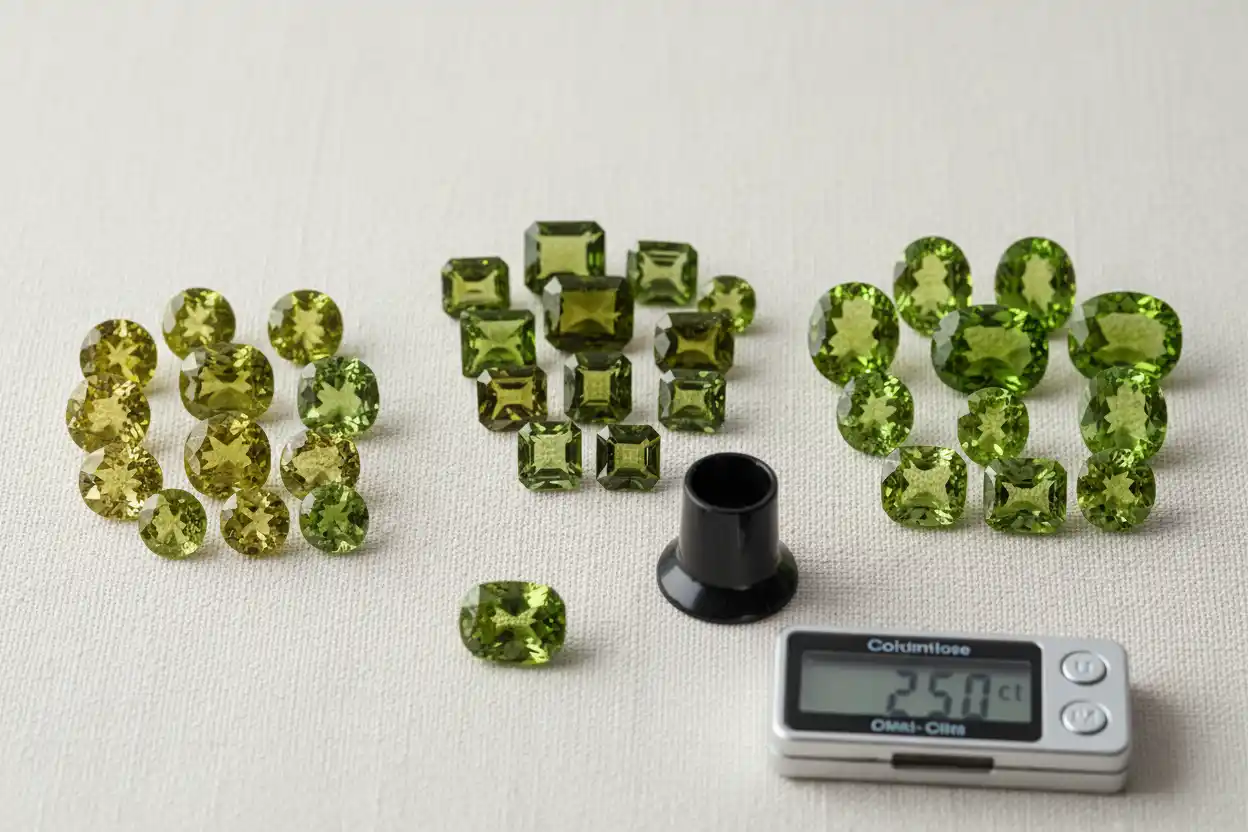
Peridot Price Guide: Value and Cost in 2026
Peridot prices in 2026 commonly range from approximately $20 to $500 per carat. Small yellowish-green commercial stones may cost less, while fine pure-green Peridot from Pakistan or Myanmar can reach $500 to $1,500 per carat in rare large sizes.
Most attractive one- to three-carat jewelry stones sell for approximately $50 to $250 per carat. Strong per-carat premiums appear when vivid green color, eye-clean clarity and good cutting continue above five or ten carats.
Peridot Price per Carat in 2026
The following ranges represent broad U.S. retail expectations for natural loose faceted Peridot.
| Peridot quality | Typical characteristics | Approximate 2026 retail price |
|---|---|---|
| Entry commercial | Pale yellow-green, brownish modifier, included or poorly cut | $10–$40 per carat |
| Good commercial | Attractive yellowish green, eye-clean appearance and competent cutting | $40–$100 per carat |
| Fine | Bright grass-green color, minimal brown, strong transparency and good proportions | $100–$300 per carat |
| Premium large Peridot | Fine color above approximately 5 ct, high clarity and respected origin | $250–$700 per carat |
| Exceptional collector quality | Rare pure-green color above 10 ct, superior cutting and major documentation | $700–$1,500+ per carat |
Current mass-market inventories contain many small stones below $100 per carat. The higher tiers apply to a comparatively small supply of large, strongly saturated and well-cut material.
The general interaction among color, clarity, cut, weight and demand appears in How Gemstone Prices Are Determined.
Peridot Prices by Carat Weight
Peridot price per carat does not rise steeply through ordinary small sizes. The major premium develops when top color continues into larger gems.
| Carat weight | Commercial quality | Fine quality | Exceptional quality |
|---|---|---|---|
| Under 1 ct | $10–$50 per carat | $50–$120 per carat | $100–$200 per carat |
| 1–3 ct | $30–$100 per carat | $80–$250 per carat | $200–$400 per carat |
| 3–5 ct | $50–$150 per carat | $150–$350 per carat | $300–$600 per carat |
| 5–10 ct | $100–$250 per carat | $250–$600 per carat | $500–$1,000 per carat |
| Above 10 ct | $150–$350 per carat | $400–$800 per carat | $700–$1,500+ per carat |
A ten-carat brownish or heavily included Peridot can remain less valuable than a clean three-carat gem with superior green color.
Dimensions should be compared with weight because deep stones may retain carats without providing proportional face-up size.
What Is Peridot?
Peridot is the transparent gem variety of olivine, a magnesium-iron silicate.
Unlike many gemstones whose colors depend on trace impurities, Peridot’s green results from iron that forms part of its fundamental composition. Consequently, the gem occurs only in shades of green, yellowish green, olive and brownish green.
The completed Peridot guide owns the material’s formation, properties and traditional symbolism.
The completed Olivine guide explains the wider mineral group and the distinction between gem Peridot and ordinary olivine.
Color Is the Primary Value Factor
Fine Peridot shows bright medium green with minimal yellow and no obvious brown.
GIA describes pure grass green as the most desirable color. However, that hue is rare, and most stones show a noticeable yellowish-green component.
Brown modifiers reduce value because they make the gem look muddy or olive. Excessive darkness can also weaken brilliance.
Small Peridots commonly appear lighter and more yellowish. The finest color often develops in stones large enough to show stronger saturation, particularly above five or ten carats.
A bright yellowish-green stone can still be attractive when the tone remains lively. The objective is not to eliminate every yellow component but to avoid weak, brown or dull material.
The broader market for green stones appears in Green Gemstones, while frequently worn green options appear in Green Gemstones for Engagement Rings.
Does Dark Green Peridot Cost More?
Darker green can create a premium when the tone remains open and brilliant.
A stone that appears rich green under daylight but almost black indoors is not top quality. Fine Peridot should retain visible color across several lighting environments.
Deep cutting can artificially darken a stone. Likewise, a dark background can make yellowish-green material look richer in photographs.
Buyers should request videos against neutral white and gray backgrounds. The stone should also be seen in indirect indoor light rather than only beneath a bright jewelry spotlight.
Color should be judged face-up. A vivid green side view does not compensate for a brown or pale appearance through the table.
Clarity and Peridot Value
Fine Peridot is generally expected to appear eye-clean. Transparent rough is sufficiently available that prominent fractures, dark crystals and dense clouds reduce value.
Common inclusions include reflective disk-like features known as lily pads. These structures can support natural identification but should not dominate the face.
Tiny black mineral crystals may be visible under magnification in otherwise fine stones.
Open fissures create a greater problem than small internal crystals. They can collect dirt, weaken the girdle and increase setting risk.
A lightly included large stone may remain valuable because fine size is rare. Smaller commercial Peridot should normally be cleaner.
Lily-Pad Inclusions
Lily pads are tension fractures or disk-shaped features associated with inclusions inside Peridot.
They may appear as reflective round or oval structures under magnification. Their resemblance to floating leaves gives them the familiar name.
One or two subtle lily pads can add gemological character without affecting beauty. Numerous large disks can weaken brilliance and lower value.
A seller should not market every included stone as rare merely because it contains lily pads. Their presence is well known within the material.
Surface-reaching versions also require caution because they may become visible after cleaning or setting.
Cut Quality
Cut is one of the most important factors in Peridot’s appearance.
A shallow pavilion can produce a transparent window through the center. Excessive depth creates hidden weight and may intensify undesirable darkness.
Ovals, cushions, emerald cuts, rounds and pears are widely available. Ovals dominate commercial production because they preserve rough efficiently.
A well-cut stone should show green across most of its face with minimal extinction. Facet junctions should be crisp, and polish should not contain drag lines or abrasion.
Rounds can receive a premium in large sizes because they require greater cutting loss. Precision and fantasy cuts may also cost more when the lapidary labor exceeds the rough value.
Detailed selection belongs to the Peridot Buying Guide.
Pakistan Peridot Prices
Pakistan, particularly deposits associated with the Himalayan and Karakoram regions, has produced some of the market’s finest Peridot.
The best material can show rich green color, strong transparency and large crystal size.
Commercial Pakistani stones may cost approximately $80 to $250 per carat. Fine five- to ten-carat gems commonly reach $300 to $800 per carat.
Exceptional pure-green stones above ten carats can exceed $1,000 per carat, especially when cutting and documentation are strong.
The Pakistani label should not be treated as a grade. The country also produces included, pale and brownish material.
Mine-level provenance can interest collectors, but visible quality remains essential.
Myanmar Peridot Prices
Myanmar, especially the Mogok region, is another classic source of fine Peridot.
Mogok stones can show rich green color and large sizes. Fine material often occupies the same premium market as top Pakistani Peridot.
Good one- to three-carat stones may cost approximately $100 to $300 per carat. Larger clean gems can range from $300 to $1,000 per carat or more.
Origin claims require support when they materially affect price. Visual appearance alone cannot reliably separate Myanmar and Pakistani stones.
Fine Mogok Peridot may receive a provenance premium, but a weak stone should not become expensive simply because the seller invokes the locality.
Arizona Peridot Prices
Arizona is a major source of commercial Peridot, particularly from the San Carlos Apache Reservation.
The material commonly occurs in smaller sizes and yellowish-green to olive-green colors.
Commercial Arizona stones often range from approximately $20 to $100 per carat. Fine clean gems with attractive color can reach $100 to $250 per carat.
Large faceted stones are less common, creating premiums when strong color continues above three or five carats.
Arizona material can provide excellent value for everyday jewelry. It should not be dismissed merely because it normally costs less than fine Pakistani or Myanmar Peridot.
Chinese, Vietnamese and Other Sources
China supplies significant commercial Peridot, often in small calibrated sizes suitable for production jewelry.
Vietnam has produced fine green material, including stones with good transparency and attractive saturation.
Peridot also occurs in Egypt, Tanzania, Norway and several other regions.
Origin usually matters less than color, clarity and size for commercial stones. A fine Vietnamese gem may be worth more than a poorly colored stone from a more famous locality.
Historic Egyptian provenance can create collector interest, although ordinary modern sellers should not claim ancient Zabargad origin without evidence.
Pallasitic Peridot
Peridot crystals occur in certain pallasite meteorites, where olivine is embedded in an iron-nickel matrix.
Transparent facetable extraterrestrial Peridot is exceptionally rare and usually small. Such gems belong to a specialist meteorite and collector market rather than ordinary Peridot jewelry pricing.
Pallasite slices can also contain translucent olivine crystals without producing conventional faceted gems.
A seller should provide credible meteorite classification and provenance. Green color alone cannot establish extraterrestrial origin.
The completed Meteorite guide owns the broader material context.
Treatment and Enhancement
Peridot is commonly sold without routine heat or irradiation treatment. Its natural iron-related color normally requires no enhancement.
Oiling, resin filling or surface coating can be used on fractured or poor-quality material, although these treatments are not central to the mainstream market.
A filled fracture may become less visible while altering durability and care requirements. It should be disclosed.
Coated glass and other green simulants can also be sold under misleading names.
A high-value Peridot should come with explicit treatment information rather than a vague “natural gemstone” statement.
The general enhancement framework appears in Gemstone Treatments Explained.
Peridot Imitations and Synthetics
Green glass, synthetic spinel, Cubic Zirconia, Tourmaline, Prasiolite and other stones can resemble Peridot.
Commercial synthetic Peridot is not a major jewelry product, but laboratory-created green materials can imitate its color.
Doubling of back facets, high birefringence and characteristic inclusions can help gemologists identify natural Peridot.
Visual inspection alone may not settle every mounted stone. Refractive index, specific gravity and spectroscopy provide stronger evidence.
The comparison with a common pale-green alternative belongs to Prasiolite vs Peridot.
Peridot vs Emerald Value
Emerald is green beryl and occupies a much higher market.
Fine Emerald can cost thousands or tens of thousands of dollars per carat. Peridot offers natural green color at a small fraction of that price.
Emerald commonly shows bluish-green to green color and visible inclusions. Peridot tends toward yellowish or olive green and is usually expected to be cleaner.
The full identification comparison belongs to Peridot vs Emerald. Current Emerald pricing appears in the Emerald Price Guide.
A seller should not describe Peridot as an inexpensive Emerald without clearly identifying the actual material.
Peridot vs Prasiolite
Prasiolite is green quartz and normally displays a lighter mint, leek-green or yellowish-green color.
Most commercial Prasiolite is produced by treating certain Amethyst or quartz material. Peridot’s green is natural to its olivine composition.
Prasiolite commonly costs less and is available in larger pale stones. Peridot offers stronger yellow-green saturation and greater mineral-specific rarity.
The detailed comparison belongs to Prasiolite vs Peridot, while current Prasiolite pricing appears in the Prasiolite Price Guide.
Peridot Jewelry Prices in 2026
| Jewelry type | Broad U.S. retail range |
|---|---|
| Silver Peridot earrings or pendant | $40–$300 |
| Silver Peridot ring | $75–$500 |
| Gold earrings or pendant | $300–$2,000 |
| Gold Peridot ring | $400–$3,500 |
| Large fine Peridot jewel | $2,000–$15,000+ |
| Designer or collector piece | Individually evaluated |
The setting often represents more value than a commercial small Peridot.
Style-specific selection belongs to the Peridot Ring Guide, Peridot Earrings Guide, Peridot Necklace Guide and Peridot Bracelet Guide.
Peridot is the principal modern August birthstone. The cultural and gifting context belongs to the August Birthstone Guide and August Birthstone Jewelry.
Durability and Condition
Peridot has a Mohs hardness of approximately 6.5 to 7. It is suitable for jewelry but scratches more readily than Sapphire or Diamond.
The gem can be brittle and may chip when struck. Existing fissures, thin girdles and exposed corners increase risk.
Acids and sudden temperature changes can damage Peridot. Steam and ultrasonic cleaning should be avoided for included or fractured stones.
A protective setting is advisable for rings. Earrings and pendants normally expose the gem to less impact.
Complete maintenance guidance belongs to How to Clean Peridot Jewelry Safely.
Certification and Appraisal
Most inexpensive small Peridot does not need a major laboratory report.
Documentation becomes more useful when:
- The stone exceeds five or ten carats
- Myanmar or Pakistani origin creates a premium
- Treatment or filling is uncertain
- Pallasitic origin is claimed
- The gem is represented as an important collector example
A laboratory can confirm natural olivine and disclose detectable treatment. Geographic origin opinions may not be available for every stone.
The Gemstone Certification Labs comparison explains report services and limitations.
Does Peridot Hold Its Value?
Commercial Peridot usually resells below retail because small stones remain widely available.
Fine large Pakistani and Myanmar stones can attract collectors, particularly when they combine pure green color and eye-clean clarity.
The secondary market remains smaller than those for Ruby, Sapphire and Emerald. A dealer may discount for testing, inventory risk and the time needed to find a buyer.
Finished jewelry may retain more value through gold, Diamonds and designer authorship than through an ordinary Peridot center.
The general resale framework appears in Do Gemstones Hold Their Value?.
Price Guide vs Buying Guide
This page owns Peridot’s 2026 price ranges and value factors. Detailed stone inspection and seller questions belong to the dedicated buying guide.
The completed Gemstones That Start With P and Crystals That Start With P directories connect Peridot with the site’s alphabetical structure.
Online buyers should request neutral-light videos, dimensions, treatment disclosure and a clear return period using How to Buy Gemstones Online Without Getting Scammed.
The Buying & Value hub connects Peridot pricing with identification, certification and resale guidance.
Frequently Asked Questions
1. How much is Peridot worth per carat in 2026?
Most Peridot costs approximately $20 to $300 per carat. Fine large Pakistani or Myanmar stones can reach $500 to $1,500 per carat.
2. What Peridot color is most valuable?
Bright pure grass green with minimal yellow and no brown modifier generally receives the highest price.
3. Why are large Peridots more expensive?
Fine green color is often strongest in larger stones, while clean gems above five or ten carats are comparatively scarce.
4. How much is a one-carat Peridot?
A one-carat stone commonly costs approximately $30 to $200, depending on color, clarity, cut and origin.
5. How much is a five-carat Peridot?
A five-carat gem may cost approximately $500 to $3,000 in total. Exceptional color can raise the price further.
6. How much is a ten-carat Peridot?
Fine ten-carat stones commonly range from several thousand dollars to above $10,000 when color and clarity are exceptional.
7. Is Pakistani Peridot valuable?
Fine Pakistani material can be highly valuable because it occurs in strong green colors and unusually large sizes.
8. Is Arizona Peridot low quality?
Not necessarily. Arizona produces attractive commercial stones, although they are commonly smaller and more yellowish green than the finest premium material.
9. Is Peridot normally treated?
Routine heat and irradiation treatment are uncommon. Filling, coating or other enhancement can still occur and should be disclosed.
10. What are lily-pad inclusions?
They are reflective disk-like features often seen in Peridot. Small examples can support identification, while numerous large ones reduce clarity.
11. Does Peridot need a certificate?
Small commercial stones usually do not. A report is useful for rare size, premium origin, treatment or meteorite-related claims.
12. Is Peridot a good investment?
Commercial Peridot is not generally an investment. Fine large, pure-green and well-documented stones have stronger collector potential.
Peridot Value Rises When Green Survives at Large Size
Peridot offers an accessible natural green gem in small sizes, but its premium market begins when a stone loses the usual yellow-brown modifiers and remains clean above five or ten carats.
In 2026, attractive one- to three-carat stones commonly fall between $50 and $250 per carat. Prices above that range should correspond to rare color, large size, superior cutting or provenance—not simply the name of a famous mining country.