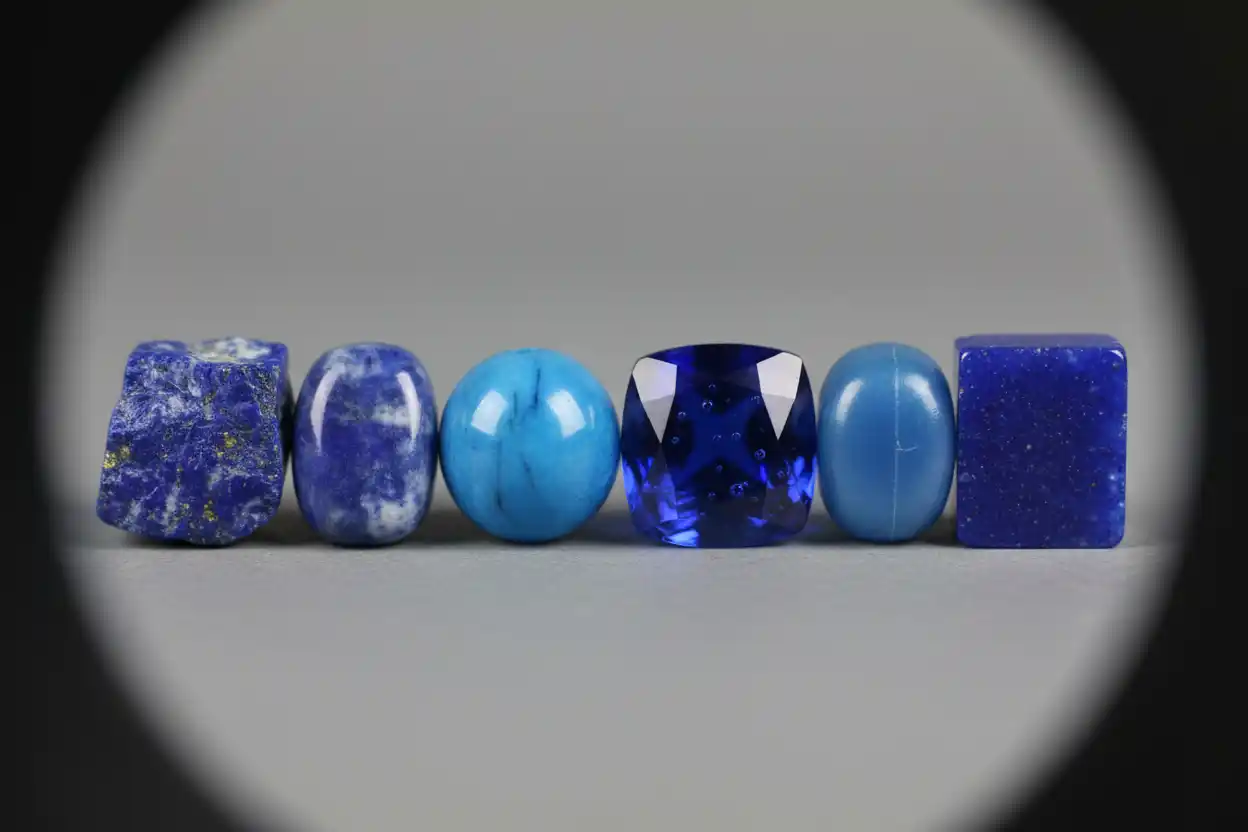
Real vs Fake Lapis Lazuli: 8 Key Signs of Genuine Royal Blue Gems
Real vs fake lapis lazuli identification starts with one important fact: lapis lazuli is a rock, not a single blue mineral. Genuine lapis is an aggregate composed mainly of lazurite, calcite, and pyrite, with smaller amounts of minerals such as diopside, amphibole, feldspar, or mica sometimes present. Lazurite produces the prized blue, calcite commonly appears as white areas, and pyrite can create metallic golden flecks.
This mixed mineral structure is why no single visual sign proves authenticity. Genuine lapis can contain obvious pyrite or almost none. It can show white calcite or appear remarkably uniform. It may be untreated, dyed, waxed, or oiled while still containing genuine lapis underneath. Glass, plastic, ceramic products, and other blue stones can also imitate its appearance. GIA specifically identifies glass, plastic, and ceramic as known lapis lazuli imitations and notes that natural lapis may be dyed or impregnated with wax or oil.
The strongest real vs fake lapis lazuli assessment therefore combines color, internal mineral texture, pyrite appearance, calcite distribution, treatment clues, hardness expectations, magnification, and professional identification when value justifies testing.
8 Real vs Fake Lapis Lazuli Signs at a Glance
- Look for natural blue variation rather than artificial uniformity.
- Check whether metallic flecks behave like pyrite.
- Examine white areas for natural calcite distribution.
- Inspect pores and fractures for concentrated dye.
- Question bubbles, mold seams, and manufactured surfaces.
- Compare hardness and density only as supporting evidence.
- Remember that genuine lapis can be treated.
- Use professional testing when untreated origin affects value.
Genuine Lapis Lazuli Is a Multi-Mineral Rock
Lapis lazuli owes much of its visual identity to the interaction of several minerals rather than one fixed crystal composition. Lazurite provides the intense blue coloration sought by collectors, calcite contributes white patches or veins, and pyrite creates metallic yellow-gold accents. GIA describes lapis as semitranslucent to opaque, with waxy to vitreous luster and Mohs hardness around 5 to 6 depending on its particular mineral mixture.
The highest-quality stones often show an intense medium to dark blue or slightly violetish blue. Visible white calcite generally lowers market desirability, while small, attractively scattered pyrite flecks may remain desirable and do not automatically reduce value. A large amount of pyrite can make the rock appear duller or greener.
| Identification Feature | Genuine Lapis Lazuli | Common Warning Sign |
|---|---|---|
| Main blue component | Lazurite | Artificial blue pigment or glass |
| White component | Calcite may occur naturally | Painted or printed white pattern |
| Gold-colored flecks | Natural pyrite may be present | Glitter-like artificial particles |
| Hardness | Roughly 5 to 6 | Plastic commonly much softer |
| Structure | Aggregate of several minerals | Homogeneous manufactured body |
| Surface | Waxy to vitreous polish | Mold seams or plastic texture |
| Treatment | Dye, wax, or oil may occur | Undisclosed treatment |
| Imitations | Not applicable | Glass, plastic, ceramic and other stones |
The absence of calcite or pyrite does not prove fake lapis. GIA specifically notes that fine lapis can have a smoothly uniform blue bodycolor without visible pyrite or calcite.
1. Study the Blue Before Looking for Pyrite
The most important quality characteristic of lapis lazuli is color. Genuine stones range through several blues, from light blue and turquoise-blue to royal blue and violetish blue. The most prized appearance is strongly saturated medium-to-dark blue or slightly violetish blue.
A common mistake is assuming that natural lapis must show obvious unevenness. High-quality lapis can be remarkably uniform.
The better question is whether the color behaves naturally within the rock. Look along edges, drill holes, chips, carved recesses, and less-polished areas. If an intense blue appears concentrated only on the outer surface, inside fractures, or around pores, dye becomes more likely.
Genuine lapis itself may also be dyed, which creates an important distinction. A dyed natural stone is still lapis lazuli, but its color has been artificially enhanced and should not be represented as untreated.
2. Pyrite Should Look Metallic, Not Like Craft Glitter
Golden specks are strongly associated with lapis, but not every gold-colored particle proves authenticity.
Natural pyrite has a metallic luster. Depending on the specimen, it may appear as tiny scattered flecks, small irregular grains, veins, or larger concentrated areas within the rock.
Artificial imitations may use metallic paint, glitter-like particles, foil, or manufactured inclusions to reproduce the visual effect.
Under magnification, natural pyrite should appear physically integrated into the stone. It should not resemble flat decorative glitter suspended uniformly in clear resin.
At the same time, pyrite is not mandatory. Some highly prized lapis contains little or no visible pyrite. GIA specifically states that fine material can be uniform blue and that small, attractively distributed pyrite is acceptable rather than required.
Therefore, “no gold flecks means fake” is unreliable.
3. White Calcite Can Support Identification, but Too Much Lowers Quality
White calcite is common in lapis lazuli and often appears as spots, irregular patches, or veins.
Its presence can support the interpretation that a stone is a natural multi-mineral rock rather than homogeneous blue glass. Yet calcite is not a requirement, and high-quality lapis often contains very little visible white material.
GIA notes that visible calcite typically lowers value because it interrupts the preferred deep blue bodycolor.
Imitation producers can also copy white patterns.
A printed white streak on plastic does not become calcite simply because it resembles a natural vein.
The useful clue is geological integration. Natural calcite should look as though it belongs within the rock rather than having been applied to the surface.
4. Look for Dye in Pores, Fractures, and Surface Irregularities
Dyeing is one of the most important treatment issues in real vs fake lapis lazuli discussions.
GIA states that lapis may be dyed to improve blue color and conceal visible calcite. Untreated stone may also receive oil or wax to improve luster and deepen apparent color.
Under magnification, artificial blue coloration may become concentrated in porous areas, fractures, drilling channels, or rough surface depressions.
A cotton swab and solvent test is sometimes recommended online, but deliberately applying chemicals to jewelry is risky. Wax, oil, dye, adhesives, and surface finishes can be damaged, and an inconclusive result does not prove untreated status.
Professional gemological testing is safer when treatment makes a significant difference to value.
Someone preparing to buy lapis lazuli should therefore ask directly whether the stone has been dyed, waxed, oiled, stabilized, or otherwise enhanced instead of asking only whether it is “real.”
5. Glass, Plastic, and Ceramic Imitations Leave Different Clues
GIA confirms that glass, plastic, and ceramic products have all been used as lapis lazuli imitations.
Glass may contain rounded gas bubbles, smooth flow structures, or an internal uniformity inconsistent with a natural aggregate rock. Plastic may feel unusually light, scratch readily, show mold seams, or display decorative metallic particles that look too uniform.
Ceramic imitation can be more convincing because a fine-grained opaque body may take rich blue coloring and imitate the solid appearance of lapis.
No single sign should decide the case.
A large bubble is suspicious for glass, but lapis can contain pores and irregular cavities. A light object may suggest plastic, but size and construction matter. A perfectly uniform blue surface may deserve scrutiny, yet top-quality natural lapis can also be remarkably even.
Identification improves as independent clues begin to agree.
6. Hardness Is Useful Knowledge, Not an Excuse to Scratch Jewelry
Lapis hardness generally falls around 5 to 6 because the rock contains minerals with different properties.
This makes lapis noticeably softer than quartz.
Internet advice sometimes recommends scratching the stone with steel, glass, or another mineral. This can permanently damage polished beads, carvings, cabochons, or inlays.
Hardness also varies locally within lapis because pyrite, calcite, lazurite, and accessory minerals do not all behave identically.
A destructive scratch test therefore creates damage while providing weaker evidence than microscopy and optical examination.
If the object is valuable, preserving it is more sensible than proving authenticity through abrasion.
7. Quality and Authenticity Are Separate Questions
A genuine lapis stone can be low quality.
It may contain large amounts of white calcite, excessive pyrite, weak greenish-blue color, fractures, poor polish, or uneven texture.
Conversely, a fake lapis imitation can look visually attractive.
This is why the factors behind lapis lazuli price should be considered only after identity has been established.
GIA states that the most valued lapis typically shows intense uniform medium-dark slightly violetish blue, minimal visible calcite, and either little pyrite or small attractive pyrite flecks.
Trade descriptions such as Afghan, Persian, Russian, Siberian, or Chilean may describe appearance, but a geographic-style name does not automatically prove actual origin. GIA specifically cautions that such terms can describe quality types rather than verified locality.
Provenance requires stronger evidence than appearance.
8. Professional Identification Is Best When Treatment or Origin Matters
For inexpensive beads or decorative carvings, laboratory testing may cost more than the object.
For an important antique, collector stone, valuable carving, or specimen represented as untreated premium lapis, independent testing becomes more reasonable.
GIA states that it evaluates lapis lazuli and can identify detectable treatments through its colored-stone identification services.
A laboratory can use microscopy, spectroscopy, refractive measurements, and other methods to identify the stone and investigate enhancement.
Professional testing becomes particularly useful when the visual evidence is ambiguous. Strong blue coloration might be completely natural, mildly waxed, heavily dyed, or produced in another substance entirely.
Lapis Lazuli Is Not Sodalite
Sodalite is one of the natural blue stones sometimes confused with lapis lazuli.
The comparison is understandable because sodalite itself can be a component of sodalite-group rocks and may show rich blue and white patterns.
Typical sodalite lacks the characteristic multi-mineral combination associated with classic lapis. It also does not automatically contain the golden pyrite pattern often seen in lapis.
Still, pyrite cannot be used as an absolute separator because genuine lapis may contain little or no visible pyrite.
The safest identification is based on mineral structure and aggregate composition rather than one color or pattern.
Lapis Lazuli Is Not Dyed Howlite
White howlite can absorb dye readily and is frequently altered to imitate other colored stones.
When dyed deep blue, it may be marketed inaccurately as lapis.
Its characteristic dark or gray veining may remain visible beneath the dye, but visual appearance varies widely.
Howlite and lapis have different mineral identities and physical properties, so an experienced gemologist can separate them with appropriate testing.
The mistake occurs when color is allowed to define identity.
Royal blue does not automatically mean lapis lazuli.
Can Genuine Lapis Be Completely Blue?
Yes.
One of the most persistent myths is that authentic lapis must contain obvious gold pyrite flecks and white calcite.
GIA explicitly states that lapis can have a smooth uniform bodycolor free of visible pyrite and calcite. In fact, the finest material is prized for strong blue with no visible calcite.
Therefore, rejecting a clean blue specimen because it lacks gold flecks may lead to the wrong conclusion.
The reverse also applies.
Artificial glitter does not turn an imitation into real lapis.
Why Afghanistan Is So Closely Associated With Lapis
Afghanistan has supplied lapis lazuli for thousands of years and remains famous for high-quality deposits.
GIA identifies Afghanistan as the traditional source of some of the finest lapis and notes that other important sources include Chile and the Lake Baikal region of Russia, with smaller occurrences elsewhere.
Origin can influence collector interest, but visual appearance alone cannot conclusively prove a particular mine.
A seller claiming exceptional Afghan provenance should have evidence stronger than the stone simply being dark blue.
Spiritual Energy Cannot Authenticate Lapis Lazuli
Lapis has a deep history of symbolism involving royalty, wisdom, truth, protection, spirituality, and communication.
These traditions are explored through topics such as lapis lazuli benefits and lapis lazuli healing properties, but they are unrelated to gem authentication.
A dyed stone can be used in meditation.
A piece of blue glass can be sold with spiritual claims.
A genuine untreated lapis cabochon may produce no unusual sensation at all.
Perceived vibration, intuition, temperature, emotional response, or chakra sensations therefore cannot establish whether a stone is lapis lazuli.
Care Can Reveal Why Treatment Disclosure Matters
Lapis is durable enough for many jewelry applications but is softer and more chemically sensitive than quartz or sapphire.
GIA recommends warm soapy water and advises against steam and ultrasonic cleaning. Heat and solvents can damage treated surfaces or affect enhancements such as wax and oil.
This means treatment status affects more than price.
It can influence cleaning choices and long-term appearance.
A buyer who knows what the stone actually is can care for it more safely.
Conclusion
Real vs fake lapis lazuli identification depends on understanding that genuine lapis is a multi-mineral rock dominated by lazurite, calcite, and pyrite rather than a single uniform blue mineral. Deep color, natural aggregate texture, convincing pyrite, calcite distribution, treatment clues, hardness expectations, and magnification all contribute useful evidence.
No single sign proves authenticity. Genuine lapis may contain no visible pyrite, may have little calcite, and may still have been dyed or waxed. Glass, plastic, ceramic, dyed stones, and other substitutes can reproduce some of its familiar appearance. When untreated status, provenance, or collector value matters, professional gemological identification provides the strongest answer.
FAQs
Does real lapis lazuli always have gold flecks?
No. The gold-colored flecks are pyrite, but genuine high-quality lapis can contain little or no visible pyrite. GIA notes that fine lapis may show a uniform blue bodycolor without visible pyrite or calcite.
Does white calcite mean lapis lazuli is real?
Calcite is a common natural component and may support identification, but imitation products can copy white patterns. Genuine premium lapis can also contain no visible calcite.
Can real lapis lazuli be dyed?
Yes. GIA states that lapis may be dyed to improve color and hide visible calcite. Genuine lapis may also be waxed or oiled to improve luster and apparent color.
What are common fake lapis lazuli substitutes?
GIA identifies glass, plastic, and ceramic as established lapis imitations. Other blue stones can also be sold incorrectly under the lapis name.
Is perfectly blue lapis fake?
Not necessarily. Fine natural lapis can be strongly saturated and relatively uniform without obvious white calcite or pyrite.
Is pyrite in lapis supposed to look like gold?
Pyrite has a metallic yellow-gold appearance, which creates the familiar golden flecks. Under magnification it should appear mineral-like rather than resembling flat craft glitter.
How hard is lapis lazuli?
GIA places lapis at approximately 5 to 6 on the Mohs scale, depending on the particular mineral mixture.
What is the most reliable way to authenticate expensive lapis?
Professional gemological identification is strongest when treatment, composition, or authenticity materially affects value. GIA states that its identification reports can name detectable treatments in lapis lazuli.
Disclaimer: Spiritual, energetic, protective, communication, wisdom, chakra, and healing interpretations associated with lapis lazuli reflect cultural traditions, beliefs, and personal practices rather than established medical or psychological effects. Such claims cannot authenticate lapis lazuli and should not replace professional gemological identification.