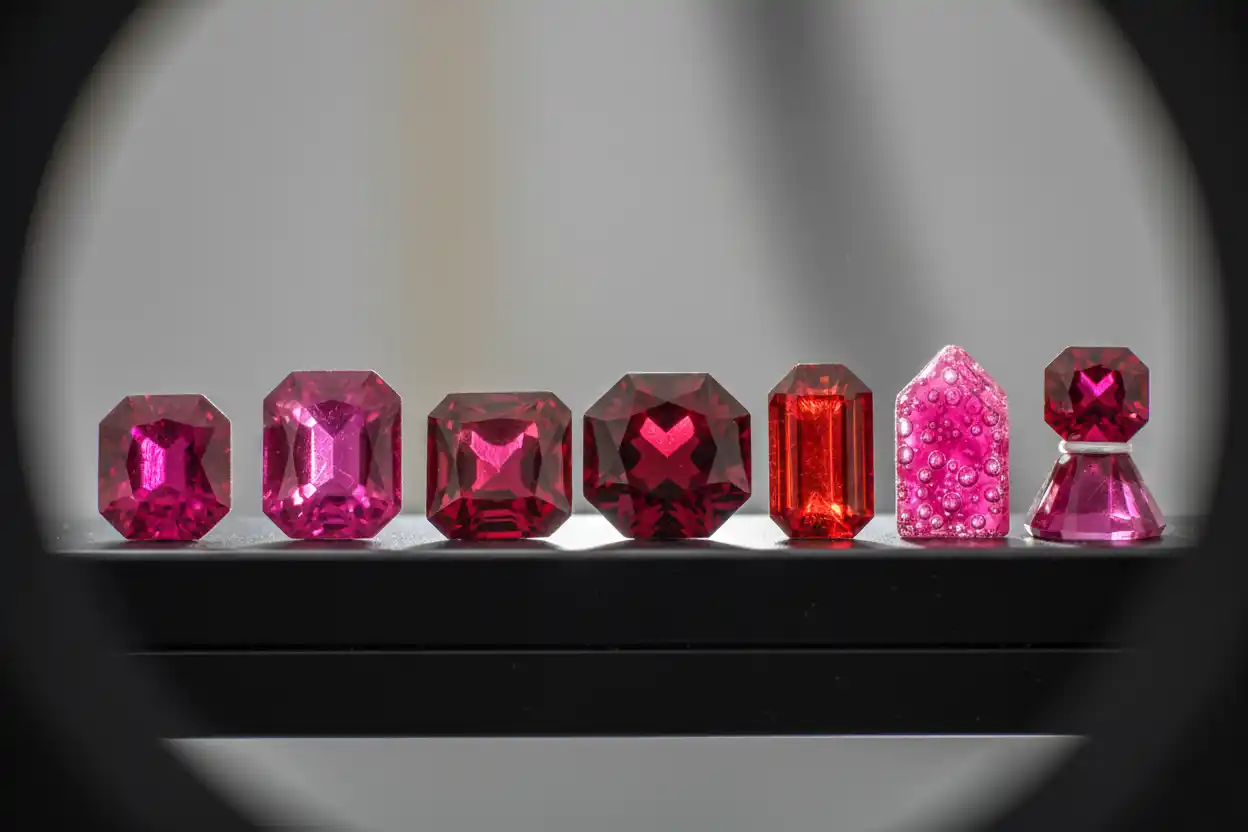
Real vs Fake Ruby: Natural, Synthetic and Treated Ruby Tests
A real natural ruby is red corundum that formed through geological processes. Chromium produces its red color, although iron, titanium and other trace elements can modify tone, fluorescence and appearance.
Laboratory-grown ruby is also corundum. It has essentially the same aluminum-oxide composition, crystal structure, hardness, density and refractive properties as mined ruby, but it grew through a manufactured process. A synthetic ruby is therefore not red glass or plastic; it is a laboratory-grown counterpart that must be disclosed clearly.
Ruby imitations include red spinel, garnet, tourmaline, glass, synthetic spinel, cubic zirconia and assembled stones. Natural ruby may also be heated, fracture-filled, diffusion-treated or combined with substantial glass. Those alterations do not all create the same product, and they can affect value and durability dramatically.
Consequently, ruby authentication has three stages:
- Determine whether the stone is corundum.
- Determine whether the corundum is natural or laboratory-grown.
- Identify heat, filling, diffusion, coating or composite construction.
This page owns that direct identification sequence. The completed treated and synthetic ruby guide retains the detailed treatment processes and laboratory criteria.
Natural Ruby vs Synthetic Ruby and Imitations
| Feature | Natural ruby | Laboratory-grown ruby | Red spinel or garnet | Red glass |
|---|---|---|---|---|
| Material | Naturally formed red corundum | Manufactured red corundum | Different natural or synthetic mineral | Manufactured glass |
| Composition | Al₂O₃ with chromium and other trace elements | Al₂O₃ with introduced colorants | Mineral-dependent | Variable silicate glass |
| Mohs hardness | 9 | 9 | Spinel about 8; garnet about 6.5–7.5 | Commonly about 5–6 |
| Refractive index | Approximately 1.762–1.770 | Same corundum range | Usually different | Usually lower |
| Specific gravity | Approximately 4.00 | Approximately 4.00 | Mineral-dependent | Variable |
| Refraction | Doubly refractive | Doubly refractive | Spinel and garnet singly refractive | Singly refractive |
| Common natural clues | Angular growth zoning, mineral crystals, rutile silk, healed fissures and natural fluids | Growth-method-related curved striae, flux residues, seed boundaries or synthetic zoning | Properties of the substitute mineral | Round bubbles, flow lines and molded features |
| Common treatments | Heat, flux healing, glass filling, diffusion and coating | Post-growth heat, diffusion or filling may occur | Treatment depends on substitute | Color is manufactured |
| Best confirmation | Microscopy, spectroscopy and trace-element analysis | The same advanced methods | Standard gemological identification | Standard glass identification |
Routine measurements can confirm corundum, but they do not determine whether the ruby grew beneath Earth or inside a laboratory.
What Is Genuine Natural Ruby?
The ruby meaning guide owns ruby’s geology, history, symbolism and broader properties.
Ruby is the red variety of corundum. Corundum consists principally of aluminum oxide and belongs to the trigonal crystal system.
Chromium substitutes for a small amount of aluminum and creates red color. Iron content can darken the stone, introduce brown or purple modifiers and suppress fluorescence.
Natural ruby forms in several geological environments. Marble-hosted rubies develop in carbonate rocks with relatively low iron, while basalt-related and amphibole-related deposits can produce rubies with different trace chemistry and inclusion populations.
No single inclusion, fluorescence reaction or red shade appears in every natural ruby.
Ruby Versus Pink Sapphire
Ruby and sapphire belong to the same corundum mineral species.
Red corundum is called ruby. Corundum of every other color is called sapphire, including pink sapphire.
The boundary between pale ruby and strongly saturated pink sapphire is not defined by one universal instrument reading. Laboratories and markets evaluate hue, tone and saturation, and different traditions may classify a borderline stone differently.
A seller should not upgrade a pale pink sapphire to ruby solely because the ruby name carries greater prestige.
The completed types-of-ruby guide retains the variety and color categories without turning every chromium-bearing pink corundum into ruby.
Natural Ruby Color
Natural ruby ranges from pinkish red through vivid red, purplish red, orangish red and dark brownish red.
Fine market color is commonly described as vivid red to slightly purplish red with enough brightness to remain lively indoors.
Color alone cannot establish natural origin. Flame-fusion and flux-grown synthetic ruby can display exceptional red, while glass and synthetic spinel can be colored to imitate almost any target shade.
Photographs create further uncertainty. Strong backlighting can make included material appear transparent, while digital saturation can suppress brown or purple modifiers.
Compare a stone under neutral daylight-equivalent illumination and warm indoor light before evaluating its color.
Natural Ruby Inclusions
Natural rubies may contain mineral crystals, fine rutile needles, partially healed fissures, growth tubes, negative crystals, fluid inclusions and angular color zoning.
Calcite, apatite, zircon, spinel and other mineral inclusions may occur according to geological source.
Rutile silk can create a soft appearance and, when aligned correctly, produce a star in cabochon-cut ruby. Heat may dissolve or alter the silk.
Healed fissures can resemble fingerprints. However, laboratory-grown flux ruby can also contain wispy veils or fingerprint-like residues.
An inclusion becomes useful only when its shape, composition and relationship with growth structures support one origin consistently.
Can a Natural Ruby Be Flawless?
Yes.
Small natural rubies can be eye-clean, and a carefully cut stone may exclude the most included regions of the original crystal.
Nevertheless, large natural rubies combining vivid color, transparency and very high clarity are rare and expensive.
A clean stone is not automatically synthetic. Conversely, visible inclusions do not prove natural origin because synthetic and composite rubies can contain complex internal features.
Clarity should be assessed alongside price, size, growth structures and laboratory documentation.
Flame-Fusion Synthetic Ruby
The Verneuil or flame-fusion process has produced synthetic ruby since the early twentieth century.
Powdered ingredients melt in a flame and fall onto a rotating support, where the material solidifies into a boule.
Classic microscopic clues include curved growth striae and round or elongated gas bubbles. Color zoning may curve with the boule’s growth.
Those features can be subtle or absent from the final cut stone. A cutter may orient the gem to conceal the most diagnostic area.
A stone without visible curved striae is not automatically natural.
Flux-Grown Synthetic Ruby
Flux growth dissolves ruby-forming ingredients in a molten chemical mixture and allows corundum to crystallize slowly.
The resulting ruby can look more natural than inexpensive flame-fusion material.
Flux residues may appear as wispy veils, fingerprints, opaque globules, angular cavities or metallic-looking platelets.
Some flux-grown synthetics contain natural-looking crystals or irregular graining. Modern material may defeat an inexperienced loupe examination.
Advanced microscopy, fluorescence imaging and trace-element analysis are often required.
Hydrothermal and Other Synthetic Ruby
Hydrothermal methods grow corundum from a hot solution under pressure.
Other laboratory techniques include Czochralski pulling, floating-zone growth and combinations of growth processes.
Possible features include seed boundaries, chevron structures, unusual growth bands and manufacturing-related inclusions.
No single synthetic-inclusion checklist covers every producer or era. Manufacturers continue to alter growth conditions and post-growth treatment.
A report should identify laboratory-grown corundum rather than relying on a visual comment such as “looks synthetic.”
Heat-Treated Natural Ruby
Heating is the most common ruby treatment.
It can improve color, reduce blue or brown modifiers, dissolve rutile silk and heal selected fissures when flux is present.
A heated ruby remains natural ruby because the original corundum formed geologically.
Heat status still matters because fine unheated ruby is scarcer and can command a substantial premium.
Microscopic evidence may include altered crystals, partially dissolved silk, discoid stress fractures and healed fissures. Low-temperature heating can be difficult to detect.
The completed treatment page owns the complete distinction between traditional heat, flux-assisted healing and other processes.
Lead-Glass-Filled Ruby
Low-quality fractured ruby can be heated with lead-rich or other high-refractive-index glass.
The glass enters large fissures and cavities, making an opaque or heavily fractured stone appear far more transparent.
A filled product can contain genuine natural corundum while relying extensively on glass for appearance and structural continuity.
Under magnification, common clues include blue, orange or yellow flash effects, flattened bubbles within filled fissures, different luster and glass-filled cavities.
This material needs careful terminology. Depending on construction and laboratory standards, it may be described as glass-filled ruby, ruby–glass composite or treated ruby.
It should not be priced or cared for like a minimally heated natural ruby.
Durability of Glass-Filled Ruby
The corundum portions remain hard, but the glass filler is softer and chemically less stable.
Acids, heat, jeweler’s torch work, aggressive cleaning solutions and some household chemicals can damage or whiten exposed filler.
Repairs require advance disclosure to the jeweler. Otherwise, heat used near the setting can alter the stone severely.
A large inexpensive ruby with unusually transparent fissures deserves careful inspection for glass filling.
Diffusion-Treated Ruby
Diffusion introduces color-producing elements into or near a corundum surface at high temperature.
Some processes create shallow color layers, while beryllium can penetrate more deeply under selected conditions.
Repolishing a shallow diffusion-treated stone may remove or change part of its color.
Immersion can reveal color concentrated along facet junctions or near the surface in selected products.
Routine refractive index and density remain corundum-like because the treated material is still corundum.
The completed treatment guide retains the detailed diffusion-identification boundary.
Ruby Doublets and Composites
An assembled ruby may join natural or synthetic corundum to glass or another gemstone.
Historical garnet-topped doublets used a hard natural garnet crown above colored glass. Modern constructions can combine ruby slices, colorless caps, glass bases and colored cement.
Inspect the girdle for a straight join, flattened bubbles and an abrupt change in inclusions.
Closed settings can conceal the assembly.
The gemstone doublets-and-triplets guide explains composite construction across materials.
Ruby Versus Red Spinel
Spinel can display vivid red caused by chromium.
Historically, several famous “rubies” were later identified as spinel because the two can look extremely similar.
Spinel is singly refractive, has a lower refractive index and usually lower density than ruby.
Natural red spinel is a valuable gemstone rather than a fake material. It becomes a ruby imitation only when sold under the wrong identity.
The planned ruby-versus-spinel guide owns their complete historical and gemological comparison.
Ruby Versus Garnet
Several garnets can resemble ruby, including pyrope, almandine and rhodolite-rich material.
Garnet is singly refractive, while ruby is doubly refractive. Garnet also occupies different density, refractive-index and absorption-spectrum ranges.
Dark red garnet commonly shows brown or purple modifiers, although color overlap remains substantial.
The planned ruby-versus-garnet-versus-spinel guide owns the complete three-way workflow.
The recently drafted real-versus-fake garnet guide explains why garnet itself is a diverse mineral group rather than one cheap red substitute.
Ruby Versus Red Glass
Red glass can imitate included ruby in inexpensive jewelry.
Round bubbles, curved flow lines, molded seams and a homogeneous interior support glass identification.
Manufacturers may add particles, fractures or cloudiness to make glass look natural.
Glass is softer and singly refractive, with lower density and refractive index than corundum.
A scratch test is unnecessary. Standard gemological measurements separate glass without damaging the object.
Ruby Versus Red Tourmaline
Rubellite and other red tourmalines can overlap ruby in pink-red, purplish-red and deep-red color.
Tourmaline commonly shows stronger pleochroism, different refractive properties and elongated growth tubes.
Iron-rich red tourmaline may appear darker or browner than fine ruby, although photographs obscure these distinctions.
A gemological test is more dependable than color-based assumptions.
Star Ruby
Star ruby displays asterism caused by aligned inclusions, commonly rutile needles.
A natural star should move across the cabochon as the light source or stone moves.
Synthetic star ruby exists, and diffusion or surface processes can produce excessively sharp or superficial stars.
A perfect star does not prove natural origin. Examine the inclusion structure, bodycolor, growth features and surface.
Lead-glass filling can also occur in star ruby, adding a treatment question beyond the star’s origin.
Refractive Index and Specific Gravity
Ruby normally measures approximately 1.762–1.770 in refractive index and around 4.00 in specific gravity.
Those values separate ruby from glass, most garnets, tourmaline and spinel.
Natural and laboratory-grown ruby share the same corundum range.
Therefore, standard measurements answer “Is this corundum?” more readily than “Where did this corundum grow?”
Mounted stones may provide limited access, while fillings and composites can distort selected measurements.
Double Refraction and Pleochroism
Ruby is doubly refractive and dichroic.
A dichroscope may reveal red and purplish-red or orangish-red directional colors.
The strength varies with orientation, color concentration and stone size.
Spinel and garnet are singly refractive, providing an important distinction.
Glass can show strain effects that imitate anomalous optical responses, so several tests should agree.
Ultraviolet Fluorescence
Chromium often causes red fluorescence in ruby.
Low-iron marble-hosted ruby can fluoresce strongly, while iron-rich material may respond more weakly.
Synthetic ruby may also fluoresce strongly. A bright red reaction is therefore not proof of natural origin.
Fillers, coatings and some treatments can create uneven or contrasting fluorescence.
Ultraviolet examination is useful when combined with inclusions, spectra and chemistry.
Spectroscope Testing
Ruby commonly shows chromium-related absorption and emission features.
A handheld spectroscope can help distinguish ruby from garnet, glass and several other red stones.
Synthetic ruby can produce an essentially ruby-like chromium spectrum because it is also corundum.
The instrument supports mineral identity but normally cannot establish natural origin alone.
Advanced Laboratory Identification
Microscopy remains central, but difficult rubies may also require FTIR, UV-Vis-NIR spectroscopy, Raman analysis, fluorescence imaging and trace-element chemistry.
Trace elements such as iron, gallium, titanium, vanadium, magnesium and beryllium can support growth-origin, treatment and geographic-origin conclusions.
Laser-ablation mass spectrometry can detect minute chemical differences not visible through a loupe.
A laboratory may issue a natural or laboratory-grown conclusion, treatment determination and, where evidence permits, a geographic-origin opinion.
Geographic-Origin Claims
Ruby sources include Myanmar, Mozambique, Madagascar, Sri Lanka, Vietnam, Tanzania, Afghanistan, Tajikistan and other regions.
No red shade proves one locality.
Laboratories compare inclusions, trace-element chemistry and spectroscopic properties with reference collections.
Some stones remain inconclusive because geological environments overlap.
“Burmese color,” “Mogok style” or “Mozambique red” is not equivalent to a laboratory-supported origin opinion.
Certificates and Reports
The gemstone-certification guide explains identification and origin reports.
A useful ruby report should state whether the stone is natural or laboratory-grown and list detectable treatment.
Descriptions such as heated, no indications of heating, fissure-filled, diffusion-treated or composite carry major value implications.
Use how to read a gem-lab report to verify dimensions, weight, report number and treatment wording.
An appraisal stating replacement value does not authenticate natural origin.
A Safe Home Inspection Sequence
Clean the stone gently before examination.
Observe its color under neutral and warm light. Then inspect it at 10× magnification.
Look for natural-looking growth zoning, crystals and silk, while also checking for curved striae, gas bubbles, flux residues, filler flashes and assembly planes.
A polariscope or dichroscope can help separate singly refractive substitutes from corundum.
Professional refractive-index testing can confirm ruby-range corundum.
Do not scratch, heat, acid-test or expose the stone to household chemicals.
When natural origin, treatment or locality affects value, obtain independent laboratory testing.
Buying a Genuine Ruby
The completed ruby buying guide owns color, clarity, cut, size and seller selection.
The ruby price guide explains how treatment, color, size and provenance affect value.
For laboratory-grown material, use the lab-ruby buying guide and lab-ruby price guide.
A seller should distinguish clearly among natural ruby, heated ruby, glass-filled ruby, laboratory-grown ruby and red simulant.
Follow how to buy gemstones online and retain enough of the return period for independent verification.
Jewelry and Care
A ruby engagement ring can perform well because corundum is hard and generally durable.
Treatment changes the care boundary. A minimally heated ruby is more repair-tolerant than a heavily glass-filled composite.
Use the completed ruby jewelry cleaning guide and tell a jeweler about filling before any repair.
Ruby’s calendar association appears in the July birthstone guide.
Frequently Asked Questions
1. What is a real natural ruby?
It is naturally formed red corundum colored principally by chromium.
2. Is laboratory-grown ruby real ruby?
It is genuine synthetic corundum with ruby properties, but it is not mined natural ruby and must be disclosed as laboratory-grown.
3. Are inclusions proof that ruby is natural?
No. Natural ruby commonly has inclusions, but synthetic ruby and ruby–glass composites can also contain complex internal features.
4. Can natural ruby be flawless?
Yes, especially in smaller sizes, although large vivid eye-clean natural rubies are rare.
5. Do curved lines prove synthetic ruby?
Curved growth striae strongly support flame-fusion origin when identified correctly, but their absence does not prove natural origin.
6. Is heated ruby fake?
No. It remains natural ruby, although treatment should be disclosed and affects value.
7. Is lead-glass-filled ruby genuine?
It contains natural corundum, but extensive glass fills its fractures and may make it a ruby–glass composite with different durability and value.
8. How can ruby be distinguished from spinel?
Ruby is doubly refractive and has different refractive index, density and spectra. Spinel is singly refractive.
9. How can ruby be distinguished from garnet?
Garnet is singly refractive and occupies different optical, density and absorption ranges.
10. Does strong red fluorescence prove natural ruby?
No. Natural and synthetic ruby can both fluoresce strongly, while iron-rich natural ruby may fluoresce weakly.
11. Can a scratch test authenticate ruby?
No. The test can damage jewelry and cannot separate natural from synthetic corundum.
12. When should a ruby receive laboratory testing?
Testing is advisable whenever natural origin, heat status, filling, geographic origin or price materially affects the transaction.
Ruby authentication cannot be solved by looking for one inclusion or one ideal red. Natural ruby, synthetic ruby, heated ruby and glass-filled ruby can all possess corundum properties, while spinel, garnet and glass can imitate the color. The reliable conclusion combines optical testing, microscopic growth evidence, treatment analysis and an independent report matched to the exact stone.
Ruby appears in Crystals That Start With R and Gemstones That Start With R.