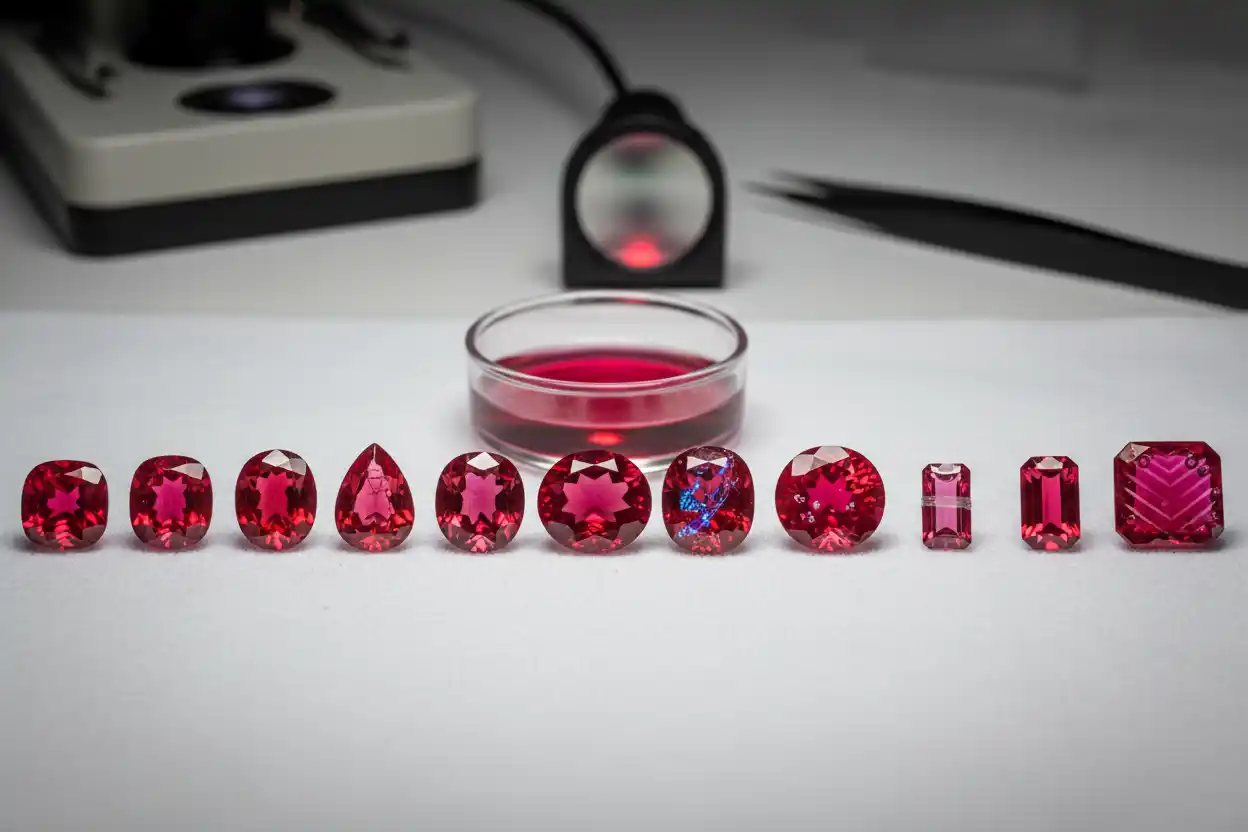
How to Spot Treated or Synthetic Ruby
Ruby is red corundum, a crystalline aluminum oxide colored mainly by chromium. Its treatment and synthetic market is one of the most complex in gemology.
Natural Ruby may be heated at low or high temperatures, heated with flux, diffusion treated, fracture filled with glass, cavity filled, dyed, coated, or assembled into a composite. Each process affects value, durability, care, and laboratory wording differently.
Laboratory-grown Ruby is also available through flame fusion, flux growth, hydrothermal growth, Czochralski pulling, and other methods. Synthetic Ruby has essentially the same corundum composition, hardness, density, refractive index, and red chromium spectrum as natural Ruby.
A Ruby can therefore belong to several categories at once. A flame-fusion synthetic Ruby may also be crackled and glass filled. A natural Ruby may be heated, flux healed, diffusion treated, and cavity filled. A report must identify every detectable stage rather than reduce the stone to real or fake.
Ruby treatment and growth categories at a glance
| Category | What it is | Common evidence | Correct description |
|---|---|---|---|
| Natural unheated Ruby | Naturally formed red corundum without detected heating | Unaltered natural inclusions and laboratory evidence | Natural Ruby, no indications of heating |
| Conventionally heated Ruby | Natural Ruby heated to improve color or clarity | Altered silk, healed fissures, tension cracks, inclusion changes | Heated natural Ruby |
| Flux-heated or flux-healed Ruby | Ruby heated with a molten flux that assists fissure healing | Flux residue, healed fingerprints, synthetic overgrowth | Heated Ruby with flux-related healing |
| Diffusion-treated Ruby | Color modified by chromium or beryllium entering from the surface | Color rims, treatment-related chemistry, diffusion zoning | Diffusion-treated natural corundum |
| Glass-filled Ruby | Fractures or cavities filled with lead, bismuth, zinc, silica, or other glass | Flash effects, bubbles, filled cavities, different luster | Glass-filled Ruby or corundum-glass composite |
| Dyed Ruby or corundum | Introduced red color in fractures or pale material | Red dye in cracks, dye fluorescence, absent chromium spectrum | Dyed corundum |
| Coated Ruby | Red film applied over corundum or another stone | Peeling, edge wear, surface-only color | Coated gemstone |
| Ruby doublet or composite | Several materials bonded together | Join plane, adhesive, different layers | Composite Ruby product |
| Flame-fusion synthetic Ruby | Laboratory-grown corundum formed from molten powder | Curved growth striae, round gas bubbles | Synthetic Ruby |
| Flux-grown synthetic Ruby | Laboratory-grown corundum crystallized from molten flux | Flux veils, metallic platelets, seed-related structures | Synthetic Ruby |
| Hydrothermal synthetic Ruby | Laboratory-grown corundum formed from hot pressurized solution | Seed plate, hydrothermal growth and fluid-related features | Synthetic Ruby |
| Pulled or melt-grown synthetic Ruby | Corundum grown from a melt by controlled crystal-pulling methods | Growth bands, seed features, process-related inclusions | Synthetic Ruby |
What natural Ruby is
Ruby belongs to the corundum mineral species. Sapphire covers corundum colors other than red.
The broader material profile appears in Ruby: Meaning, Properties & Symbolism, while the color, locality, star, included, and trade varieties appear in Types of Ruby.
Natural Ruby commonly contains rutile silk, mineral crystals, growth zoning, healed fissures, negative crystals, fluid inclusions, twins, and internal stress.
No one inclusion is required. Fine natural stones can be remarkably clean, while synthetic Rubies can contain bubbles, flux, seed structures, or fingerprint-like features.
The full identity decision tree—natural, synthetic, glass, Garnet, Spinel, Tourmaline, composite, and other red materials—belongs to Real vs Fake Ruby.
This page owns treatment and laboratory-growth analysis.
Conventional heat treatment
Heat is the most common Ruby treatment.
It can reduce blue or brown modifiers, strengthen red color, dissolve or modify rutile silk, improve transparency, heal certain fissures, and alter mineral inclusions.
Treatment conditions range from relatively low temperatures to temperatures approaching corundum’s melting environment. Atmosphere, duration, pressure, flux, starting chemistry, and inclusion content influence the result.
A heated natural Ruby remains naturally formed corundum. The treatment is generally accepted when disclosed and priced appropriately.
Heat does not automatically make a Ruby low quality. Many fine jewelry stones are heated. However, an otherwise comparable unheated Ruby with respected laboratory documentation can command a significant rarity premium.
Low-temperature heat
Low-temperature heating can be especially difficult to detect.
The familiar signs of high heat—strongly altered rutile, melted crystals, conspicuous healed fissures, chalky fluorescence patterns, or major inclusion damage—may remain absent.
Recent laboratory research has shown that FTIR features and Raman analysis of mineral inclusions can support detection even when ordinary microscopy reveals little change.
Therefore, a Ruby should not be called unheated merely because its silk looks intact or no melted inclusions are visible.
The most defensible wording comes from a laboratory report stating whether indications of heating were observed.
High-temperature heat
Higher-temperature treatment can dissolve rutile silk, alter crystal inclusions, heal fractures, redistribute color, and create new internal features.
Partially dissolved silk may appear broken, dotted, or converted into reflective particles. Solid inclusions can develop tension fractures or melt-related residues.
Healed fissures may form fingerprint-like networks of tiny cavities.
These features support heat treatment when their morphology and orientation agree with corundum. Natural healed fractures can also look fingerprint-like, so the full inclusion scene matters.
Heat and star Ruby
Star Ruby displays asterism from oriented needle-like inclusions, commonly rutile or related particles.
Heat can dissolve or change the silk responsible for the star. Controlled treatment may improve transparency but weaken the optical phenomenon.
Diffusion can also create or strengthen a star-like surface effect in some corundum.
The natural material profile appears in Star Ruby: Meaning, Properties & Symbolism.
A sharp star does not prove untreated natural origin. Synthetic star Ruby and diffusion-treated corundum exist.
Flux-assisted heating
Flux is a molten substance used during high-temperature treatment.
It can dissolve material from fracture walls and help corundum recrystallize across fissures. This reduces the visual impact of cracks and may improve structural continuity.
The healed areas may contain flux residue, fingerprints, cavities, or newly deposited corundum.
Flux healing is different from glass filling. In flux-assisted treatment, part of the Ruby itself can recrystallize across a fissure. In glass filling, a foreign glass remains inside the crack or cavity.
The boundary can become complex because flux, synthetic overgrowth, and glassy residues may coexist.
Synthetic overgrowth after treatment
High-temperature treatment can partly dissolve corundum and redeposit a thin synthetic layer over the Ruby.
The overgrowth may appear around the surface, within cavities, or along treated areas. Its chemistry can include elements from the crucible and flux.
A natural Ruby with synthetic overgrowth is not the same as a wholly synthetic Ruby, but it is also not an untouched natural coherent surface.
Chemical analysis, immersion, microscopy, and growth examination determine how much of the object consists of natural core and treatment-created overgrowth.
Beryllium diffusion
Beryllium diffusion uses very high heat to move beryllium into the corundum lattice.
The treatment can alter brownish, dark, or unattractive Ruby into a more appealing red or orangy-red color. It can also change other corundum colors.
Because beryllium is a light element present at low concentrations, ordinary gemological instruments may not detect it reliably.
LA-ICP-MS, SIMS, or comparable advanced chemical methods may be required.
Early diffusion-treated stones often showed a relatively thin color rim. Modern treatment can penetrate more deeply, so a deep color layer does not automatically prove natural color.
Chromium diffusion
Chromium diffusion introduces red color near the surface of pale corundum.
The resulting Ruby-like color may be shallow and concentrated around facet edges or surface zones.
Repolishing, recutting, abrasion, or damage can remove part of the treated layer and reveal a paler interior.
Immersion can reveal color concentration around the surface, but laboratory confirmation remains necessary.
Chromium-diffused corundum should not be priced like naturally red Ruby.
Glass filling
Glass filling is one of the most commercially important and care-sensitive Ruby treatments.
Highly fractured, low-transparency corundum is heated with glass that enters surface-reaching fissures and cavities. The filler reduces the visibility of fractures and can make the stone appear much clearer.
Lead-rich glass became especially widespread because its refractive index approaches corundum more closely than ordinary silica glass. Bismuth, zinc, cobalt, and other glass compositions have also been documented.
The amount of glass can be substantial. Some products depend so heavily on filler that composite terminology provides a more accurate commercial understanding than a simple treated-Ruby label.
Microscopic clues to glass filling
Filled fractures commonly show blue, purple, orange, yellow, or green flash effects when the stone is tilted.
Round or flattened gas bubbles may appear inside the glass. Cavities can show a different luster from the surrounding corundum.
A filler-filled fissure may look transparent in one direction and strongly reflective in another.
The most obvious bubbles belong to glass rather than natural fluid inclusions when they sit within a broad filler network and accompany flash effects.
Microscopy can identify many filled Rubies, although some modern glasses and small filled fissures require advanced imaging and chemical analysis.
Durability of glass-filled Ruby
Ruby itself ranks 9 on the Mohs scale, but the glass inside its fractures is softer and more chemically vulnerable.
Acids, some solvents, strong cleaners, heat, ultrasonic vibration, repolishing, and jewelry repair can damage the filler.
The treatment may become cloudy, etched, discolored, or partly removed. The fractures beneath it remain.
A glass-filled Ruby should never receive the same care assumptions as sound untreated or conventionally heated corundum.
Cavity filling
Some Rubies contain surface cavities filled with glass or another substance.
Filling can increase weight, improve outline, reduce visible pits, and make the cut appear more complete.
Under reflected light, the cavity may have different luster or polishing quality. Bubbles and flow structures can appear inside it.
Large filled cavities materially affect value and should be described specifically rather than hidden under a generic heat-treated statement.
Dyeing
Colorless, pale, or low-color corundum can be thermally crackled and then dyed red.
Introduced color follows fractures rather than corundum growth sectors. Dye may fluoresce differently from the surrounding stone and can produce a Ruby-like absorption profile without the natural chromium features expected from true Ruby color.
A dyed natural corundum host remains corundum, but it should not be sold as naturally red Ruby.
The general color-distribution workflow appears in How to Spot Dyed Crystals.
Coatings
Corundum, synthetic Ruby, glass, quartz, or another material can receive a red surface film.
Possible evidence includes worn facet junctions, scratches through the coating, peeling, colorless chips, and stronger color beneath prongs or on pavilion facets.
A coating can create red color, improve apparent saturation, or conceal a pale body.
Modern films can be extremely thin. Surface chemical analysis, Raman spectroscopy, and careful immersion may be needed.
Ruby doublets and triplets
A Ruby composite can combine natural Ruby, synthetic Ruby, Sapphire, Spinel, Garnet, glass, quartz, or colored cement.
One traditional construction places a natural Garnet crown over a glass pavilion. Other products may use a thin Ruby layer over synthetic or glass backing.
Possible clues include a straight join plane, adhesive bubbles, abrupt color changes, and inclusions that stop at one layer.
The complete construction framework appears in Gemstone Doublets and Triplets.
Flame-fusion synthetic Ruby
Flame fusion is the oldest and most widespread synthetic Ruby process.
Powdered ingredients melt in a flame and solidify into a curved boule. Chromium produces the red color.
Typical clues include curved growth striae and round gas bubbles. The curved pattern follows the boule’s growth rather than natural angular corundum zoning.
Not every stone shows obvious striae or bubbles. Careful immersion, several viewing directions, and higher magnification may be required.
Flame-fusion Ruby has corundum hardness, refractive index, density, pleochroism, and chromium fluorescence. A scratch test or ultraviolet glow cannot prove natural origin.
Flux-grown synthetic Ruby
Flux-grown Ruby crystallizes from a molten solvent at lower temperatures than direct melt growth.
The process can create crystals with natural-looking shapes and inclusions.
Possible clues include wispy flux veils, fingerprint-like patterns, metallic platelets, rounded flux residues, seed structures, and growth features linked to the crucible environment.
Some flux inclusions resemble natural healed fissures. Identification depends on orientation, chemistry, associated features, and comparison with known synthetic products.
Hydrothermal synthetic Ruby
Hydrothermal growth uses hot pressurized solution and a seed crystal.
Possible clues include seed plates, chevron or angular growth zoning, hydrothermal fluid features, growth striations, and trace chemistry different from natural geological Ruby.
Hydrothermal synthetic Ruby is less common than flame-fusion material but can be highly convincing.
Natural-versus-synthetic determination may require microscopy, FTIR, UV-visible spectroscopy, photoluminescence, and chemical analysis.
Czochralski and other melt-grown Ruby
The Czochralski method pulls a crystal from molten corundum while controlling rotation and temperature.
Other melt-growth systems include variations of pulling, zone melting, skull melting, and heat-exchange methods.
Possible features include seed remnants, curved or planar growth bands, internal strain, bubbles, and highly clean crystal areas.
The separate synthetic material profile appears in Lab Ruby: Meaning, Properties & Symbolism.
Synthetic Ruby is genuine laboratory-grown corundum, but its manufactured origin must be disclosed.
Natural versus synthetic physical tests
Natural and synthetic Ruby share Mohs hardness 9, specific gravity near 4.00, refractive index around 1.762–1.770, double refraction, pleochroism, and chromium-related spectra.
A Diamond tester, scratch test, or ultraviolet lamp cannot separate them reliably.
Microscopy evaluates growth structure and inclusions. FTIR, Raman, UV-visible, photoluminescence, X-ray fluorescence, and trace-element analysis address treatment and origin.
The broader origin distinction appears in Lab-Grown vs Natural Gemstones.
Treatment and price
Treatment category can create a larger value difference than carat weight.
Fine unheated natural Ruby occupies the strongest rarity market. Conventionally heated natural Ruby remains important and widely accepted.
Diffusion-treated, heavily glass-filled, dyed, coated, composite, and synthetic products generally occupy different price tiers.
The Ruby Price Guide owns detailed value factors. Laboratory-grown pricing belongs to the Lab Ruby Price Guide.
A low price does not prove treatment, but a large transparent “unheated natural Ruby” offered cheaply deserves immediate independent testing.
Buying and laboratory reports
The Ruby Buying Guide owns natural-Ruby color, cut, clarity, treatment, origin, and seller evaluation. Synthetic purchase questions belong to the Lab Ruby Buying Guide.
A significant Ruby should receive a respected colored-stone report. The document should state natural or laboratory-grown origin and identify detectable heat, diffusion, filling, or other treatment.
Geographic origin is a separate opinion that may require additional evidence. Color alone cannot prove Myanmar, Mozambique, Sri Lanka, Madagascar, Tanzania, or another source.
The completed Gemstone Certification Labs Compared explains report scope. Use How to Read a Gem Lab Report to match the weight, measurements, photograph, treatment wording, and report number to the stone.
Before purchasing online, follow How to Buy Gemstones Online Without Getting Scammed.
Related Ruby comparisons
Ruby can overlap visually with red Garnet and Spinel. Their three-way separation appears in Ruby vs Garnet vs Spinel.
The focused historical and optical distinction appears in Ruby vs Spinel.
These comparison pages establish mineral identity. They do not replace treatment testing after a stone has been confirmed as corundum.
Jewelry and care
Sound unheated and conventionally heated Ruby normally tolerate warm soapy water and careful professional cleaning.
Glass-filled, dyed, coated, composite, and heavily fractured stones require conservative handling.
Avoid acids, solvents, steam, ultrasonic cleaners, high repair heat, and repolishing unless the treatment is known to tolerate them.
The complete care workflow appears in How to Clean Ruby Jewelry Safely. Laboratory-grown care appears in How to Clean Lab Ruby Jewelry Safely.
Ring-specific buying and setting decisions belong to Ruby Engagement Rings.
Frequently Asked Questions
1. Is most Ruby heat treated?
A large portion of commercial Ruby is heated to improve color or transparency, although untreated material also exists.
2. Is heated Ruby still natural?
Yes. The corundum formed naturally, while heat modified its appearance after mining.
3. Can laboratories always detect low-temperature heat?
No. Some low-temperature treatment leaves few visible changes and requires FTIR or Raman analysis of inclusions.
4. What is flux-healed Ruby?
It is natural Ruby heated with molten flux that helps corundum recrystallize across fissures.
5. What is diffusion-treated Ruby?
It is corundum whose color was modified by elements such as chromium or beryllium entering from the surface during high-temperature treatment.
6. What is lead-glass-filled Ruby?
It is heavily fractured corundum whose cracks contain high-refractive-index glass that greatly improves apparent clarity.
7. Is glass-filled Ruby durable?
The corundum is hard, but the filler can be damaged by chemicals, solvents, repair heat, ultrasonic cleaning, and repolishing.
8. Can natural corundum be dyed red?
Yes. Pale corundum can be crackled and dyed, creating red color concentrated inside fractures.
9. Is laboratory-grown Ruby real corundum?
It is synthetic crystalline corundum with Ruby color but did not form geologically.
10. What is the easiest clue to flame-fusion Ruby?
Curved growth striae and round gas bubbles are classic clues, although they are not visible in every stone.
11. Can hardness separate natural and synthetic Ruby?
No. Both have corundum hardness 9 and overlapping standard gemological properties.
12. When is a Ruby laboratory report essential?
A report is essential when natural origin, unheated status, geographic origin, diffusion, glass filling, or substantial purchase value affects the transaction.
Conclusion
Ruby treatment ranges from accepted conventional heat to processes that radically alter appearance and durability.
Low- and high-temperature heat can improve natural Ruby, while flux treatment can heal fissures. Chromium and beryllium diffusion modify color within surface-related zones. Glass filling can transform heavily fractured material into a transparent-looking product whose care requirements differ sharply from sound corundum.
Synthetic Ruby is produced through flame fusion, flux growth, hydrothermal growth, Czochralski pulling, and other methods. Because natural and laboratory-grown Ruby share corundum properties, ordinary hardness, fluorescence, and color observations cannot determine origin.
The strongest workflow confirms corundum, identifies natural or synthetic growth, evaluates heat and diffusion, maps filler and composite construction, and verifies every commercially significant conclusion through an independent report.