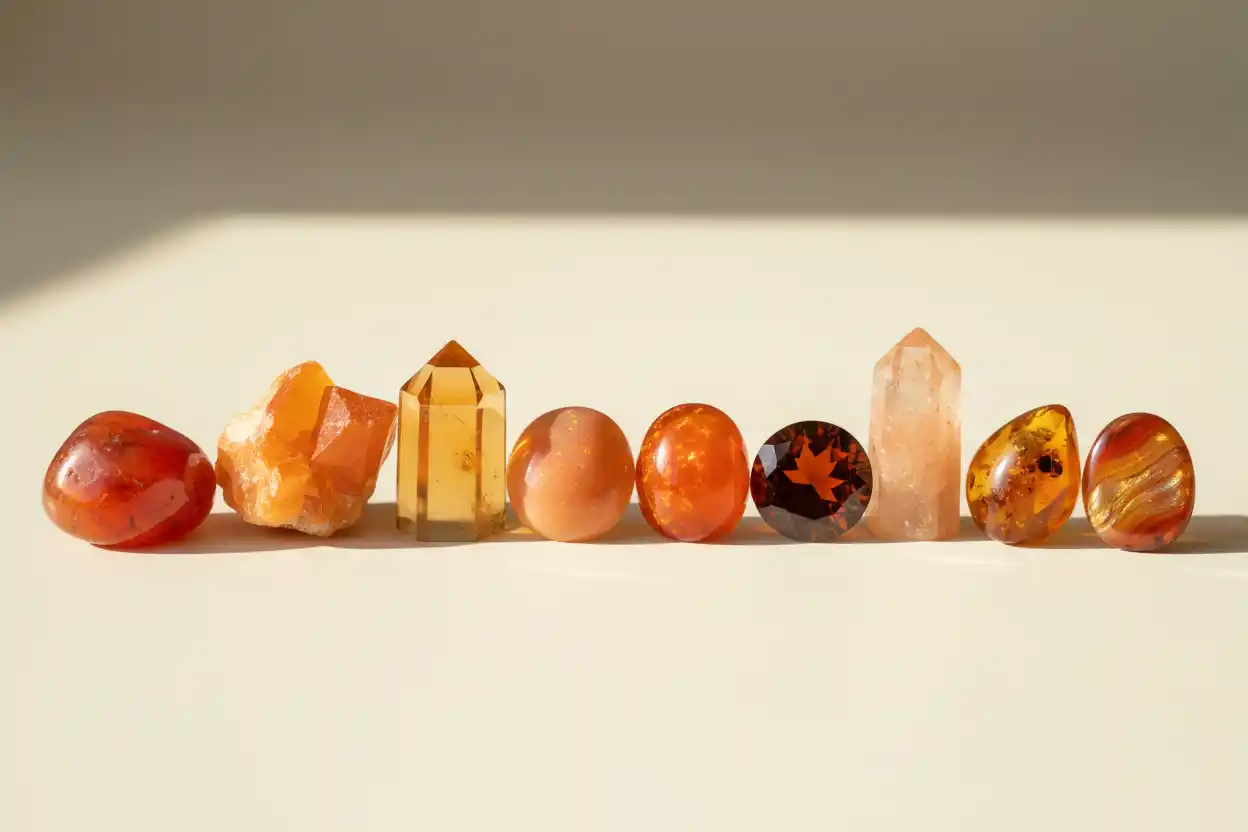
Orange Crystals: 7 Inspiring Stones, Positive Symbolism & Safe Uses
Orange crystals are traditionally associated with creativity, enthusiasm, confidence, motivation, warmth, sociability, and taking constructive action. Their colors range from pale peach and honey-orange to bright tangerine, reddish orange, and deep burnt orange. That warmth makes them visually energetic, which helps explain why modern crystal traditions frequently connect orange stones with movement, expression, and optimism.
Seven especially useful choices are carnelian, orange calcite, fire opal, sunstone, amber, citrine, and orange mookaite. They share a color family rather than a mineral family. Amber is an organic gem rather than a crystal, fire opal has very different care requirements from quartz, and calcite is far softer than carnelian or citrine. Choosing safely therefore means looking beyond color and understanding each stone’s structure and durability.
Carnelian and Orange Calcite for Creative Momentum and Practical Motivation
Carnelian is one of the classic orange gemstones. It is a translucent orange to reddish-orange variety of chalcedony, which places it within the quartz family. Fine stones can range from pale amber-orange to deep red-orange and often show a smooth, waxy polish rather than the brilliance of a transparent faceted gem.
Traditional carnelian healing properties often emphasize creativity, courage, motivation, confidence, and moving from intention into action. Those ideas can be applied practically by associating a carnelian stone with starting a task instead of repeatedly planning it. A small polished piece beside a notebook, art desk, or computer can become a visual reminder to begin.
Carnelian is also one of the more convenient orange stones for everyday handling because chalcedony has useful scratch resistance and toughness. It works well in beads, cabochons, pendants, rings, and pocket stones.
Orange calcite provides a softer, cloudier appearance. It can range from pale cream-orange to saturated tangerine and commonly displays translucent internal bands or cleavage surfaces. Calcite reacts strongly with acids and ranks only about 3 on the Mohs scale, so it scratches much more easily than quartz.
Traditional orange calcite healing properties commonly revolve around optimism, creativity, renewed interest, and breaking a task into manageable steps. A palm stone can suit a desk or meditation area, but exposed rings are less practical because daily contact can quickly mark the surface.
Orange calcite should also be kept away from vinegar, acidic household cleaners, and aggressive polishing compounds. Its softness makes gentle external handling the simplest approach.
Fire Opal and Sunstone for Confidence, Expression, and Visible Energy
Fire opal is valued primarily for its warm body color, which can range from yellow and orange to reddish orange and red. Unlike the popular image of precious opal, fire opal does not need to show rainbow play-of-color to qualify for the name. Some examples are transparent enough to facet, while others are cut as cabochons.
Traditional fire opal healing properties are commonly associated with confidence, creative expression, spontaneity, and enthusiasm. The intense orange color makes those associations visually intuitive, particularly for someone choosing a stone as a personal reminder to participate more actively in a project or social situation.
Opal requires thoughtful care. It is softer than quartz, can scratch or chip, and sudden temperature changes or strong heat can cause cracking. Warm soapy water is the safest cleaning approach for a sound stone. A ring should use a protective setting when possible, while pendants and earrings offer lower-impact alternatives.
Sunstone earns its name from warm colors and sparkling reflections. It is a feldspar gem that may appear orange, peach, red-orange, golden, green, or bicolor. Reflective inclusions can create aventurescence, producing small flashes as the stone moves.
Traditional sunstone healing properties frequently emphasize independence, optimism, warmth, confidence, and enjoying visible progress. Physically, sunstone has enough hardness for jewelry but also has cleavage and only modest toughness. A protected setting is preferable for rings, while pendants and earrings reduce impact risk.
Sunstone should be cleaned with warm soapy water rather than steam or ultrasonic methods. Its color is generally stable to ordinary light, but strong heat should be avoided.
Amber and Citrine for Warmth, Optimism, and Everyday Positivity
Amber is not a mineral crystal. It is fossilized tree resin, but it is commonly included in crystal collections because of its long history in jewelry and its warm yellow, honey, cognac, and orange colors.
Traditional amber healing properties often center on warmth, comfort, optimism, memory, and connection with the natural world. Its extremely light weight makes amber jewelry feel very different from ordinary stones of the same apparent size.
That lightness comes with lower durability. Amber is soft, around 2 to 2.5 on the Mohs scale, and can be scratched easily. Heat, strong chemicals, perfumes, and prolonged intense light can damage or darken it. Warm mild soapy water is the safest basic cleaning method.
Citrine sits at the opposite end of this pair in terms of physical durability. It is yellow to orange quartz and therefore ranks 7 on the Mohs scale. Natural citrine is uncommon compared with the amount sold commercially, and much market citrine begins as amethyst that has been heated to produce yellow or orange-brown color.
Traditional citrine healing properties commonly emphasize confidence, optimism, generosity, motivation, and prosperity symbolism. Those ideas can be used as behavioral prompts rather than predictions. A citrine on a work desk might represent completing revenue-generating tasks, for example, without implying that the stone itself produces financial results.
Very dark burnt-orange or reddish-brown citrine should also be judged as a color preference rather than automatically being considered higher quality. Brightness and attractive hue often matter more than darkness.
Orange Mookaite for Adaptability, Curiosity, and Taking the Next Step
Mookaite can display striking combinations of orange, mustard yellow, red, burgundy, cream, pink, and brown. Individual polished stones may contain several colors at once, while others are dominated by warm orange and yellow.
Traditional mookaite healing properties commonly focus on adaptability, confidence during change, curiosity, and balancing careful thought with a willingness to try something new. Its multicolor patterns make it especially suitable for symbolism connected with flexible decision-making rather than following one rigid path.
Orange mookaite can be used in pendants, beads, cabochons, palm stones, and decorative carvings. Its silica-rich composition generally provides useful durability, although fractures and weak zones can occur in individual pieces.
Because mookaite is usually opaque, quality depends heavily on pattern, polish, color balance, and the appeal of the finished shape. A smooth orange-red cabochon with a strong natural pattern can be more attractive than a larger stone with dull uneven color.
Why Orange Crystals Are Linked With Creativity, Motivation, and Confidence
Orange combines visual warmth with high visibility, which helps explain its recurring symbolism. It sits between energetic red and bright yellow, so modern crystal traditions often interpret it through enthusiasm, creative movement, sociability, confidence, and enjoyment.
Each stone modifies that theme. Carnelian is commonly associated with taking action, orange calcite with renewed interest, sunstone with confidence, fire opal with expression, amber with warmth, citrine with optimism, and mookaite with adaptable decision-making.
The traditions around crystals for creativity become more useful when tied to a real activity. A carnelian beside drawing tools can represent beginning before perfectionism takes over. Sunstone can accompany a presentation plan, while mookaite can symbolize trying a different method when the first approach fails.
The stone does not need to be credited with producing the result. Its role can simply be to make an intention visible and easier to remember.
Orange Crystal Jewelry Requires Very Different Levels of Care
Carnelian and citrine are among the easiest orange stones for regular jewelry because both belong to the quartz family and provide good resistance to ordinary scratching. They can work well in rings, earrings, necklaces, and bracelets when sound and properly set.
Mookaite is also suitable for many jewelry designs, particularly cabochons and beads. Sunstone requires more care because feldspar has cleavage, making protective settings useful for rings.
Fire opal needs additional protection from impact, abrasion, heat, and sudden temperature changes. Amber is softer still and should be kept away from harder jewelry that can scratch it.
Orange calcite is best treated as a protected pendant, palm stone, carving, or display piece rather than an exposed everyday ring.
The crystal hardness chart is particularly useful with orange stones because similar color gives no reliable indication of how well each one will tolerate daily wear.
Safe Everyday Uses for Orange Crystals
Orange stones fit naturally into creative and work environments because their warm colors stand out visually. Carnelian beside a task list can represent starting. Citrine beside a business notebook can symbolize constructive optimism, while mookaite can remind you to remain flexible when plans change.
A quiet meditation routine can use any smooth stone as a tactile point of attention. Hold the stone, notice its temperature and texture, and return attention to breathing when thoughts wander. The structured pause can be useful without treating the stone as a medical device.
Orange crystals can also be used purely for decoration. Fire opal, sunstone, amber, and polished carnelian each interact with light differently and can provide visual interest independent of spiritual symbolism.
Avoid homemade crystal drinks, powders, or ingestion. Even when a stone itself is relatively stable, treatments, surface residues, adhesives, contaminants, or unknown identity can make internal use unnecessary and unsafe.
Conclusion
Orange crystals combine warm color with traditions centered on creativity, confidence, motivation, optimism, expression, and adaptable action. Carnelian, orange calcite, fire opal, sunstone, amber, citrine, and orange mookaite each offer a distinct appearance and level of durability. The best choice is the one whose color and symbolism fit your purpose while its physical properties suit the way you plan to wear, handle, clean, or display it.
FAQs
What do orange crystals traditionally symbolize?
Orange crystals are commonly associated with creativity, motivation, confidence, enthusiasm, optimism, warmth, sociability, and constructive action.
Which orange crystal is commonly linked with creativity?
Carnelian is one of the most frequently associated stones, while orange calcite, sunstone, and fire opal also appear in creativity-focused traditions.
Is amber really a crystal?
No. Amber is fossilized tree resin and is an organic gem rather than a crystalline mineral, although it is commonly grouped with crystals in jewelry and spiritual contexts.
Is fire opal always rainbow colored?
No. Fire opal is defined mainly by its yellow, orange, or reddish body color. Some stones show play-of-color, while others do not.
Is sunstone suitable for rings?
Yes, but protective settings are helpful because sunstone has feldspar cleavage and can be damaged by hard blows.
Is orange calcite durable?
Orange calcite is relatively soft and scratches easily. It is better suited to protected jewelry, palm stones, carvings, and display pieces than exposed everyday rings.
Is orange citrine natural?
Natural orange citrine exists, but much commercial citrine is produced by heating amethyst. Treatment disclosure is useful when natural color matters to the buyer.
Which orange stones are easiest to wear frequently?
Carnelian and citrine offer strong quartz-family durability. Mookaite is also practical, while sunstone, fire opal, amber, and calcite need progressively more care.
Can orange crystals increase motivation or create financial success?
They can serve as symbolic prompts within goal-setting or creative routines, but there is no established evidence that crystals directly change motivation, health, or financial outcomes.
Crystal meanings and wellness associations are traditional or personal practices, not established medical treatments.