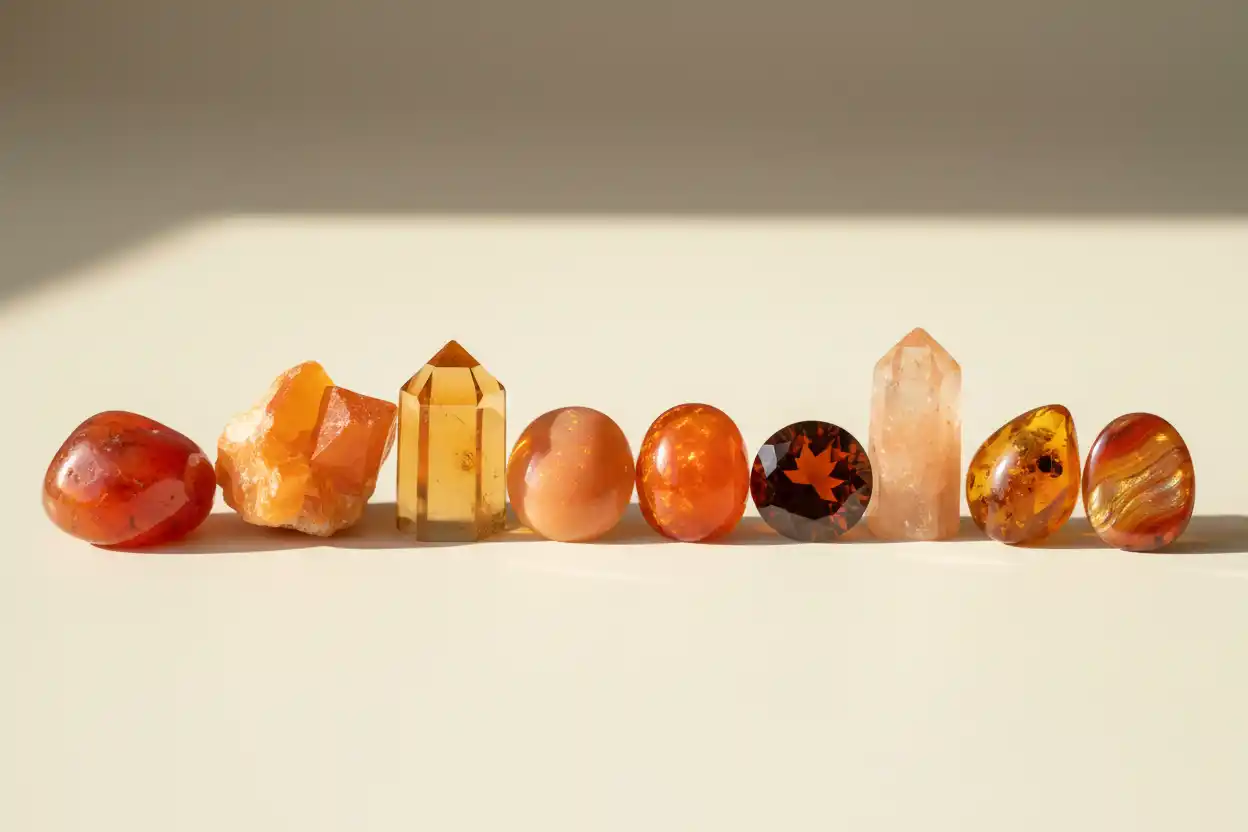
Orange Crystals: Meanings, Uses and Complete List
Orange crystals range from translucent chalcedony and soft calcite to transparent Garnet, feldspar, Quartz, Topaz, Opal and fossilized resin. Their shared color creates a visual family, but their mineral compositions, hardness, treatments and care requirements differ substantially.
Modern crystal traditions associate orange with creativity, motivation, pleasure, sociability, confidence and emotional warmth. Orange stones are also frequently linked with the sacral chakra and, in more yellow-orange examples, the solar plexus chakra.
These meanings are symbolic rather than scientifically established healing effects. An orange crystal can serve as a reminder to begin a project, express an idea or reconnect with enjoyable activity, but the mineral does not produce confidence, fertility, creativity or financial success through color alone.
The sibling Orange Gemstones guide owns the jewelry-focused list, including cutting, durability, rarity and market considerations. This page focuses on orange crystals as collector materials and spiritual or reflective tools.
Orange Crystals at a Glance
| Crystal | Material identity | Typical orange appearance | Common symbolic themes | Main care concern |
|---|---|---|---|---|
| Carnelian | Chalcedony | Red-orange to brownish orange | Motivation, courage, creativity | Dye and heat |
| Orange Calcite | Calcite | Pale peach to vivid orange | Emotional warmth and play | Softness and acids |
| Citrine | Quartz | Yellow-orange to reddish orange | Optimism and abundance | Heat treatment and strong light |
| Sunstone | Feldspar | Peach, orange, red-orange or coppery | Confidence and vitality | Cleavage and impact |
| Fire Opal | Hydrated silica | Yellow, orange or red bodycolor | Passion and creative action | Heat, dryness and porosity |
| Spessartite Garnet | Garnet | Mandarin orange to reddish orange | Energy and ambition | Inclusions and impact |
| Hessonite Garnet | Grossular Garnet | Honey, cinnamon or orange-brown | Confidence and perspective | Included material |
| Tangerine Quartz | Quartz with surface coloration | Pale to vivid orange coating or staining | Curiosity and playfulness | Surface alteration |
| Imperial Topaz | Topaz | Golden orange to orange-pink | Purpose and self-worth | Perfect cleavage |
| Amber | Fossilized resin | Honey, orange and reddish brown | Warmth and memory | Softness, heat and chemicals |
| Orange Aragonite | Aragonite | Peach, rust or orange-brown clusters | Patience and grounding | Soft, brittle crystals |
| Fire Agate | Chalcedony with iron-oxide layers | Brown-orange with iridescent flashes | Resilience and confidence | Polishing and imitation |
| Orange Aventurine | Quartz-rich rock | Peach to orange with sparkle | Sociability and optimism | Dye and ambiguous naming |
| Orange Fluorite | Fluorite | Pale yellow-orange to amber-orange | Focus and mental flexibility | Very soft and cleavable |
| Orange Sapphire | Corundum | Yellowish orange to vivid orange | Creativity and commitment | Treatment disclosure |
| Orange Tourmaline | Tourmaline | Peach, orange and reddish orange | Expression and emotional warmth | Fractures and treatment |
| Peach Moonstone | Feldspar | Cream, peach and orange-pink | Receptivity and calm | Cleavage and scratches |
| Sard | Chalcedony | Brownish red to orange-brown | Endurance and discipline | Dye and naming overlap |
What Makes a Crystal Orange?
Orange color can arise through several different mechanisms.
Iron compounds create orange, red and brown tones in many Quartz and chalcedony materials. Manganese contributes to the color of Spessartite Garnet and some orange-to-pink gemstones. Copper inclusions can create the glittering appearance of certain Sunstones.
Color centers produced naturally or through treatment can create yellow and orange Quartz or Topaz. Fire Opal’s bodycolor develops through impurities within hydrated silica, while Amber’s color comes from organic resin chemistry and aging.
Some orange products receive dye, irradiation, heating, coating or surface staining. Color alone cannot identify the mineral or prove that the appearance is natural.
Orange Crystal Meaning
Orange is commonly interpreted as an active, warm and socially expressive color.
In contemporary crystal practice, orange stones represent creativity, enthusiasm, pleasure, confidence, attraction and the willingness to begin. Darker rust and brown-orange stones may receive more grounded meanings involving endurance and practical effort.
The symbolism follows ordinary color associations more than mineral chemistry. A vivid orange Garnet and a soft Orange Calcite may be assigned similar intentions despite having unrelated compositions and durability.
A practical use connects the color with a specific behavior. An orange stone can sit beside a sketchbook, exercise plan or unfinished task as a reminder to begin.
Orange Crystals and the Sacral Chakra
Orange stones are strongly associated with the Sacral Chakra.
Within that spiritual framework, the sacral center represents creativity, pleasure, emotional movement, relationships and sexuality.
A grounded sacral practice can ask whether daily life contains enough rest, creative activity, social connection and healthy enjoyment.
The stone cannot treat infertility, reproductive disease, hormonal conditions or sexual dysfunction.
Orange Calcite, Carnelian and Sunstone frequently appear in sacral-chakra traditions because their colors align with the system. The association is symbolic rather than anatomical.
Orange Crystals and the Solar Plexus Chakra
Yellow-orange and golden stones may also be linked with the Solar Plexus Chakra.
This spiritual center represents confidence, willpower, decision-making and personal agency.
A practical solar-plexus exercise identifies one decision that has been postponed, gathers the necessary evidence and chooses the next proportionate action.
The crystal cannot create authority, ensure success or make another person comply.
Citrine, Imperial Topaz and golden-orange Sunstone commonly bridge the sacral and solar-plexus color ranges.
1. Carnelian
Carnelian is orange-to-red-brown chalcedony.
Its color commonly results from iron compounds dispersed through the microcrystalline Quartz structure. Translucence can range from nearly transparent at thin edges to opaque in darker material.
Carnelian is one of the most familiar orange crystals and is associated with motivation, courage, creativity and physical confidence.
Its practical durability makes it suitable for palm stones, beads, carvings and jewelry.
Some Carnelian is heated or dyed to strengthen color. Uniform vivid orange without natural variation should be evaluated carefully.
2. Orange Calcite
Orange Calcite is a soft calcium-carbonate mineral ranging from pale peach to vivid orange.
It commonly shows cloudy translucence, cleavage surfaces and a waxy-to-vitreous polish.
Modern traditions associate it with playfulness, emotional warmth and restarting creative activity after a period of stagnation.
Calcite is much softer than Quartz and reacts with acids. It should not be soaked in acidic cleaners, salt water or household chemicals.
A polished Orange Calcite stone can resemble orange glass or dyed material, making seller disclosure important.
3. Citrine
Citrine is yellow-to-orange Quartz.
Natural Citrine is relatively uncommon. Much commercial material begins as Amethyst and receives heat treatment that changes purple color to yellow, orange or reddish brown.
Citrine is commonly linked with optimism, abundance, confidence and constructive action.
The stone can serve as a financial-planning reminder, but it does not attract money or guarantee business success.
Very dark burnt-orange clusters with pale or white bases are commonly heated Amethyst rather than naturally formed Citrine crystals.
4. Sunstone
Sunstone is feldspar whose color can range from pale peach to orange, red, green or multicolored.
Some material contains reflective copper or hematite inclusions that produce aventurescence or glittering flashes.
Sunstone is associated with confidence, vitality, independence and enjoyment.
Despite the energetic symbolism, the gem can have cleavage and should be protected from sharp blows.
Transparent Oregon material, included commercial feldspar and orange aventurine glass should not be treated as identical products.
5. Fire Opal
Fire Opal has yellow, orange or red bodycolor and may or may not display play-of-color.
Transparent material can be faceted, while translucent stones are commonly cabochon cut.
Its warm color creates associations with passion, creative action, confidence and emotional expression.
Opal is relatively soft, can be brittle and may contain structural water or porosity. Heat, dryness, liquid absorption and sudden temperature changes are important care concerns.
Fire Opal’s name refers to bodycolor rather than proof that every stone displays rainbow fire.
6. Spessartite Garnet
Spessartite Garnet ranges from yellow-orange and mandarin orange to reddish orange.
Manganese is a major component of the mineral and contributes to its characteristic color.
Fine stones can show intense saturation and strong brilliance. Included material may contain needles, crystals or other internal features.
In crystal traditions, Spessartite is associated with ambition, enthusiasm, confidence and sustained effort.
The gem is more durable than many orange collector crystals, but surface-reaching fractures still matter.
7. Hessonite Garnet
Hessonite Garnet is an orange-to-brownish variety of Grossular Garnet.
Its color is often described as honey, cinnamon, amber or reddish brown. Many stones show a distinctive roiled internal appearance.
Hessonite is associated with perspective, confidence and navigating uncertainty.
Within Jyotish traditions, it also represents Rahu, although those planetary meanings are cultural rather than scientifically established.
Hessonite should not be confused with Citrine, Zircon, glass or Spessartite solely from color.
8. Tangerine Quartz
Tangerine Quartz is usually Quartz whose surface carries orange iron-oxide staining, coating or inclusions.
The color may be concentrated along growth faces, fractures and uneven surfaces rather than distributed throughout the crystal.
It is associated with curiosity, joy, creativity and renewed interest in ordinary experiences.
Cleaning should preserve the natural surface layer. Abrasive scrubbing, acids and chemical treatments may remove or alter the orange appearance.
A vivid uniform coating should be examined for artificial treatment.
9. Imperial Topaz
Imperial Topaz is a valuable warm-color Topaz category associated with golden orange, orange-pink and related hues.
Definitions vary, so the name should not be applied automatically to every yellow or orange Topaz.
The stone is associated with purpose, confidence, self-worth and achievement.
Topaz ranks high in scratch resistance but has perfect cleavage. A sharp blow can split it despite the hardness number.
Treatment and color-origin disclosure become increasingly important as price rises.
10. Amber
Amber is fossilized plant resin rather than a mineral crystal.
Its colors include pale yellow, honey, orange, cognac and reddish brown. Inclusions, flow structures and weathered surfaces can add collector interest.
Amber is associated with warmth, memory, protection and ancestral connection.
It is soft, lightweight and vulnerable to heat, solvents, perfume and scratching.
Plastic, pressed Amber, copal and treated material are common market concerns.
11. Orange Aragonite
Aragonite is a calcium-carbonate mineral that may form radiating clusters, coral-like shapes and crystals.
Orange or rust tones commonly reflect iron staining or inclusions.
The material is associated with patience, grounding and creating structure during periods of change.
Aragonite is soft and brittle. Cluster specimens should be handled by their base rather than individual projections.
It should remain away from acids, prolonged water exposure and rough cleaning.
12. Fire Agate
Fire Agate is chalcedony containing thin iron-oxide layers that produce iridescent flashes.
Its body may appear brown, orange or reddish, while the optical effect can show green, gold, red and other colors.
Fire Agate is associated with resilience, courage and protecting creative energy from distraction.
The cutter must preserve the thin optical layers without grinding through them.
Glass and coated imitations can reproduce surface color without the same internal structure.
Other Orange Crystals
Orange Aventurine is commonly Quartz-rich material with peach or orange color and subtle sparkle. Some commercial products are dyed or confused with aventurine glass.
Orange Fluorite is less common and may range from pale honey to amber-orange. It is soft and cleavable, making it better suited to specimens than demanding jewelry.
Peach Moonstone combines cream, peach and orange-pink bodycolor with internal sheen. Its feldspar cleavage requires careful handling.
Orange Sapphire and orange Tourmaline occupy a more gemological and jewelry-focused market. Sard is brownish-red to orange-brown chalcedony related to Carnelian.
Orange Jasper, orange Barite, Wulfenite, Crocoite and Vanadinite may also appear in collections. Several of these are fragile, toxic if powdered or unsuitable for water-based rituals.
Choosing an Orange Crystal by Intention
For creativity, Carnelian, Orange Calcite and Tangerine Quartz are common symbolic choices. The wider Crystals for Creativity guide compares them with stones of other colors.
For confidence and visible action, Sunstone, Spessartite Garnet and Imperial Topaz offer stronger visual brilliance. The Crystals for Confidence guide owns the broader intention.
For motivation, Carnelian, Citrine and Fire Opal are popular. The Crystals for Motivation guide separates symbolic support from practical goal-setting.
The best stone is not the one described as having the strongest energy. Choose a material that is physically suitable, accurately identified and comfortable to use.
Choosing by Durability
Quartz and chalcedony materials such as Carnelian, Citrine and Fire Agate offer practical hardness for handling and jewelry.
Garnets and Topaz provide stronger scratch resistance, although Topaz’s cleavage requires protection.
Calcite, Aragonite and Fluorite are soft and better suited to careful display or gentle personal use.
Opal and Amber need protection from heat, chemicals and abrasion.
A color-based category should never be used to assume that every orange stone can be cleaned, worn or stored in the same way.
Dyed and Artificially Colored Orange Crystals
Orange color can be strengthened through dye, heat, irradiation, coating or surface treatment.
The guide to How to Spot Dyed Crystals explains color concentrations, fractures, drill holes and surface clues.
Heating is common in Citrine and some Carnelian. Dye may affect chalcedony, Quartz-rich rocks and porous materials.
Coatings occur on Quartz, glass and other decorative stones.
Treatment does not automatically make a crystal unsuitable, but it should be disclosed because it changes value, care and expectations.
Orange Glass and Imitations
Glass can imitate Carnelian, Fire Opal, Sunstone, Citrine and other orange stones.
Gas bubbles, mold seams, flow lines, uniform color and lower hardness may provide clues, although no single feature works in every product.
Aventurine glass contains metallic particles and is manufactured rather than natural Sunstone.
Resin can imitate Amber and included Quartz. Dyed calcite may be sold under invented trade names.
The guide to How to Spot Fake Crystals owns the broader diagnostic workflow.
Avoid destructive scratch, flame, acid and hot-needle tests on valuable or finished pieces.
Using Orange Crystals in Daily Life
An orange crystal can be placed near a workspace, art area or exercise plan as a visual cue.
A short practice can define one project, choose the smallest action and begin before waiting for perfect motivation.
During meditation, observe color, transparency and texture without treating every sensation as a message.
In jewelry, choose the material according to durability rather than symbolism alone. Carnelian and Garnet tolerate more wear than Calcite, Aragonite or Amber.
The crystal cannot create energy when sleep, nutrition, health or workload problems remain unaddressed.
Cleaning Orange Crystals
There is no universal cleaning method for every orange material.
Quartz, chalcedony and many Garnets generally tolerate brief washing with mild soap and lukewarm water. Calcite, Aragonite and Fluorite require gentler dry or slightly damp cleaning.
Opal, Amber, coated Quartz and glued pieces need especially conservative care.
Avoid prolonged soaking, salt, acids, bleach, steam and ultrasonic equipment when the material or treatment is uncertain.
Always follow the care requirements of the specific mineral rather than a color-based cleansing list.
Frequently Asked Questions
1. What do orange crystals symbolize?
They are commonly associated with creativity, motivation, warmth, sociability, confidence and pleasure.
2. Which orange crystal is best for creativity?
Carnelian, Orange Calcite and Tangerine Quartz are popular symbolic choices, although creativity develops through practice and experimentation.
3. Which orange crystals are linked with the sacral chakra?
Carnelian, Orange Calcite, Sunstone and Fire Opal are frequently connected with sacral-chakra traditions.
4. Which orange crystal is most durable?
Orange Sapphire is the hardest common option. Spessartite Garnet, Topaz, Quartz and chalcedony also offer practical durability with different limitations.
5. Is Citrine naturally orange?
Natural Citrine exists, but much commercial orange Citrine is heat-treated Amethyst.
6. Is Orange Calcite safe in water?
Brief contact may not destroy every piece, but Calcite is soft, acid-sensitive and unsuitable for prolonged soaking or salt-water rituals.
7. Is Amber an orange crystal?
Amber is often grouped with crystals by color and use, but it is fossilized organic resin rather than a mineral crystal.
8. Is Fire Opal always rainbow-colored?
No. Fire Opal is defined by yellow-to-red bodycolor and may or may not show play-of-color.
9. What is the difference between Sunstone and orange aventurine glass?
Sunstone is natural feldspar. Aventurine glass is manufactured glass containing reflective particles.
10. Can orange crystals attract money or success?
No scientific evidence supports guaranteed financial effects. A stone can serve as a reminder to budget, work or complete a goal.
11. Can all orange crystals be cleansed the same way?
No. Their hardness, porosity, cleavage and treatments differ, so care must follow the specific material.
12. How can I identify an unknown orange crystal?
Compare hardness, luster, transparency, inclusions, cleavage, density and treatment clues, then seek professional testing when value matters.
Orange crystals form a color family rather than a mineral family. Iron-stained Quartz, manganese-rich Garnet, copper-bearing feldspar, hydrated Opal and fossilized resin can all occupy the same visual range while behaving very differently. Their shared symbolism can inspire action, but accurate identification remains essential for care and responsible use.
Orange-crystal claims involving chakra healing, fertility, confidence, creativity, motivation, energy and abundance are cultural, spiritual or personal beliefs rather than scientifically established effects. Do not use crystals to replace medical care, mental-health support, financial planning or practical action.