Orange Calcite Healing Properties: 9 Claims, Mineral Facts & Safe Use
Orange calcite healing properties are commonly associated with motivation, creativity, confidence, optimism, concentration, emotional perspective, resilience, social openness, and spiritual reflection. Its warm orange, apricot, honey, and amber shades make energy and enthusiasm intuitive symbolic themes, but color does not establish a therapeutic mechanism. Orange calcite has not been demonstrated to treat depression, fatigue, digestive disorders, hormonal conditions, reproductive problems, pain, inflammation, blood disorders, or another medical condition, and calcium inside the crystal does not become a useful dietary supplement simply because the stone touches the skin. Scientifically, orange calcite is an orange-colored variety of calcite, CaCO₃. It belongs to the trigonal crystal system, measures Mohs 3, has perfect rhombohedral cleavage, shows exceptionally strong birefringence in transparent pieces, and reacts readily with even weak acids. These verified properties matter far more to safe handling than claims about energy or chakra activation.
9 Orange Calcite Healing Claims
- Motivation and willingness to begin
- Creativity and idea generation
- Confidence during unfamiliar situations
- Optimism and constructive perspective
- Concentration and practical focus
- Emotional awareness during stress
- Resilience after setbacks
- Social openness and communication
- Spiritual reflection on energy and purpose
These nine themes can support separate personal practices without becoming nine scientifically verified effects. Many Orange Calcite benefits become more useful when translated into actions such as starting a delayed task, brainstorming several options, preparing for a conversation, reviewing a setback, or deliberately reducing distraction.
Orange Calcite Mineral Facts
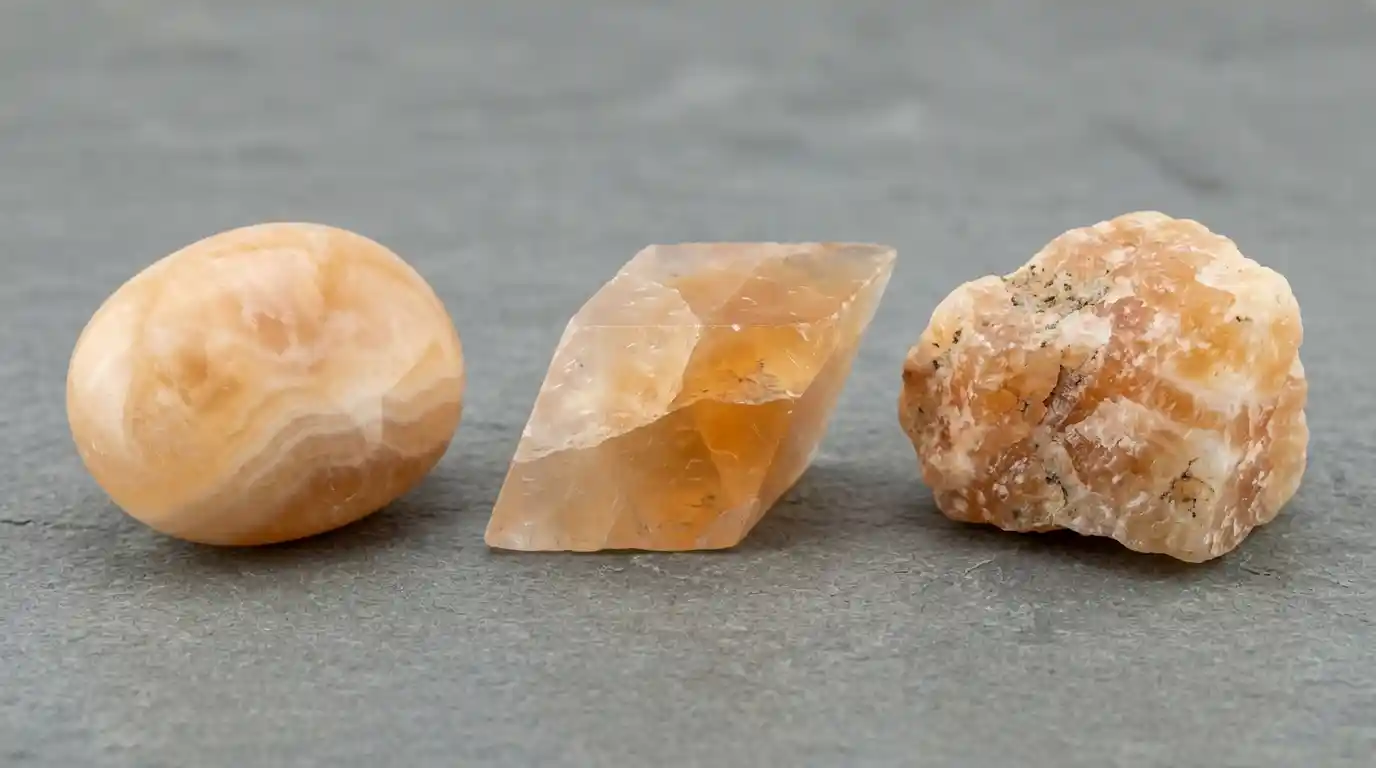
Orange calcite is calcite whose bodycolor falls within orange, peach, amber, yellow-orange, or honey tones. The host mineral is calcium carbonate with the formula CaCO₃.
Calcite crystallizes in the trigonal system and occurs in a remarkable variety of habits, including rhombohedra, scalenohedra, prisms, tabular crystals, fibrous forms, stalactitic growths, massive deposits, and granular aggregates.
Its defining physical property is Mohs hardness 3. This means the stone can be scratched by a copper coin, steel, glass, quartz, feldspar, and most familiar jewelry gemstones. A high polish can therefore become dull surprisingly quickly if the stone is stored loosely with harder objects.
Calcite also has perfect rhombohedral cleavage. It can split cleanly along three crystallographic directions, producing characteristic rhomb-shaped fragments. This makes the stone considerably more fragile than its dense appearance suggests.
Transparent calcite displays very strong double refraction or birefringence. Text viewed through a clear crystal can appear doubled because light entering the stone separates into two rays traveling at different velocities.
Orange calcite can range from transparent to opaque depending on inclusions, fractures, grain size, and color intensity. Luster varies from vitreous and sub-vitreous to pearly, waxy, or dull on some surfaces.
What Makes Calcite Orange?
Calcite itself is colorless when chemically pure, but natural specimens can occur in white, yellow, orange, red, green, blue, brown, gray, black, and other colors because of impurities, microscopic inclusions, structural defects, and associated compounds.
Orange calcite does not have one universal color-causing mechanism. Iron-bearing compounds, manganese, microscopic inclusions, and other impurities can contribute yellow, orange, peach, or reddish coloration in different deposits.
This variability is important because simply seeing an orange crystal does not reveal the exact trace-element chemistry. Two visually similar pieces from different mines may owe their color to somewhat different combinations of impurities and inclusions.
Some calcite also fluoresces under ultraviolet light. Manganese can act as an activator responsible for orange-red fluorescence in certain specimens, sometimes with other elements acting as sensitizers. Not every orange calcite fluoresces strongly, and fluorescence should not be treated as proof of healing ability or universal authenticity.
The warm bodycolor should also be distinguished from the rainbow flashes of precious opal or structural optical phenomena such as labradorescence. Orange calcite’s ordinary visible color comes from its composition and inclusions rather than light diffraction from an ordered nanoscale structure.
Calcite Formation and History
Calcite is one of Earth’s most widespread minerals. It forms in sedimentary, hydrothermal, metamorphic, igneous, and biological settings and is the principal mineral in limestone and marble.
In sedimentary environments, calcium carbonate can precipitate directly from water or accumulate through shells and skeletal remains of marine organisms. Limestone can later recrystallize during metamorphism to produce marble.
Calcite also fills fractures and cavities from hydrothermal fluids, forms stalactites and stalagmites in caves, and occurs in veins associated with many metallic ore deposits. Orange-colored examples can therefore come from several geological environments rather than one single source.
The mineral name calcite has deep historical roots related to the Latin calx, meaning lime. Calcium carbonate substances were familiar to ancient societies through limestone, marble, lime production, shells, and construction.
That deep history applies to calcite as a substance. It does not establish an equally ancient standardized tradition of “orange calcite healing properties.” The specific modern wellness identity of orange calcite developed much later around color symbolism and contemporary crystal practice.
The Orange Calcite meaning associated with creativity, motivation, sexuality, confidence, and positivity is therefore best understood as modern symbolism rather than a proven ancient therapeutic system.
Motivation and Creativity
Motivation Through Starting
Orange calcite is frequently described as energizing or motivating because orange is culturally associated with warmth and activity. The stone does not raise metabolic energy or dopamine through touch. A practical ritual is to place it beside a task that has been delayed and commit to working for a short defined period before deciding whether to continue. Starting creates the momentum.
Creativity Through Brainstorming
Bright orange stones are commonly associated with creativity. Calcite has not been shown to increase creative cognition biologically. A writer, artist, designer, or problem-solver can instead use the stone as a visual cue to generate several ideas without immediately judging them. Separating generation from evaluation can make creative work less restrictive.
Confidence and Optimism
Confidence Through Preparation
Orange calcite is often promoted for confidence and social courage. It cannot biologically improve self-esteem. Before an unfamiliar situation, use it as a reminder to identify what has already been prepared, what remains uncertain, and what first action is under your control. Confidence grows more reliably from repeated evidence of capability.
Optimism With Realistic Action
The stone’s warm color also encourages themes of joy and positivity. It cannot guarantee favorable events or remove legitimate problems. A grounded optimism exercise is to identify one genuine difficulty, one reason improvement remains possible, and one realistic action that could make the outcome better.
Focus and Emotional Awareness
Concentration With Fewer Distractions
Orange calcite is sometimes marketed as stimulating the mind or helping with concentration. Calcium carbonate has not been shown to increase attention span through skin contact. It can become a work cue instead. Pair the stone with one clearly defined task, silence unrelated notifications, and work for a predetermined interval.
Emotional Awareness During Stress
Some practitioners say orange calcite helps release or process emotions. The crystal cannot remove emotional distress from the body. A more useful reflection separates what happened, what emotion is present, what interpretation is increasing the intensity, and what action remains available.
Resilience and Social Openness
Resilience After Setbacks
Motivation symbolism often extends to resilience. Orange calcite cannot make someone psychologically stronger through mineral energy. After a setback, use it as a cue to identify what failed, what lesson is useful, and what next attempt should change. Resilience develops through adaptation.
Social Openness and Communication
Orange calcite is sometimes associated with sociability, warmth, and interpersonal confidence. The stone cannot make someone extroverted or guarantee positive social reactions. Before a conversation or event, use it to choose one simple behavior under your control, such as asking a thoughtful question, making eye contact appropriately, or communicating one idea clearly.
Spiritual Reflection
The ninth common claim involves vitality, purpose, or spiritual energy. A person may use orange calcite during meditation to reflect on enthusiasm, direction, creativity, and whether daily behavior matches personal priorities.
The practice can be meaningful without claiming that calcium carbonate emits a life-force frequency or alters biological energy production.
Orange Calcite Chakra Meaning
Orange calcite is most commonly associated with the sacral chakra because of its color. Contemporary crystal systems connect it with creativity, pleasure, relationships, sexuality, emotional expression, and adaptability. Some practitioners also associate golden-orange pieces with the solar plexus chakra and themes of confidence or motivation.
Chakras are a spiritual framework rather than anatomical structures. Orange calcite has not been demonstrated to affect the reproductive organs, digestive system, pancreas, endocrine glands, nervous system, or another physiological system through chakra placement.
Claims involving fertility, sexual function, digestion, or hormones should therefore not be presented as established medical effects.
Orange Calcite Care
Orange calcite is one of the softer stones commonly sold in crystal shops. At Mohs 3, it should be stored separately from nearly all ordinary jewelry gemstones. Quartz-rich dust alone can scratch and dull a polished surface.
Perfect rhombohedral cleavage creates additional fragility. A hard knock can split the stone along smooth planes even if the impact does not look severe. Thin carvings, points, and exposed crystal edges require especially gentle handling.
Calcite reacts readily with acids. Vinegar, lemon juice, citrus-based cleaners, bathroom descalers, acidic jewelry solutions, and other weak acids can etch the surface and cause visible fizzing as calcium carbonate reacts.
Brief contact with plain lukewarm water is generally acceptable for sound untreated calcite, but soaking is unnecessary. Repeated immersion can also affect fractures, coatings, glue, matrix minerals, or assembled pieces.
Warm water, a very mild non-acidic soap, and a soft cloth are suitable when cleaning is necessary. Avoid vigorous brushing that could scratch the surface.
Steam and ultrasonic cleaning are poor choices because heat, vibration, perfect cleavage, and internal fractures can cause damage. Abrasive powders should also be avoided.
Orange calcite should not be intentionally powdered or ingested as a source of calcium. Wearing or holding the crystal does not provide a controlled dietary calcium dose.
Safe Ritual Cleansing
Ritual cleansing should respect calcite’s softness and acid sensitivity. There is no scientifically demonstrated negative energy that requires soaking, salting, heating, or chemically treating the stone.
Sound, intentional breathing, dry placement, quiet reflection, or a gentle wipe with a soft cloth are low-risk options. A motivation-themed ritual can involve choosing one delayed task and beginning it immediately after the reflection.
Avoid saltwater, vinegar, citrus, acids, abrasive salt, steam, flame, aggressive sunlight combined with heat, and prolonged soaking.
Conclusion
Orange calcite’s verified properties already make it distinctive: CaCO₃ chemistry, strong birefringence, perfect rhombohedral cleavage, Mohs 3 softness, acid reactivity, and a wide range of naturally occurring warm colors. Its nine healing themes can support motivation, creativity, confidence, focus, resilience, and reflection when those benefits come from deliberate behavior rather than an unproven therapeutic property.
FAQs
What are the main orange calcite healing properties?
Common claims include motivation, creativity, confidence, optimism, concentration, emotional awareness, resilience, social openness, and spiritual reflection. These are contemporary wellness or spiritual beliefs rather than scientifically proven therapeutic effects.
What is orange calcite made of?
Orange calcite is calcium carbonate with the formula CaCO₃. Trace impurities and inclusions contribute its orange, peach, yellow-orange, or honey coloration.
How hard is orange calcite?
Calcite has Mohs hardness 3, making it much softer than quartz and most familiar jewelry gemstones.
What causes orange calcite’s color?
The exact cause can vary between deposits. Iron-bearing compounds, manganese, inclusions, and other impurities can contribute warm orange, peach, yellow, or reddish tones.
Does orange calcite fluoresce?
Some calcite fluoresces orange, red, pink, or other colors under ultraviolet light, often because of activators such as manganese. Not every orange calcite specimen fluoresces strongly.
Which chakra is orange calcite associated with?
Modern crystal practice most commonly links orange calcite with the sacral chakra and sometimes the solar plexus chakra. These are spiritual correspondences rather than anatomical effects.
Can orange calcite go in water?
Brief contact with plain lukewarm water is usually acceptable for a sound untreated piece, but prolonged soaking is unnecessary. Gentle hand cleaning is preferable.
Can orange calcite be cleaned with vinegar?
No. Calcite reacts readily with weak acids such as vinegar and can become permanently etched.
Is orange calcite good for everyday jewelry?
Its Mohs 3 hardness and perfect cleavage make it vulnerable to scratching and impact. Pendants or protected occasional-wear pieces are generally more practical than exposed everyday rings.
Does orange calcite provide calcium through the skin?
No evidence shows that wearing or holding calcite provides a useful dietary or medicinal calcium dose through normal skin contact.
Crystal healing claims are traditional or personal beliefs and should not replace qualified medical or mental health care.