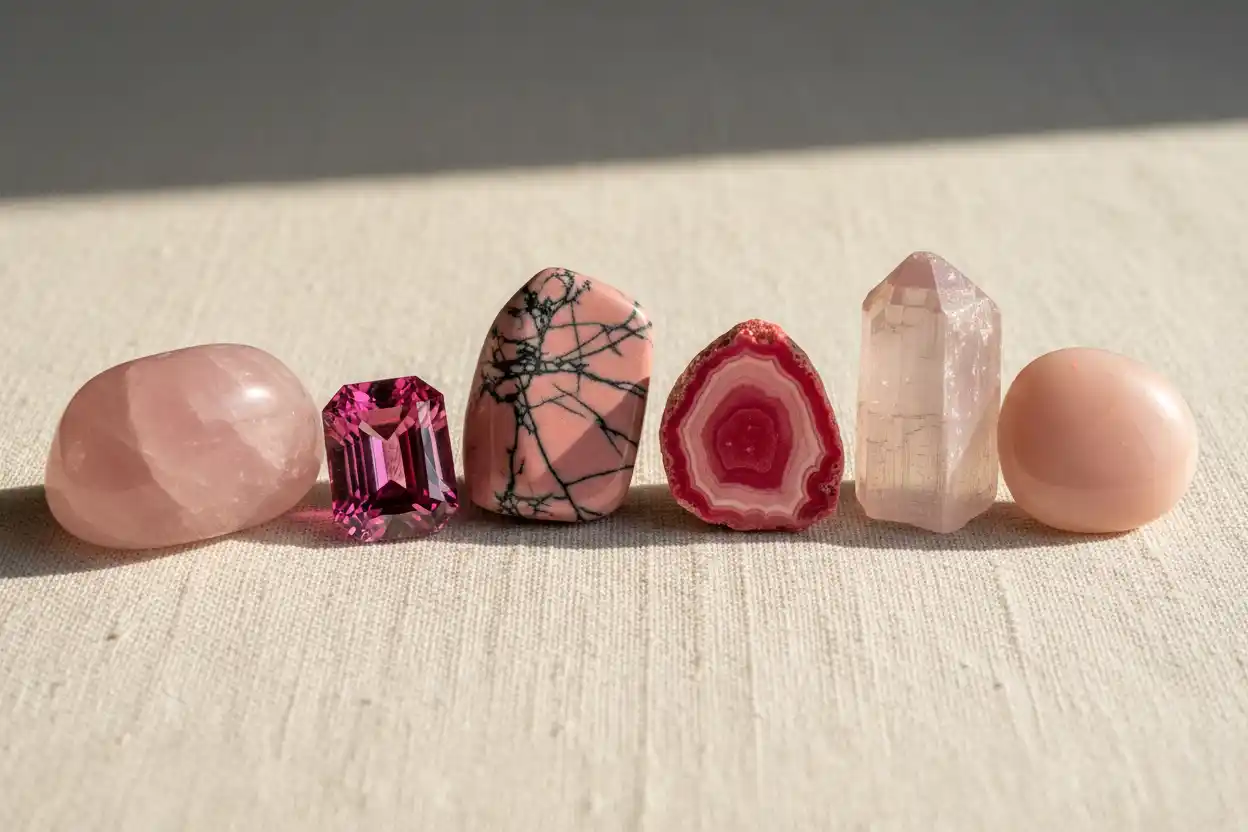
Pink Crystals: Meanings, Uses and Complete List
Pink crystals are commonly associated with love, compassion, emotional openness, friendship, self-respect and gentle recovery after disappointment. Those meanings arise from cultural symbolism, color psychology, modern crystal practice and the personal stories people attach to individual stones.
The color category includes very different materials. Rose quartz is a quartz variety; pink tourmaline belongs to a complex borosilicate group; rhodochrosite is a manganese carbonate; rhodonite is a manganese silicate; pink opal is an amorphous hydrated silica material. Shared color does not make them physically interchangeable.
This page owns the belief-based pink crystal roundup: symbolic meanings, intentions, meditation ideas and safe ways to choose among them. The separate pink gemstones guide owns the complete gemological list, identification and jewelry-use comparison.
Pink Crystals at a Glance
| Pink crystal | Typical appearance | Common symbolic association | Practical intention |
|---|---|---|---|
| Rose quartz | Pale to medium translucent pink | Self-love and tenderness | Speak to yourself with less hostility |
| Pink tourmaline | Pale blush to vivid pink | Emotional courage and openness | Express a need clearly |
| Rhodochrosite | Pink bands, swirls or transparent red-pink | Inner-child work and emotional honesty | Name an old pattern without judgment |
| Rhodonite | Pink with black or brown veining | Forgiveness and grounded compassion | Combine empathy with boundaries |
| Pink opal | Soft opaque to translucent pink | Calm and emotional rest | Create space before reacting |
| Kunzite | Pale lilac-pink to violetish pink | Gentle affection and receptivity | Remain open without abandoning discernment |
| Morganite | Peach-pink to rose | Mature love and patience | Practice steady, reciprocal care |
| Mangano calcite | Pale pink, often softly translucent | Comfort and reassurance | Use a gentler internal tone |
| Strawberry quartz | Clear to pink quartz with red inclusions | Joy and affectionate connection | Notice small positive moments |
| Pink sapphire | Pale pink to vivid magenta | Loyalty, resilience and commitment | Follow through on a chosen promise |
| Pink spinel | Soft pink to intense hot pink | Renewal and vitality | Begin again after fatigue |
| Rubellite | Rich pink-red tourmaline | Passion with emotional depth | Act honestly rather than dramatically |
| Pink amethyst | Blush to mauve quartz | Calm reflection | Separate emotion from assumption |
| Pink aragonite | Pale coral-pink clusters or bands | Patience and stability | Slow down a rushed decision |
| Pink halite | Delicate pale pink cubic crystals | Release and purification symbolism | Let one unhelpful habit end |
| Pink aventurine | Soft pink quartz-rich material | Hope and gentle motivation | Take one manageable step |
The meanings in this table are contemporary or traditional associations, not scientifically proven effects. A crystal can support reflection as a symbol or reminder, but it does not control relationships, hormones, mood disorders or physical healing.
Why Pink Crystals Share Similar Meanings
Pink is widely linked with affection, care, softness and warmth. Modern crystal traditions apply those color associations to stones that have otherwise unrelated mineral identities.
This color-based approach explains why rose quartz, pink calcite and kunzite may appear in the same emotional-healing collection even though their hardness, chemistry, structure and care needs differ.
A useful practice treats the shared color as a thematic starting point rather than proof that every pink stone has the same “energy.” The individual crystal’s history, texture, origin and personal significance can shape a more specific intention.
Rose Quartz
Rose quartz is the best-known pink crystal. It usually appears pale to medium pink and translucent, though clearer and more saturated material also occurs.
Contemporary practice links it with self-compassion, affection and emotional gentleness. A grounded rose-quartz intention might involve replacing harsh self-talk with a more accurate statement, asking for support or resting without treating rest as failure.
Its symbolism is often reduced to romance, yet its more useful role may concern the quality of the wearer’s relationship with themselves. Self-love does not require constant confidence; it can mean maintaining boundaries, eating, sleeping, seeking help and refusing unnecessary cruelty toward oneself.
Pink Tourmaline
Pink tourmaline ranges from delicate blush to saturated pink. Some crystals show zoning, while others transition into green as watermelon tourmaline.
Modern interpretations associate it with emotional courage, tenderness and the ability to remain open after disappointment. This does not mean accepting unsafe behavior. Emotional openness works best when paired with judgment and clear limits.
A pink-tourmaline intention can focus on saying what is true without exaggeration: expressing affection, admitting hurt, asking a direct question or declining a request without hostility.
Rhodochrosite
Rhodochrosite may appear banded pink and white, opaque with swirling patterns or transparent red-pink in rare gem-quality crystals.
It is frequently associated with inner-child work, memory and emotional honesty. The phrase “inner child” is a reflective metaphor used in some therapeutic and spiritual settings; a crystal cannot diagnose trauma or retrieve hidden memories reliably.
A grounded practice can examine which present reaction resembles an earlier coping pattern. The goal is not to blame the past for every difficulty but to identify a behavior that can now be updated.
Rhodonite
Rhodonite commonly displays pink material crossed by black manganese-oxide veins. Its appearance naturally supports symbolism that combines warmth with structure.
Contemporary practitioners associate rhodonite with forgiveness, repair and compassionate boundaries. Forgiveness need not mean reconciliation, restored access or denial of harm.
A useful intention may be: “I can release repeated mental argument while still protecting myself.” That distinction keeps compassion from becoming passivity.
Pink Opal
Pink opal usually has a soft, opaque to translucent appearance rather than the play-of-color associated with precious opal.
Its symbolism often centers on emotional rest, reassurance and quiet recovery. A pink-opal practice may suit periods when stimulation feels excessive and the most useful action is to reduce demands temporarily.
The stone is physically more delicate than quartz, so ritual methods involving water, salt, heat or impact should be avoided. Gentle symbolism should be matched by gentle material care.
Kunzite
Kunzite is the pink to violetish-pink gem variety of spodumene. It can show strong pleochroism and may fade after prolonged exposure to intense light or heat.
Contemporary beliefs connect it with receptivity, peaceful affection and releasing emotional defensiveness. Kunzite can be used as a reminder to hear what another person actually said before reacting to what was feared.
Because the gem has cleavage and light-sensitivity concerns, it is better suited to deliberate wear and careful storage than rough daily handling.
Morganite
Morganite is a peach, salmon or pink member of the beryl family. Its restrained color has encouraged associations with mature affection, patience and steady partnership.
Unlike symbolism focused on dramatic attraction, morganite can represent consistency: responding, keeping commitments, apologizing specifically and allowing trust to develop through repeated behavior.
A personal practice might pair the stone with one relationship habit that can be measured, such as scheduling uninterrupted time or raising concerns before resentment accumulates.
Mangano Calcite
Mangano calcite is a manganese-bearing pink calcite that often appears pale, softly translucent and visually gentle.
Modern crystal traditions associate it with comfort, emotional reassurance and a softer internal voice. Since calcite is relatively soft, it should not be carried loose beside harder stones or used in abrasive rituals.
Its symbolic use can center on reducing unnecessary self-punishment. Accountability remains possible without repeating insults toward oneself.
Strawberry Quartz
Strawberry quartz is a trade name used for quartz containing reddish or pink inclusions that create a speckled or diffuse strawberry color.
It is commonly linked with joy, affection and appreciating ordinary pleasures. A practical intention can involve noticing one small positive event without demanding that it cancel a difficult day.
The trade name is used inconsistently, so buyers should seek accurate disclosure. Some products sold under this name may be glass, treated quartz or composite material.
Pink Sapphire
Pink sapphire is corundum colored by trace elements, principally chromium. Shades range from pale pink through vivid magenta and may approach the trade boundary with ruby.
Symbolically, pink sapphire is associated with commitment, loyalty and resilient affection. Its hardness also makes it a practical jewelry stone, although physical durability does not validate spiritual claims.
The broader sapphire guide owns mineral identity, color and gemological context. In intention work, pink sapphire can represent following through after the initial emotion has passed.
Pink Spinel
Pink spinel can appear pastel, rose, hot pink or neon-like, depending on composition and saturation. It is a separate mineral rather than a variety of corundum.
Modern practitioners often associate it with vitality, renewal and recovering enthusiasm after depletion. The spinel guide retains the complete material profile.
A grounded pink-spinel intention might be to restart one paused activity at a manageable scale. Renewal becomes an action rather than a demand to feel energetic immediately.
Rubellite
Rubellite is the trade name used for richly saturated pink to red tourmaline that maintains attractive color across different lighting.
Its symbolism often combines affection with passion, courage and emotional depth. The most constructive interpretation avoids possessiveness and dramatic certainty.
Rubellite may represent telling the truth about desire while respecting consent, timing and another person’s autonomy.
Other Pink Crystals
Pink amethyst is a pink to mauve quartz material whose commercial name may cover different geological appearances. It is commonly associated with calm reflection and emotional clarity.
Pink aragonite often forms clusters or banded material and is linked with patience, stability and slowing reactive decisions. Because aragonite is soft, it needs careful handling.
Pink halite forms delicate salt crystals. It dissolves in water and can be damaged by humidity, so it should never be used in crystal water or wet cleansing rituals.
Pink aventurine is a quartz-rich material commonly associated with hope and gentle motivation. Its market name and composition should be verified because pale pink stones can be mislabeled.
Pink fluorite, pink calcite, cobaltoan calcite, thulite and pink chalcedony may also appear in color-based collections. The later gemstone list will handle their identification and jewelry suitability without expanding every entry into a duplicate healing profile.
Pink Crystals for Love
Pink crystals are often included in the crystals for love guide. Their symbolism can support affection, communication and receptivity, but no stone can compel another person to return feelings or remain in a relationship.
A realistic love intention concerns the user’s own behavior: communicate clearly, notice reciprocity, respect consent and leave room for the other person’s independent choice.
Rose quartz suits gentle affection, pink tourmaline can symbolize emotional courage, and morganite may represent steady partnership. The best choice depends on the behavior being practiced rather than a claim that one stone guarantees romance.
Pink Crystals for Self-Love
The crystals for self-love guide covers the broader practice. Pink crystals are useful symbols when self-love is defined concretely.
It may mean ending hostile self-talk, setting a medical appointment, asking for fair treatment, eating consistently or refusing to measure worth only through productivity.
Rose quartz and mangano calcite suit gentler themes, while rhodonite can represent boundaries and pink spinel can symbolize renewed agency.
Pink Crystals for Emotional Healing
Pink stones frequently appear in the crystals for emotional healing guide. Emotional healing is not a straight line and cannot be measured by whether someone remains positive.
Rhodochrosite may symbolize examining old patterns, pink opal may represent rest, and rhodonite can support reflection on repair and boundaries.
Crystals can accompany journaling, therapy or healthy routines, but they do not process trauma independently or replace professional care.
Pink Crystals for Forgiveness
The crystals for forgiveness guide explores releasing resentment without requiring unsafe reconciliation.
Rhodonite is especially associated with the balance between compassion and boundaries. Rose quartz may support a softer tone toward oneself, while pink tourmaline can symbolize honest communication.
Forgiveness practices should never pressure a person to deny abuse, restore access or abandon legal and practical protection.
Pink Crystals for Friendship
Pink stones also appear in the crystals for friendship guide. Friendship symbolism emphasizes care, loyalty, mutual effort and the ability to repair ordinary misunderstandings.
A small pink crystal can mark a shared memory or serve as a reminder to initiate contact rather than waiting indefinitely. The stone does not determine whether a friendship is healthy; reciprocity and behavior do.
Pink Crystals and the Heart Chakra
Modern crystal traditions strongly connect pink stones with the heart chakra. The heart chakra guide explains this spiritual concept, while heart chakra crystals compares commonly used green and pink stones.
Pink crystals are usually assigned to themes of receiving affection, self-compassion and emotional tenderness. Green stones are often associated with growth, balance and outward compassion, although systems vary.
Chakras are spiritual concepts rather than anatomical structures. Chest pain, palpitations, breathing difficulty or other physical symptoms require medical assessment.
How to Choose a Pink Crystal
Begin with the intention rather than the color alone. Someone focused on self-kindness may choose rose quartz, while a person working on boundaries may prefer rhodonite. Pink opal can symbolize rest, whereas pink spinel may better suit renewed action.
Next, consider physical use. A soft specimen belongs on a stable shelf, while a more durable polished stone may be carried. Jewelry requires separate attention to settings, treatments and wear.
The healing crystals beginner’s guide explains how symbolic practice differs from evidence-based medicine. Choose a crystal because its appearance, history or meaning supports reflection—not because a seller promises guaranteed results.
Setting an Intention
An intention should describe something within the user’s control. “This crystal will make someone love me” removes consent and depends on another person’s behavior.
A better statement might be: “I will express affection clearly and notice whether it is reciprocated.”
The how to program crystals guide provides a ritual framework for connecting an object with a chosen intention. The useful mechanism comes from attention, repetition and behavior rather than scientifically demonstrated crystal programming.
Meditation with Pink Crystals
Place one stone on a stable surface or hold a smooth piece without strain. Notice its temperature, texture, weight and color.
Choose one theme rather than trying to solve an entire relationship history in one session. Self-kindness, grief, forgiveness and courage require different questions.
Return attention to breathing whenever the mind wanders. Afterward, write one specific action that supports the chosen intention.
Combining Pink Crystals
Pink stones can be combined when the intentions remain clear and the materials are stored safely. Rose quartz and rhodonite may symbolize compassion with boundaries, while pink tourmaline and morganite can represent emotional honesty with patience.
The crystals not to combine guide explains that many combination warnings concern conflicting goals, physical hardness or ritual preference rather than proven energetic danger.
Do not allow a hard faceted gem to scrape a soft calcite or opal. Store materials separately even when they are used together symbolically.
Cleansing Pink Crystals
Physical cleaning and spiritual cleansing are different tasks. Water, salt, sunlight and smoke may damage particular pink stones.
The how to cleanse crystals guide describes belief-based methods, but material-specific care must take priority.
Sound, a clean dry cloth, quiet reflection or placing the stone on a soft surface can offer low-risk symbolism. Avoid soaking unknown stones, exposing kunzite to intense light or placing soft carbonates in salt.
The crystals that fade in sunlight guide covers light-sensitive materials, while which crystals can go in water addresses dissolution, porosity and treatment concerns.
Buying Pink Crystals
Color names are not identities. Dyed quartz, glass, resin, coated material and composites may be sold under attractive pink trade names.
Ask for the mineral or material name, treatment disclosure, dimensions, origin claim and return policy. Unusually vivid color at a very low price deserves scrutiny, though price alone does not prove imitation.
For valuable jewelry-grade pink stones, use the gemological criteria in the dedicated pink gemstone and buying pages rather than relying on metaphysical descriptions.
Frequently Asked Questions
1. What do pink crystals symbolize?
They are commonly associated with affection, compassion, emotional openness, self-respect, friendship and gentle renewal.
2. Which pink crystal is best for self-love?
Rose quartz is the most common choice, while mangano calcite may symbolize comfort and rhodonite can represent compassionate boundaries.
3. Which pink crystal is associated with romantic love?
Rose quartz, pink tourmaline, morganite and rubellite are widely used in romance-focused practices. None can make another person feel or act a certain way.
4. What is the best pink crystal for emotional healing?
The choice depends on the intention. Rhodochrosite is linked with old patterns, pink opal with rest and rhodonite with repair and boundaries.
5. Are all pink crystals connected to the heart chakra?
Many modern systems connect them with the heart chakra, but assignments vary and are not universal.
6. Can pink crystals heal anxiety or depression?
No crystal has been scientifically proven to treat anxiety or depression. A stone may accompany a coping practice but should not replace qualified care.
7. Can I sleep with pink crystals?
A polished stone can be placed safely on a bedside surface. Remove crystal jewelry before sleep and keep small stones away from children and pets.
8. Can pink crystals go in water?
Some tolerate brief contact, while others dissolve, absorb water or contain treatments and fractures. Identify the material before using water.
9. Do pink crystals fade in sunlight?
Some can. Kunzite is particularly light-sensitive, while dyed or treated materials may also fade. Avoid prolonged intense exposure.
10. Can I combine rose quartz and rhodonite?
Yes. Many practitioners pair them for compassion and boundaries, provided the stones are stored so harder material does not scratch softer pieces.
11. How can I tell whether a pink crystal is real?
Identification depends on the material. Review color, inclusions, hardness, optical properties, treatment disclosure and professional testing rather than using one universal home test.
12. Do expensive pink crystals have stronger spiritual effects?
There is no evidence that price increases spiritual effectiveness. Personal meaning and the behavior connected to the practice matter more than rarity.
Pink crystals are most useful when their symbolism becomes specific. Rose quartz can represent a kinder internal voice, rhodonite can mark a boundary, pink tourmaline can support honest expression and pink opal can signal permission to rest. The stone does not perform the emotional work, but it can make an intention visible enough to remember.
Alphabetical browsing continues through Crystals That Start With P and Gemstones That Start With P.
Pink crystal meanings, chakra assignments and healing uses are cultural, spiritual or personal-belief traditions. Crystals do not diagnose, prevent or cure medical or mental-health conditions and cannot control another person’s emotions or consent.