11 Powerful Pink Crystals: Positive Meanings & Trusted Practical Uses
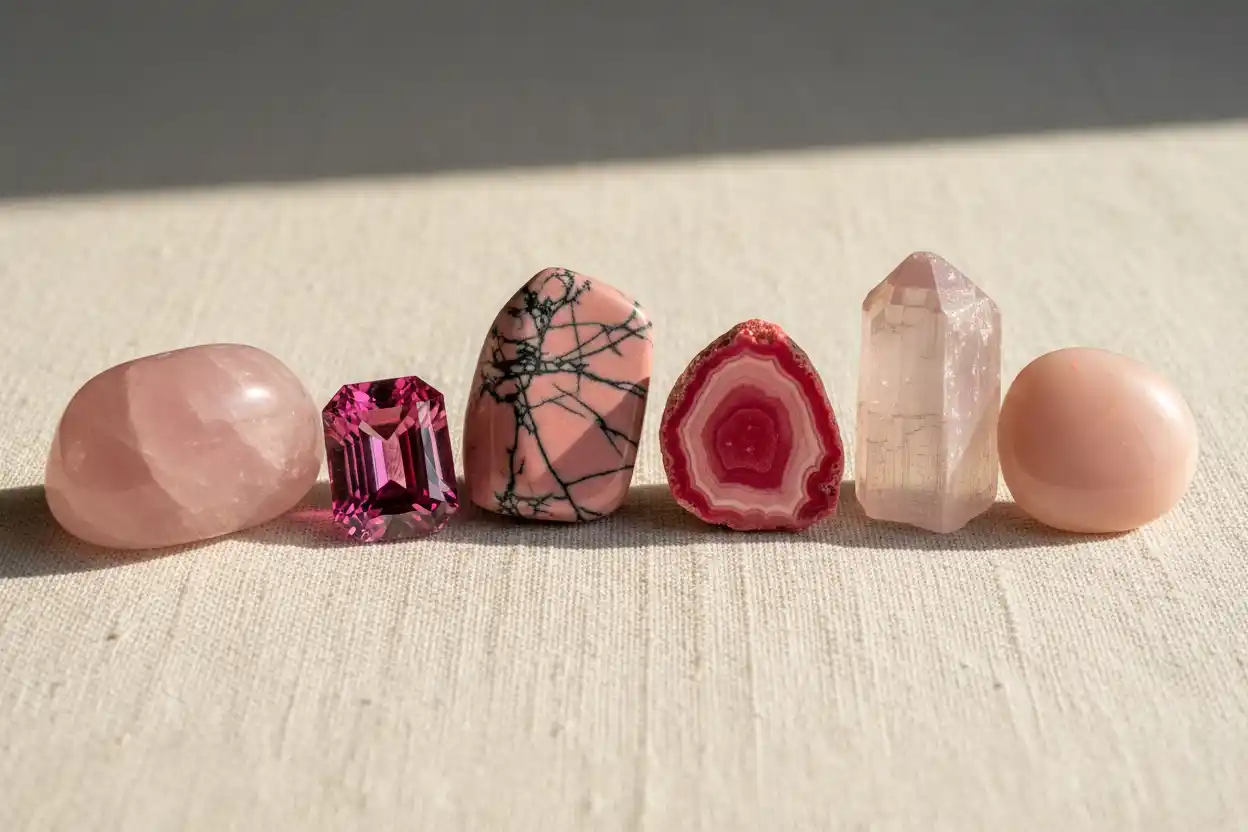
Pink crystals are traditionally associated with affection, compassion, emotional openness, friendship, self-respect, reassurance, and gentle communication. Their colors range from almost colorless blush through peach-pink, rose, raspberry, and vivid magenta, while their physical structures range from durable corundum and quartz to softer calcite and opal. The shared color creates a visual connection, but these stones need very different care.
Rose quartz, rhodonite, rhodochrosite, morganite, pink tourmaline, kunzite, pink opal, strawberry quartz, peach moonstone, mangano calcite, and pink sapphire offer eleven distinct ways to build a pink collection. Some are practical for frequent jewelry wear, while others are better suited to pendants, palm stones, or protected displays. Their traditional meanings can work as personal reminders within journaling, relationship rituals, gratitude practices, or reflective routines without treating the stones as medical treatments.
Rose Quartz, Rhodonite, and Rhodochrosite for Compassion, Boundaries, and Emotional Perspective
Rose quartz is one of the best-known pink stones and belongs to the quartz family. Its color ranges from nearly white pink to stronger rose tones, while microscopic inclusions often give the stone a cloudy or translucent appearance. With Mohs hardness 7, rose quartz is durable enough for many jewelry styles, carvings, palm stones, and decorative objects.
The traditions surrounding rose quartz healing properties commonly emphasize affection, compassion, forgiveness, and treating yourself and other people with greater patience. A practical use is to place a polished stone beside a journal and connect it with questions about relationships, gratitude, or the way you speak to yourself during difficult periods. The value of that routine comes from reflection and repeated intention rather than a demonstrated force emitted by the quartz.
Rhodonite provides a much stronger visual contrast. It is commonly pink to reddish pink with black manganese-oxide veins, creating patterns that can range from fine lines to bold dark patches. Its appearance has encouraged symbolism around combining warmth with firm boundaries, especially because the pink and black areas can seem to represent softness and strength within the same stone.
Traditional rhodonite healing properties often focus on emotional balance, reconciliation, self-control, and responding thoughtfully after conflict. A rhodonite palm stone can therefore serve as a tangible reminder to separate compassion from passivity and to approach difficult conversations without abandoning clear boundaries.
Rhodochrosite usually shows lighter and darker pink bands, although fine transparent crystals can display intense raspberry-red to pink color. It is manganese carbonate and is much softer than rose quartz, so rings and bracelets require considerably more protection.
The symbolism linked with rhodochrosite healing properties commonly includes emotional honesty, self-worth, kindness, and recognizing recurring relationship patterns. Its banding makes it particularly suitable for reflective use because the stone itself visibly records repeated layers of growth. Polished pieces are best kept away from acidic substances and rough contact that can scratch the surface.
Morganite, Pink Tourmaline, and Kunzite for Communication, Confidence, and Affection
Morganite is the pink to orange-pink variety of beryl, the same mineral family that includes emerald and aquamarine. Most morganite is pastel rather than deeply saturated, although stronger pure pink to purplish-pink stones are especially attractive. It has good jewelry hardness at about 7.5 to 8, making it one of the more practical transparent pink gems for rings, pendants, and earrings.
The traditions around morganite healing properties commonly connect the stone with gentle communication, affection, patience, and approaching relationships without unnecessary defensiveness. Its soft color makes it particularly suitable as a symbolic stone for conversations where warmth and honesty are both important.
Pink tourmaline spans a much wider color range, from pale blush to vivid fuchsia and reddish pink. Tourmaline ranks about 7 to 7.5 on the Mohs scale and has fair toughness, so it works well in jewelry with normal care. Heat can damage some stones or alter color, while sudden temperature changes can cause fractures, especially in heavily included gems.
The traditions connected with tourmaline healing properties commonly emphasize emotional openness, resilience, confidence, and maintaining warmth without losing personal boundaries. A pink tourmaline pendant or ring can therefore carry personal symbolism while also functioning as a durable colored gemstone.
Kunzite provides a cooler pink that often leans toward violet or lilac. It is the pink-to-violet variety of spodumene and can occur in large transparent crystals with excellent brilliance. Despite hardness around 6.5 to 7, kunzite has poor toughness because it has perfect cleavage in two directions.
Traditional kunzite healing properties frequently focus on openness, affection, communication, and emotional sensitivity. Kunzite is best suited to protected pendants, earrings, pins, or carefully worn rings because a hard blow can split the gem. Its color can also fade after prolonged exposure to intense light or heat, so valuable pieces should not be stored permanently in strong sunlight.
Pink Opal, Strawberry Quartz, and Peach Moonstone for Reflection and Gentle Change
Pink opal usually displays opaque to translucent blush, rose, cream, or peach-pink color without the strong rainbow play-of-color associated with precious opal. Its smooth, understated appearance has made it popular for beads, cabochons, and palm stones.
Traditional pink opal healing properties often emphasize reassurance, emotional reflection, patience, and adjusting gently to change. Opal is softer than quartz and requires protection from abrasion, impact, harsh chemicals, and sudden temperature changes. Pendants and earrings generally expose it to less wear than rings.
Strawberry quartz combines transparent to translucent quartz with pink, red, or reddish inclusions that can create speckled or shimmering internal patterns. The trade name is used for quartz with this strawberry-like appearance, although lookalikes and treated products also exist, so buyers should pay attention to reliable identification when authenticity matters.
The traditions surrounding strawberry quartz healing properties often connect it with joy, appreciation, friendship, and noticing positive experiences that are easy to overlook. A stone placed near a gratitude journal can therefore become a visual prompt for recording something specific rather than simply repeating a vague positivity ritual.
Peach moonstone ranges from cream-pink to peach and can show a floating white or silvery glow caused by light interacting with its feldspar structure. It is softer than quartz and has cleavage, so it should be protected from repeated impact.
Traditional peach moonstone healing properties commonly emphasize patience, cycles, emotional flexibility, and accepting gradual change. Its shifting surface glow makes these themes visually intuitive because the stone’s appearance changes as it moves.
Mangano Calcite and Pink Sapphire for Two Very Different Pink Experiences
Mangano calcite is typically pale pink to stronger rose and can appear translucent, cloudy, or softly banded. It is a manganese-bearing variety of calcite and is much softer than most traditional jewelry gems, ranking about 3 on the Mohs scale.
The symbolism surrounding mangano calcite healing properties commonly centers on kindness, reassurance, emotional softness, and giving yourself time to recover from stressful experiences. It works well as a palm stone or protected display piece, but rings and rough pocket use are poor choices because harder objects can scratch it easily.
Calcite also reacts with acids, so vinegar, acidic cleaners, and aggressive household products should never be used for cleaning. A soft dry cloth or gentle water-based cleaning is safer for sound polished pieces.
Pink sapphire sits at the opposite end of the durability spectrum. Sapphire is corundum and ranks 9 on the Mohs scale, with excellent toughness and no cleavage. Pink sapphire can range from delicate pastel pink to intense hot pink and pinkish red, making it one of the most practical pink gems for everyday fine jewelry.
The traditions connected with sapphire healing properties often emphasize loyalty, sincerity, commitment, discipline, and protecting what matters over the long term. Pink sapphire can therefore combine romantic symbolism with physical durability appropriate for engagement rings and frequently worn jewelry.
What Pink Crystal Meanings Share and Where They Differ
Pink symbolism is strongly shaped by familiar cultural associations with affection, tenderness, friendship, care, and emotional warmth. This is why stones from unrelated mineral families repeatedly receive similar meanings even though their chemistry and physical behavior have little in common.
The useful distinctions appear when you connect each stone with a more precise idea. Rose quartz can represent compassion, rhodonite boundaries within relationships, and rhodochrosite emotional honesty. Morganite and pink tourmaline work naturally with communication themes, while kunzite can symbolize openness with sensitivity.
Pink opal and peach moonstone suit slower reflection, while strawberry quartz works naturally with appreciation and gratitude. Mangano calcite offers a soft tactile object for quiet routines, and pink sapphire fits long-term commitment because it combines traditional loyalty symbolism with high durability.
The traditions around crystals for friendship become more practical when the stone represents an action such as expressing appreciation, listening carefully, setting a healthy boundary, or maintaining contact rather than being expected to change a relationship on its own.
Pink Crystal Jewelry Safety Depends on the Actual Stone
Pink sapphire is the strongest choice here for frequent rings because its hardness, toughness, and lack of cleavage suit daily wear. Morganite is also durable enough for most jewelry, while pink tourmaline and rose quartz can perform well with ordinary care.
Strawberry quartz shares quartz-family durability when the stone is genuine quartz and structurally sound. Rhodonite varies according to quality and internal features, while moonstone requires more protection because feldspar has cleavage.
Kunzite deserves particularly careful treatment despite reasonable hardness because its perfect cleavage can turn a sharp knock into a fracture. Pink opal needs protection from scratches and sudden changes in temperature, while rhodochrosite and mangano calcite are much softer and better suited to protected pieces.
The crystal hardness chart is useful when deciding whether a pink stone belongs in a ring, pendant, bracelet, pocket, or display collection. Color alone gives no reliable clue about durability.
Practical Ways to Use Pink Crystals Without Complicated Rituals
Pink crystals fit naturally into journaling and relationship-centered routines. Rose quartz can sit beside a gratitude journal, rhodonite beside notes for a difficult conversation, and strawberry quartz near a list of people you want to thank or reconnect with.
Jewelry can carry personal meaning without requiring a spiritual claim. A morganite pendant can represent kindness, pink sapphire commitment, or pink tourmaline confidence during social situations. The symbolism is strongest when it refers to a specific value or memory.
Meditation can remain simple. Hold a polished stone and use its weight, temperature, color, or texture as a focus point while breathing slowly. The structured pause can support relaxation, while the crystal serves as a tactile cue rather than a treatment.
There is no need to prepare crystal water or ingest powders. External handling, jewelry, decor, journaling, and meditation provide safer ways to use stones whose treatments, inclusions, adhesives, or exact composition may be uncertain.
Conclusion
Pink crystals offer far more variety than a single symbolism of love. Rose quartz, rhodonite, rhodochrosite, morganite, pink tourmaline, kunzite, pink opal, strawberry quartz, peach moonstone, mangano calcite, and pink sapphire can represent compassion, boundaries, gratitude, communication, commitment, and constructive emotional reflection. The strongest choice is one whose appearance and meaning fit your purpose while its hardness, toughness, light stability, and care requirements suit the way you plan to use it.
FAQs
What do pink crystals traditionally symbolize?
Pink crystals are commonly associated with affection, compassion, friendship, emotional openness, patience, reassurance, and self-respect.
Which pink crystal is most commonly associated with love?
Rose quartz is probably the best-known stone connected with affection and compassion traditions, while morganite, pink tourmaline, and pink sapphire carry related symbolism.
Is rose quartz durable enough for jewelry?
Yes. Rose quartz has Mohs hardness 7 and is suitable for many jewelry styles with normal care.
Is pink tourmaline suitable for rings?
Yes. Tourmaline has useful hardness, but fair toughness means protective settings and avoidance of hard impact are sensible.
Does kunzite fade in sunlight?
Kunzite can lose color after prolonged exposure to intense light or heat, so valuable pieces should not be stored continuously in bright sunlight.
Is pink opal the same as precious opal?
Not necessarily. Pink opal is usually valued for its body color and often lacks the rainbow play-of-color associated with precious opal.
Is mangano calcite good for everyday jewelry?
It is relatively soft and scratches easily, so palm stones, pendants, and protected pieces are usually more practical than exposed everyday rings.
Is pink sapphire durable?
Yes. Sapphire ranks 9 on the Mohs scale, has excellent toughness, and is one of the strongest pink gemstone choices for frequent wear.
Can pink crystals repair relationships or treat emotional conditions?
They can serve as personal symbols within reflective or relationship-focused routines, but they do not replace communication, professional support, or evidence-based health care.
Crystal meanings and wellness associations are traditional or personal practices, not established medical treatments.