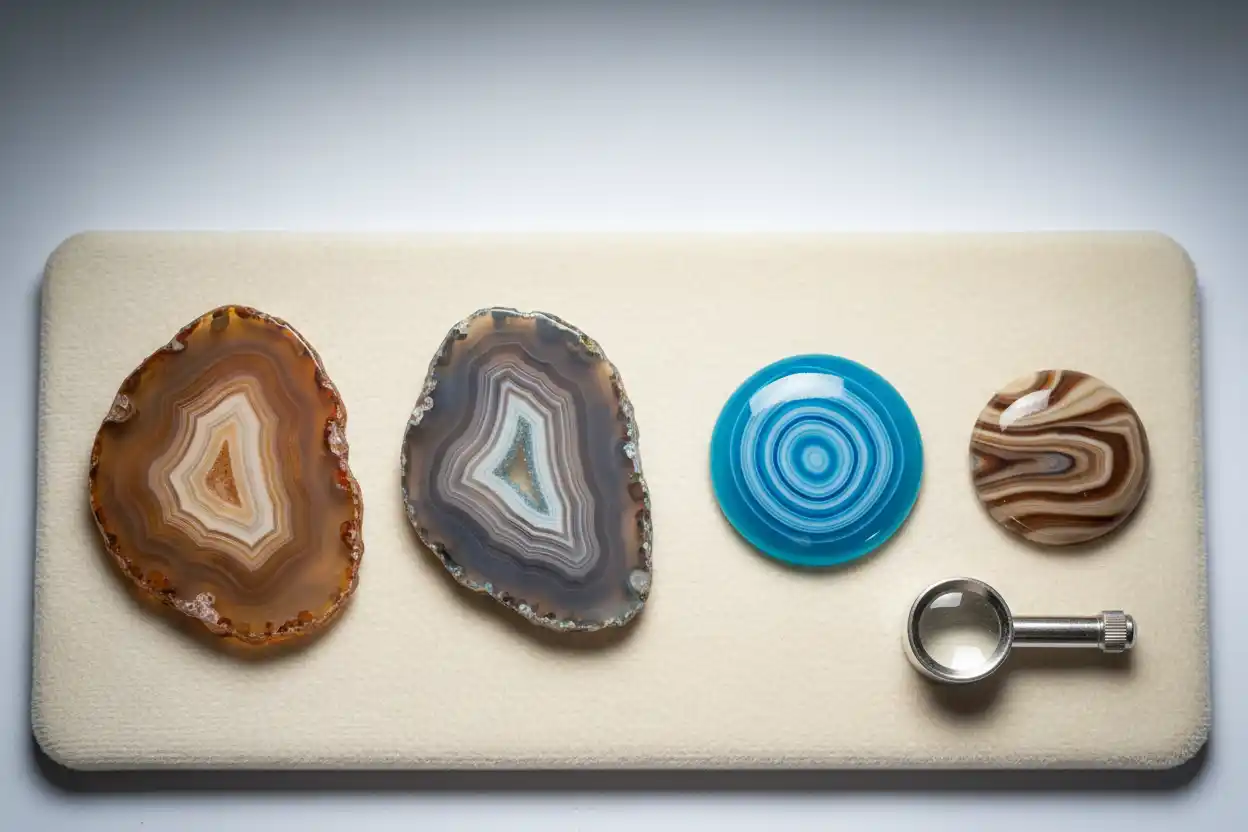
Real vs Fake Agate: 9 Easy Ways to Spot Authentic Stones
Real vs fake agate identification begins with an important distinction: not every unnaturally colored agate is fake. Genuine natural agate can be dyed, heated, or otherwise enhanced while remaining real chalcedony. A fake or imitation, by contrast, may be glass, plastic, resin, reconstructed stone, or another substance sold incorrectly as natural agate.
Agate is a banded variety of chalcedony, which itself is a fine fibrous form of silica composed largely of microscopic quartz together with moganite. GIA describes agate as banded chalcedony and explains that its characteristic layers can vary in darkness, transparency, texture, crystal size, and inclusion content.
That natural diversity means no single home test can authenticate every specimen. Some real agates look highly uniform, some dyed stones still show convincing natural banding, and sophisticated treatments may require spectroscopy or microscopic examination. The safest approach is to combine several observations rather than relying on one dramatic test.
9 Real vs Fake Agate Checks at a Glance
- Examine whether the banding looks naturally layered.
- Check fractures and drill holes for concentrated dye.
- Question extremely saturated unnatural colors.
- Look for bubbles that may indicate glass.
- Compare weight with obvious plastic imitations.
- Inspect surface texture and polish under magnification.
- Check whether patterns continue through exposed edges.
- Avoid destructive scratch, flame, or acid tests.
- Use laboratory identification when value justifies it.
What Real Agate Actually Is
Real agate is primarily microcrystalline silica. Rather than growing as one large transparent quartz crystal, it consists of microscopic fibrous quartz structures and commonly moganite arranged into layers.
The defining feature is banding.
Those bands may form concentrically along cavity walls, horizontally, irregularly, or in complex patterns depending on how silica-rich fluids entered and filled the original space. GIA research describes agate banding as a result of variations in quartz and moganite proportions, crystallite size, pore structure, and micro-inclusions.
| Feature | Natural Agate | Common Imitation or Treatment Warning |
|---|---|---|
| Structure | Fine chalcedony with natural banding | Printed, molded, or artificial-looking pattern |
| Main chemistry | Mostly SiO₂ | Glass, polymer, resin, or another stone possible |
| Mohs hardness | Around 6.5 to 7 | Plastic considerably softer |
| Surface | Takes a good polish | Plastic may scratch or deform easily |
| Color | Wide natural range | Neon saturation may indicate dye |
| Fractures | May occur naturally | Dye may concentrate inside them |
| Drill holes | Natural stone texture visible | Dye rings or polymer texture may appear |
| Bubbles | Not typical of natural chalcedony | Rounded gas bubbles can suggest glass |
| Band depth | Usually structural | Surface-only color may indicate treatment |
The table provides screening clues rather than proof. Real agate can be dyed intensely, and certain imitations can reproduce visual features convincingly.
1. Examine the Banding Before Anything Else
Natural banding is the most useful starting point in real vs fake agate identification.
Agate bands typically look like layers that belong to the stone rather than lines painted across the surface. They may change thickness, curve around cavity shapes, merge with neighboring layers, or vary slightly in translucency.
Perfect regularity should not automatically be treated as fake because some natural agates develop extremely fine rhythmic banding. The important question is whether the pattern behaves like internal mineral growth.
When an edge, chipped area, or unpolished back is visible, examine whether bands continue into the stone.
If the entire design exists only on the exterior, the piece deserves closer investigation.
2. Look for Dye Around Fractures and Drill Holes
Dyeing is extremely common in chalcedony and agate because the fine pore structure can accept coloring agents.
GIA notes that chalcedony has long been dyed in a wide variety of colors. Laboratory studies of dyed blue chalcedony have shown color concentrations around drill holes and penetration from the surface inward.
This makes drilled beads particularly useful for inspection.
Under magnification, look around the hole where polishing is less likely to hide treatment clues. Stronger color along cracks, pores, or drill-hole surfaces can indicate dye.
That does not mean the agate itself is fake.
It means the color may not be natural.
This distinction matters because a seller may accurately describe something as genuine dyed agate but inaccurately represent it as naturally colored untreated agate.
3. Extremely Bright Color Deserves Extra Attention
Agate occurs naturally in many colors, including white, gray, brown, reddish, orange, yellowish, black, blue-gray, and combinations produced by mineral inclusions.
However, intensely uniform neon pink, electric purple, saturated cobalt blue, brilliant emerald green, and similar colors are frequently created through dyeing.
Gem-A notes that dyed green agate is commonly encountered in jewelry and that agate structures can remain visible even after treatment.
Color alone therefore cannot establish authenticity.
A vivid stone may be genuine agate with artificial color.
The correct description would be treated natural agate, not necessarily fake agate.
4. Glass Imitations May Show Bubbles
Glass can imitate translucent agate surprisingly well, particularly when it has been swirled or layered to create artificial patterns.
One useful clue is the presence of rounded gas bubbles.
Natural agate may contain cavities, mineral inclusions, fractures, and irregular microscopic features, but smooth spherical gas bubbles inside a transparent glass-like body are suspicious.
Magnification is useful here.
A 10x loupe can reveal whether a supposed natural pattern contains curved flow lines, clusters of rounded bubbles, or molded features associated with manufactured glass.
One bubble should not be interpreted carelessly, because surface pits can resemble internal bubbles from certain viewing angles.
Always rotate the stone and confirm that the feature is actually enclosed.
5. Plastic Imitations Usually Feel and Wear Differently
Plastic and resin can imitate colorful tumbled agate, beads, carvings, and decorative slices.
They usually differ substantially from genuine silica in hardness, density, temperature response, and surface wear.
Agate typically feels relatively substantial for its size, while many plastics feel unusually light. Real chalcedony also takes a crisp glassy-to-waxy polish, whereas inexpensive plastic may show mold seams, shallow scratches, soft rounded edges, or a slightly artificial surface.
Temperature can provide a weak clue because mineral specimens often initially feel cooler than plastic in the same room, but this is not a reliable standalone test.
Both eventually reach skin temperature.
Weight and tactile impression should therefore support other observations rather than decide the identification.
6. Use Magnification Instead of Risky Destructive Tests
Internet advice often recommends scratching agate with knives, heating it with flame, placing chemicals on it, or attempting other destructive home tests.
These approaches are unnecessary and can damage genuine stones.
Agate has hardness around 6.5 to 7, but hardness testing requires known reference points and correct technique. Testing a finished surface can leave permanent marks, while a steel knife test may be misinterpreted because metal can leave streaks that resemble scratches.
Magnification provides much safer information.
Examine natural band transitions, fractures, polish, dye concentrations, drill holes, surface pits, and possible bubbles.
The same principle applies to general crystal authenticity checks: several nondestructive observations are more useful than one aggressive trick.
7. Inspect Whether Color Is Surface-Deep or Structural
A natural agate pattern usually extends through the stone because the layers formed during mineral growth.
Dye can also penetrate below the surface, sometimes deeply, so this test does not separate natural color from dyed natural agate by itself.
It does help identify some coatings and poorly executed treatments.
Inspect edges, backs, holes, chips, or thin translucent portions. If color abruptly stops at the surface or forms a very thin outer layer that does not follow the internal structure, a coating or shallow treatment may be present.
GIA documented dyed chalcedony in which copper-based color was concentrated toward the surface and declined inward, a pattern confirmed through laboratory analysis.
This is exactly why laboratory examination may be needed for valuable stones.
8. Natural Agate Can Still Look Almost Too Perfect
Buyers sometimes assume that authentic agate must look irregular or imperfect.
That rule is unreliable.
Natural agate can produce remarkably precise concentric bands, fortification patterns, parallel layers, eyes, tubes, moss-like inclusions, plumes, dendritic-looking features, and complex cavity shapes.
No two specimens are exactly identical, but nature can produce patterns that appear surprisingly organized. GIA has described agate as a microcrystalline silica variety with diverse banding and growth structures, while research has documented concentric, parallel, and other repeated layer patterns.
Perfect-looking banding therefore should trigger examination, not an automatic fake verdict.
9. Laboratory Testing Is the Final Answer for Difficult Cases
Home observations can identify obvious plastic or glass imitations and may reveal signs of dye.
They cannot resolve every case.
Laboratories can use refractive index, microscopic structure, spectroscopy, chemical analysis, Raman testing, and other techniques to determine identity and investigate treatment.
GIA offers colored stone identification reports that identify submitted stones and list detectable treatments.
Laboratory testing makes the most sense when the stone has significant value, when natural untreated color creates a substantial premium, or when a seller’s claim cannot be verified visually.
For an inexpensive decorative agate bead, the cost may not be justified.
For a valuable collector specimen represented as exceptional natural-color agate, professional testing may be worthwhile.
Real Agate, Dyed Agate, and Fake Agate Are Three Different Things
This distinction is essential.
A natural agate can remain real even after dyeing.
The underlying stone is still banded chalcedony, but the color has been altered.
An imitation may contain no agate at all.
It could be glass, polymer, another stone, a composite, or a reconstructed product represented inaccurately.
The word fake is therefore most useful for substitutes or deceptive representations rather than every treated gem.
This same distinction matters when reading about agate benefits. A metaphysical interpretation does not authenticate mineral identity, and a stone being natural does not prove spiritual claims.
Identification requires physical evidence.
Why Agate Is So Easy to Dye
Chalcedony’s microcrystalline structure can contain fine pores and pathways that allow coloring agents to enter.
Different layers may absorb dye differently, which can make artificial coloration emphasize natural banding dramatically.
This explains why dyed agate can still look highly geological.
The pattern may be completely natural while the strong purple, green, blue, pink, or black appearance has been produced or intensified artificially.
Treatment therefore needs to be evaluated separately from authenticity.
The mineral identity may be genuine even when the appearance is altered.
Black Agate and Onyx Need Extra Caution
Black chalcedony is especially complicated because dark coloration may be natural, treated, or produced in stones selected specifically because their banding accepts color unevenly.
GIA has documented black chalcedony in which banding became visible only under strong transmitted illumination and noted that the stone may have been agate before treatment.
Commercial names can add another layer of confusion.
Onyx traditionally refers to chalcedony with relatively straight parallel bands, but retail usage is inconsistent and dyed black chalcedony is frequently sold under the onyx name.
A buyer interested in natural untreated black agate should therefore ask precise questions rather than relying on the trade name alone.
Blue Agate Is Frequently Misunderstood
Blue agate can be natural, but intense bright blue deserves scrutiny because dyeing is common.
GIA laboratory research has identified dyed blue chalcedony using spectroscopy and observed color concentrations near drill holes.
Natural blue chalcedony also exists, so blue should never be treated as automatic proof of dye.
The distinction may become difficult enough that standard visual testing cannot provide certainty.
For ordinary decorative stones, disclosure from a trustworthy seller may be sufficient. For high-value natural-color claims, laboratory confirmation is stronger.
Agate Versus Glass
Glass and agate can both appear translucent and glossy, but their internal structures differ.
Real agate commonly contains mineral banding, microcrystalline texture, occasional crystal-lined cavities, fractures, or transitions into macrocrystalline quartz.
Glass may contain smooth flow structures, bubbles, artificial swirls, or molded surfaces.
Edges can also be revealing. Freshly broken chalcedony can show conchoidal fracture, but so can glass, meaning fracture shape alone does not separate them reliably.
The most useful conclusion is therefore cumulative.
Banding, hardness, microscopic texture, bubbles, weight, polish, and provenance should all agree before the identification is considered convincing.
Agate Versus Dyed Howlite or Other Stones
Howlite is frequently dyed to imitate turquoise, but other inexpensive stones can also be colored and sold under inaccurate names.
The important question is whether the stone displays the microcrystalline silica structure and agate banding expected for chalcedony.
A different stone painted with stripes is not agate simply because the colors resemble agate.
Likewise, a natural quartz-family stone without true agate banding may be chalcedony but not necessarily agate in the strict mineralogical sense.
Names should follow structure and mineral identity rather than appearance alone.
Does Price Reveal Whether Agate Is Real?
Price is a weak authenticity test.
Real agate is abundant enough that many genuine pieces are inexpensive. A low price therefore does not prove fake.
Likewise, an expensive stone can still be dyed, misidentified, or overpriced.
Value depends on pattern, color, rarity, size, polish, locality, treatment, artistic cutting, and collector demand.
The best buying approach is to judge the claim being made.
If a seller simply offers inexpensive dyed natural agate and states the treatment openly, the product may be completely legitimate.
Problems arise when treatment or identity is misrepresented.
Can Real Agate Have Bright Artificial-Looking Colors?
Yes.
Some natural agates have vivid colors, especially when iron oxides and other mineral inclusions create strong reds, oranges, browns, yellows, or contrasting layers.
The difficulty is that dyeing can produce even more saturated colors.
Color therefore needs supporting evidence.
A vivid stone with natural-looking internal bands may still be dyed.
The question is not only whether the agate is genuine, but whether the color itself is natural.
Why Authenticity Matters for Collectors
A decorative dyed agate can be attractive and inexpensive, but a collector purchasing a rare locality specimen or naturally colored example is paying for different qualities.
Treatment can change the scientific and collector significance of the piece.
For collectors, provenance, locality, natural color, cutting history, pattern, mineral associations, and alteration matter because they preserve geological information.
An untreated specimen from a recognized locality may therefore be valued differently from commercial agate dyed after extraction.
Neither has to be unattractive.
They simply belong to different collecting purposes.
Spiritual Claims Cannot Authenticate Agate
Some sellers use terms such as high vibration, natural energy, aura response, chakra strength, or healing power as though these prove authenticity.
They do not.
The beliefs described in agate healing properties belong to spiritual practice and are not identification tests.
A glass imitation can be marketed with spiritual language just as easily as genuine agate.
Authentication depends on mineral structure, optical properties, chemistry, treatment evidence, and reliable provenance.
This distinction protects buyers from confusing symbolism with gemology.
Caring for Real and Dyed Agate
Agate is relatively durable because chalcedony has hardness around 6.5 to 7.
Gentle washing with lukewarm water, mild soap, and a soft cloth is suitable for most uncomplicated stones.
Dyed examples deserve additional care because aggressive chemicals, prolonged soaking, strong solvents, or excessive heat may affect treatment.
Avoid testing color stability by intentionally exposing jewelry to harsh cleaners.
Good care preserves both natural and treated agate more effectively than destructive authenticity experiments.
Conclusion
Real vs fake agate identification depends on combining several clues rather than trusting one home test. Genuine agate should show characteristics consistent with banded chalcedony, while glass, plastic, resin, coatings, and other substitutes may reveal bubbles, artificial surface patterns, unusual weight, soft wear, or manufacturing features.
The most important distinction is between real agate, treated real agate, and imitation agate. Dye does not automatically make the stone fake, but undisclosed treatment can make a seller’s description misleading. When value is significant or natural untreated color matters, professional gemological testing provides stronger evidence than visual inspection alone.
FAQs
What is the easiest way to tell if agate is real?
Begin with banding and magnification. Real agate typically shows internal chalcedony layers rather than a purely surface-applied pattern. Then inspect fractures, drill holes, weight, bubbles, and color distribution before making a conclusion.
Does real agate have perfect bands?
It can. Natural agate sometimes forms remarkably regular concentric or parallel bands, so perfect-looking patterns are not automatic evidence of imitation.
Is dyed agate fake?
No. If the underlying stone is natural agate, dyeing changes the color but does not turn it into glass or plastic. It should be described accurately as dyed or treated natural agate.
How can I spot dyed agate?
Strong color concentrations around fractures, pores, or drill holes can indicate dye. GIA has documented dyed chalcedony with visible color concentration around drilled areas and surface-to-interior color penetration.
Can fake agate be made from glass?
Yes. Glass can imitate translucent banded stone. Rounded gas bubbles, artificial flow patterns, or molded features may provide clues, although laboratory testing may be needed for convincing imitations.
Should I scratch agate to test it?
It is better not to scratch a finished stone. Destructive tests can damage genuine agate and may still be interpreted incorrectly. Magnification and standard gemological testing are safer.
Can natural agate be bright blue or green?
Natural blue and green chalcedony occur, but very saturated colors are also commonly produced by dyeing. Color alone cannot determine treatment. Gem-A specifically notes that dyed green agate is common in the trade.
Can a jeweler confirm whether agate is real?
An experienced jeweler or gemologist may identify obvious cases, but difficult treatment questions can require laboratory instruments. Professional identification services can test the stone and report detectable treatments.
Does spiritual energy prove that agate is genuine?
No. Perceived energy, temperature sensations, chakra responses, or other spiritual experiences cannot establish mineral identity. Authenticity should be based on physical and gemological evidence.