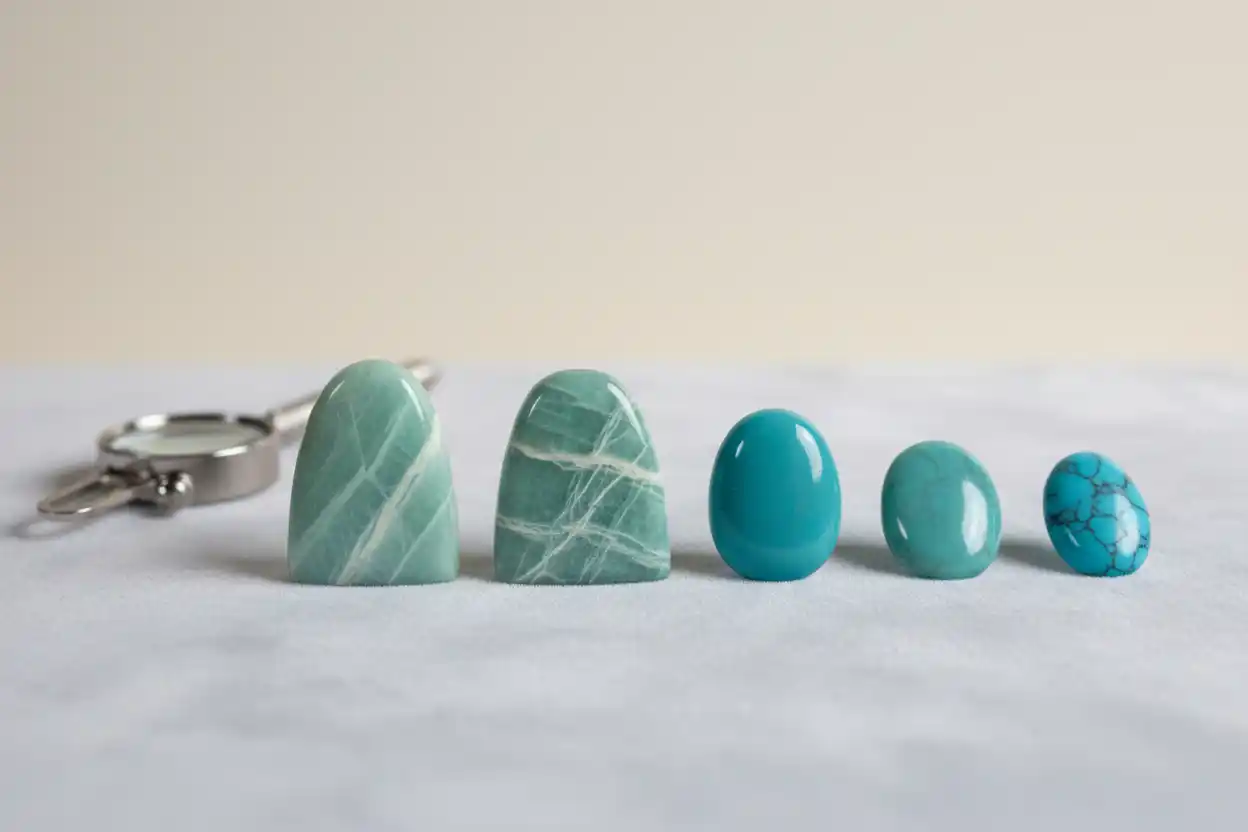
Real vs Fake Amazonite: Identification Tests and Imitations
Real amazonite is a green to blue-green variety of potassium feldspar, usually microcline. It commonly appears opaque to translucent and may display white streaks, patches or crosscutting perthitic textures caused by intergrowths of feldspar with slightly different compositions.
Imitations include dyed howlite, magnesite, quartzite, glass, resin, ceramic and other blue-green stones. Amazonite is also confused with turquoise because both can show opaque blue-green color and dark or pale matrix patterns.
No single feature proves authenticity. White streaks are common in amazonite but can be painted or molded. A cool feel can be copied by glass. Even real feldspar may be dyed, coated, stabilized or assembled.
This page owns the direct material-identification workflow. The treated-amazonite guide retains the detailed enhancement and synthetic-material boundaries, while amazonite versus turquoise owns the complete comparison between those two natural gems.
Real Amazonite vs Common Imitations
| Feature | Genuine amazonite | Dyed howlite or magnesite | Glass | Resin or plastic | Turquoise |
|---|---|---|---|---|---|
| Material | Potassium feldspar, usually microcline | Calcium borosilicate or magnesium carbonate | Manufactured glass | Polymer | Hydrated copper aluminum phosphate |
| Typical color | Green, blue-green, turquoise-green | Dyed blue, green or turquoise | Uniform blue-green possible | Any manufactured color | Blue to green |
| Pattern | White perthite streaks, feldspar patches, cleavage and grain texture | Dark web-like veins or porous texture | Flow lines, bubbles or uniform body | Molded, printed or poured patterns | Matrix veins and nodules |
| Mohs hardness | About 6–6.5 | About 3.5–5.5 | Commonly around 5–6 | Much softer | About 5–6 |
| Cleavage | Perfect feldspar cleavage | Different fracture and cleavage behavior | No mineral cleavage | No mineral cleavage | No feldspar cleavage |
| Transparency | Opaque to translucent; uncommon transparent material | Usually opaque | Transparent to opaque | Variable | Opaque |
| Weight and feel | Stone-like, specific gravity near 2.56 | Stone-like but often lighter or softer | Often glassy | Often light and warm | Stone-like |
| Dye clues | Treatment possible but not required | Color concentrated in pores and veins | Color through glass or coating | Color manufactured into body | Treatment common in commercial material |
| Best confirmation | Optical, microscopic and mineral testing | Mineral identification | Bubble and optical testing | Density and microscopy | Gemological separation |
What Is Genuine Amazonite?
Amazonite belongs to the feldspar family, one of the most abundant mineral groups in Earth’s crust.
Most amazonite is a variety of microcline, a potassium-rich alkali feldspar with the general composition KAlSi₃O₈. The trade name has occasionally been applied to blue-green orthoclase or related potassium feldspar, but microcline is the expected identity for most ornamental amazonite.
The amazonite meaning guide owns its formation, localities, symbolism and jewelry use.
Genuine amazonite usually forms in coarse granites and pegmatites, where large feldspar crystals grow alongside quartz, mica, albite, tourmaline and other minerals.
What Causes Amazonite’s Color?
Amazonite’s blue-to-green color is not usually caused by copper, despite the color’s resemblance to turquoise and chrysocolla.
Research connects the color with lead-related centers, structurally bound water and natural irradiation within potassium feldspar. Iron and other variables may also influence individual shades.
This mechanism means the color belongs to the feldspar structure rather than to a simple surface stain in untreated material.
However, real amazonite can still be dyed, coated or stabilized after mining. Natural identity and natural color are separate questions.
Typical Amazonite Colors
Amazonite may appear pale green, mint, robin’s-egg blue, turquoise-green, blue-green, teal or deeper green-blue.
Some localities produce stronger and more even color, while others show pale feldspar crossed by white streaks or brownish areas.
The color may be distributed unevenly through one crystal. Edges, cleavage planes and perthitic zones can show different tones.
Uniform color does not prove imitation. Fine amazonite can be comparatively even, while manufactured products can intentionally include irregular patterns.
Extremely neon, saturated or perfectly uniform material deserves closer examination, especially when offered at a very low price.
White Streaks and Perthite
White streaks are among amazonite’s most familiar visual features.
They commonly represent perthitic intergrowths—thin or coarse areas of sodium-rich feldspar within a potassium-feldspar host. The pattern may appear as lines, patches, grids, feathery zones or irregular pale bands.
Natural streaks usually possess depth. They continue beneath the surface and change as the object is rotated.
Printed or molded imitations may show identical white lines on several beads or a pattern that sits only on the outer surface.
Not every genuine amazonite displays obvious white streaks. Transparent or unusually homogeneous feldspar can lack the classic commercial appearance.
Cleavage and Blocky Texture
Microcline has well-developed cleavage in two directions. Rough crystals often appear blocky and may break into flat, stepped surfaces.
Polished amazonite can retain subtle planar lines, reflections or chips related to cleavage.
Those features can support feldspar identification, but deliberately breaking a stone is destructive and unnecessary.
Glass fractures conchoidally rather than along mineral cleavage. Howlite, magnesite and turquoise also show different structural behavior.
A professional can examine existing edges or microscopic internal planes without creating new damage.
Cross-Hatched Twinning
Microcline is famous for tartan or cross-hatched twinning when viewed under polarized light through a microscope.
The pattern results from intersecting twin orientations within the triclinic feldspar structure.
It may not be visible to the naked eye, especially in opaque amazonite. Nevertheless, appropriate optical examination can provide strong evidence that the material is microcline.
A painted white grid on a bead is unrelated to crystallographic twinning.
Dyed Howlite
Howlite is a white, porous mineral commonly marked by gray or black web-like veins.
It accepts dye readily and is frequently used to imitate turquoise. Blue-green dyed howlite can also be labeled amazonite.
The veins tend to look like dark cracks or spiderweb lines rather than pale feldspar intergrowths. Dye may become especially dark along porous boundaries.
Howlite is softer than amazonite, but scratch testing a finished bead is not recommended.
A chalky texture, intense color in drill holes and repeated web patterns across many pieces support a dyed-howlite conclusion.
Dyed Magnesite
Magnesite is another porous white mineral that can be dyed blue, green and turquoise.
It may show irregular veining, granular texture or a more uniform body than howlite.
Commercial dyed magnesite is sometimes sold under invented names that contain amazon, turquoise or jade.
Its mineral properties differ from feldspar, and a gemologist can separate it through refractive response, density and spectroscopy.
The object may still be natural magnesite, but it is not amazonite.
Dyed Quartzite and Chalcedony
Quartz-rich rocks and chalcedony can be dyed to imitate amazonite.
Dyed quartzite often has a sugary granular texture visible around chips or drill holes. Amazonite should show feldspar cleavage and intergrowth textures rather than interlocking quartz grains.
Dyed chalcedony may be more uniformly translucent and display conchoidal fracture without feldspar cleavage.
Dye can concentrate in cracks, grain boundaries and holes.
Because quartz is harder than amazonite, a simple scratch test is unreliable and destructive. Mineral identification should rely on several properties.
Glass Imitations
Glass can reproduce amazonite’s blue-green color and translucency.
Look for spherical bubbles, curved flow lines, molded seams and a homogeneous interior. White streaks may be painted, embedded or created by mixing differently colored glass.
Some glass products show no visible bubbles, so absence does not establish amazonite.
A glass imitation may feel cool and heavy enough to pass casual handling tests.
Refractive index, density and microscopic structure provide better separation.
Resin and Plastic
Resin beads can contain white swirls, dark veins or crushed mineral chips.
They commonly feel lighter and may warm more quickly in the hand, although environmental temperature makes this subjective.
Inspect for mold seams, identical repeated patterns, surface scratches, casting bubbles and color that appears suspended in a clear polymer.
A hot-needle or flame test should not be used. It damages the product and releases fumes.
Some composites contain real amazonite chips bonded with resin. They should be sold as reconstructed or composite material rather than solid amazonite.
Ceramic and Polymer-Clay Imitations
Ceramic can be glazed in convincing turquoise-green colors with painted white or brown veins.
A chipped area may reveal a pale clay body beneath the glaze. The color and shine may remain entirely on the surface.
Polymer clay can copy streaks and matrix through layered rolling techniques. Repeated bead patterns and very low weight provide clues.
These materials are decorative products, not gemstones. Accurate labeling allows them to be valued for craft rather than mineral rarity.
Amazonite Versus Turquoise
Amazonite is feldspar, while turquoise is a hydrated copper aluminum phosphate.
Turquoise usually forms as nodules, vein fillings and crusts rather than large blocky feldspar crystals. Its matrix may be dark brown or black, while amazonite commonly shows pale feldspar intergrowths.
Amazonite is generally harder and has distinctive cleavage. Turquoise may be porous and frequently receives stabilization, dye or reconstruction.
The complete side-by-side identification belongs in Amazonite vs Turquoise.
The planned real-versus-fake turquoise guide owns turquoise imitations and treatments.
Amazonite Versus Jade
Amazonite has historically been used as a jade substitute because of its green color.
True jade is jadeite or nephrite. Both have different structures and are notably tougher than brittle, cleavage-bearing feldspar.
Amazonite often shows a blocky or streaked texture, while fine jade may have a fibrous, granular or smoothly interlocking structure.
A vague name such as Amazon jade does not turn feldspar into jade.
The planned real-versus-fake jade guide should be used for jade-specific authentication.
Amazonite Versus Aventurine
Green aventurine is quartz containing reflective mineral inclusions that produce aventurescence.
Its surface may sparkle when moved beneath light. Amazonite generally lacks that glitter and instead shows feldspar streaks or patches.
Aventurine is also harder and does not possess amazonite’s feldspar cleavage.
Pale non-sparkling quartzite can still resemble amazonite, so the absence of glitter is not conclusive.
Treatments and Enhancements
Amazonite may be dyed, coated, impregnated with polymer, waxed or assembled.
Dye can deepen pale material or create more uniform blue-green color. Resin may strengthen fractured or porous pieces and improve polish.
Coating places color or gloss primarily on the surface. Wear at edges and drill holes can expose the underlying feldspar.
The treated-amazonite guide owns detection, stability and disclosure. The wider gemstone-treatments guide explains how dyeing, filling and coating differ.
Is Synthetic Amazonite Common?
Laboratory synthesis of feldspar is possible for research and industrial purposes, but true laboratory-grown amazonite is not a standard mainstream jewelry product.
Listings using created amazonite, synthetic amazonite or lab amazonite should be examined carefully. The product may be glass, resin, ceramic, dyed stone or composite material.
A manufacturer should identify the actual substance rather than borrowing synthetic terminology from gems with established laboratory-grown counterparts.
The laboratory-grown versus natural gemstones guide explains why synthetic and imitation are not interchangeable.
Hardness and Scratch Testing
Amazonite generally measures about 6–6.5 on the gemstone-hardness chart.
It can scratch softer materials but may itself be scratched by quartz, topaz, sapphire and diamond.
A scratch test risks damaging genuine amazonite and can produce misleading results when the object has a coating or composite surface.
Hardness also does not measure impact resistance. The gemstone-toughness-versus-hardness guide explains why cleavage makes feldspar vulnerable despite moderate hardness.
Cleavage and Durability
Amazonite’s cleavage can create flat chips and fractures under impact.
The gemstone-cleavage guide explains how structurally preferred breakage differs from ordinary surface scratching.
Rings and bracelets expose amazonite to greater impact than earrings and pendants. Beads can chip around drill holes when strung too tightly.
A polished piece with many surface-reaching cleavage cracks may be genuine but lower in durability and value.
Transmitted Light and Magnification
Hold a thin edge against diffused light. Genuine amazonite may reveal cloudy feldspar zones, cleavage planes and white intergrowths.
Dyed material may show color collecting in fractures or around the outer surface. Glass may reveal bubbles or uniform flow. Resin can show casting structures.
Use a 10× loupe around drill holes and chips. Grain texture, mold seams and coating wear often become clearer there.
Strong backlighting can exaggerate color and should not replace ordinary-light observation.
Specific Gravity and Refractive Properties
Amazonite’s density is commonly near 2.56, consistent with microcline feldspar.
Its refractive index generally lies around 1.52–1.53. Aggregate, opaque and curved surfaces can make ordinary refractometer readings difficult.
Howlite, magnesite, glass, turquoise and resin occupy different combinations of density and optical behavior.
Professional testing combines several measurements rather than treating one value as universal proof.
Raman and X-Ray Identification
Raman spectroscopy can identify feldspar structure by its molecular-vibration pattern.
X-ray diffraction is especially useful for distinguishing microcline, orthoclase and other crystalline materials.
These methods can resolve cases where the surface appearance has been altered by dye or polish.
A laboratory may also use infrared or chemical analysis to investigate polymer treatment and unusual color.
Amazonite and Lead Safety
Lead contributes to amazonite’s natural color centers, but it is held within the feldspar structure rather than existing as loose metallic lead on an intact polished surface.
Even so, amazonite should not be ingested, licked, ground without protection or placed in drinking water. Acidic liquids can interact with minerals and treatments unpredictably.
The toxic-crystals safety list provides handling context. The crystal water-safety guide explains why a decorative mineral does not belong in an elixir merely because it survives brief washing.
Wash hands after cutting, drilling or handling mineral dust and use appropriate respiratory controls during lapidary work.
Raw and Polished Amazonite
Raw amazonite may preserve blocky crystal shape, cleavage, pegmatite associations and contact with smoky quartz or albite.
Polishing strengthens color and reveals intergrowth patterns but removes natural surfaces.
The raw-versus-polished crystal guide explains why either form can be genuine and why polishing is not the same as synthetic manufacture.
A polished tower is a manufactured shape even when carved from natural amazonite.
Buying Real Amazonite
The where-to-buy-real-amazonite guide owns seller selection and marketplace risks.
Ask for the exact material name, treatment disclosure, dimensions and photographs of the actual item.
A seller should distinguish solid amazonite from reconstructed material and should not use turquoise, jade or lab-grown language ambiguously.
Follow how to buy gemstones online for return-window and independent-inspection safeguards.
Laboratory Reports
Ordinary amazonite beads rarely justify a full report. Testing becomes more relevant for expensive carvings, unusual transparent feldspar, locality claims or suspected composite material.
The gemstone-certification guide explains report types. Use how to read a gem lab report to determine whether the document identifies microcline, treatment or only replacement value.
A retailer’s printed card with metaphysical descriptions is not a gemological identification report.
A Safe Home Inspection Sequence
Observe the object under neutral light. Note whether the color is naturally varied or unnaturally uniform.
Inspect white streaks from the edge and back to see whether they possess depth.
Use a loupe around drill holes, chips and fractures. Look for concentrated dye, glass bubbles, mold seams, resin and surface coating wear.
Consider the stated source and price but do not treat either as proof.
Compare the piece with the dedicated amazonite and turquoise guides rather than relying on a general blue-green color chart.
Avoid scratch, flame, acid and hot-needle testing. Seek a gemologist when the value or identity matters.
Frequently Asked Questions
1. What is real amazonite?
Real amazonite is blue-to-green potassium feldspar, usually the microcline variety.
2. Does genuine amazonite always have white streaks?
No. White perthite streaks are common but not mandatory, particularly in homogeneous or unusual transparent material.
3. What is most often sold as fake amazonite?
Dyed howlite, magnesite, quartzite, glass, resin and ceramic are common imitations.
4. How can I distinguish dyed howlite from amazonite?
Howlite commonly shows dark web-like veins and porous dye concentration, while amazonite tends to show pale feldspar streaks, cleavage and blocky texture.
5. Is amazonite the same as turquoise?
No. Amazonite is feldspar, while turquoise is a hydrated copper aluminum phosphate.
6. Is amazonite a type of jade?
No. True jade is jadeite or nephrite. Amazonite has different composition, cleavage and toughness.
7. Can real amazonite be dyed?
Yes. The base material may be genuine feldspar while its color has been enhanced.
8. Is laboratory-grown amazonite common?
No. Products marketed as synthetic or lab amazonite are more likely to be imitation glass, resin or another manufactured material unless clearly documented.
9. Can I scratch-test amazonite?
Do not scratch a finished piece. The test is destructive and can be misleading.
10. Is amazonite safe to put in drinking water?
No. Do not ingest amazonite or use it for direct crystal-water preparation, particularly because composition, dust and treatment may be unknown.
11. Can glass feel as cool as real amazonite?
Yes. Temperature is subjective and glass can feel cool, so the touch test is unreliable.
12. When is laboratory testing worthwhile?
Testing is useful for expensive specimens, transparent green feldspar, important locality claims or disputed treatment and composite construction.
Genuine amazonite is best recognized as feldspar rather than simply as a turquoise-colored stone. Its pale intergrowths, cleavage, blocky texture and microcline properties form a consistent material identity. When those features are replaced by porous dark veins, glass bubbles, printed streaks or resin seams, the object may be another material. When the feldspar is genuine but dyed or stabilized, the correct conclusion is treated amazonite—not automatically fake stone.
Amazonite appears in Crystals That Start With A and Gemstones That Start With A.