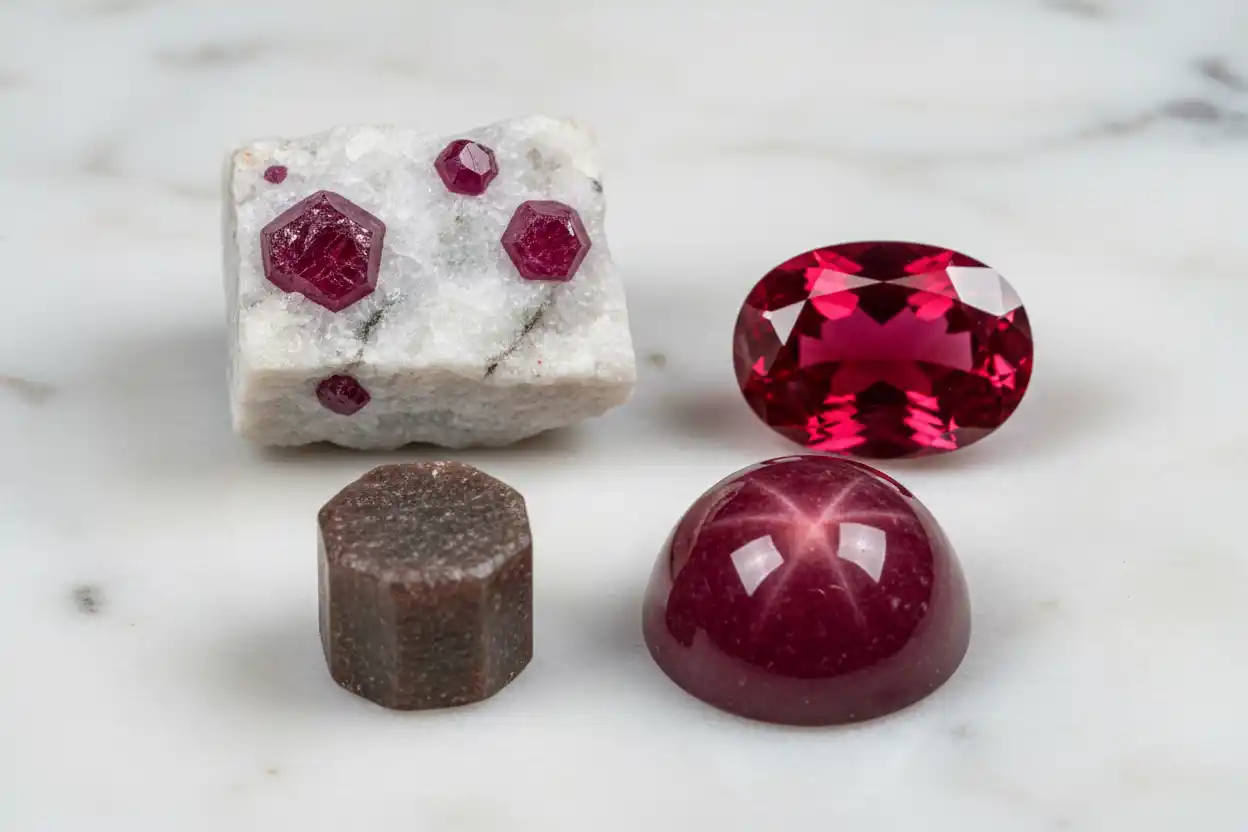
Ruby Meaning: 13 Spiritual Symbols of the Stone of Kings
Ruby meaning combines red corundum mineralogy, centuries of human admiration, royal symbolism, religious and cultural traditions, modern spiritual beliefs, and personal associations. Ruby is the red gem variety of corundum, Al2O3, with chromium primarily responsible for its color. It crystallizes in the trigonal system and has Mohs hardness 9, giving the gemstone a physical identity that exists independently of any symbolic interpretation.
The phrase “Stone of Kings” has a genuine historical foundation. In Sanskrit, ruby was called ratnaraj, commonly translated as “king of precious stones” or “king of gems.” Ruby’s intense color, rarity, durability, and high value helped it become associated with status, power, passion, protection, and wealth in many periods.
Modern ruby meaning adds themes involving courage, spiritual vitality, love, root chakra symbolism, confidence, and personal motivation. These ideas may be meaningful within prayer, meditation, jewelry traditions, or private rituals, but they should not be treated as proof that ruby changes health, hormones, energy fields, or future events.
13 Ruby Meaning Symbols at a Glance
- Kingship and status reflect ruby’s long association with rarity, wealth, and elite jewelry.
- Courage comes from centuries of symbolism linking intense red color with bravery and strength.
- Passion reflects the long human association between red and strong emotion.
- Love connects ruby with romance, devotion, marriage, and meaningful jewelry gifts.
- Vitality comes from symbolic comparisons between red ruby and blood, fire, warmth, and life.
- Protection appears in older beliefs that treated ruby as a powerful talisman.
- Wisdom is part of several historical religious and literary references to precious red gems.
- Prosperity reflects ruby’s high value and its long place in royal and wealthy collections.
- Commitment makes ruby a natural symbol for anniversaries, engagement jewelry, and enduring relationships.
- Root chakra symbolism connects its red color with modern spiritual ideas about stability and confidence.
- Leadership fits the gemstone’s historical association with kingship, authority, and personal strength.
- Hope and inner fire can be represented by fluorescence and the visual intensity of fine red ruby.
- Personal ruby meaning can come from family history, achievement, birthstone traditions, jewelry, or important life events.
Ruby Meaning Starts With Red Corundum
Scientific identity gives ruby meaning a clear starting point. Ruby is corundum colored red primarily by chromium, and its Al2O3 crystal structure is the same fundamental mineral structure found in sapphire.
The difference between ruby and sapphire shows how small chemical changes can transform a gemstone’s appearance. Pure corundum is colorless, while trace elements alter the wavelengths of light absorbed by the crystal.
Chromium produces the red color that defines ruby. It can also create strong red fluorescence, giving suitable stones a visual intensity that likely helped inspire comparisons with fire, glowing embers, blood, and life.
These comparisons are symbolic. The red appearance is real gem physics, while ideas about passion or vitality come from human interpretation.
Red Color Is Central to Ruby Meaning
Red has powerful cultural associations long before it becomes attached to any particular gemstone. It can represent love, danger, courage, sacrifice, heat, anger, blood, authority, celebration, and vitality depending on the society and occasion.
The natural ruby color meaning therefore develops from both mineral chemistry and human color symbolism. Chromium explains why ruby is red, while people decide what that red represents.
Fine ruby ranges through red, pinkish red, and purplish red. Trade descriptions often favor vivid, strongly saturated red, but symbolic meaning does not depend on one commercial grade.
A family ruby can carry great emotional value even when its color would not receive the highest gemological grade. Market quality and personal meaning are different forms of value.
Why Ruby Became the Stone of Kings
Ruby meaning has a particularly strong connection with royalty because fine stones were rare, highly valued, durable, and visually striking. Before modern gemological testing, many red gems were grouped under names that did not always distinguish ruby from spinel or garnet, so historical royal collections can contain more than one red gemstone species.
Even with that complication, genuine ruby held an exceptional position. In Sanskrit it was called ratnaraj, the “king of precious stones,” a phrase that directly connects the gemstone with rank and prestige.
The natural ruby history includes references from South Asia, Europe, the Middle East, and other regions where red gems were associated with wealth, beauty, protection, and authority.
Ruby meaning should still be tied to specific traditions rather than assuming every culture interpreted the gemstone in the same way. Royal symbolism is strong, but there has never been one universal ruby belief system.
Courage and Warrior Symbolism
Courage is one of the most persistent themes in ruby meaning. Historical traditions from parts of Asia associated ruby with protection, invincibility, strength, or success in conflict.
Such beliefs make sense when the stone’s red color is considered. Red can resemble blood and fire, while ruby’s exceptional hardness creates a physical impression of strength.
These historical beliefs should not be converted into a promise of physical protection. A ruby ring cannot prevent injury, guarantee victory, or remove fear.
A modern wearer may still choose ruby as a symbol of courage. It can represent the decision to speak honestly, face uncertainty, defend a boundary, or continue after a setback.
Ruby Meaning as Passion and Love
Passion is another major part of ruby meaning. Red gemstones have long been associated with romance and intense emotion, making ruby a natural choice for anniversary rings, engagement jewelry, and gifts connected with love.
Passion can also mean enthusiasm for work, art, learning, travel, family, or another deeply valued part of life. A ruby does not have to represent romance to symbolize commitment.
A ruby engagement ring can represent devotion or individuality, but the gemstone itself cannot create loyalty, attraction, or relationship compatibility.
Jewelry gains meaning through the people who wear it and the events attached to it. The symbolism can be powerful without implying control over another person’s emotions.
Vitality and the Symbolism of Blood and Fire
Ruby meaning often includes vitality because the gemstone’s color resembles blood, flame, and glowing embers. Earlier cultures sometimes interpreted this visual intensity as evidence of life force or an inner fire within the stone.
Modern gemology gives a different explanation. Chromium absorption and fluorescence account for ruby’s red appearance and, in some specimens, its vivid glowing quality.
The historical metaphor can still be appreciated without turning it into physiology. Ruby does not improve blood production, oxygenation, heart function, metabolism, fertility, or physical stamina.
Someone may use the gemstone as a personal symbol of enthusiasm or renewed purpose. The vitality belongs to the person’s intention rather than to energy released by corundum.
Protection as an Older Ruby Belief
Protection appears frequently in older ruby meaning traditions. People in different periods attributed protective qualities to gems, especially rare stones with unusual colors or optical effects.
Some historical beliefs treated ruby as protection against enemies, misfortune, illness, or physical danger. These traditions reveal how valuable gemstones were understood before modern geology and medicine.
They should be described as beliefs rather than tested properties. Ruby cannot create an invisible shield or guarantee safety.
A modern person may reinterpret protection more practically. A ruby ring can symbolize personal boundaries, courage, responsibility, or remembering to avoid an unhealthy situation.
Prosperity, Wealth, and Ruby Value
Ruby meaning also developed around prosperity because top-quality stones have historically been rare and expensive. Royalty, wealthy merchants, collectors, and important jewelry houses prized fine rubies for their beauty and status.
The connection with wealth is symbolic rather than causal. Owning ruby does not attract money, increase investment returns, or improve business probabilities.
Ruby’s high economic value comes from market factors such as color, transparency, size, origin, treatment, rarity, and demand. The practical ruby benefits also include outstanding hardness and jewelry durability, which help explain why fine stones can survive through generations.
A family ruby can therefore symbolize prosperity because it is a valuable possession or heirloom. That is different from claiming the stone generates wealth.
Wisdom and Religious Symbolism
Ruby meaning also appears in religious and literary traditions, although translations and historical gemstone names require care. Ancient texts often used gem names differently from modern mineral classification, and one historical “ruby” may not always meet today’s laboratory definition.
Red precious stones nevertheless became symbols of beauty, wisdom, status, sacrifice, virtue, and divine favor in several traditions. These meanings reflect the cultural value placed on rare color and brilliance.
The important distinction is between religious symbolism and mineral science. Corundum’s physical properties do not prove a spiritual doctrine.
A person can still wear ruby because it has meaning within a family or faith tradition. Personal spiritual value does not require a laboratory mechanism.
Root Chakra Symbolism
Modern ruby chakra traditions most often associate the stone with the root chakra because contemporary chakra color systems connect red with grounding, stability, security, courage, and physical presence.
Some practitioners also extend ruby symbolism to the heart because of its relationship with love and passion. Spiritual systems vary, so there is no single fixed chakra assignment accepted by every practitioner.
Chakras are spiritual concepts rather than anatomical organs. Ruby does not physically activate the spine, reproductive system, adrenal glands, heart, blood vessels, or nervous system.
Meditation with ruby can still provide a deliberate focus. Someone might use the stone while reflecting on stability, confidence, financial responsibility, relationships, or another chosen theme.
Geological Origin Gives Ruby Meaning Through Place
Ruby meaning can also come from geology rather than spirituality. A stone from Myanmar’s Mogok region carries a different geological and mining story from a ruby found in Mozambique, Sri Lanka, Madagascar, Vietnam, Tanzania, or Afghanistan.
Marble-hosted rubies often develop in metamorphic carbonate rocks, while other rubies form in amphibolite, gneiss, or basalt-related geological settings. These environments influence trace elements, inclusions, fluorescence, and sometimes color.
Locality can make a gemstone personally meaningful. A ruby purchased while traveling, inherited from a particular region, or collected with reliable provenance may connect its owner to a real place.
For collectors, this physical history can matter as much as symbolic tradition. The gemstone becomes a record of geological processes as well as human ownership.
Star Ruby Meaning and the Symbolism of Light
Star ruby carries another layer of ruby meaning because a six-rayed star can appear to float across the surface of a well-cut cabochon. The effect is called asterism and commonly results from oriented rutile needles reflecting light along specific crystallographic directions.
Historically, star stones naturally attracted symbolic interpretations involving guidance, protection, fate, or hope. The moving star can still inspire those themes today.
Gemologically, the effect has a clear physical cause. It does not indicate supernatural energy inside the stone.
This is a useful example of how ruby meaning can be inspired by a real optical phenomenon without confusing symbolism with science.
July Birthstone Meaning
Ruby is the traditional modern birthstone for July, giving ruby meaning a strong connection with birthdays and personal identity. A July birthstone ring or pendant may represent family, age milestones, children, anniversaries, or gifts received at important moments.
Birthstone systems are cultural traditions rather than mineralogical classifications. A person’s birth month does not create a biological connection with corundum.
Even so, these traditions give jewelry a clear emotional role. A ruby may become meaningful because it marks a birth, not because the gemstone changes the wearer’s body or fate.
Birthstone symbolism is therefore one of the simplest ways ruby meaning becomes personal.
Leadership and Personal Authority
The royal history of ruby has encouraged modern symbolism involving leadership, confidence, and personal authority. A stone once associated with kings and powerful elites naturally lends itself to ideas about responsibility and decisiveness.
Leadership symbolism is more useful when separated from ideas about dominance. A person may use ruby to represent responsibility, clear decisions, consistency, or the courage to take ownership of an outcome.
The gemstone does not create leadership ability. Skills develop through experience, judgment, communication, preparation, and behavior.
Ruby can simply become a physical reminder of the qualities a person wants to practice.
Treatments Do Not Erase Personal Ruby Meaning
Heat treatment is common in ruby, and other enhancements such as fracture filling also exist. These gemological facts affect commercial description, care, rarity, and sometimes value.
Treatment does not automatically erase personal ruby meaning. A heated ruby inherited from a family member can still hold deep sentimental value.
Accuracy still matters. A natural heated ruby, a glass-filled ruby, and a laboratory-grown ruby should not be represented as though they are identical products.
Personal symbolism and honest gem disclosure can exist together. Knowing exactly what a stone is often makes its story more meaningful rather than less.
Personal Ruby Meaning Can Be Unique
Ruby meaning does not have to come from an ancient tradition or modern chakra system. Ruby can represent a relationship, graduation, July birthday, career milestone, family heirloom, artistic achievement, journey, or private memory.
A small inherited ruby may mean more to one person than a commercially superior stone. Personal history changes how an object is valued emotionally.
The gemstone’s durability makes it particularly suited to this role because well-cared-for ruby jewelry can survive through generations. Each owner can add another story to the same physical gem.
Personal symbolism does not need universal agreement to be meaningful.
Conclusion
Ruby meaning combines red corundum mineralogy, the historic “king of precious stones” tradition, royal status, courage, passion, vitality symbolism, protection beliefs, chakra practices, birthstone customs, and personal memory. These meanings become more credible when real history and gemology remain distinct from modern spiritual interpretations and medical claims.
FAQs
What does ruby mean spiritually?
Ruby meaning in modern spiritual practice commonly includes courage, passion, vitality, confidence, protection, love, and grounding. These themes are symbolic and are not scientifically established effects of corundum.
Why is ruby called the Stone of Kings?
In Sanskrit, ruby was known as ratnaraj, commonly translated as “king of precious stones” or “king of gems.” Its rarity, red color, durability, and long association with elite jewelry strengthened its royal symbolism.
What does the red color of ruby symbolize?
Red can symbolize passion, love, courage, blood, fire, strength, danger, and vitality. Chromium causes ruby’s actual red color, while the meanings assigned to that color come from human culture and personal interpretation.
Does ruby symbolize courage?
Yes. Courage is a long-standing ruby meaning, partly because red evokes strength, blood, fire, and bravery. The gemstone can represent courage personally, but it does not physically remove fear or guarantee safety.
Is ruby connected with love?
Ruby has strong associations with love, romance, devotion, and passion. It is often used in meaningful relationship jewelry, although no gemstone can create attraction, loyalty, or compatibility between people.
What chakra is ruby associated with?
Modern crystal traditions commonly connect ruby with the root chakra because of its red color, while some also associate it with heart-centered themes. Chakra systems are spiritual frameworks rather than anatomical structures.
What does star ruby symbolize?
Star ruby may symbolize guidance, hope, protection, or direction because of its moving six-rayed star. Gemologically, that star is an optical effect produced by oriented inclusions, commonly fine rutile needles.
Does ruby attract wealth?
There is no scientific evidence that ruby attracts money or changes financial outcomes. Its prosperity symbolism comes partly from the stone’s rarity, market value, royal history, and long association with wealth.
Can ruby meaning be personal?
Yes. Ruby can represent a July birthday, relationship, anniversary, family heirloom, achievement, career milestone, journey, or private memory. Personal symbolism does not require a universal spiritual explanation.
Disclaimer: Courage, love, vitality, chakra, protection, prosperity, leadership, and energetic interpretations of ruby reflect cultural traditions, spiritual beliefs, and personal practices. Ruby is not a medical treatment and cannot guarantee health, safety, wealth, or relationship outcomes.