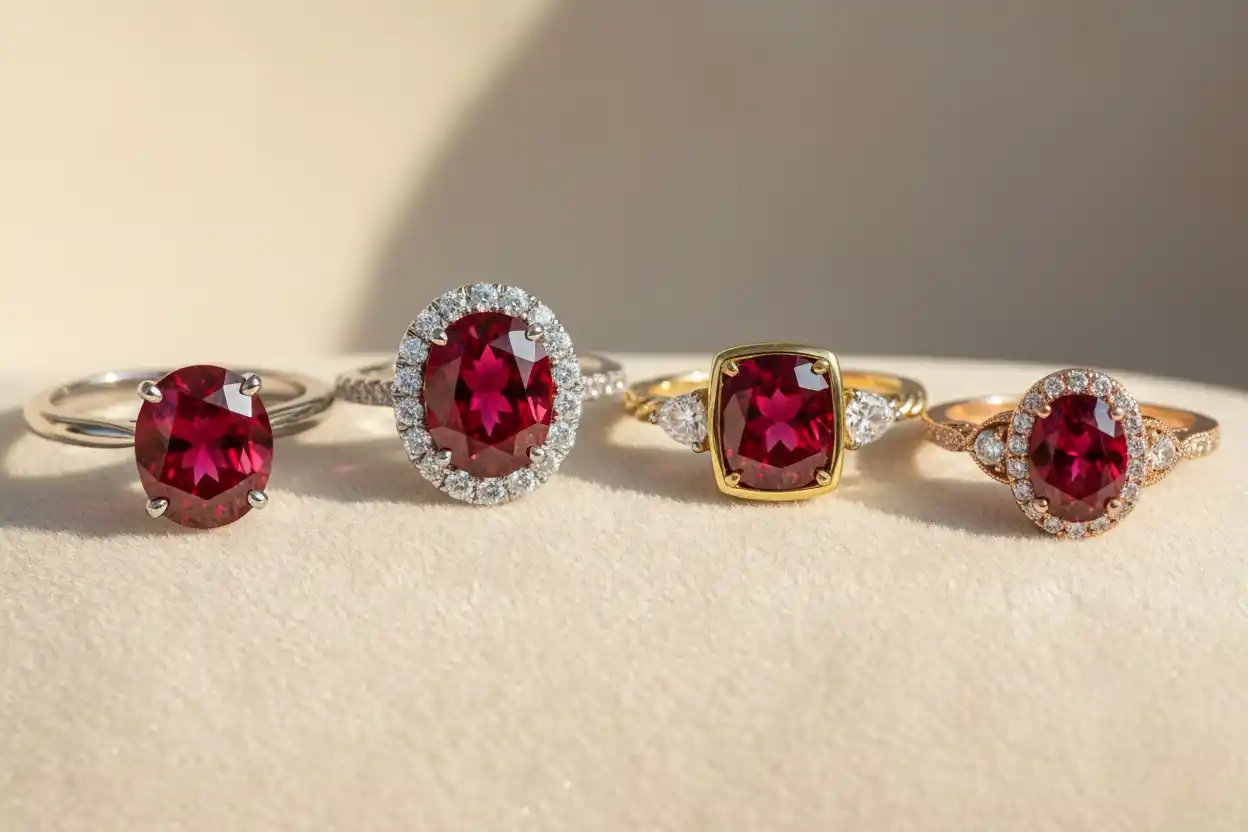
Ruby Engagement Rings: Quality, Settings and Buying Guide
A ruby engagement ring combines saturated red color with one of the strongest gemstone structures available for daily jewelry. Ruby is corundum, the same mineral species as sapphire, and ranks 9 on the Mohs scale. Only diamond is significantly harder among the gemstones commonly used in engagement rings.
Durability alone does not make every ruby suitable. Color, cut, fractures, filling, setting design and laboratory disclosure determine whether a ring will remain attractive and secure through years of wear.
Fine natural ruby can also be more expensive per carat than many diamonds, particularly when the stone has vivid color, good transparency, substantial size, desirable origin and no evidence of heat treatment. Laboratory-grown ruby and heated natural material provide lower-cost alternatives without sacrificing the basic hardness of corundum.
A successful purchase therefore begins by deciding which form of ruby is acceptable: natural unheated, natural heated, laboratory-grown or another clearly disclosed category. The setting and budget can then be built around that decision.
Ruby Engagement Rings at a Glance
| Decision | Strong starting point |
|---|---|
| Best color | Vivid red to slightly purplish red with good brightness |
| Daily-wear durability | Excellent for sound untreated, heated or suitable lab-grown corundum |
| Hardness | Mohs 9 |
| Cleavage | None |
| Major treatment concern | Extensive glass filling, undisclosed diffusion or composite construction |
| Strongest setting | Low bezel or protected six-prong setting |
| Classic accent | Diamond or white sapphire |
| Budget alternative | Heated natural ruby or clearly disclosed laboratory-grown ruby |
| Report priority | Natural versus lab origin, treatment status and optional geographic-origin opinion |
| Cleaning | Warm soapy water for sound untreated or heated ruby; gentler care for filled material |
| Birthstone connection | July |
| Main buying principle | Evaluate color, treatment and report before carat weight alone |
Is Ruby a Good Engagement-Ring Stone?
Ruby is one of the strongest colored gemstones for an engagement ring.
Its hardness provides excellent resistance to scratching and abrasion. It has no perfect cleavage, reducing the risk of splitting along one structural plane.
The stone remains brittle enough to chip under a sharp impact, particularly at thin girdles or exposed points.
Durability also changes with treatment. A heavily glass-filled ruby contains areas that are softer and less chemically stable than corundum.
For an overview of alternatives suitable for long-term hand wear, see Best Gemstones for Engagement Rings and Best Gemstones for Everyday Wear.
Ruby is a better mechanical choice than opal, pearl, tanzanite, fluorite, moonstone and many other colored stones, provided the ruby itself is sound.
Natural Ruby Versus Lab Ruby Engagement Rings
A natural ruby formed geologically.
A laboratory-grown ruby formed through a manufactured process but is still corundum. Its hardness, refractive properties and chemical composition correspond closely to natural ruby.
Lab ruby can provide larger dimensions, higher clarity and vivid matching color for a lower budget.
Natural ruby carries geological rarity and can command substantial premiums for color, treatment status, size and provenance.
The choice is not simply real versus fake. Both materials are ruby, but their origins and market values differ.
Use the lab ruby buying guide and lab ruby price guide when considering manufactured corundum.
The broader lab-grown versus natural gemstones guide explains origin disclosure across gemstone species.
Heated Versus Unheated Ruby
Heating is common in natural ruby.
It can improve color, reduce unwanted blue or brown modifiers, dissolve silk and heal selected fissures.
A heated ruby remains natural ruby.
Fine unheated stones are scarcer and may command a premium when color and transparency are already strong.
Treatment detection can require microscopy, FTIR, spectroscopy and other laboratory analysis.
An unheated claim should be supported by an independent report when it affects the price materially.
A well-chosen heated ruby can provide excellent beauty and durability without the premium attached to exceptional untreated material.
Glass-Filled Ruby Engagement Rings
Heavily fractured ruby can be filled with lead-rich or other glass to improve transparency.
The result may contain natural corundum, but the visible stone can depend extensively on filler.
Such material is generally unsuitable for a high-value engagement ring expected to undergo decades of wear, resizing and repair.
The glass can be damaged by heat, acids, aggressive cleaning and jeweler’s torch work.
Filled fractures may show colored flash effects, bubbles or transparent material within cavities.
The treated ruby guide explains heat, diffusion, filling and synthetic ruby, while the real-versus-fake ruby guide separates natural corundum from composites and simulants.
A seller should not describe extensively filled material simply as natural ruby without prominent treatment disclosure.
Choosing Ruby Color
Color is the most important appearance factor.
The most prized ruby commonly shows vivid red to slightly purplish red with enough brightness to remain lively under ordinary lighting.
Tone should be neither so light that the stone appears pink nor so dark that it appears black.
Orangish-red and brownish-red rubies can be attractive and more affordable, particularly in yellow or rose gold.
Color should be examined under daylight-equivalent and warm indoor illumination.
Retail spotlights can make a dark stone appear brighter than it will at home.
Photographs should be compared against video and written color descriptions. Digital saturation can remove brown or purple modifiers.
The types of ruby guide explains color varieties, star ruby and locality-linked trade descriptions.
Ruby Versus Pink Sapphire
Ruby and pink sapphire are both corundum.
The distinction depends on how strongly red the stone appears.
There is no single universal numerical color boundary accepted across every laboratory and market.
A pale pink stone should not receive a ruby premium merely because the seller prefers the more prestigious name.
For an engagement ring, appearance matters more than arguing over a borderline label, but the report and invoice should use consistent terminology.
Clarity
Ruby usually contains inclusions.
Small crystals, rutile silk, healed fractures and color zoning can support natural origin and create visual character.
Inclusions reduce quality when they make the stone cloudy, gray or structurally weak.
A large surface-reaching fracture near a prong deserves caution.
Eye-clean natural ruby exists, especially in smaller sizes, but becomes less common as size and saturation increase.
Do not assume a clean ruby is synthetic or an included ruby is natural. Laboratory-grown stones and filled products can also contain complex features.
Cut Quality
Ruby rough is valuable, so cutters often preserve weight.
That decision can create deep stones with dark centers or asymmetrical outlines.
A well-cut ruby returns red light across most of its face.
Windowing appears as a pale or transparent center, while extinction appears as broad black areas.
Ovals, cushions and rounds are the most common engagement-ring shapes.
Pears and marquises create length but need point protection. Emerald cuts emphasize clarity and color zoning and make windowing easy to see.
The stone should sit level within the setting, with a girdle thick enough for security but not so bulky that it hides weight.
Shape Selection
Round rubies provide balanced brilliance and straightforward setting.
Ovals often face up larger for their weight and create an elegant elongated outline.
Cushions show broad color flashes and suit vintage or halo settings.
Pears provide a directional design but need a V-prong at the point.
Marquises offer finger coverage but can show bow-tie extinction and exposed tips.
Cabochons suit opaque, included and star rubies.
Shape should be chosen from the actual stone’s optical performance rather than from a trend alone.
Carat Weight and Dimensions
Ruby is relatively dense.
A one-carat ruby can appear smaller than a one-carat diamond or beryl because weight is distributed differently.
Millimeter dimensions give a clearer picture of face-up size.
The carat-versus-millimeter chart explains density-based differences.
Price can rise sharply as natural ruby becomes larger while retaining fine color and transparency.
A smaller vivid stone frequently looks more impressive than a larger dark or heavily included ruby.
A halo or three-stone setting can increase visual coverage without forcing the budget into a rare center-stone size.
Ruby Solitaire Engagement Rings
A solitaire keeps attention on one ruby.
Four prongs expose more of the stone. Six prongs provide additional redundancy and suit larger rounds and ovals.
A low basket reduces snagging and impact.
A cathedral setting creates an elegant side profile but raises the ruby above the finger.
The girdle should remain fully supported without direct pressure on a fracture.
A solitaire also makes treatment, inclusions and cut easier to inspect than a heavily decorated design.
Bezel-Set Ruby Engagement Rings
A bezel surrounds the ruby’s edge with metal.
It is one of the most protective engagement-ring settings.
The smooth profile reduces snagging and shields the girdle from direct impact.
An open-backed bezel allows cleaning and preserves more light.
A full bezel can darken an already deep ruby, so the center should be bright enough before setting.
Partial bezels expose more of the gemstone but protect fewer sides.
Bezel rings work particularly well for active wearers and people who use gloves frequently.
Ruby Halo Engagement Rings
A halo surrounds the ruby with diamonds, white sapphires or another accent.
The border increases apparent size and creates strong color contrast.
A low halo can protect part of the ruby’s perimeter.
The center should not sit so high that it becomes vulnerable.
Diamond accents need separation from the ruby’s exposed girdle because diamond is harder.
Shared prongs and pavé require regular inspection.
The gallery should be open enough for cleaning, since residue can make the center look darker.
Three-Stone Ruby Engagement Rings
A three-stone ring may represent past, present and future.
A ruby center can be paired with diamonds, white sapphires or smaller rubies.
The side stones should not rub directly against the ruby girdle.
Trapezoids, half-moons and pears can frame an oval or cushion center effectively.
The side stones should support rather than overwhelm the ruby.
The complete ring should be examined from the side to ensure the stones sit at compatible heights.
Vintage-Inspired Ruby Rings
Ruby suits Victorian, Edwardian, Art Deco and revival designs.
Milgrain, engraving, filigree and geometric diamond accents create historical character.
Antique rings may contain old heat-treated rubies, glass-filled stones, synthetic corundum, garnet-topped doublets or later replacement gems.
Construction and stone identity should therefore be assessed separately.
Fine decorative metal wears gradually and may have limited resizing options.
An antique appearance does not prove an antique date or natural ruby.
Star Ruby Engagement Rings
Star ruby is cut as a cabochon to display asterism.
The moving star provides a distinctive alternative to faceted brilliance.
A star should move across the dome beneath a focused light.
Synthetic star ruby and filled star material occur, making laboratory testing important for significant purchases.
A bezel or substantial prong setting protects the cabochon perimeter.
Star ruby is generally better suited to a low profile than a tall exposed dome.
The star ruby guide explains its optical effect and material properties.
Choosing the Metal
White gold and platinum create strong contrast with red ruby.
Yellow gold emphasizes warmth and can complement orangish or brownish modifiers.
Rose gold creates a tonal red-pink appearance.
Platinum is dense and durable but increases weight and cost.
Gold alloy strength depends on karat and composition. Some white gold contains nickel.
A delicate metal color should not be chosen at the expense of sufficient prong and shank thickness.
The ring should be evaluated for long-term repairability as well as initial appearance.
Diamond Side Stones
Diamond is the classic ruby accent because its colorless brilliance intensifies red contrast.
However, diamond is harder than ruby.
The setting must prevent direct girdle contact, particularly in three-stone and halo designs.
Accent quality should be proportionate to the ruby rather than carrying an unnecessary premium for grades that are not visible in small stones.
Lab-grown diamonds can provide the same physical properties at a different price structure.
The diamond engagement-ring guide and lab diamond engagement-ring guide explain the two diamond categories.
White Sapphire and Moissanite Accents
White sapphire creates a corundum-based accent with lower brilliance than diamond.
Moissanite provides stronger fire and can create a more visually active halo.
The moissanite engagement-ring guide explains its optical and buying characteristics.
Accent choice should consider contrast, cost, replacement availability and whether the buyer wants natural or laboratory-grown side stones.
The ruby should remain the focal point rather than being visually overwhelmed by highly dispersive accents.
Ruby Versus Sapphire Engagement Rings
Ruby and sapphire are the same mineral species in different color categories.
Both rank 9 in hardness and are excellent for daily rings.
Ruby generally carries a stronger rarity premium for fine vivid red, while sapphire offers a wider color range.
The sapphire engagement-ring guide covers blue and fancy-sapphire choices.
The comparative sapphire, emerald and ruby guide helps evaluate color, durability and maintenance.
Ruby Versus Spinel Engagement Rings
Fine red spinel can resemble ruby closely.
Spinel ranks approximately 8 in hardness and is also a strong ring stone.
Natural red spinel is often untreated, while ruby heat treatment is common.
The ruby-versus-spinel guide explains their optical and historical differences.
Spinel can offer a vivid natural red at a lower price than comparable fine ruby, although exceptional spinel is also valuable.
Ruby Versus Garnet Engagement Rings
Garnet offers a broad range of red shades at accessible prices.
Most red garnets are softer than ruby and may appear darker or browner.
Rhodolite provides brighter purple-red color, while pyrope and almandine create deeper traditional reds.
The ruby, garnet and spinel comparison explains identification and wear differences.
Garnet can be an excellent engagement-ring choice for an informed wearer but does not match ruby’s scratch resistance.
Setting Height and Daily Wear
A low setting is generally more practical.
High cathedral and peg-head settings make the ruby prominent but expose it to greater leverage and impact.
The ring should not catch constantly on clothing, gloves or hair.
An open gallery improves cleaning but should not leave the girdle unsupported.
The shank needs enough thickness to resist bending.
A top-heavy ring that spins continually requires sizing, sizing beads or a redesigned shank.
Wedding-Band Compatibility
A low basket or broad halo may prevent a straight wedding band from sitting flush.
Curved, contoured and open bands can accommodate the engagement-ring profile.
Direct rubbing between rings can wear prongs and scratch metal.
Diamond-set wedding bands should not press exposed diamond girdles against the ruby.
Try both rings together before purchase.
Soldering the rings can reduce independent movement but limits future flexibility and repair.
Ring Sizing and Resizing
Measure the finger at a normal temperature and at more than one time of day.
Wide bands feel tighter than narrow ones.
Pavé, engraving, full-eternity designs and unusual metals may have limited resizing ranges.
The ruby should be removed or protected appropriately during torch work, particularly when treatment is unknown.
Glass-filled material can be damaged severely by heat.
Ask how the design can be resized before purchasing a ring intended for decades of wear.
Laboratory Reports
A laboratory report is important when natural versus laboratory origin, treatment or geographic origin affects price.
The report should identify natural or laboratory-grown corundum and disclose detectable heat, filling, diffusion or other treatment.
A geographic-origin opinion is separate from identity and treatment. It may remain inconclusive because deposits overlap.
Use the gemstone certification guide to compare report types.
The gem-lab-report guide explains dimensions, weight, treatment wording and report-number matching.
A retailer appraisal is not a substitute for independent gemological identification.
Geographic Origin
Myanmar, Mozambique, Sri Lanka, Madagascar, Tanzania, Vietnam and other regions produce ruby.
Origin can affect value when supported by laboratory evidence and market demand.
Color alone cannot prove a locality.
Descriptions such as Burmese red, Mogok color or Mozambique style may be marketing language rather than documented provenance.
A buyer should pay an origin premium only when the report, seller history and stone quality support it.
Ethical and Supply-Chain Questions
Ask the seller what is known about mine, country, dealer and cutting provenance.
Traceability varies widely in the colored-stone market.
A vague conflict-free statement may not describe the full supply chain.
Laboratory-grown ruby provides an alternative for buyers who prefer manufactured origin, although energy, labor and disclosure questions still remain.
Responsible buying involves asking specific questions and accepting that some historical or secondary-market stones have incomplete provenance.
Establishing a Budget
Decide whether the budget should prioritize natural origin, untreated status, size, color, clarity or elaborate setting.
For most buyers, vivid color and strong cut create more visible benefit than paying primarily for an origin label.
Heated natural ruby often offers a practical balance.
Lab ruby can provide a significantly larger and cleaner center for the same budget.
Avoid choosing a heavily glass-filled stone solely because it appears large.
Use the ruby price guide for value factors rather than relying on one universal price-per-carat figure.
Buying Online
Request exact-item photographs and video under more than one lighting condition.
Ask for dimensions, weight, treatment, report number, metal specifications and return terms.
Check whether the report applies to the loose stone before setting or to the finished ring.
Confirm who pays for return shipping and whether resizing voids the return policy.
Follow How to Buy Gemstones Online and retain enough time for independent verification.
Do not rely on stock photographs, unsupported AAA grades or verbal promises that disappear from the invoice.
July Birthstone and Symbolism
Ruby is July’s traditional birthstone.
Its symbolism includes vitality, protection, passion, courage and enduring devotion.
The July birthstone guide explains its historical role.
A ruby engagement ring can carry birthstone meaning, personal symbolism or simply a preference for red.
The gemstone does not guarantee fidelity, fertility, health or relationship success.
The value of the symbol comes from the couple’s intention and conduct.
Cleaning and Maintenance
Warm water, mild soap and a soft brush are suitable for sound untreated and conventionally heated ruby.
Glass-filled, dyed or uncertain stones require gentler care.
Use How to Clean Ruby Jewelry for detailed instructions.
Remove the ring before exercise, gardening, household cleaning and manual work.
Have prongs and the shank inspected periodically.
Store the ring separately from diamonds, which can scratch ruby, and away from softer gems that ruby can scratch.
Frequently Asked Questions
1. Is ruby durable enough for an engagement ring?
Yes. Ruby ranks 9 on the Mohs scale, lacks perfect cleavage and is one of the strongest colored-gemstone choices.
2. Is natural ruby better than lab ruby?
Neither is universally better. Natural ruby offers geological rarity, while lab ruby offers corundum durability, larger size and lower cost.
3. Is heated ruby suitable for an engagement ring?
Yes. Conventional heat treatment is common, generally stable and compatible with long-term wear when disclosed.
4. Should glass-filled ruby be used in an engagement ring?
It is generally a poor choice for a valuable lifetime ring because filler is vulnerable to heat, chemicals, repair and aggressive cleaning.
5. What ruby color is most valuable?
Vivid red to slightly purplish red with strong saturation and good brightness is typically most prized.
6. Can ruby look black in a ring?
Yes. Dark tone, deep cutting and closed settings can create excessive extinction.
7. Which setting protects ruby best?
A low full or partial bezel provides excellent girdle protection and reduced snagging.
8. Does a ruby engagement ring need a laboratory report?
A report is strongly advisable when natural origin, treatment, geographic origin or a significant price depends on the claims.
9. Is ruby more durable than emerald?
Yes. Ruby is harder, lacks emerald’s common fracture-related fragility and generally tolerates daily wear better.
10. Can ruby be paired with a diamond wedding band?
Yes, provided the settings prevent exposed diamond edges from rubbing directly against the ruby.
11. How should a ruby engagement ring be cleaned?
Use warm soapy water for sound untreated or heated ruby. Filled or uncertain stones require gentler treatment.
12. Is ruby a traditional engagement-ring gemstone?
Ruby has a long history in important jewelry and is well suited mechanically and symbolically to engagement rings, although diamond became the dominant modern convention.
A ruby engagement ring should be selected around the complete lifetime object rather than the center stone alone. Vivid color and sound corundum create the visual foundation, but treatment disclosure, laboratory documentation, protective setting design, ring fit and repairability determine whether the jewelry remains suitable for decades of wear.
Ruby is indexed in Crystals That Start With R and Gemstones That Start With R.