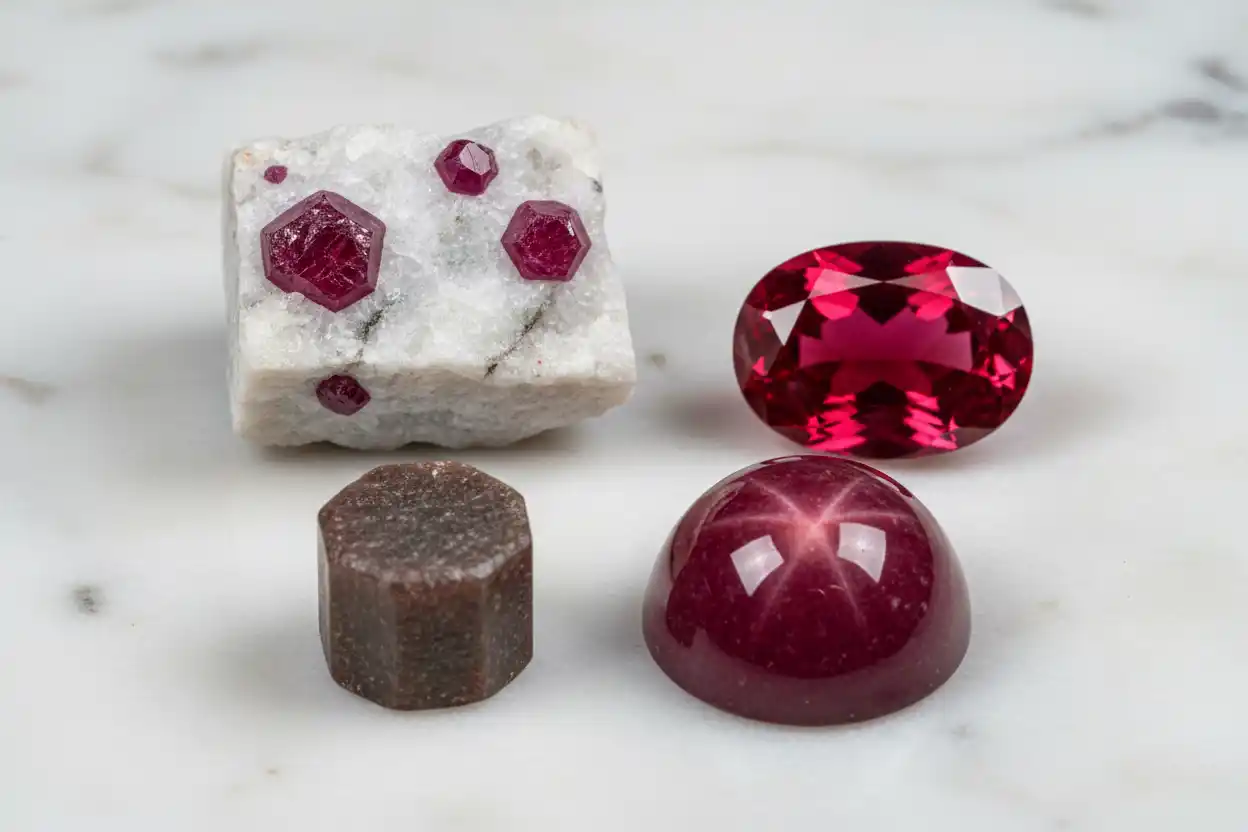
Ruby Meaning: Properties, Healing Traditions, Uses & Care
Ruby is the red variety of corundum, the same mineral species that produces sapphire in every other major color. Its intense red comes primarily from chromium, which can also create strong red fluorescence. With a Mohs hardness of 9, excellent practical durability and centuries of royal, religious and ornamental use, ruby has become one of the world’s most recognizable gemstones. Ruby meaning developed alongside that history, with passion, courage, vitality, devotion, authority and protection becoming its most enduring symbolic themes.
The physical gemstone and ruby meaning should be kept distinct. Mineralogy explains ruby’s composition, red color, crystal structure, inclusions, treatments and durability. History explains why rulers, merchants and jewelry traditions prized it. Ruby meaning belongs to cultural symbolism and contemporary spiritual practice rather than scientifically demonstrated healing effects.
That distinction also matters for laboratory-grown ruby. A lab-grown ruby is genuine corundum with essentially the same fundamental chemical composition, crystal structure, hardness and optical properties as mined ruby, but its origin is manufactured rather than geological. Ruby meaning may be personally attached to either origin, while rarity, treatment, disclosure and monetary value remain separate gemological questions.
Ruby at a Glance
| Property | Ruby |
|---|---|
| Mineral species | Corundum |
| Composition | Aluminum oxide, Al₂O₃ |
| Primary color cause | Chromium |
| Color range | Orangy red, red, pinkish red and purplish red |
| Crystal system | Trigonal |
| Luster | Vitreous to subadamantine |
| Transparency | Transparent to opaque |
| Mohs hardness | 9 |
| Cleavage | None in the gemological sense; parting may occur |
| Tenacity | Brittle, with generally strong practical toughness in sound stones |
| Refractive index | Approximately 1.762–1.770 |
| Specific gravity | About 4.00 |
| Important optical feature | Red fluorescence may occur |
| Phenomenal variety | Star ruby |
| Common treatments | Heating, fracture healing, diffusion, filling and coating |
| Laboratory-grown forms | Flame-fusion, flux and other synthetic corundum |
| Main quality factors | Color, treatment, transparency, size, cut and origin evidence |
| Birthstone | July |
| Common symbolic themes | Passion, courage, devotion, vitality, leadership and protection |
What Is Ruby?
Ruby is red corundum. Chemically, corundum consists primarily of aluminum oxide. Pure corundum is colorless, but small amounts of trace elements change how the crystal absorbs visible light.
Chromium is the most important color-causing element in ruby. It substitutes for a small amount of aluminum within the crystal structure and produces red. Iron and other trace elements can modify tone, fluorescence and overall appearance.
This mineral identity establishes an important boundary in ruby meaning discussions. A red stone does not become ruby because it symbolizes passion or because a seller describes it as powerful. Garnet, spinel, tourmaline, glass and other red materials may look similar while remaining entirely different substances.
The real vs fake ruby guide focuses on distinguishing natural, laboratory-grown, treated and imitation material. Ruby meaning cannot authenticate any of those categories.
Why Ruby Is Red
Ruby’s red color results mainly from chromium ions within corundum.
Those chromium ions absorb particular portions of visible light while allowing red wavelengths to dominate. Chromium can also produce red fluorescence when the stone is exposed to ultraviolet-rich light.
The effect can make some rubies appear unusually vivid in daylight.
Iron can suppress fluorescence, which helps explain why two rubies with broadly similar body colors may respond differently under ultraviolet light. Low-iron marble-hosted rubies can sometimes display particularly strong fluorescence, while higher-iron material may appear darker or less glowing.
This red color has strongly shaped ruby meaning. Across different cultures, red naturally became associated with blood, fire, life, authority, desire and vitality.
Those symbolic associations are understandable responses to color. They are not evidence that chromium-bearing corundum increases blood flow, energy levels or physical vitality.
Ruby Color and the Pink Sapphire Boundary
Ruby ranges from orangish red through balanced red to purplish red.
The boundary between pale ruby and pink sapphire can become subjective because both materials are chromium-colored corundum. Strongly dominant red material is generally called ruby, while clearly pink material is classified as pink sapphire.
Different laboratories and markets can sometimes classify borderline stones differently.
The types of ruby guide explores ruby colors, origins, star material and commercial categories in greater detail.
Color is also central to ruby meaning. Deep red tends to encourage stronger associations with passion and decisive action, while lighter material may receive softer interpretations.
These symbolic differences should not be mistaken for separate mineral species or measurable levels of spiritual power.
What Does “Pigeon’s Blood” Ruby Mean?
“Pigeon’s blood” is a prestigious trade description associated with exceptionally vivid red ruby.
It is not a separate variety of corundum and does not have one universal visual definition accepted by every dealer or gem laboratory.
Some laboratories use tightly controlled criteria involving hue, saturation, tone, fluorescence, treatment and other observations. In casual retail, however, the term may be applied much more loosely.
A seller should therefore not justify a major premium simply by attaching the phrase to a stone.
Ruby meaning is also unrelated to this commercial designation. A pigeon’s-blood description addresses color and market positioning, not stronger passion, courage, protection or healing symbolism.
For expensive stones, laboratory documentation is more meaningful than romantic color language.
How Ruby Forms
Ruby requires unusual geological conditions.
Corundum needs an aluminum-rich environment with relatively low silica availability. If abundant silica is present, aluminum tends to become incorporated into minerals such as feldspar and mica rather than forming corundum.
Ruby occurs in several major geological settings.
Marble-hosted deposits form during metamorphism of carbonate rocks. These environments can produce relatively low-iron material with strong chromium fluorescence.
Other rubies form in amphibole-related or altered mafic and ultramafic environments. Mozambique has become one of the most important modern sources of this material.
Ruby can also be liberated from its host rock by weathering. Because corundum is hard and chemically resistant, crystals may survive transport and accumulate in river or alluvial gravels.
The dramatic geological conditions behind ruby provide natural metaphors for persistence and pressure, but ruby meaning remains a symbolic interpretation rather than a consequence of metamorphism.
Important Ruby Sources
Myanmar, particularly the Mogok region, has one of the longest and most prestigious associations with ruby.
Fine Mogok material can display vivid red color and strong fluorescence. However, Myanmar also produces ruby across a wide quality range.
Mozambique is now a major commercial source, especially from the Montepuez region. Its production ranges from opaque commercial corundum to exceptionally fine transparent stones.
Other important ruby-producing regions include Vietnam, Sri Lanka, Madagascar, Tanzania, Afghanistan, Pakistan, Thailand, Cambodia and Greenland.
Origin can influence market value when supported by credible evidence, but country names should not substitute for grading the actual gemstone.
A ruby does not automatically become superior because it comes from a prestigious location. Likewise, ruby meaning is not determined by geography.
Ruby Meaning and Symbolism
The broadest ruby meaning centers on passion, courage, vitality, devotion, protection, confidence and purposeful action.
Its intense red color explains much of that symbolic vocabulary. Red is visually commanding and culturally associated with life, fire, blood, authority and love.
Historical rarity also influenced ruby meaning. Large fine rubies were difficult to obtain, which helped connect them with rulers, wealth and status.
A grounded approach to ruby meaning translates those ideas into deliberate behavior.
Passion can represent sustained commitment rather than impulsiveness. Courage can mean taking an appropriate action despite uncertainty. Protection can symbolize preparation and boundaries. Devotion can mean consistent behavior rather than possessiveness.
Ruby does not create those qualities automatically.
The gemstone can function as a personal reminder of them.
Ruby Meaning for Courage
Courage is one of the strongest themes within ruby meaning.
Historical traditions sometimes described ruby as giving warriors invincibility or protection in battle. Those beliefs are culturally important but should not be treated as evidence that the gemstone prevents physical injury.
A practical interpretation of ruby meaning focuses on courageous action.
Courage may mean initiating a difficult conversation, submitting an application, asking for help, reporting misconduct or admitting that a previous decision needs revision.
The useful question is not whether ruby generates bravery. It is what action would still be appropriate even if fear remains.
That distinction prevents ruby meaning from becoming a promise that fear will disappear.
Courage often involves acting carefully while fear is still present.
Ruby Meaning for Passion
Passion is probably the symbolic association most closely linked with ruby meaning.
The connection comes directly from its intense red color and long use in romantic jewelry.
Passion can be constructive when it supports meaningful work, creativity, relationships or long-term goals. It can also become destructive when confused with obsession, possessiveness or impulsive behavior.
A grounded interpretation of ruby meaning therefore pairs passion with judgment.
Someone might use a ruby ring as a reminder to invest energy in a project that genuinely matters. Another person may connect the stone with expressing affection more clearly.
The gemstone does not manufacture desire or control another person’s feelings.
Ruby meaning can symbolize commitment to an intention, while actions determine what happens next.
Ruby Meaning in Love and Relationships
Love, devotion and loyalty occupy an important place in ruby meaning.
Ruby has appeared in engagement jewelry, anniversary gifts and ceremonial objects because red naturally communicates intensity and affection.
A ruby gift can symbolize devotion, but the gemstone cannot guarantee fidelity, compatibility, reconciliation or lasting love.
A practical relationship interpretation of ruby meaning asks what devotion looks like in observable behavior.
Is communication honest? Are commitments followed? Can both people set boundaries safely? Does affection coexist with respect?
Passion without consent is not love, and devotion does not require accepting manipulation or mistreatment.
The popularity of the ruby engagement ring demonstrates how effectively the gemstone can carry relationship symbolism while remaining an exceptionally durable jewelry choice.
Ruby Meaning for Motivation and Purpose
Modern crystal traditions often associate ruby meaning with motivation, drive and purposeful action.
There is no evidence that wearing corundum increases motivation through a mineral-specific biological mechanism.
However, a symbolic object can act as a behavioral cue.
Someone working toward a difficult goal might assign one specific action to a ruby object: begin a planned training session, make the scheduled call, complete the first thirty minutes of focused work or review progress before changing the plan.
In that context, ruby meaning becomes an intentional reminder.
Motivation naturally fluctuates. A gemstone does not need to eliminate those fluctuations to be useful as a personal symbol.
The action remains the important part.
Ruby Meaning for Confidence and Leadership
Confidence and leadership also appear frequently in ruby meaning.
Historical royal use contributes strongly to these associations. Rare red gems appeared in crowns, ceremonial jewelry and elite collections, making ruby visually connected with authority.
A responsible modern interpretation avoids equating leadership with dominance.
Leadership can mean making decisions transparently, accepting responsibility, communicating expectations and correcting mistakes.
Ruby meaning may symbolize the willingness to be visible and accountable.
Confidence can be interpreted similarly. It does not require certainty or superiority.
A person can act confidently while admitting what remains unknown.
Ruby cannot supply expertise that someone does not have. Preparation, experience and evidence still matter.
Ruby Meaning for Protection
Protection appears repeatedly in historical ruby lore.
Some traditions attributed protection from enemies, illness or misfortune to the gemstone. Those beliefs should be understood historically rather than treated as scientifically established effects.
Modern ruby meaning can retain the protective theme in a practical way.
A ruby ring or pendant might symbolize remembering to use appropriate safety equipment, protect personal boundaries, secure important information or seek assistance when a situation exceeds personal control.
This approach gives the symbol an observable purpose.
The gemstone does not stop accidents, infection, violence or financial loss.
Real protection depends on practical safeguards, professional expertise and appropriate decisions.
Ruby Meaning for Prosperity and Wealth
Ruby’s historical rarity and royal associations naturally connected it with prosperity.
Modern spiritual practices sometimes extend ruby meaning into wealth manifestation or career success.
Ruby does not create money, guarantee employment, produce promotions or protect investments from loss.
A grounded financial interpretation can instead connect the stone with stewardship.
Someone might use ruby meaning as a reminder to review a budget, complete income-producing work, negotiate from documented evidence or avoid a purchase driven solely by emotion.
The symbolism then reinforces purposeful action without promising a particular financial outcome.
This distinction is particularly important because expensive gemstones themselves can become poor financial decisions when purchased using unsupported claims of investment value.
Ruby Meaning and Emotional Reflection
Ruby meaning is sometimes presented as emotionally energizing or confidence-building.
Those descriptions belong to spiritual tradition rather than established mental-health treatment.
The symbolism can still support reflection.
When strong emotions arise, ruby’s intense color can become a reminder to distinguish emotion from impulse. Anger may indicate that something matters, but it does not automatically identify the correct response. Attraction may feel intense without proving compatibility.
A useful question is: What action would still seem appropriate after the intensity settles?
This version of ruby meaning does not suppress emotion. It asks that emotion be combined with judgment.
Persistent depression, anxiety, trauma symptoms or other significant mental-health concerns require appropriate professional support rather than gemstone-based treatment.
Ruby Meaning and the Root Chakra
Ruby is commonly associated with the root chakra in contemporary spiritual systems.
Red color contributes heavily to that connection. Root-chakra symbolism typically focuses on stability, safety, embodiment and practical foundations.
Within this framework, ruby meaning can represent active engagement with basic responsibilities.
A reflective practice might involve reviewing sleep, food, housing, finances, physical safety or daily routines.
Ruby is also sometimes connected with the heart chakra because of its relationship symbolism and with the solar plexus chakra through confidence and leadership themes.
These assignments vary among practitioners.
Chakras are spiritual concepts rather than scientifically established anatomical structures. Ruby does not treat spinal disorders, circulatory conditions, heart disease or hormonal problems.
Ruby in Historical South Asian Traditions
Ruby has held exceptional prestige in South Asian gemstone history.
Classical traditions often placed fine red stones among the most important precious gems, associating them with rulers, status, generosity and solar symbolism.
Ruby is also one of the nine gemstones used in the traditional Navratna arrangement, where it represents Surya, the Sun.
In that system, ruby meaning can include visibility, authority, vitality and royal power.
These traditions should be understood within their cultural frameworks rather than converted automatically into modern medical claims.
Historical gem terminology can also be complicated. Before modern mineralogical testing, some red spinels and garnets were classified or discussed alongside ruby based mainly on appearance.
Cultural significance can therefore be genuine even when a historical object later receives a different mineral identification.
Ruby and July Birthstone Meaning
Ruby is the recognized modern July birthstone.
That association gives ruby meaning an additional personal dimension for July birthdays.
Birthstones are cultural jewelry traditions rather than biological relationships between gemstones and birth dates.
A person born in July does not gain medically measurable benefits from ruby, and people born in other months can wear it safely.
For many owners, however, a birthstone association is meaningful precisely because it marks identity, family or an important date.
Ruby also appears in anniversary traditions, particularly for significant relationship milestones.
In these settings, ruby meaning may simply represent endurance and a shared history rather than metaphysical belief.
Natural Ruby vs Laboratory-Grown Ruby
Laboratory-grown ruby deserves careful treatment because it is often misunderstood.
Lab-grown ruby is synthetic corundum produced through a controlled manufacturing process. It has essentially the same fundamental chemical composition and crystal structure as natural ruby.
It is not the same as red glass, cubic zirconia or garnet imitation.
This distinction is central to accurate ruby meaning and buying information.
A laboratory-grown ruby can still be red corundum, rank 9 on the Mohs scale and display chromium fluorescence. Its difference is origin.
Manufacturing methods can include flame fusion, flux growth and other processes. Each method may produce characteristic growth structures or inclusions.
Modern synthetic ruby can be visually convincing enough that professional testing is required to separate it from natural material reliably.
Ruby meaning does not scientifically become stronger or weaker because a stone formed in a laboratory. Personal symbolism is subjective, while natural rarity and market value are separate issues.
Does Lab-Grown Ruby Have Ruby Meaning?
Someone who uses gemstones symbolically can reasonably attach the same broad ruby meaning to laboratory-grown ruby if the symbolism comes from color, corundum identity or personal intention.
There is no scientific test for metaphysical strength in either natural or lab-grown material.
The important distinction is disclosure.
A laboratory-grown ruby should be sold clearly as laboratory-grown or synthetic ruby, not represented as mined.
Likewise, a red imitation should not be called lab ruby simply because it resembles one.
This distinction protects buyers from paying natural-ruby prices for manufactured material.
Ruby meaning belongs to personal interpretation; origin belongs to gemology and commerce.
Those categories should not be used to obscure each other.
Synthetic Star Ruby
Laboratory-grown ruby can also display asterism.
Synthetic star ruby contains oriented inclusions capable of producing a star when the material is cut into a cabochon.
The result can be visually impressive and highly durable.
Mass-produced synthetic star rubies may show unusually precise, sharp or regular stars, although appearance alone is not always enough to establish origin.
Natural star material is covered separately in the star ruby guide.
Asterism affects visual interest and value, but it does not prove a different ruby meaning. The star may acquire personal symbolism, while the physical effect depends on oriented internal structures and proper cutting.
Ruby Inclusions
Natural ruby commonly contains inclusions.
These may include rutile needles, mineral crystals, healed fissures, fingerprints, growth zoning and twinning-related structures.
Fine rutile needles are often called silk.
Inclusions can help gemologists investigate natural origin, treatment and sometimes geographic source. Heat can alter or dissolve certain inclusions, making microscopic examination particularly important.
A completely flawless-looking ruby is not automatically fake. Small high-quality natural stones can be very clean.
Conversely, an included ruby is not automatically natural because synthetic stones can also contain growth features and inclusions.
Ruby meaning has no diagnostic value here. Authenticity depends on physical evidence.
Star Ruby
Star ruby shows asterism, usually as a six-rayed star moving across a domed cabochon.
Aligned microscopic inclusions reflect light in specific directions. When the stone is oriented correctly, intersecting reflections create the star.
A fine star should be reasonably complete and centered, with rays that move across the surface as the light source or stone moves.
Color, transparency, star sharpness, treatment and natural versus synthetic origin all influence value.
A star may add themes of direction or focus to personal ruby meaning, but those interpretations come from symbolism.
The visible star itself is an optical phenomenon.
Ruby Treatments
Treatment is one of the most important practical subjects in the ruby market.
Heating is common and widely accepted when disclosed. Conventional heat can improve color, alter inclusions and reduce unwanted tonal modifiers.
A heated ruby remains natural ruby.
Fine unheated ruby may carry a substantial premium because attractive untreated material is comparatively rare.
More extensive treatments require additional caution. Diffusion can modify surface-near color. Fracture or cavity filling can improve apparent transparency. Lead-glass filling can transform highly fractured corundum into a much clearer-looking product.
The treated ruby guide explains these categories in detail.
Treatment status affects price, durability and cleaning much more than ruby meaning does.
A spiritual claim should never be used to distract from disclosure.
Glass-Filled Ruby Requires Special Care
Lead-glass-filled ruby deserves particular attention because the filler can represent a substantial portion of heavily fractured material.
The corundum component may be natural, but filling can dramatically improve apparent transparency.
These products are usually much less valuable than fine untreated or conventionally heated ruby.
They can also be more vulnerable to acids, heat, chemicals and repair procedures.
A jeweler should know that a stone is filled before exposing it to a torch, aggressive cleaning or other workshop conditions.
Ruby meaning does not make a filled stone more durable.
When treatment is uncertain, conservative cleaning is the safer default.
Ruby Imitations
Red spinel, garnet, tourmaline and glass can all imitate ruby visually.
Historically, spinel created some of the most famous cases of mistaken identity because vivid red spinel can resemble fine ruby closely.
The ruby vs spinel comparison explains why the two are distinct mineral species despite their overlapping colors.
Garnet presents another common challenge, especially in dark red jewelry. The ruby vs garnet vs spinel comparison separates the three by hardness, optical properties and identification evidence.
Imitation does not mean worthless. Fine spinel and garnet can be valuable gemstones in their own right.
The problem occurs only when one material is misrepresented as another.
Ruby meaning cannot distinguish them. A red stone associated with passion is not automatically ruby.
Ruby in Fuchsite
Ruby in fuchsite combines red corundum with green chromium-bearing muscovite mica.
The material is a multi-mineral aggregate rather than a homogeneous ruby gemstone.
Its visual appeal comes from strong red-green contrast, sometimes accompanied by pale blue or whitish reaction zones.
Durability varies dramatically across the material. Ruby has Mohs hardness 9, while fuchsite is much softer and has pronounced cleavage.
For that reason, jewelry care must follow the softer matrix rather than treating the entire object like solid ruby.
Modern symbolism often combines ruby meaning themes of commitment and courage with green associations involving adaptation or growth.
Those interpretations remain symbolic.
Ruby in Zoisite
Ruby in zoisite, also known as anyolite, combines red ruby with green zoisite and commonly dark amphibole.
Like ruby in fuchsite, it is a multi-mineral material rather than one continuous ruby crystal.
Large opaque red areas can be genuine corundum without having the transparency or value of fine faceted ruby.
The contrast between red, green and black makes the material popular for carvings, cabochons, beads and decorative objects.
Contemporary symbolism often interprets the contrasting minerals as a combination of focused action, development and practical structure.
That is an extension of ruby meaning rather than evidence that the rock produces physical or emotional effects.
Ruby Hardness and Durability
Ruby ranks 9 on the gemstone hardness chart.
Only diamond is significantly harder among commonly encountered natural gemstones.
That exceptional hardness makes ruby resistant to everyday scratching. It can scratch quartz, emerald, opal, garnet, glass and many other materials.
Hardness does not mean indestructibility.
Ruby is still brittle and can chip along thin girdles, corners or existing fractures. The distinction between scratch resistance and breakage resistance is explored in gemstone toughness vs hardness.
Treatments can also change practical durability substantially.
Ruby meaning may symbolize strength, but physical strength still depends on condition, treatment and setting design.
Ruby Jewelry
Ruby is suitable for almost every major jewelry format.
A well-selected ruby ring can withstand frequent wear because corundum combines high hardness with good overall durability.
Ruby earrings provide lower-impact wear and work well for matched stones, cabochons and drops.
A ruby necklace can accommodate everything from a small solitaire to beads, stations or large statement stones.
A ruby bracelet experiences more frequent impact and therefore benefits from secure settings and treatment-aware care.
In all formats, ruby meaning may influence why the jewelry is chosen, but construction determines whether it performs well.
Glass-filled, heavily fractured or poorly set stones require more caution regardless of their symbolism.
How to Judge Ruby Quality
Color is usually the most important visible quality factor.
Fine ruby generally combines attractive red hue with strong saturation and enough brightness to avoid looking excessively dark.
Clarity matters, but natural ruby commonly contains inclusions. A stone does not need to be flawless to be valuable.
Cut affects brightness and apparent color. Because ruby rough can be expensive, cutters sometimes accept asymmetry or extra depth to preserve desirable material.
Size becomes increasingly important at higher qualities. Large transparent ruby with vivid color is much rarer than small commercial material.
Treatment can change value dramatically. Fine unheated natural ruby may command a substantial premium, while glass-filled commercial material occupies a very different market.
The ruby buying guide provides a more detailed evaluation framework.
Ruby meaning should never substitute for these quality factors. Claims that a particular ruby feels more powerful do not establish rarity or value.
Ruby Price and Value
Ruby can range from inexpensive commercial material to exceptionally valuable fine gems.
Current price depends on the interaction of color, transparency, treatment, size, cut, origin evidence and market demand.
A vivid heated ruby can be more visually attractive than a dark unheated stone, even though untreated status can create a premium when quality is otherwise comparable.
Origin can also affect price when a credible laboratory supports the claim.
The ruby price guide provides the dedicated value discussion.
Laboratory-grown ruby is generally far less expensive than comparable-looking fine natural material because production is scalable and geological rarity is absent.
That price difference does not prove anything about ruby meaning. It reflects supply, origin and market preferences.
Ruby Certification
Laboratory reports become especially important when treatment, natural versus laboratory-grown origin or geographic source materially affects price.
A respected laboratory may identify corundum, determine whether it is natural or synthetic and disclose many detectable treatments.
Origin reports can provide a geographic opinion when the gem contains sufficient evidence.
Certification does not determine spiritual value.
A report cannot tell someone whether ruby meaning feels personally significant, just as spiritual interpretation cannot replace laboratory testing.
The gemstone certification guide compares major testing organizations, while how to read a gem lab report explains treatment wording, dimensions, weight and other report details.
How to Buy Ruby Responsibly
A ruby purchase should begin with material identity rather than symbolism.
Ask whether the stone is natural or laboratory-grown. Then ask about heat, filling, diffusion or other treatment.
For high-value natural material, written laboratory evidence becomes increasingly important.
Look at the stone under more than one lighting condition. A ruby that appears vivid under intense jewelry-store lighting may look much darker in ordinary indoor light.
Photographs should also be treated cautiously because saturation and brightness can be enhanced digitally.
Compare the seller’s asking price with the evidence being supplied.
Ruby meaning may make the final piece personally compelling, but the purchase decision should still rest on accurate disclosure and realistic value.
Meditation and Reflective Uses
Ruby meaning can be incorporated into meditation without treating the gemstone as a source of supernatural information.
Place an intact ruby or ruby-bearing object somewhere comfortable and select one theme: courage, commitment, boundaries or purposeful action.
Then ask a specific question.
What decision am I delaying because I want certainty first?
Which commitment still matters after the initial excitement has faded?
What action would demonstrate the value I say is important?
The stone can serve as a visual focus while the answer comes from reflection.
Ruby should not be used as a method for predicting relationships, diagnosing health conditions or obtaining factual information unavailable through ordinary evidence.
Practical Ways to Use Ruby Meaning
The strongest applications of ruby meaning connect a symbolic theme with an observable behavior.
For courage, identify one necessary action that fear has delayed.
For devotion, decide what consistency looks like rather than relying only on intensity.
For confidence, prepare before an important conversation instead of expecting the gemstone to remove uncertainty.
For prosperity symbolism, complete a financial or professional action that can actually influence the outcome.
For protection, review real boundaries and safety measures.
This makes ruby meaning concrete without claiming that the mineral itself controls events.
The same approach works with natural and laboratory-grown ruby because the symbolism belongs to the person using the object.
How to Clean Ruby Jewelry
Sound untreated and conventionally heated ruby can usually be cleaned with lukewarm water, mild soap and a soft brush.
The complete ruby jewelry cleaning guide provides treatment-specific instructions.
Ultrasonic and steam cleaning may be appropriate for many sound untreated or conventionally heated rubies, but the entire jewelry piece must be considered.
Glass-filled, dyed, coated, glued, antique or heavily fractured material requires much more conservative care.
Lead-glass filler can be damaged by heat, acids and some household chemicals.
When treatment is unknown, begin with the gentlest method.
Physical cleaning does not alter ruby meaning. Its purpose is simply to preserve the gemstone and setting.
How to Store Ruby
Ruby’s hardness creates an unusual storage issue: it needs protection from diamond, but it can also damage many softer gemstones.
Store ruby jewelry separately in a lined compartment or soft pouch.
Avoid allowing loose ruby to rub against emerald, quartz, opal, pearl, moonstone, garnet or other softer materials.
Check rings and bracelets periodically for loose prongs, worn metal and damaged stone edges.
Remove valuable jewelry before heavy manual work, exercise or situations involving strong chemicals.
A ruby worn as a symbol of strength still benefits from ordinary preventive care.
How Ruby Meaning Fits With the Real Gem
Ruby meaning becomes most coherent when its symbolism reflects genuine characteristics without being confused with them.
Red color can symbolize passion. Exceptional hardness can represent persistence. Historical royal use can suggest leadership. A long tradition of engagement and anniversary jewelry can represent devotion.
Those connections are meaningful because people create meaning through culture, memory and intention.
The stone does not need to regulate circulation, increase fertility, cure fatigue, force love or guarantee success for ruby meaning to matter.
At Gems Lore, ruby meaning is best understood as a symbolic layer around one of gemology’s most important materials. The mineral facts establish what ruby is. Treatment and laboratory testing establish what has happened to a particular stone. Buying evidence establishes what it may reasonably be worth. Personal interpretation establishes what the object represents to its owner.
Keeping those questions separate makes each answer stronger.
Frequently Asked Questions
What is the main ruby meaning?
The central ruby meaning involves passion, courage, devotion, vitality, confidence, leadership and protection. These themes developed through historical, cultural and contemporary spiritual traditions rather than scientifically demonstrated energetic effects.
What does ruby symbolize in love?
Ruby meaning in relationships commonly emphasizes passionate love, commitment and devotion. The gemstone cannot guarantee fidelity, reconciliation or compatibility; those outcomes depend on people and their behavior.
Does ruby have healing properties?
Ruby healing properties belong to traditional and contemporary spiritual belief systems. Scientific evidence has not established that ruby treats disease, improves circulation, increases fertility, boosts physical energy or treats mental-health conditions.
Is ruby good for confidence?
Confidence is a common part of ruby meaning. A ruby can be used symbolically as a reminder to prepare, communicate and act despite uncertainty, but the gemstone has not been shown to biologically increase confidence.
Is ruby considered protective?
Ruby has a long history as a protective talisman. Modern ruby meaning can interpret protection as a reminder to maintain boundaries and use practical safeguards, but the gemstone cannot prevent accidents, illness or harm.
Does ruby attract wealth?
Ruby has historical associations with royalty and prosperity, but it does not create money or guarantee financial success. Prosperity-focused ruby meaning is best used as a reminder to take realistic financial or professional action.
What chakra is ruby associated with?
Ruby is most commonly associated with the root chakra because of its red color. Some traditions also connect it with the heart or solar plexus chakras. Chakra assignments are spiritual frameworks rather than established anatomy.
Is ruby the July birthstone?
Yes. Ruby is the recognized modern birthstone for July and carries additional symbolism involving passion, courage, protection and vitality within birthstone traditions.
Is lab-grown ruby a real ruby?
Laboratory-grown ruby is genuine synthetic corundum with essentially the same fundamental composition and crystal structure as natural ruby. It is ruby material, but its origin is manufactured rather than geological and should always be disclosed.
Does lab-grown ruby have the same ruby meaning?
Ruby meaning is symbolic rather than scientifically measurable, so a person may attach the same themes of passion, courage or devotion to natural or laboratory-grown ruby. The important objective difference is origin, which strongly affects rarity and market value.
Is synthetic ruby the same as fake ruby?
Not necessarily. Synthetic ruby is laboratory-grown corundum. An imitation such as red glass, cubic zirconia or garnet only resembles ruby and has a different composition.
Are most natural rubies treated?
Heat treatment is very common in the ruby market and is widely accepted when disclosed. Other treatments, including filling, diffusion and coating, have different effects on price and durability.
Is heated ruby still real ruby?
Yes. A heated natural ruby remains natural corundum. Heat treatment changes aspects of appearance but does not make the material laboratory-grown.
What is glass-filled ruby?
Glass-filled ruby is heavily fractured corundum whose fissures have been filled with glass to improve apparent transparency. The treatment substantially affects value, durability and cleaning requirements.
What is star ruby?
Star ruby is ruby that displays asterism, usually a six-rayed star caused by oriented inclusions. The stone is cut as a cabochon to display the phenomenon properly.
How can I tell whether ruby is natural?
No simple visual test can reliably distinguish every natural ruby from modern laboratory-grown material. Inclusions, growth structures, spectroscopy and other gemological evidence are used together. Valuable stones should be assessed by a qualified laboratory.
Is ruby harder than sapphire?
No. Ruby and sapphire are both corundum and both rank 9 on the Mohs scale. Their major naming difference is color: dominantly red corundum is ruby, while other gem colors are classified as sapphire.
Is ruby harder than garnet or spinel?
Yes. Ruby ranks 9 on the Mohs scale. Spinel is commonly around 8, while many red garnets are approximately 6.5–7.5.
Can ruby be worn every day?
Sound untreated and conventionally heated ruby is one of the better colored gemstones for frequent wear because of its hardness and lack of pronounced cleavage. Filled or badly fractured material requires more care.
How should ruby be cleaned?
For most sound untreated or conventionally heated ruby, use lukewarm water, mild soap and a soft brush. Glass-filled, dyed, coated, heavily fractured or uncertain stones require gentler treatment.
Ruby combines unusually strong physical properties with an equally powerful cultural image. Chromium gives corundum its red color, geological rarity creates much of its market value, and centuries of royal and romantic use have shaped ruby meaning around courage, passion, devotion and authority.
The most useful interpretation of ruby meaning does not depend on promises of healing, wealth or guaranteed love. Ruby can represent the courage to act, the discipline to sustain a commitment and the intensity that comes from caring deeply about something. Natural or laboratory-grown, the gemstone can carry personal symbolism while gemological facts continue to determine its origin, treatment, durability and value.
Ruby meaning, chakra associations, protection traditions, vitality symbolism, emotional-healing practices and prosperity beliefs are cultural, historical, spiritual or personal interpretations rather than scientifically established effects. Ruby should not be used to diagnose or treat illness, improve fertility, change circulation, guarantee protection, attract wealth or control relationship outcomes. Treatment status—especially glass filling—should always be considered before cleaning, repair or prolonged jewelry wear.