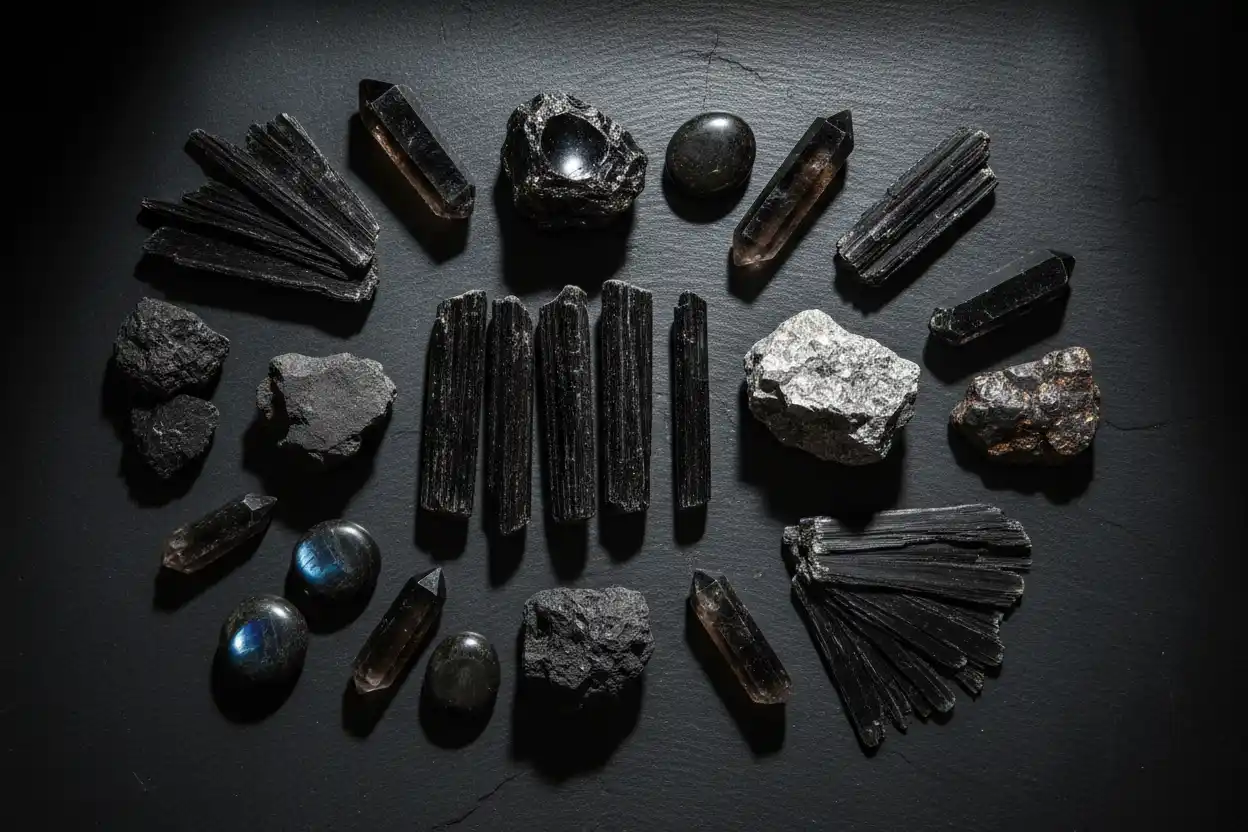
Black Crystals: Benefits, Uses & Practical Guidance
Black crystals are commonly associated with grounding, boundaries, stability, protection and clear thinking, although those meanings come from cultural traditions, color symbolism and contemporary crystal practices rather than scientifically demonstrated energies. What makes the category especially interesting is its extraordinary material diversity, because stones sold together as black crystals can actually be crystalline minerals, volcanic glass, carbon-rich rock, chalcedony, quartz with inclusions or even organic gem materials whose physical properties have little in common beyond their dark appearance.
Black tourmaline is usually iron-rich schorl with a genuine crystalline structure, while black obsidian is rapidly cooled volcanic glass and is not a mineral crystal at all. Smoky quartz is crystalline silica whose darkest material can approach black, hematite is an iron oxide with a metallic surface and reddish streak, shungite is a variable carbon-rich geological material, and jet is transformed ancient wood rather than an inorganic mineral.
That distinction matters whenever black crystals are worn, cleaned, carried, placed around the home or used symbolically, because the safest treatment for quartz may be unsuitable for jet, a chipped obsidian edge can become extremely sharp, and a porous or mixed rock can behave very differently from a compact tourmaline crystal. The most useful approach is therefore to understand what each object physically is first, then decide whether its traditional symbolism adds personal meaning.
Black Crystals at a Glance
| Black Crystal | What It Actually Is | Approx. Mohs Hardness | Common Modern Symbolism | Main Practical Concern |
|---|---|---|---|---|
| Black tourmaline | Usually schorl, an iron-rich tourmaline mineral | 7–7.5 | Boundaries, grounding, protection | Brittle crystals and chipped terminations |
| Black obsidian | Natural volcanic glass | About 5–5.5 | Truth, reflection, boundaries | Broken edges can become extremely sharp |
| Smoky quartz / morion | Dark crystalline quartz | 7 | Perspective, grounding, letting go | Fractures and heat-sensitive color centers |
| Hematite | Iron oxide, Fe₂O₃ | About 5–6.5 | Stability, focus, grounding | Brittle; strongly magnetic imitations are common |
| Black onyx | Chalcedony, commonly commercially darkened | About 6.5–7 | Discipline, steadiness, boundaries | Black color is frequently treatment-produced |
| Black agate | Banded chalcedony; dark material may be dyed | About 6.5–7 | Balance, patience, stability | Treatment disclosure |
| Shungite | Carbon-rich rock/mineraloid material | Variable, often around 3.5–4 | Endurance, grounding, boundaries | Dust, brittleness and exaggerated health claims |
| Jet | Organic carbon-rich material formed from altered wood | About 2.5–4 | Remembrance, continuity, transition | Soft, brittle and sensitive to heat/chemicals |
| Magnetite | Iron oxide, Fe₃O₄ | About 5.5–6.5 | Orientation, steadiness, grounding | Strong magnetism; brittle material |
| Tourmalinated quartz | Quartz containing black tourmaline inclusions | 7 host | Integration, clarity, boundaries | Internal fractures and exposed inclusions |
| Black kyanite | Dark kyanite crystals or aggregates | Direction-dependent | Alignment, boundaries, direction | Excellent cleavage and splintery edges |
| Black spinel | Spinel mineral | 8 | Resilience, composure, strength | More jewelry-oriented than most crystal-practice stones |
The phrase black crystals is therefore a convenient collecting and symbolic category rather than a mineralogical classification.
What Counts as a Black Crystal?
In strict mineralogy, a crystal has an ordered atomic structure, which means materials such as tourmaline, quartz, hematite, magnetite and spinel qualify as crystalline minerals while obsidian and jet do not.
Crystal shops use the word more broadly.
Under that retail convention, black crystals may include polished stones, mineral specimens, rocks, volcanic glasses, organic materials and carved objects chosen for a dark appearance or similar symbolism. That broader usage is not necessarily a problem as long as the underlying material is identified correctly.
Obsidian provides the clearest example because it is routinely called a crystal despite being amorphous volcanic glass. Shungite likewise lacks the single fixed crystal structure and chemical formula expected from a mineral species, while jet originates from ancient wood.
Understanding those differences gives black crystals more depth rather than reducing their appeal.
A dark object can be appreciated symbolically while still being described scientifically.
Why Are So Many Crystals Black?
There is no single chemical cause responsible for the color of all black crystals.
A stone appears black when relatively little visible light returns to the observer, but that result can emerge through several different physical mechanisms.
Iron-Rich Chemistry
Iron contributes strongly to dark coloration in many minerals.
Black tourmaline is commonly schorl, an iron-rich tourmaline species whose crystals can appear nearly opaque black.
Magnetite is itself an iron oxide and normally appears black.
Hematite can appear metallic steel gray to black even though its powder is characteristically red to reddish brown.
Light Absorption in Volcanic Glass
Black obsidian develops its dark appearance from the chemistry and microscopic structures within natural volcanic glass.
Thick pieces can appear opaque, while a sufficiently thin edge may transmit smoky brown, gray or greenish light.
Radiation-Related Color Centers
Smoky quartz becomes gray, brown or nearly black when natural or artificial irradiation interacts with aluminum-related defects in the quartz lattice.
Very dark smoky quartz is traditionally called morion.
The Gems Lore guide to types of smoky quartz explains why almost-black quartz can remain crystalline and translucent even when a thick specimen appears opaque.
Carbon-Rich Material
Jet and shungite receive their dark appearance from carbon-rich composition, although they formed through very different geological processes.
Color alone therefore tells you almost nothing about whether two black crystals are chemically or structurally related.
1. Black Tourmaline: The Classic Boundary Stone
Black tourmaline is probably the most widely recognized of all black crystals used in contemporary spiritual practice, where it is associated with grounding, boundaries, stability and symbolic protection.
Mineralogically, black tourmaline is commonly schorl, an iron-rich member of the tourmaline group.
Schorl typically forms elongated prismatic crystals with strong longitudinal striations, often producing triangular or rounded triangular cross-sections. Its Mohs hardness of roughly 7–7.5 gives the surface reasonable scratch resistance, although crystals remain brittle and terminations can chip.
The broader tourmaline color guide explains why black tourmaline belongs to a chemically diverse mineral group capable of producing almost every major gemstone color.
Black Tourmaline Meaning
Modern symbolism generally connects black tourmaline with:
- Personal boundaries
- Grounding
- Stability
- Practical protection
- Separating your responsibilities from someone else’s
- Maintaining direction under pressure
Those ideas can be turned into concrete behavior.
A black tourmaline stone beside a workspace might represent turning off unnecessary notifications, defining working hours or declining commitments that do not fit available time.
The stone does not enforce the boundary.
The person’s actions do.
Does Black Tourmaline Block EMF?
Tourmaline has genuine electrical properties, including pyroelectric behavior, meaning temperature changes can create electrical polarization across a crystal.
That real scientific property does not demonstrate that a black tourmaline specimen protects a person from electromagnetic radiation emitted by phones, routers, computers or power equipment.
If electromagnetic exposure requires control, engineering standards, distance, shielding designed for the specific frequency and authoritative safety guidance are appropriate tools.
Black crystals should not replace those measures.
2. Black Obsidian: A Glass Associated With Reflection and Truth
Black obsidian is one of the most familiar black crystals in shops, but mineralogically it is not a crystal.
It is natural volcanic glass created when suitable lava cools before extensive crystalline structure can develop.
The result is amorphous material with a vitreous surface and conchoidal fracture.
The detailed black obsidian guide explores its volcanic formation, historical use, identification and material-specific care.
Why Obsidian Needs Special Handling
Conchoidal fracture can produce extremely thin and sharp edges.
That property made obsidian valuable for cutting tools throughout human history, but it also means a chipped bracelet, arrowhead carving or rough specimen can become a genuine laceration hazard.
A polished piece that develops a sharp chip should be removed from use rather than carried loosely in a pocket.
Black Obsidian Meaning
Traditional and contemporary symbolism often associates black obsidian with:
truth, reflection, clear boundaries, confronting avoided information and releasing patterns that no longer serve a purpose.
A grounded use might involve keeping polished obsidian near a journal and asking:
What fact am I avoiding because the answer is inconvenient?
The benefit comes from examining the question.
The volcanic glass does not reveal hidden truths independently.
3. Smoky Quartz and Morion: Black Crystals for Perspective
Smoky quartz provides one of the clearest examples of a genuine crystal becoming almost black without becoming opaque in the same way as onyx or hematite.
Quartz is crystalline SiO₂ with Mohs hardness 7 and no easy cleavage.
Its smoky color develops when irradiation interacts with aluminum-related defects in the crystal structure, creating color centers that absorb visible wavelengths. Natural geological radiation can produce the effect, while commercial quartz can also be irradiated artificially.
Very dark material is commonly called morion.
Smoky Quartz Meaning
Among black crystals, smoky quartz is commonly associated with:
- Perspective
- Grounding
- Simplification
- Releasing unnecessary mental clutter
- Separating known facts from assumptions
A practical exercise is to divide a difficult situation into three columns:
What I know
What I assume
What I can actually influence
Smoky quartz can serve as a physical marker for that routine without being credited with changing cognition itself.
Care
Quartz is relatively durable, although sharp crystal points can chip and heavily fractured specimens deserve more care.
Strong heat can alter smoky color centers, so heating a specimen to test authenticity or deliberately modify its shade is poor practice.
4. Hematite: A Dense Black Crystal for Grounded Focus
Hematite is iron oxide, Fe₂O₃, and can appear steel gray, silver-gray or almost black when crystallized or polished.
Its most useful identification characteristic is surprising: despite a metallic gray or black exterior, hematite normally produces a red to reddish-brown streak.
The complete hematite guide explains why that red powder contributed to historical blood symbolism despite the mineral’s dark polished appearance.
Hematite is also noticeably dense, commonly around specific gravity 5.2, so a small polished piece can feel unusually heavy.
Hematite Meaning
Hematite is one of the black crystals most commonly associated with:
grounding, concentration, stability, courage and practical decision-making.
Its real physical weight makes it particularly effective as a tactile reminder.
Hold the stone and identify one immediate task rather than treating an overwhelming problem as one indivisible situation.
Hematite Does Not Treat Iron Deficiency
Hematite contains iron chemically bound within Fe₂O₃, but wearing or holding the mineral does not supply nutritional iron through the skin.
It should not be used to treat anemia, poor circulation or any other medical condition.
Its association with blood has a historical mineralogical explanation rather than a medical mechanism.
5. Black Onyx: Smooth Chalcedony Associated With Discipline
Black onyx is commonly included among black crystals even though commercial terminology deserves careful attention.
True onyx is a form of chalcedony characterized by relatively parallel banding.
Much of the uniform black onyx used in beads, cabochons and carvings is chalcedony whose color has been darkened through treatment, traditionally by processes that penetrate porous material and create a stable black appearance.
That does not make the product worthless or inherently deceptive.
The important issue is disclosure.
Black Onyx Meaning
Modern symbolism commonly links black onyx with:
discipline, steadiness, self-control, endurance and maintaining boundaries.
A useful interpretation is to connect the stone with consistency rather than dramatic transformation.
For example, black onyx can represent following the same reasonable routine after motivation fades.
The stone does not create willpower.
It can mark the commitment.
Onyx vs Obsidian vs Tourmaline
These three black crystals are frequently confused despite major physical differences.
Tourmaline is crystalline silicate.
Onyx is microcrystalline quartz-family material.
Obsidian is volcanic glass.
The Gems Lore black tourmaline vs obsidian comparison separates their symbolism and material identities in more detail.
6. Black Agate: Layered Stability
Black agate belongs to the chalcedony family and can show bands ranging from subtle gray-black layering to strongly contrasting dark and light zones.
Natural agate occurs in many colors, but commercial material is also frequently dyed because microcrystalline silica can accept color treatment effectively.
Consequently, an unusually uniform saturated black agate should not automatically be assumed untreated.
Black Agate Meaning
Symbolically, black agate is often associated with:
patience, stability, gradual progress and remaining composed while a situation develops.
Its layered structure makes those ideas particularly intuitive because the stone records successive stages of silica deposition.
A grounded use is to treat each visible band as a reminder that complex outcomes can develop incrementally.
No individual band has a scientifically measured emotional effect.
7. Shungite: A Carbon-Rich Material With Important Limits
Shungite is one of the most misunderstood black crystals because commercial descriptions often treat it as though it were one uniform crystalline mineral.
It is not.
Shungite is a carbon-rich geological material associated principally with ancient rocks in Karelia, while commercial pieces can contain varying quantities of carbon alongside silicates, sulfides, carbonates and other components.
Its appearance ranges from dull gray-black rock to more lustrous carbon-rich material.
The shungite guide explains why carbon content and mineral composition vary substantially among specimens carrying the same trade name.
Shungite Meaning
Modern symbolism tends to emphasize:
endurance, grounding, boundaries, resilience and purification.
Its ancient carbon-rich geological history makes endurance an understandable metaphor.
However, shungite should not be described as scientifically proven to detoxify the body, cure disease or protect a person from all electromagnetic radiation.
Do Not Put Shungite in Drinking Water
Claims that shungite makes drinking water safer are particularly problematic because natural material can contain multiple mineral phases and trace elements.
A decorative mineral specimen is not a certified water-treatment device.
Using black crystals directly in drinking water creates unnecessary uncertainty about contaminants while providing no established metaphysical benefit.
8. Jet: A Black Organic Material With a Long Human History
Jet is another material routinely included among black crystals even though it is neither an inorganic mineral nor a crystal.
It forms from ancient wood that underwent burial, compression and chemical alteration, eventually producing lightweight carbon-rich material capable of taking a deep black polish.
The detailed jet guide explains why jet differs from black glass, plastic, onyx and ordinary coal-like materials used as imitations.
Jet Meaning
Jet has a particularly strong historical connection with:
remembrance, mourning, continuity, protection and dignity.
Its transformation from wood into a compact black gem material also encourages modern symbolism involving endurance through change.
These associations have cultural depth, but they do not establish measurable energetic properties.
Jet Care
Jet is relatively soft and brittle.
Keep it away from perfume, solvents, high heat and harder stones that can scratch its polished surface.
Large antique jet jewelry deserves particularly conservative handling because old strings, adhesives and metal fittings may be more fragile than the material itself.
9. Magnetite: Black Mineral With Real Magnetism
Magnetite is an iron oxide with the formula Fe₃O₄ and is strongly magnetic compared with most familiar black crystals.
It commonly appears black with metallic to submetallic luster and occurs in octahedral crystals, massive material and iron-rich rocks.
Its magnetism is a genuine measurable physical property.
That should not be confused with claims that magnetite aligns a person’s spiritual field, improves circulation or changes biological processes merely through ordinary wear.
Magnetite Meaning
Symbolically, magnetite is sometimes associated with:
orientation, direction, attraction and steadiness.
The most grounded interpretation uses its real magnetic behavior as a metaphor.
A magnet aligns according to physical forces; a person still needs evidence, goals and decisions to establish direction in life.
10. Tourmalinated Quartz: Light and Dark in One Crystal
Tourmalinated quartz consists of quartz containing needle-like or prismatic tourmaline inclusions, commonly black schorl.
The host is usually clear, milky or smoky quartz, while dark tourmaline crystals pass through the interior in irregular patterns.
The tourmalinated quartz guide explains how the two minerals grow together and why natural inclusions should not look like perfectly repeated inserted fibers.
Tourmalinated Quartz Meaning
This material is frequently associated symbolically with:
clarity plus boundaries, integration of contrasting experiences, perspective and maintaining structure inside complexity.
Its symbolism comes naturally from the visual contrast.
Transparent quartz allows light through while black tourmaline creates strong internal lines.
A practical use is to ask:
What part of this situation needs openness, and what part needs a boundary?
That question provides the benefit.
The stone supplies the visual metaphor.
11. Black Kyanite: A Crystal That Requires Care
Black kyanite commonly occurs as bladed, radiating or fan-like aggregates whose dark appearance can result from inclusions and compositional factors.
Kyanite is unusual because its hardness is direction-dependent, meaning measurements along one crystallographic direction differ substantially from those taken across another.
It also has excellent cleavage.
Those properties make a black kyanite fan much more delicate than its dramatic blade-like appearance suggests.
Black Kyanite Meaning
Modern traditions commonly connect black kyanite with:
alignment, boundaries, direction and clearing unnecessary complications.
A practical interpretation is to use its blade-like geometry as a reminder to define one direction before trying to solve every part of a problem simultaneously.
Rough fans should be handled carefully because thin blades can chip or splinter.
12. Black Spinel: Durable but Better Treated as a Gemstone
Black spinel is a genuine crystalline mineral and one of the most durable dark materials commonly encountered in jewelry, with Mohs hardness around 8 and generally good toughness.
It can certainly appear in a collection of black crystals.
However, its strongest practical value lies in jewelry and gemology rather than in crystal-practice use.
That distinction helps prevent this page from becoming interchangeable with the separate black gemstones guide, which focuses more directly on species, jewelry durability, treatments, value and buying.
Black Spinel Meaning
Modern symbolism often links black spinel with resilience, confidence and composure.
Those associations may provide personal meaning, but the stone’s objectively useful strengths are its durability, polish and naturally dark appearance.
Which Black Crystals Are Actually Natural Crystals?
Among the most common black crystals, the following are genuinely crystalline minerals:
Black tourmaline: crystalline tourmaline, usually schorl.
Smoky quartz: crystalline quartz.
Hematite: crystalline iron oxide.
Magnetite: crystalline iron oxide.
Black spinel: crystalline magnesium-aluminum oxide.
Black kyanite: crystalline aluminum silicate.
Tourmalinated quartz: a crystalline quartz host containing crystalline tourmaline.
By contrast:
Obsidian is volcanic glass.
Jet is an organic gem material derived from altered wood.
Shungite is a variable carbon-rich geological material rather than one mineral species.
Using the retail term black crystals for all of them is common, but identifying the material correctly prevents problems with cleaning, safety and authenticity.
What Are Black Crystals Used For?
Black crystals are used in several completely different ways, and separating them helps keep practical benefits distinct from symbolic claims.
Mineral Collecting
Natural tourmaline crystals, smoky quartz, magnetite and hematite can be collected for crystal form, locality, geological association and scientific interest.
In this context, polishing may actually reduce collector value because natural surfaces and matrix relationships are part of the specimen.
Jewelry
Onyx, spinel, obsidian, hematite, smoky quartz, tourmalinated quartz and some tourmaline are fashioned into beads, cabochons, pendants and rings.
Jewelry suitability differs substantially.
Black spinel and quartz are much more abrasion-resistant than jet or obsidian.
Home Display
Large black crystals can provide visual contrast in interior spaces, particularly beside pale minerals, wood, plants or neutral surfaces.
The practical priorities are stability, weight and placement.
The Gems Lore guide to crystals at home covers room placement from a safety and symbolic perspective without claiming that mineral specimens alter a building’s measurable energy.
Meditation and Reflection
A black stone can function as a tactile or visual focus during meditation.
The benefit comes from the attention practice rather than a demonstrated emission from the mineral.
Symbolic Boundary Reminders
Black tourmaline, obsidian, hematite and onyx are especially common as reminders involving limits and personal responsibility.
A boundary can be represented symbolically by a stone, but it becomes effective through actual behavior such as saying no, controlling access, documenting an agreement or leaving an unsafe situation.
The Symbolic Benefits of Black Crystals
The word “benefits” requires careful definition.
There is no reliable evidence that black crystals remove toxins, cure disease, absorb supernatural negativity, guarantee physical protection or automatically improve mental-health conditions.
Their more defensible benefits arise when a physical object supports an intentional reflective practice.
Grounding
Grounding can mean returning attention to immediate sensory information and observable facts.
A dense hematite stone can act as a tactile cue.
Boundaries
Black tourmaline or onyx can represent a commitment to define what behavior, access or responsibility you will accept.
Reflection
Obsidian’s dark reflective surface can symbolize looking directly at uncomfortable information rather than avoiding it.
Perspective
Smoky quartz can represent separating facts from assumptions and focusing on what can realistically be influenced.
Remembrance
Jet’s cultural history makes it a meaningful symbolic object for remembrance and continuity.
Structure
Black kyanite or tourmaline can represent maintaining a defined direction through complex circumstances.
These benefits depend on what a person actually does with the reminder.
Black Crystals for Grounding
If grounding is the main goal, choose a stone that feels physically distinctive enough to act as a reliable sensory cue.
Hematite is especially effective because of its unusual density.
Black tourmaline offers a rougher striated texture.
Smooth onyx provides a uniform polished surface.
A simple grounding routine might involve holding the stone and identifying:
five things you can see, four physical sensations, three sounds, two concrete facts about the current situation and one useful action you can take next.
The black crystal is not required for the exercise.
It simply provides a consistent object around which the routine can be built.
Black Crystals for Protection
Protection is perhaps the most heavily marketed black crystal theme, but the word should be interpreted carefully.
No black crystal has been scientifically demonstrated to create an invisible shield that prevents accidents, crime, illness, electromagnetic exposure or harmful behavior from other people.
A more useful symbolic approach connects individual black crystals with practical forms of protection.
Black tourmaline can represent boundaries.
Obsidian can represent noticing warning signs.
Hematite can represent pausing before making an impulsive decision.
Onyx can represent consistency with previously established limits.
Shungite can represent checking extraordinary claims rather than trusting them automatically.
Those habits can improve decision-making without assigning supernatural control to the minerals.
Black Crystals for the Home
Black crystals can be placed around the home as decorative objects and symbolic reminders, provided placement respects the physical specimen.
A stable black tourmaline cluster can sit near an entrance as a reminder to transition between outside demands and home responsibilities.
Hematite can sit on a work desk as a focus cue.
Smoky quartz can be placed in a reading or planning area.
Obsidian mirrors and polished slabs should be positioned where they cannot fall and create sharp fragments.
Shungite should remain away from food and drinking water.
Large specimens should never be balanced on narrow shelves above beds, seating or children’s play areas.
Symbolism should never override ordinary household safety.
Black Crystals for Workspaces
Dark mineral specimens can be particularly useful as deliberate visual markers in a workspace because they are visually distinct from paper, screens and ordinary desk equipment.
Choose one purpose rather than assigning ten supposed powers to the same object.
For example:
Black tourmaline: “Work ends at this boundary.”
Hematite: “Finish the current task before opening another.”
Smoky quartz: “Separate facts from assumptions.”
Onyx: “Follow the routine even when motivation is low.”
Obsidian: “Address the uncomfortable problem directly.”
The behavior gives the object practical meaning.
Can You Wear Black Crystals Together?
Yes, provided their physical properties and jewelry construction are compatible.
There is no scientific reason that the symbolism of one black crystal should cancel another.
The practical concerns are much more ordinary.
A hard spinel or quartz bead can abrade softer jet.
Heavy hematite beads can place greater strain on stringing.
Rough tourmaline can scratch nearby polished material.
Obsidian can chip.
A mixed bracelet should therefore be designed according to hardness, weight, shape and drill-hole condition rather than a supposed energetic compatibility chart.
How to Choose Between Black Tourmaline, Obsidian and Onyx
These are three of the most frequently compared black crystals.
Choose black tourmaline when you want a natural prismatic mineral crystal and symbolism centered on boundaries and steadiness.
Choose obsidian when you prefer smooth volcanic glass and symbolism involving reflection, truth and confronting avoided information.
Choose onyx when you want a durable polished chalcedony material associated with consistency, discipline and stability.
From a physical standpoint, they are unrelated materials.
From a symbolic standpoint, overlap exists because black color itself strongly influences modern interpretations.
How to Tell Whether Black Crystals Are Real
There is no universal home test because the category contains too many materials.
Instead, identify the claimed material first.
Black Tourmaline
Look for plausible longitudinal striations and tourmaline crystal form when rough, while remembering that polished pieces lose many natural surface clues.
Obsidian
Look for glassy luster, conchoidal fracture features, subtle transmitted brown or gray at thin edges and natural flow structures where visible.
Avoid intentionally breaking a piece to test it.
Hematite
Natural hematite is dense and characteristically produces a red-brown streak, but destructive testing should not be performed on finished jewelry.
Strongly magnetic polished “hematite” is often a manufactured ferrite material.
Smoky Quartz
Natural quartz should show plausible crystalline structure and quartz properties, while color can be natural or treatment-produced.
Shungite
Do not rely on conductivity alone because composition varies and several carbon-rich or manufactured materials can conduct electricity.
Jet
Jet is unusually light compared with many black stones, but glass, plastic and other imitations require more than one clue for reliable identification.
For valuable specimens, proper gemological or mineralogical testing is more reliable than scratch, flame, acid or impact tests.
Do Black Crystals Need Cleansing?
Physical cleaning and symbolic cleansing are different activities.
Physical cleaning removes dirt, skin oils, dust and residues.
Symbolic cleansing is a ritual intended to mark a reset, transition or new intention.
There is no scientific evidence that a crystal accumulates negative energy that must be physically removed through moonlight, smoke, sound, salt or water.
Someone who values a cleansing ritual can still perform one safely.
The method should respect the actual material.
Sound, visualization or placing the stone on a clean dry surface avoids many of the physical risks created by salt, water and sunlight.
Which Black Crystals Can Go in Water?
A single black-crystals water rule is unsafe because these materials differ substantially.
Sound untreated quartz and many polished tourmalines can tolerate brief gentle washing.
Obsidian can generally tolerate brief contact but should not be subjected to thermal shock, and chipped pieces remain physically hazardous.
Shungite should not be soaked for drinking-water practices.
Jet should receive conservative moisture exposure because it is soft organic material and may occur in old jewelry containing glue or string.
Matrix specimens may contain additional minerals with entirely different water sensitivity.
When the material is uncertain, dry cleaning is the safer default.
Black Crystals and Salt
Direct salt contact is unnecessary for black crystals and can create several problems.
Salt grains can abrade softer polished surfaces.
Saltwater can reach fractures, drill holes and metal settings.
Some matrix specimens contain minerals that respond poorly to salts or prolonged moisture.
Old jewelry may include adhesives.
If salt has spiritual significance in a personal ritual, keep the crystal physically separated from it rather than burying an unknown specimen in salt.
Black Crystals and Sunlight
Black color does not mean universal light stability.
Smoky quartz color centers can respond to strong heat and, in some material, prolonged intense exposure.
Organic jet should not be stored in excessive heat.
Resins, dyes, adhesives and coatings used on commercial stones may also behave differently from the underlying material.
Routine indoor display is generally less concerning than leaving specimens continuously in hot direct sunlight.
Material-specific guidance is more reliable than a one-rule-for-all-black-stones approach.
Physical Safety With Black Crystals
Black crystals are often marketed almost entirely through symbolism, yet physical safety deserves equal attention.
Obsidian
Broken edges can become extremely sharp.
Shungite
Avoid inhaling dust produced by grinding or drilling mixed carbon-rich material, and do not use unidentified shungite in drinking water.
Hematite and Magnetite
Dense specimens can cause injury if dropped, particularly larger polished pieces.
Black Kyanite
Thin blades can splinter or chip.
Tourmaline
Rough crystal terminations can be sharp, while fractured pieces can break under impact.
Jet
Soft antique material may crack or break when dropped.
Unknown Black Minerals
Do not grind, heat, lick, burn or dissolve unidentified specimens merely to test them.
Mineral safety depends on composition and exposure route, not color symbolism.
Black Crystals and Medical Claims
Black crystals should not be used to diagnose, treat or prevent medical conditions.
Hematite does not treat iron deficiency because it contains iron.
Shungite does not become a medical detoxification device because it contains carbon.
Black tourmaline does not treat anxiety because it symbolizes grounding.
Obsidian does not remove trauma because it is associated with reflection.
A person can still use a stone during meditation, journaling or a calming routine if that practice feels meaningful, while healthcare decisions remain based on appropriate evidence and professional guidance.
Black Crystals and Chakras
Contemporary crystal practice commonly associates black crystals with the root chakra because black, dark brown and deep red colors are frequently linked symbolically with stability, safety, physical presence and grounding.
Black tourmaline, obsidian, hematite, onyx and smoky quartz are especially common in this context.
The chakra system belongs to spiritual and philosophical traditions rather than scientifically established anatomy.
A black crystal can therefore be used as a symbolic meditation object without claiming that it physically opens, cleanses or repairs a chakra.
At Gems Lore, black crystals are most useful when their symbolism supports intentional reflection while their mineral identity, durability and safety remain grounded in measurable physical evidence.
How to Choose the Right Black Crystal
Choose by material first.
If you want a genuine mineral crystal with strong natural striations, black tourmaline is a natural starting point.
If you want glassy black volcanic material, choose obsidian.
If you want a transparent-to-translucent true crystal, choose dark smoky quartz.
If you prefer a heavy metallic stone, hematite offers a completely different tactile experience.
If you want historical organic material, jet has a cultural story unmatched by most black crystals.
If you are interested in unusual carbon-rich geology, choose accurately identified shungite without believing exaggerated detoxification claims.
Then choose by symbolic theme if symbolism matters to you.
The symbolism should refine a material choice rather than replace identification.
Frequently Asked Questions
What are black crystals?
Black crystals is a broad retail and spiritual category that includes dark crystalline minerals as well as volcanic glass, rocks, mineraloids and organic materials. Black tourmaline and smoky quartz are true crystals, while obsidian, shungite and jet belong to different material categories.
What are the most popular black crystals?
Popular black crystals include black tourmaline, black obsidian, smoky quartz or morion, hematite, black onyx, black agate, shungite, jet, magnetite, tourmalinated quartz and black kyanite.
What do black crystals symbolize?
Modern traditions commonly associate black crystals with grounding, boundaries, stability, reflection, protection and resilience. These meanings are symbolic rather than scientifically demonstrated energetic properties.
Which black crystal is best for grounding?
Hematite, black tourmaline, smoky quartz and onyx are all commonly associated with grounding. Hematite’s real physical density can make it particularly useful as a tactile focus object.
Which black crystal is associated with protection?
Black tourmaline, obsidian, onyx and hematite are frequently described as protection stones. A grounded interpretation connects them with practical boundaries, awareness and deliberate decision-making rather than supernatural shielding.
Does black tourmaline block negative energy?
There is no scientific method establishing that black tourmaline blocks an invisible negative-energy field. Protection symbolism can instead serve as a reminder to create real boundaries and reduce unwanted access or exposure.
Does black tourmaline block electromagnetic radiation?
Tourmaline has genuine pyroelectric properties, but that does not demonstrate that an ordinary crystal specimen shields a person from electromagnetic radiation produced by electronic equipment.
Is black obsidian a crystal?
Not mineralogically. Black obsidian is amorphous natural volcanic glass, although crystal shops commonly include it within the broader black crystals category.
Is shungite a crystal?
Not in the strict mineralogical sense. Shungite is a variable carbon-rich geological material rather than one crystalline mineral species with a fixed formula.
Is jet a crystal?
No. Jet is an organic carbon-rich gem material produced from altered ancient wood.
Is hematite a black crystal?
Hematite is a crystalline iron oxide mineral that can look metallic steel gray to almost black. Its powdered streak is characteristically red to reddish brown.
Is smoky quartz actually black?
Very dark smoky quartz can appear nearly black, especially in thick crystals. The darkest traditional material is often called morion.
Which black crystals are best for jewelry?
Black spinel, smoky quartz, onyx and many tourmalines provide useful jewelry durability. Obsidian, hematite, jet and shungite require more careful design and wear because their physical properties differ.
Which black crystals are safest for beginners?
There is no spiritual-risk hierarchy, but polished onyx, smoky quartz and sound tourmaline are physically straightforward materials when correctly identified. Obsidian deserves extra care because broken edges can become extremely sharp.
Can black crystals go in water?
Some can tolerate brief washing, while others should not be soaked. The correct answer depends on the exact material, treatments, matrix and jewelry construction rather than the color black.
Can black crystals go in salt?
Direct salt contact is usually unnecessary and may scratch softer surfaces or create problems in fractures, drill holes and settings. A non-contact symbolic ritual is safer for an unidentified stone.
Can I sleep with black crystals?
A small stable polished stone can be kept safely on a bedside surface if desired, but avoid placing heavy, pointed, brittle or sharp specimens where they can fall or become hidden in bedding. Black crystals are not proven treatments for insomnia.
Can I put black crystals around my home?
Yes, as decorative or symbolic objects, provided large specimens are placed securely and kept away from edges, children, pets, food preparation and locations where broken material could create injury.
Can black crystals be worn together?
Yes. There is no scientific energetic incompatibility between black crystals. The practical issue is whether different hardness values, weights and shapes can damage one another within the jewelry.
Are all black crystals naturally black?
No. Some materials have naturally dark bodycolor, while commercial black onyx and agate may be color-treated. Smoky quartz can also receive artificial irradiation that deepens its color.
How can I tell whether black crystals are real?
First identify which material the seller claims to offer, then evaluate properties appropriate to that material. There is no universal authenticity test for every black stone, and destructive scratch, flame or acid tests should be avoided.
Are black crystals magnetic?
Most are not strongly magnetic. Magnetite is strongly magnetic, while ordinary hematite is not generally a powerful permanent magnet. Strongly magnetic products sold as hematite may be manufactured ferrite material.
Do black crystals have healing properties?
There is no reliable scientific evidence that black crystals cure illness, detoxify the body, alter blood chemistry, treat anxiety or prevent disease. They can still serve as personally meaningful objects in meditation, reflection and habit-building practices.
What chakra are black crystals associated with?
Modern crystal traditions most often associate black crystals with the root chakra and themes of stability, security and grounding. Chakra associations are spiritual interpretations rather than established anatomical effects.
Which black crystal should I choose?
Choose according to the actual material and practical use first, then symbolism. Black tourmaline suits natural crystal collecting and boundary symbolism, obsidian offers volcanic-glass history and reflection symbolism, smoky quartz provides a durable true crystal associated with perspective, and hematite provides a distinctive dense metallic grounding object.