11 Powerful Black Obsidian Healing Claims: Calming Traditions, Proven Facts & Safe Use
Black obsidian healing properties are traditionally associated with grounding, protection symbolism, self-reflection, emotional release, boundaries, resilience, courage, clarity, letting go, confidence, and confronting uncomfortable truths. These meanings come from crystal traditions rather than established medical evidence. Black obsidian does not absorb toxins from the body, block harmful radiation, treat anxiety or depression, cure trauma, relieve pain, prevent accidents, or protect someone from another person’s harmful behavior through ordinary contact. Its safest role is symbolic, particularly when the stone’s dark glassy appearance is used as a reminder to examine facts directly and respond to problems with practical action.
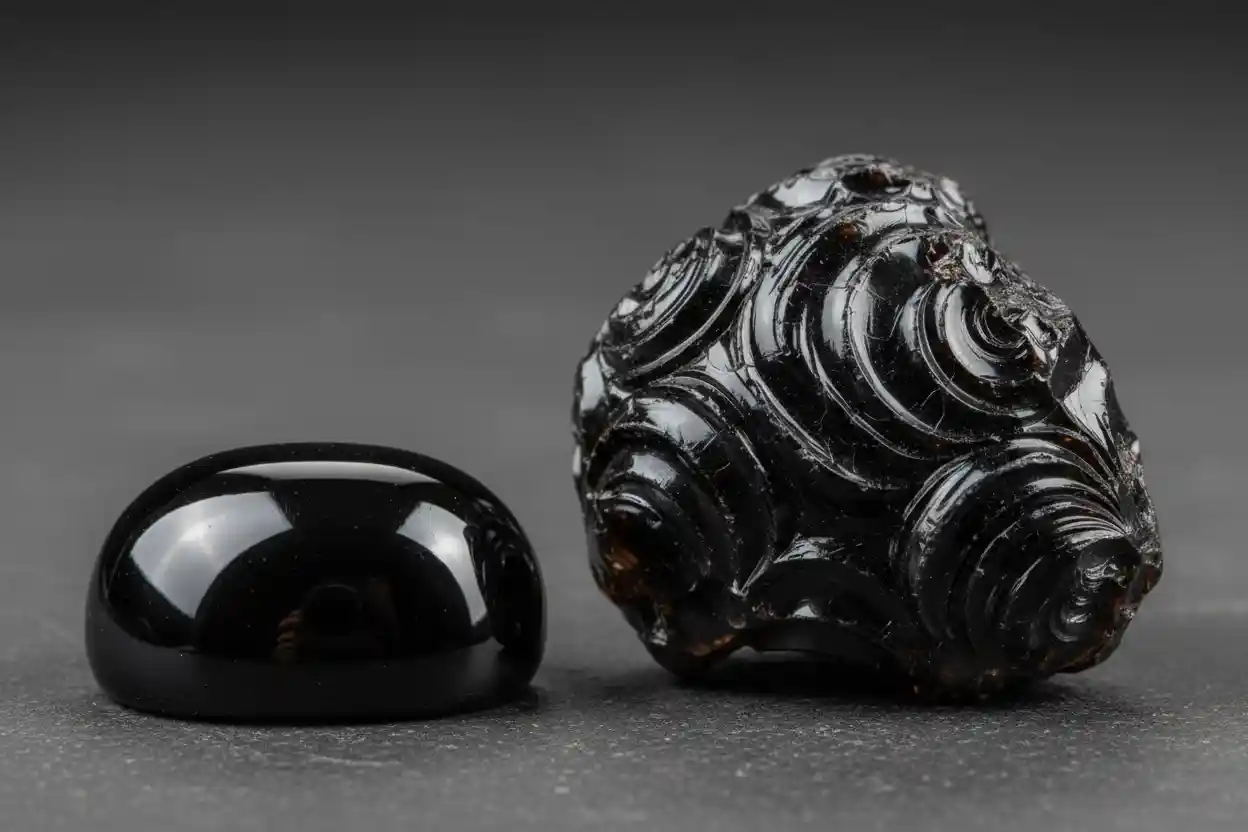
Black obsidian is natural volcanic glass rather than a true mineral crystal. It forms when silica-rich lava cools so rapidly that extensive crystal growth cannot occur, creating an amorphous glass. This structure gives obsidian its glossy surface and characteristic conchoidal fracture, which can produce extraordinarily sharp edges. Obsidian generally falls around 5 to 5.5 on the Mohs hardness scale, but its brittleness matters more than the number suggests because a broken piece can form razor-like edges. These geological facts explain why obsidian has been used historically for cutting tools and why chipped specimens require careful handling.
Black Obsidian Grounding Claims Support Present-Focused Decisions Rather Than Energy Transfer
Grounding is one of the most common traditions associated with black obsidian. Its deep color, substantial feel, and volcanic origin naturally encourage symbolism around earth, stability, and returning attention to immediate reality. There is no established evidence that obsidian electrically grounds the human body or alters nervous-system function, but a polished stone can become a reliable cue to stop mentally rehearsing every possible outcome and focus on what can actually be done now.
A person dealing with a stressful situation may use black obsidian beside a notebook while listing the facts that are certain, the assumptions that remain unverified, and the next decision that needs attention. Traditional black obsidian benefits become more useful when grounding means reducing unnecessary mental drift and creating structure rather than expecting the stone to remove anxiety.
Grounding can also involve ordinary routines. Sleep, meals, movement, work boundaries, practical planning, and contact with supportive people can restore a sense of stability during demanding periods. Black obsidian can symbolize returning to those basics, but the routines themselves create the practical effect.
Black Obsidian Protection Claims Cannot Block Violence, Radiation, Theft, or Accidents
Black obsidian is widely marketed as a powerful protection stone that absorbs negative energy or forms a spiritual shield. These traditions can have personal meaning, but the stone cannot physically prevent assault, accidents, theft, infection, electrical hazards, or environmental exposure. It also does not block electromagnetic fields or harmful radiation simply by being placed near a person or electronic device.
Protection symbolism becomes safer when connected with observable precautions. A black obsidian stone near an entrance can represent checking locks and maintaining boundaries. One in a workspace can symbolize protecting confidential information or recognizing when workload demands have become unreasonable. The protective value comes from the action, not from an invisible barrier generated by volcanic glass.
This distinction is especially important in abusive or threatening situations. No crystal should be used to encourage someone to remain exposed because they believe they are spiritually protected. Real safety plans, trusted support, secure environments, and professional assistance take priority.
Black Obsidian Self-Reflection Claims Should Encourage Evidence, Context, and Self-Compassion
Black obsidian has a particularly strong reputation as a stone of truth, shadow work, and confronting hidden parts of the self. Its dark reflective surface makes this symbolism memorable, but obsidian does not objectively reveal subconscious information or expose another person’s secrets. A stone can instead create a ritual context for asking questions that someone has been avoiding.
Someone might examine why the same conflict keeps recurring, whether an expectation is realistic, or which behavior they are responsible for changing. The traditional black obsidian meaning often emphasizes truth and self-awareness, yet useful reflection should include context and uncertainty. It is possible to take responsibility without accepting blame for events that were outside personal control.
This matters because intense “shadow work” language can sometimes encourage excessive self-criticism. A reflective practice should improve understanding and decision-making, not create a belief that every difficult experience exists because a person has failed spiritually.
Black Obsidian Emotional-Release Claims Do Not Remove Trauma or Stored Negative Energy
Modern crystal descriptions often claim that black obsidian pulls out emotional blocks, buried trauma, or negative energy. There is no established mechanism by which volcanic glass extracts emotions from the body. Emotional release is better understood as noticing, naming, and expressing feelings that may have been avoided.
A person may hold polished obsidian while journaling about a painful experience or use it during a counseling session as a familiar tactile object. The crystals for emotional healing tradition becomes more responsible when healing means processing an experience rather than believing the stone is removing an invisible substance.
Trauma deserves particular caution. Severe or persistent trauma symptoms can require professional treatment, and intentionally provoking overwhelming memories without adequate support can be destabilizing. Black obsidian can remain a personal symbol, but it should not be treated as trauma therapy.
Black Obsidian Boundary and Courage Traditions Work Through Decisions and Consequences
Black obsidian is frequently associated with strong boundaries, independence, and courage. These themes become useful when a stone represents a specific behavior rather than a vague feeling of strength. Someone may need to decline an unreasonable request, reduce contact with a person who repeatedly crosses limits, or state clearly what consequence will follow if a boundary continues to be ignored.
The crystals for courage tradition fits black obsidian when courage means acting despite discomfort rather than becoming fearless. Setting a boundary may still feel difficult, especially when the other person reacts negatively. The stone cannot force respect, but it can remind the wearer of the decision already made.
Boundaries also differ from control. A healthy boundary describes what you will do in response to a situation. It does not attempt to dictate another person’s thoughts or feelings. Black obsidian symbolism is most constructive when it reinforces that distinction.
Black Obsidian Letting-Go Claims Should Focus on Changing Repeated Behaviors
Black obsidian is commonly recommended after breakups, disappointments, or difficult personal changes because it is associated with release and cutting ties. No stone can erase attachment, grief, or memory on command, but symbolic use can become practical when letting go is tied to a specific behavior that keeps the attachment active.
Someone might decide to stop rereading old messages, reduce checking another person’s social media, remove reminders that repeatedly restart distress, or stop returning to a conversation that has already reached its limit. The crystals for letting go tradition becomes meaningful when the stone marks one of those decisions.
Emotional adjustment may continue long after the behavior changes. That does not mean the process has failed. Letting go can mean reorganizing life around the present while still acknowledging that the past mattered.
Black Obsidian Clarity and Confidence Claims Reflect Direct Thinking Rather Than Enhanced Cognition
Black obsidian is often described as cutting through confusion or exposing the truth. There is no established evidence that it improves intelligence, memory, or cognition. Its dark, simple appearance can nevertheless work well as a cue to reduce a complicated problem to its essential facts.
If a situation feels confusing, someone can use black obsidian beside a notebook and separate what happened from what they fear might happen. This can reveal where additional information is needed and where a decision is already clear. Confidence grows more reliably from this process than from assuming a stone has provided certainty.
Direct thinking can also reveal uncomfortable choices. Sometimes clarity means recognizing that an option is not working even when it remains emotionally appealing. Black obsidian symbolism is strongest when it supports that kind of evidence-based honesty.
Black Obsidian Is Volcanic Glass With Conchoidal Fracture, Not a True Crystal
Obsidian forms when silica-rich lava cools rapidly enough to produce glass rather than a fully crystalline rock. Its amorphous structure distinguishes it from minerals such as quartz, feldspar, or kyanite, which have ordered crystal lattices. Calling obsidian a crystal is common in wellness language, but geologically it is more accurate to describe it as natural volcanic glass.
The obsidian healing properties tradition covers several colors and patterns, while black obsidian is the familiar dark form. Thin edges may sometimes transmit brownish or smoky light even when the stone appears opaque black in normal viewing conditions.
Conchoidal fracture is one of obsidian’s defining physical behaviors. When it breaks, curved shell-like surfaces and extremely sharp edges can form. This property made obsidian useful for cutting tools in many cultures and remains one of the most important handling considerations today.
Black Obsidian, Snowflake Obsidian, and Rainbow Obsidian Share Volcanic Origins but Look Different
Not all obsidian appears uniformly black. Snowflake obsidian contains pale spherulitic structures that create its characteristic spotted appearance, while rainbow obsidian can show subtle colored bands when light strikes internal structures at favorable angles. Mahogany obsidian contains reddish-brown and black areas produced by iron-rich features within the glass.
Traditional snowflake obsidian healing properties often emphasize balance and acceptance, while rainbow obsidian healing properties are commonly linked with emotional reflection and hope. These distinctions arise from symbolism connected with appearance rather than proven differences in healing action.
The varieties still share the essential reality of volcanic glass. Color and pattern can change collector appeal and personal association, but none turns obsidian into a medical treatment.
Black Obsidian Jewelry and Handling Require Caution Because Broken Edges Can Be Extremely Sharp
Polished obsidian is widely used for cabochons, beads, carvings, pendants, and decorative objects. Intact polished pieces can feel smooth and comfortable, but chips and fractures should be taken seriously because broken edges may be much sharper than those of many common gemstones.
A hardness around 5 to 5.5 also means quartz and numerous harder stones can scratch obsidian. Separate storage is sensible, particularly for polished surfaces where fine scratches quickly reduce the mirror-like luster. Rings and bracelets face more impact than pendants, so protective settings and careful wear are helpful.
Routine cleaning requires little more than lukewarm water, mild soap, and a soft cloth. Aggressive impact-based rituals, rough abrasives, extreme heat, or attempts to intentionally fracture the stone should be avoided. A chipped piece should be handled carefully rather than rubbed directly against the skin.
Black Obsidian Healing Claims Cannot Detoxify the Body or Treat Mental and Physical Conditions
Some black obsidian descriptions claim that the stone draws toxins, improves circulation, relieves pain, supports digestion, heals trauma, reduces anxiety, or treats depression. These claims are not established therapeutic effects of volcanic glass. Obsidian does not pull chemicals from tissues or deliver a medicine into the body through ordinary contact.
The term detoxification is especially misleading when applied to crystals. The body already relies on organs such as the liver and kidneys to process and remove many substances, while actual poisoning or toxic exposure requires appropriate medical assessment. A black stone placed on the body does not replace those biological systems.
Mental health concerns deserve the same distinction. Black obsidian may have personal meaning during reflection or counseling, but serious depression, panic, trauma symptoms, or thoughts of self-harm require appropriate human and professional support rather than increasingly intense crystal rituals.
Conclusion: Black Obsidian Healing Claims Stay Symbolic While Volcanic Glass Explains Its Real Power and Risk
Black obsidian healing properties are best understood as traditional themes of grounding, protection symbolism, self-reflection, emotional release, boundaries, resilience, courage, clarity, letting go, and confidence. Its real geological interest comes from rapid volcanic cooling, amorphous glass structure, glossy appearance, and exceptionally sharp conchoidal fracture when broken. Black obsidian can support reflective routines and personal symbolism, but it does not detoxify the body, treat mental health conditions, block radiation, or provide physical protection.
FAQs About Black Obsidian Healing Properties, Volcanic Glass, and Safe Handling
What are the main traditional black obsidian healing properties?
Black obsidian is commonly associated with grounding, protection symbolism, self-reflection, emotional release, boundaries, courage, clarity, resilience, and letting go.
Is black obsidian scientifically proven to heal?
No. There is no established evidence that black obsidian treats physical or mental health conditions through ordinary use.
Is black obsidian a crystal?
Geologically, black obsidian is natural volcanic glass rather than a true crystalline mineral.
How does black obsidian form?
It forms when silica-rich lava cools rapidly enough that extensive crystal growth cannot occur.
Can black obsidian protect someone from harm?
No. Protection claims are symbolic and cannot replace practical safety measures.
Can black obsidian remove toxins?
No. Obsidian does not pull toxins from the body or replace normal biological detoxification processes.
Can black obsidian help with emotional trauma?
It may serve as a personal reflection object, but it does not treat trauma and should not replace appropriate professional care.
How hard is black obsidian?
Obsidian is generally around 5 to 5.5 on the Mohs scale.
Can broken black obsidian be dangerous?
Yes. Broken obsidian can form extremely sharp edges capable of cutting skin.
Is black obsidian the same as snowflake obsidian?
They are both forms of obsidian, but snowflake obsidian contains pale spherulitic structures that create its distinctive pattern.
Can black obsidian go in drinking water?
There is no need to use black obsidian in drinking water for wellness purposes. External symbolic use is simpler and avoids unnecessary risk.
Black obsidian healing meanings are traditional or personal practices, not established treatments for physical or mental health conditions.