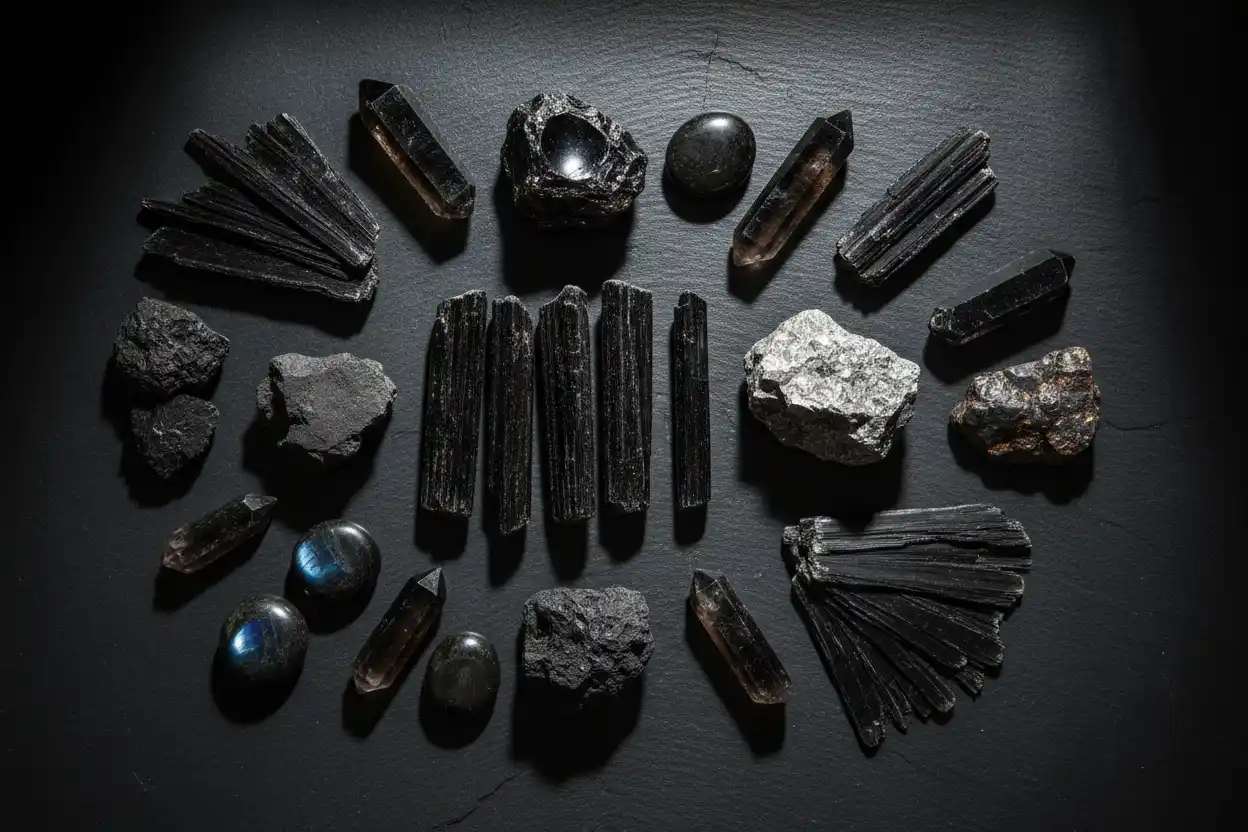
11 Powerful Black Crystals: Positive Meanings & Trusted Practical Uses
Black crystals are traditionally associated with grounding, steadiness, personal boundaries, reflection, and protection symbolism. Their dark colors also make them popular for jewelry, meditation spaces, desk displays, pocket stones, and collections where visual contrast matters. The group is far more varied than it first appears because black tourmaline, obsidian, smoky quartz, hematite, onyx, shungite, kyanite, moonstone, and opal come from very different geological families and have different durability, textures, and care needs.
The most useful way to choose among black crystals is to separate symbolic tradition from the physical characteristics of the stone. Someone who wants a rugged pocket crystal may choose differently from someone buying jewelry, a delicate specimen, or a reflective object for meditation. Grounding, protection, confidence, and emotional release are traditional associations rather than measurable properties of the stones themselves, but they can still provide a meaningful framework for personal rituals and intentional routines.
Black Tourmaline, Black Obsidian, and Smoky Quartz for Grounding and Boundary Symbolism
Black tourmaline is one of the stones most strongly associated with grounding and personal boundaries in contemporary crystal traditions. The black variety commonly encountered is schorl, a member of the tourmaline group that forms as elongated or vertically striated crystals. Its dark appearance, substantial feel, and rugged crystal form help explain why people often use it as a symbolic reminder to stay steady during stressful or distracting situations. The traditions surrounding black tourmaline healing properties commonly connect it with protection, stability, and emotional boundaries, making a small polished stone or durable specimen suitable for a desk, entryway, pocket, or meditation area.
Black obsidian carries a different visual and geological character. It is natural volcanic glass created when silica-rich lava cools rapidly enough that large mineral crystals do not develop. Fresh obsidian can display a glossy surface and conchoidal fracture, producing exceptionally sharp edges when broken. Traditional symbolism often connects black obsidian with truth, self-examination, release, and confronting difficult patterns. The black obsidian healing properties are therefore commonly framed around reflection rather than literal physical treatment. A polished palm stone can work well for journaling or meditation, while raw pieces should be handled carefully because broken edges can be sharp.
Smoky quartz offers a softer visual transition from transparent brown to nearly black. Its color develops through natural irradiation acting on trace elements and structural features within quartz, producing shades from pale smoke to deep brown-black. Symbolically, smoky quartz is commonly linked with steadiness, practical thinking, and releasing mental clutter. The traditions around smoky quartz healing properties make it a popular choice for workspaces because the stone can serve as a physical cue to slow down, organize priorities, or return attention to the task at hand. Its quartz hardness also makes polished smoky quartz suitable for frequent handling and many jewelry settings.
Onyx, Hematite, and Shungite for Discipline, Stability, and Practical Focus
Onyx has a long decorative history and is closely associated with discipline, confidence, endurance, and personal control in modern crystal practice. True onyx is a banded form of chalcedony, although much black onyx sold in jewelry has been treated to create a more even dark color. That treatment does not prevent the stone from being attractive, but buyers interested in natural appearance should ask how the color was produced. Traditional onyx healing properties often focus on persistence and emotional steadiness. A polished onyx ring, bead bracelet, or desk stone works especially well when the intention is to create a simple visual reminder of consistency rather than an elaborate ritual.
Hematite has a metallic gray to black appearance and a noticeably dense feel because it is an iron oxide. It can take a highly reflective polish, although natural hematite is not usually strongly magnetic despite the magnetic products sometimes sold under its name. Traditional associations emphasize stability, focus, and staying connected to practical reality. The themes connected with hematite healing properties make it popular for study desks, work areas, or routines that involve concentration and organization. Hematite jewelry should be kept reasonably dry because some surfaces can tarnish or change with prolonged moisture and wear.
Shungite is a carbon-rich black rock strongly associated with the Karelia region. Its appearance ranges from dull black to more lustrous forms, and its unusually high carbon content has attracted significant interest beyond ordinary decorative use. In crystal traditions, shungite is commonly used as a symbol of clearing, protection, and environmental awareness. The shungite healing properties are often discussed alongside modern claims about purification and electromagnetic exposure, but the most practical use is as a display stone or personal symbolic object. Shungite should not be ingested, and placing unverified rough stone in drinking water is unnecessary because naturally occurring rock can contain substances that are not appropriate for consumption.
Black Kyanite, Apache Tears, and Snowflake Obsidian for Reflection and Transition
Black kyanite typically forms as dark bladed crystals rather than the rounded polished form seen in many pocket stones. Kyanite has directional hardness, meaning resistance to scratching differs according to crystal direction, and its bladed structure can make specimens more fragile than their appearance suggests. Symbolically, black kyanite is commonly associated with boundaries, clearing mental distractions, and regaining a sense of direction. The traditions surrounding black kyanite healing properties fit particularly well with intentional practices involving decision-making or resetting priorities. A specimen can be placed near a journal or work area, but the blades should be protected from impact.
Apache tears are small rounded or irregular forms of obsidian, usually translucent brown-black when held against strong light. Their name is connected with cultural stories from the American Southwest, so they deserve respectful treatment rather than being reduced to a generic mystical product. Modern crystal symbolism often connects them with grief, acceptance, emotional transition, and gentle remembrance. The Apache tears healing properties are commonly interpreted as emotional symbolism rather than physical treatment. Their smooth shape makes them well suited to pocket use, quiet remembrance practices, or placement beside meaningful photographs or keepsakes.
Snowflake obsidian combines dark volcanic glass with pale gray or white spherical patterns produced by cristobalite growth. The contrast creates a distinctive appearance that has inspired symbolism around balance, perspective, and seeing patterns within difficult experiences. Unlike uniformly black obsidian, snowflake obsidian visually contains both dark and light elements, which is one reason people often choose it for themes of integration rather than simple protection. A polished palm stone works well for reflective practices, while jewelry should still be protected from hard impact because obsidian can chip.
Black Moonstone and Black Opal for Intuition, Cycles, and Creative Depth
Black moonstone is generally gray, brown-black, or charcoal feldspar with flashes of silver, peach, cream, or subdued blue depending on the specimen. Like other moonstones, its appeal comes from light scattering within layered feldspar structures, creating a floating glow known as adularescence. Crystal traditions commonly connect dark moonstone with transition, intuition, new beginnings, and awareness of emotional cycles. It is softer and more vulnerable to impact than quartz, so rings and bracelets require greater care than pendants or earrings.
Black opal is visually different from every other stone in this group. The name refers to precious opal with a dark body tone that makes flashes of blue, green, orange, red, and other spectral colors appear especially vivid. Its symbolism tends to center on imagination, transformation, individuality, and emotional depth rather than grounding alone. Black opal is also much more sensitive to physical conditions than many black crystals. It contains water within its structure, can be scratched relatively easily, and should be protected from harsh chemicals, sudden temperature changes, and impact. Because fine black opal can also be financially valuable, it is better suited to careful jewelry use than casual pocket carrying.
How Black Crystals Can Fit Into Everyday Routines Without Complicated Rituals
Black crystals do not require elaborate routines to have personal symbolic value. A stone can simply act as a physical prompt for a habit you want to strengthen. Black tourmaline beside a laptop might represent maintaining boundaries around work. Smoky quartz beside a planner can signal practical decision-making. Onyx jewelry can represent consistency, while Apache tears can accompany a private remembrance practice.
Meditation is another straightforward use. Holding a smooth stone gives the hands a fixed sensory point while attention returns to breathing, posture, or a chosen intention. The calming effect of the practice comes from the meditation routine and attention process rather than a demonstrated energy emitted by the crystal, but the stone can still become a meaningful object within that routine.
Home placement can be equally simple. Dark stones create visual contrast against wood, white shelves, pale ceramics, and green plants. A specimen can be chosen because its shape and geological structure are interesting even if the owner has no interest in crystal symbolism.
Jewelry adds portability. Black onyx, smoky quartz, polished obsidian, hematite, and black tourmaline are all used in jewelry, but their durability differs. A stone intended for daily wear should be selected for both appearance and resistance to scratching, chipping, heat, moisture, and impact.
Choosing a Black Crystal by Meaning, Appearance, and Durability
Choose black tourmaline when rugged crystal texture and protection symbolism appeal to you. Black obsidian works well when you prefer glassy polish and traditions centered on reflection. Smoky quartz suits someone who wants transparency, quartz durability, and understated brown-black color, while onyx provides a smooth uniform look suitable for classic jewelry.
Hematite is distinctive when metallic luster and substantial weight are desirable. Shungite suits collectors interested in unusual carbon-rich rocks, while black kyanite offers dramatic bladed crystal forms. Apache tears and snowflake obsidian provide two gentler visual variations of volcanic glass, and black moonstone adds a shifting feldspar glow. Black opal is the choice for someone who wants a dark body tone illuminated by vivid play-of-color rather than an entirely black appearance.
The best choice does not depend on finding the stone with the strongest supernatural claim. It depends on which object has the appearance, durability, symbolism, and practical use that fits the way you intend to interact with it.
Conclusion
Black crystals combine striking geology with traditions centered on grounding, boundaries, reflection, resilience, and transition. Black tourmaline, obsidian, smoky quartz, onyx, hematite, shungite, black kyanite, Apache tears, snowflake obsidian, black moonstone, and black opal each offer a different appearance and practical experience. Choosing carefully means considering both the symbolism you enjoy and the physical characteristics that determine how safely and comfortably the stone can be worn, handled, or displayed.
FAQs
What do black crystals traditionally symbolize?
Black crystals are commonly associated with grounding, protection, boundaries, resilience, reflection, and emotional steadiness in modern crystal traditions.
Which black crystal is commonly used for grounding symbolism?
Black tourmaline, smoky quartz, hematite, and onyx are among the most commonly chosen stones for grounding and stability themes.
Is black obsidian actually a crystal?
No. Obsidian is natural volcanic glass rather than a crystalline mineral, although it is commonly grouped with crystals in retail and spiritual contexts.
Is smoky quartz naturally black?
Smoky quartz ranges from light smoky brown to extremely dark brown-black. Its natural color develops through irradiation interacting with features in the quartz crystal.
Is hematite magnetic?
Natural hematite is generally not strongly magnetic. Highly magnetic products sold as hematite may contain other substances or manufactured components.
Can black tourmaline be worn every day?
Black tourmaline is reasonably durable, but individual crystals can contain fractures and exposed edges. Jewelry settings should protect vulnerable points from hard impact.
Is shungite safe to put in drinking water?
Using unverified rough shungite in drinking water is not recommended. A safer practical use is to keep it as a decorative, collectible, or symbolic stone.
Are Apache tears a type of obsidian?
Yes. Apache tears are rounded or irregular nodules of obsidian that often look black but can reveal brownish translucency against strong light.
Which black crystal is best for jewelry?
Onyx, smoky quartz, hematite, black tourmaline, black moonstone, and black opal are all used in jewelry, but durability and care requirements differ considerably.
Can black crystals treat anxiety or other health conditions?
Crystal traditions can support personal reflection or ritual, but crystals should not replace evidence-based medical or mental health care.
Crystal meanings and wellness associations are traditional or personal practices, not established medical treatments.