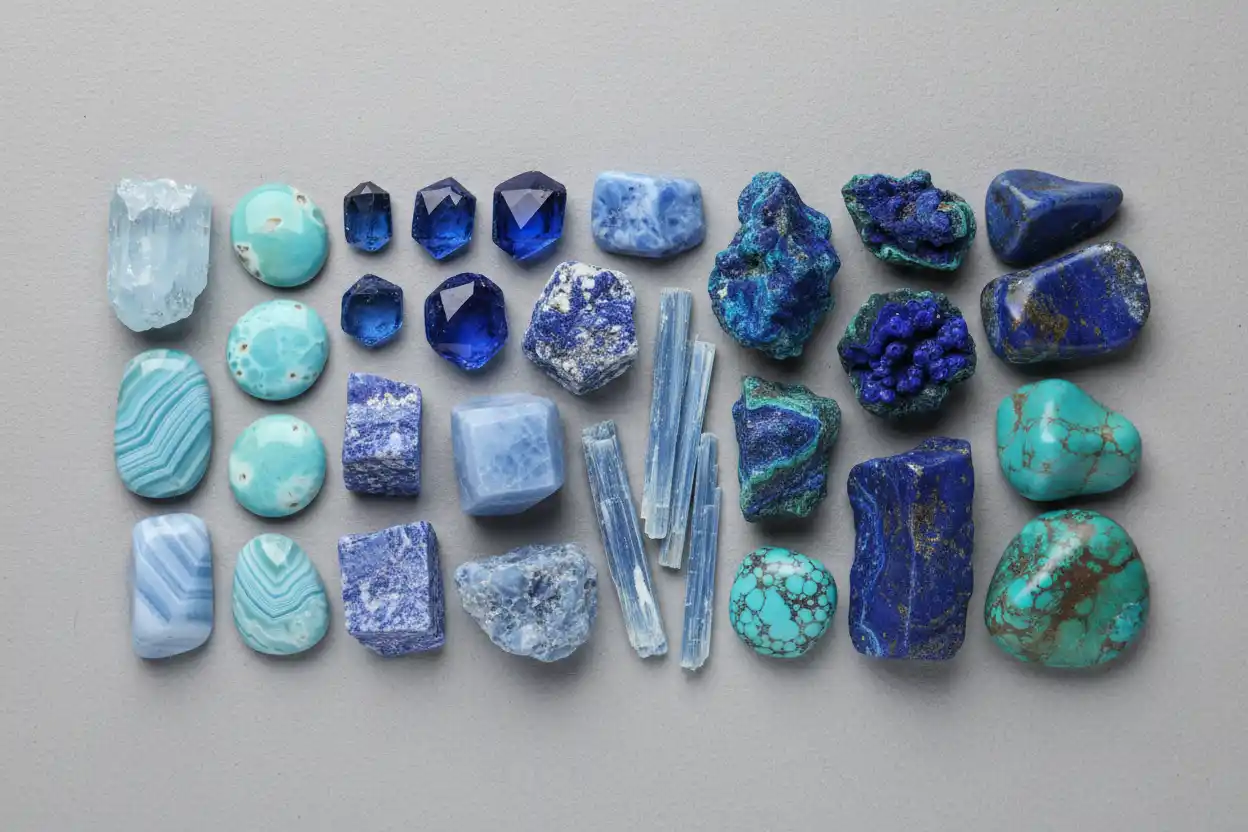
Blue Crystals: Benefits, Uses & Practical Guidance
Blue crystals range from pale translucent minerals that resemble a clear sky to dark blue rocks, fibrous aggregates, banded chalcedony, copper minerals, and stones whose blue appearance comes from optical effects rather than blue body color. They are often grouped together in crystal traditions because blue is symbolically associated with communication, thoughtful expression, patience, reflection, and truth, yet their physical properties can differ dramatically.
The term blue crystals is therefore useful as a color and practice category, but it is not a mineralogical classification. Blue calcite is a soft carbonate, blue chalcedony is microcrystalline silica, kyanite is an aluminum silicate with directional hardness, celestite is strontium sulfate, sodalite is a feldspathoid mineral, and lapis lazuli is a rock made from several minerals rather than one crystal species.
Those distinctions matter whenever blue crystals are handled, cleaned, carried, displayed, worn, or purchased. Two stones that look similar in a photograph may react very differently to water, impact, acids, sunlight, abrasion, or dust-producing lapidary work.
At Gems Lore, blue crystals are best understood through both perspectives at once: their measurable identity determines how they should be handled, while their symbolic associations can provide personal reminders for communication, concentration, reflection, or intentional routines without being presented as medically proven effects.
Blue Crystals at a Glance
| Blue material | Actual identity | Typical appearance | Approx. Mohs hardness | Common symbolic theme | Practical caution |
|---|---|---|---|---|---|
| Aquamarine | Blue to greenish-blue beryl | Transparent pale to medium blue | 7.5–8 | Clear communication | Protect fractures and exposed corners |
| Blue apatite | Apatite-group mineral | Bright blue to blue-green | 5 | Learning and motivation | Scratches more easily than quartz |
| Azurite | Copper carbonate | Deep royal to indigo blue | 3.5–4 | Insight and examination | Soft, acid-sensitive; avoid dust |
| Blue aventurine | Quartz-rich material with inclusions | Speckled or subtly shimmering blue | Around 7 | Discipline and steady action | Check for dye or misleading names |
| Blue calcite | Calcium carbonate | Cloudy pale blue | 3 | Gentle reflection | Soft with perfect cleavage |
| Blue chalcedony | Microcrystalline silica | Translucent gray-blue or lavender-blue | 6.5–7 | Measured speech | Dyed material occurs |
| Blue lace agate | Banded chalcedony | Pale blue with lace-like bands | 6.5–7 | Patient communication | Check color and band authenticity |
| Blue fluorite | Calcium fluoride | Transparent blue to violet-blue | 4 | Organization | Soft with perfect cleavage |
| Blue kyanite | Aluminum silicate | Bladed blue crystals | Directional | Alignment and honesty | Cleavage and thin blades are fragile |
| Celestite | Strontium sulfate | Pale sky-blue crystal clusters | 3–3.5 | Contemplation | Brittle, cleavable clusters |
| Dumortierite | Aluminum borosilicate | Denim to violet-blue | Around 7 | Patience and learning | Material may occur within quartz |
| Lapis lazuli | Lazurite-bearing metamorphic rock | Deep blue with calcite or pyrite | Around 5–5.5 | Wisdom and truth | Can be dyed or impregnated |
| Sodalite | Feldspathoid mineral | Royal blue with white areas | 5.5–6 | Logic and communication | Avoid acids and harsh cleaning |
| Turquoise | Hydrated copper-aluminum phosphate | Blue to greenish blue | 5–6 | Protection and expression | Often porous or treated |
| Chrysocolla | Copper-rich material/mineral association | Blue-green to turquoise | Variable | Adaptability and expression | Identity and hardness can vary |
This table shows why blue crystals should never be treated as interchangeable simply because they share a color.
What Counts as a Blue Crystal?
In everyday crystal collecting, blue crystals is an umbrella phrase rather than a strict scientific term. The category includes true individual minerals, mineral aggregates, rocks, microcrystalline materials, gemstones, and commercial lapidary products.
That difference is worth understanding before choosing a stone.
Blue calcite is a recognized mineral variety. Sodalite is also a mineral. Lapis lazuli, however, is a metamorphic rock containing several mineral components, while blue chalcedony consists of microscopic silica crystallites rather than the obvious large crystal faces people often associate with the word crystal.
Labradorite can be included in broader lists of blue crystals even though its body may be gray and the visible blue comes from an optical phenomenon. Blue tiger’s eye similarly owes much of its appearance to internal structure and aligned fibers rather than a simple blue pigment distributed uniformly through the stone.
Commercial terminology makes the category even broader. Some products sold among blue crystals may be dyed, stabilized, irradiated, heated, assembled, coated, or given trade names that do not correspond to mineral species.
Understanding the material first prevents color-based assumptions from becoming identification mistakes.
What Gives Blue Crystals Their Color?
Blue crystals do not all become blue through the same mechanism.
Some receive color from trace elements within their structure. Others contain microscopic mineral inclusions that absorb or scatter light. Crystal defects can alter which wavelengths are absorbed, while structural optical effects can produce visible blue without creating a truly blue body color.
Copper contributes strongly to the blue of minerals such as azurite and turquoise. Iron plays a role in the color of aquamarine, while other blue minerals depend on different structural or chemical mechanisms.
Treatment can also create or intensify blue.
Blue topaz is one of the clearest examples: much commercial material obtains its familiar blue through controlled treatment rather than occurring naturally in the same saturated shade.
Dyed chalcedony, dyed howlite, dyed magnesite, treated quartz, colored glass, and resin products can also enter the market beside natural blue crystals.
For that reason, vivid color by itself does not establish rarity, natural origin, treatment status, or even mineral identity.
What Do Blue Crystals Symbolize?
Blue crystals are commonly associated with communication, reflection, calm expression, thoughtful listening, truth, patience, and intellectual clarity.
Pale blue crystals often carry softer interpretations involving measured speech or taking time before responding. Medium and royal blues may symbolize confidence and direct communication, while indigo or violet-blue stones are commonly linked with introspection, complex thought, and examining assumptions.
These interpretations belong to cultural, spiritual, and personal traditions rather than established mineral science.
A blue stone does not independently make someone calm, truthful, articulate, confident, or emotionally balanced. It also cannot guarantee protection, reconciliation, luck, love, financial success, or another person’s response.
A more practical way to work with blue crystals is to connect the symbolism to an observable action.
For example, a stone associated with communication might become a cue to reread a difficult message before sending it. A stone linked with concentration might sit beside study notes as a reminder to remove distractions and complete one task before starting another.
The action creates the practical benefit. The stone gives the action a personally meaningful symbol.
Blue Crystals for Communication
Communication is one of the most consistent themes attached to blue crystals, but different materials can represent different aspects of the process.
Blue chalcedony fits the idea of measured expression because its symbolism commonly emphasizes diplomacy, patient listening, and communicating complicated ideas without unnecessary escalation.
Blue lace agate can represent slowing speech down enough to choose wording carefully, especially when a conversation has emotional weight.
Sodalite is often associated with logic and the willingness to examine whether a conclusion is supported by the available information.
A practical communication exercise with blue crystals is straightforward:
Before an important conversation, identify the main fact, the specific request or boundary, and one question that still needs clarification. Use the chosen stone as a visual reminder to return to those three points rather than allowing assumptions to dominate the discussion.
Nothing about the mineral forces better communication. The value comes from using the symbol consistently.
Blue Crystals for Reflection and Decision-Making
Some blue crystals are better suited symbolically to reflection than outward expression.
Lapis lazuli has a long history as a decorative blue material and is commonly associated today with wisdom, self-examination, and truth. Because lapis is a rock rather than one uniform mineral, it also provides a useful reminder that a single visible object can contain several different components.
Dumortierite is commonly connected with patience, structured learning, and staying with a difficult problem long enough to understand it.
Blue kyanite can represent checking whether actions match stated priorities. Its blade-like structure also makes it physically distinctive from massive blue materials.
A grounded reflective use is to separate a problem into three categories:
What is known?
What is assumed?
What evidence would change the conclusion?
Blue crystals can mark the exercise, but critical thinking does the work.
Blue Crystals for Study and Concentration
Blue crystals are frequently used symbolically around desks, study spaces, and reading areas.
Blue apatite is often associated with learning and turning ideas into action. Dumortierite can represent disciplined study, while fluorite is commonly connected with sorting information and recognizing patterns.
Those symbolic themes become more useful when paired with an actual study method.
A student might place one blue crystal beside a notebook and use it as a cue to switch from passive rereading to active recall. Another person might associate the stone with completing one focused work block before checking messages.
Blue crystals cannot improve memory, intelligence, or attention through a scientifically established mineral effect. They can, however, become part of a consistent environment or routine that reminds someone what they intended to do.
Blue Crystals for Calm, Deliberate Routines
Pale blue crystals such as blue calcite, celestite, and angelite are often marketed around themes of peacefulness or calm.
Blue calcite can symbolically represent slowing down before reacting, although physically it is a very soft carbonate with perfect cleavage.
Celestite is commonly associated with contemplation, yet its delicate strontium-sulfate crystals are better suited to protected display than constant handling.
Angelite is a commercial name used for blue anhydrite. Its pale blue-gray color encourages gentle symbolism, but the material should remain physically dry and protected from rough handling.
Using these blue crystals in a quiet routine can be as simple as placing one near a journal, reading area, or desk. The stone does not treat anxiety, depression, insomnia, trauma, or other medical or psychological conditions.
Its role is symbolic and environmental.
Important Blue Crystals and Their Practical Differences
Azurite
Azurite is a deep blue copper carbonate often found with green malachite.
Its rich color makes it visually distinctive among blue crystals, while symbolic traditions commonly connect it with insight, study, and examining assumptions more carefully.
Azurite is soft and unsuitable for rough treatment. Acids can damage it, and cutting or grinding copper-bearing material requires proper dust control.
Use intact specimens primarily for careful display or low-contact personal practice.
Blue Aventurine
Blue aventurine is a quartz-rich material whose blue appearance is associated with fine mineral inclusions.
Its quartz content gives it much better scratch resistance than soft blue crystals such as calcite or fluorite.
Symbolically, it is commonly associated with discipline and steady communication.
Commercial products should still be checked carefully because artificially colored blue quartz and misleading trade descriptions occur.
Blue Calcite
Blue calcite has a cloudy, pale blue appearance and is often carved into spheres, palm stones, towers, and decorative objects.
Its Mohs hardness is only about 3, while perfect cleavage creates additional breakage risk.
Blue calcite should therefore be protected from harder stones, sharp impacts, acids, and abrasive cleaning.
Its symbolic use commonly centers on reflection and gentle communication rather than physically demanding daily wear.
Blue Chalcedony
Blue chalcedony has a smoother, more translucent appearance than many massive blue crystals.
Because it belongs to the microcrystalline quartz family, it provides useful hardness for beads, carvings, and carefully worn jewelry.
Natural and dyed material both occur.
Do not assume an intensely saturated blue cabochon is naturally colored without suitable disclosure or testing.
Blue Kyanite
Blue kyanite commonly forms elongated blades and has the unusual property of differing hardness depending on crystallographic direction.
Its physical structure makes raw specimens vulnerable to splitting along cleavage.
Symbolically, blue kyanite is frequently associated with honesty, alignment, and ensuring that behavior matches stated values.
It is more suitable for careful display and protected jewelry than rough handling.
Celestite
Celestite, also called celestine, is strontium sulfate and commonly forms pale sky-blue crystals.
Large clusters can appear substantial while still containing fragile points and weak attachments.
Do not carry celestite loosely with harder stones. A padded display location reduces breakage and minimizes the need for frequent cleaning.
Dumortierite
Dumortierite can occur as distinct mineral material or as blue fibrous inclusions within quartz-rich material.
Its denim, navy, and violet-blue colors can resemble sodalite, lapis lazuli, or blue aventurine.
Identification should therefore rely on more than visual color.
Lapis Lazuli
Lapis lazuli is one of the most important materials to classify correctly in a blue crystals directory.
It is a metamorphic rock rather than one mineral crystal. Its composition commonly includes blue feldspathoid minerals together with calcite, pyrite, and other components.
The material can be dyed or impregnated, and acids may damage carbonate-rich areas.
Its traditional and modern symbolism frequently emphasizes wisdom, truth, and considered judgment.
Sodalite
Sodalite is a blue feldspathoid mineral commonly seen as massive royal-blue material with white areas.
It can resemble lapis lazuli, although strong pyrite distribution typical of some lapis is generally absent from ordinary sodalite.
Sodalite is softer than quartz and should not be cleaned with acids.
Turquoise
Turquoise is a hydrated copper-aluminum phosphate rather than quartz, calcite, or chalcedony.
Natural turquoise can be porous, while commercial material may be stabilized, dyed, backed, reconstructed, or otherwise treated.
Those treatments can improve usability but should be disclosed.
Avoid prolonged soaking, aggressive chemicals, perfume, cosmetics, and high heat.
Chrysocolla
Chrysocolla occupies a more complicated position because material sold under the name can vary significantly in composition, hardness, and association with quartz or other copper minerals.
Some silica-rich chrysocolla material can polish beautifully, while softer specimens require much greater protection.
Color alone is not enough to establish composition.
Blue Crystals vs Blue Gemstones
The distinction between blue crystals and blue gemstones is primarily about purpose rather than a rigid boundary.
A sapphire can appear in both categories. So can aquamarine, turquoise, chalcedony, and several other materials.
However, a blue crystal directory is most useful when it answers different questions:
What is the material actually made of?
Is it a mineral, rock, aggregate, glass, or treated product?
Can the specimen tolerate handling?
Can it safely contact water?
Does it contain soft cleavage planes?
Could dust from cutting create an exposure concern?
How can its symbolic use remain grounded?
A gemstone directory has a different emphasis: jewelry durability, treatment disclosure, cut quality, setting choice, value, and buying.
Keeping those purposes separate prevents blue crystals from becoming merely a duplicate jewelry list.
Natural Blue Crystals vs Dyed and Treated Material
Not every blue stone sold in crystal shops has natural blue color.
Treatments are not automatically a problem. The problem is undisclosed treatment.
Dyed chalcedony can produce vivid blue. White howlite or magnesite may be dyed turquoise-blue. Quartz products can receive color modification, and some stones are stabilized with resin to improve durability.
Glass can also imitate translucent blue crystals.
When buying a blue specimen, look for color concentrated around fractures, pits, drill holes, porous areas, or the outer surface. Extremely uniform electric color in a naturally variable material deserves closer inspection.
Visual clues are not always conclusive, however.
The general how to identify crystals framework is more reliable because identification should combine luster, hardness, transparency, structure, inclusions, density, fracture, cleavage, and professional testing when necessary.
Do not damage a valuable specimen merely to perform a home scratch or acid test.
Choosing Blue Crystals by Practical Use
The best blue crystals depend on what you actually intend to do with them.
For a Desk or Study Space
Choose a stable polished material or securely based specimen that will not shed particles or break through ordinary contact.
Blue chalcedony, dumortierite-rich quartz, sodalite, or blue aventurine can work well.
For Frequent Handling
Prioritize compact material with useful hardness and no delicate crystal terminations.
Blue chalcedony and quartz-rich blue aventurine are generally more forgiving than calcite or celestite.
For Display
Display allows far greater freedom.
Azurite, celestite, blue fluorite, kyanite blades, and delicate mineral clusters can be enjoyed without exposing them to repeated handling.
For Carrying in a Pocket
Use compact polished material rather than brittle clusters.
Keep blue crystals separate from keys, coins, and harder gemstones that can scratch or chip them.
For Symbolic Practice
Choose the material whose symbolic theme connects most directly with an action you are prepared to take.
If communication is the goal, define the conversation. If focus is the goal, define the task. If reflection is the goal, define the question.
The stone should support a practice, not replace it.
Blue Crystals and Chakra Traditions
Many spiritual systems associate blue crystals with the throat chakra, which symbolically relates to expression, communication, listening, and personal truth.
This is a spiritual framework rather than an anatomical or medical model.
Someone working within that tradition might use blue chalcedony as a reminder to speak carefully, sodalite to examine logic before making a claim, or kyanite to consider whether words and actions align.
Blue crystals do not physically open chakras in a scientifically demonstrated way, nor do they treat throat disorders, thyroid conditions, anxiety, depression, or communication disabilities.
The safest interpretation is symbolic and behavioral.
Water Safety for Blue Crystals
There is no universal answer to whether blue crystals can go in water.
The category contains too many different materials.
Blue chalcedony tolerates brief routine washing far better than soft, porous, repaired, or highly cleavable specimens. Angelite should not be soaked. Celestite clusters are better kept dry. Calcite requires special caution around acids and prolonged exposure, while turquoise can be porous or treated.
Mixed specimens introduce another problem because one mineral may tolerate water while its matrix, glue, coating, dye, or associated mineral does not.
Never assume that a blue crystal is water-safe simply because another blue stone is.
Direct-contact drinking-water preparations are also unnecessary. Unknown specimens can contain treatments, surface residues, matrix minerals, or elements that were never intended for ingestion.
Sunlight, Heat, and Display
Normal indoor display is suitable for many blue crystals, but prolonged intense light and heat are not good universal storage methods.
Some fluorite colors can change after strong light exposure, while dyes, coatings, resins, and adhesives may age differently from the underlying mineral.
Heat can also stress fractures or affect assembled specimens.
A shaded shelf or display cabinet is usually more conservative than leaving valuable blue crystals permanently on a bright windowsill.
Dust and Physical Safety
Intact polished blue crystals are generally different from dust produced during sawing, grinding, sanding, or drilling.
Silica-bearing materials require proper dust control during lapidary work. Copper minerals such as azurite and chrysocolla should also be handled conservatively when cutting because finely divided material creates a different exposure route from simply touching an intact specimen.
Use appropriate wet-working methods, ventilation or local extraction, and suitable respiratory protection when lapidary work generates mineral dust.
Wash hands after handling visibly dusty or crumbling specimens and before eating.
Do not grind unknown blue crystals into powders for ingestion or cosmetic use.
How to Clean Blue Crystals Safely
There is no single cleaning method suitable for every blue crystal.
Begin by identifying the material.
For a stable polished quartz-family stone, lukewarm water, mild soap, and a soft cloth may be appropriate. For fragile clusters, dry dusting with a soft brush or hand-operated air blower may be safer.
Avoid treating the entire collection the same way.
Particular caution is appropriate with:
- Calcite and other acid-sensitive carbonates.
- Cleavable fluorite.
- Fragile celestite clusters.
- Angelite.
- Porous or treated turquoise.
- Copper-rich specimens.
- Dyed stones.
- Resin-filled or repaired pieces.
- Mixed-mineral matrix specimens.
Ultrasonic and steam cleaning should never be a default for unidentified blue crystals.
Storing Blue Crystals
Store blue crystals according to hardness and fragility rather than color.
Quartz-family material can scratch softer calcite, fluorite, turquoise, celestite, and similar specimens if they rub together.
Soft pouches work well for compact polished pieces. Fragile clusters need rigid padded boxes or stable display supports.
Keep tall towers and spheres away from shelf edges, particularly when the material is cleavable or brittle.
Labels are also useful. Record the mineral or material name, locality when genuinely known, treatments when disclosed, and any special care requirements.
Good labeling prevents a future owner from cleaning a soft or treated stone as though it were ordinary quartz.
How to Choose the Right Blue Crystal
Start with identity, not symbolism.
Ask what the object actually is. A proper name should lead to a recognizable mineral, rock, or material description rather than only a commercial nickname.
Then evaluate physical condition.
Look for unstable fractures, repaired areas, chipped crystal points, powdering surfaces, dye concentration, glue, unusual coatings, and weak matrix.
Next, decide what you want from the stone.
If it will remain on a shelf, fragile blue crystals become realistic options. If it will be carried or handled frequently, compact harder materials are generally more practical.
Only after those questions should symbolism influence the choice.
A meaningful stone is much easier to appreciate when you understand what it is and how to protect it.
Frequently Asked Questions
What are blue crystals?
Blue crystals is a broad color-based term covering natural minerals, microcrystalline materials, rocks, aggregates, gemstones, and some treated commercial stones that display blue coloration or blue optical effects.
What do blue crystals symbolize?
Blue crystals commonly symbolize communication, listening, reflection, truth, patience, and thoughtful expression. These meanings belong to cultural and spiritual interpretation rather than established medical science.
Which blue crystals are best for communication?
Blue chalcedony, blue lace agate, sodalite, blue kyanite, and aquamarine are commonly associated with communication. The useful approach is to connect the symbolism with a specific behavior such as listening carefully or preparing words before a difficult conversation.
Which blue crystals are good for study?
Dumortierite, blue apatite, sodalite, and fluorite are commonly associated symbolically with learning, organization, and concentration. They do not scientifically improve intelligence or memory.
Are all blue crystals naturally blue?
No. Some blue crystals occur naturally in their displayed color, while others may be dyed, irradiated, heated, coated, stabilized, or otherwise treated. Disclosure matters more than assuming that every treatment is undesirable.
Is lapis lazuli a crystal?
Not in the strict mineralogical sense. Lapis lazuli is a metamorphic rock composed of multiple minerals, typically including blue feldspathoid components along with varying calcite, pyrite, and other minerals.
Can blue crystals go in water?
Some tolerate brief washing better than others, but there is no universal rule. Angelite, fragile celestite, porous turquoise, repaired specimens, mixed matrices, and other sensitive materials should not be treated like durable quartz.
Are blue crystals safe to touch?
Most intact specimens are straightforward to handle normally, but dust generated during cutting or grinding can create different risks. Copper-bearing and silica-containing materials deserve appropriate lapidary dust precautions.
What is the difference between blue crystals and blue gemstones?
The materials can overlap, but blue crystals are better approached as a specimen, identity, safety, symbolism, and practical-use category, while blue gemstones place greater emphasis on jewelry durability, treatment, cutting, value, and buying.
Are darker blue crystals stronger than pale blue crystals?
No. Color depth does not determine hardness or toughness. Deep blue azurite is much softer than pale aquamarine, for example.
Can blue crystals treat anxiety or depression?
No. Blue crystals may symbolize calm or reflection, but they are not established treatments for anxiety, depression, trauma, or other mental-health conditions.
Do blue crystals bring luck or protection?
Blue crystals may represent luck, protection, or confidence within particular traditions, but they cannot guarantee protection or control future events.
How can I tell whether a blue crystal is fake?
Begin by checking whether its appearance matches the claimed material. Examine luster, transparency, inclusions, structure, fractures, color concentration, and density, and use non-destructive gemological testing when identity or value matters.
Which blue crystals are easiest to care for?
Compact quartz-family materials such as blue chalcedony and many blue aventurine pieces generally tolerate routine handling better than calcite, fluorite, celestite, or delicate kyanite. Treatments and fractures can still change care requirements.
What is the best blue crystal?
There is no universal best choice. The right blue crystal depends on whether you want a display specimen, durable polished stone, jewelry material, study symbol, communication cue, or collector mineral.
Using Blue Crystals With Clear Expectations
Blue crystals become more interesting, rather than less meaningful, when their physical reality and symbolic use remain distinct.
A pale blue calcite carving, a celestite cluster, a polished sodalite stone, and a piece of lapis lazuli may all fit within the same color tradition, yet they represent entirely different materials with different structures, hardness, care requirements, and safety considerations.
Their symbolic similarities do not erase those differences.
Blue crystals can represent thoughtful speech, careful listening, disciplined study, reflection, honesty, or patience when those meanings connect with intentional actions. They cannot independently cure illness, regulate emotions, guarantee relationships, create luck, or produce predictable external outcomes.
Choose blue crystals first by correct material identity, physical condition, treatment disclosure, and intended use. Then choose the symbolism that genuinely helps you remember what you want to practice.
That approach preserves both sides of the subject: respect for the mineral or material in front of you, and space for personal meaning without turning symbolism into unsupported fact.