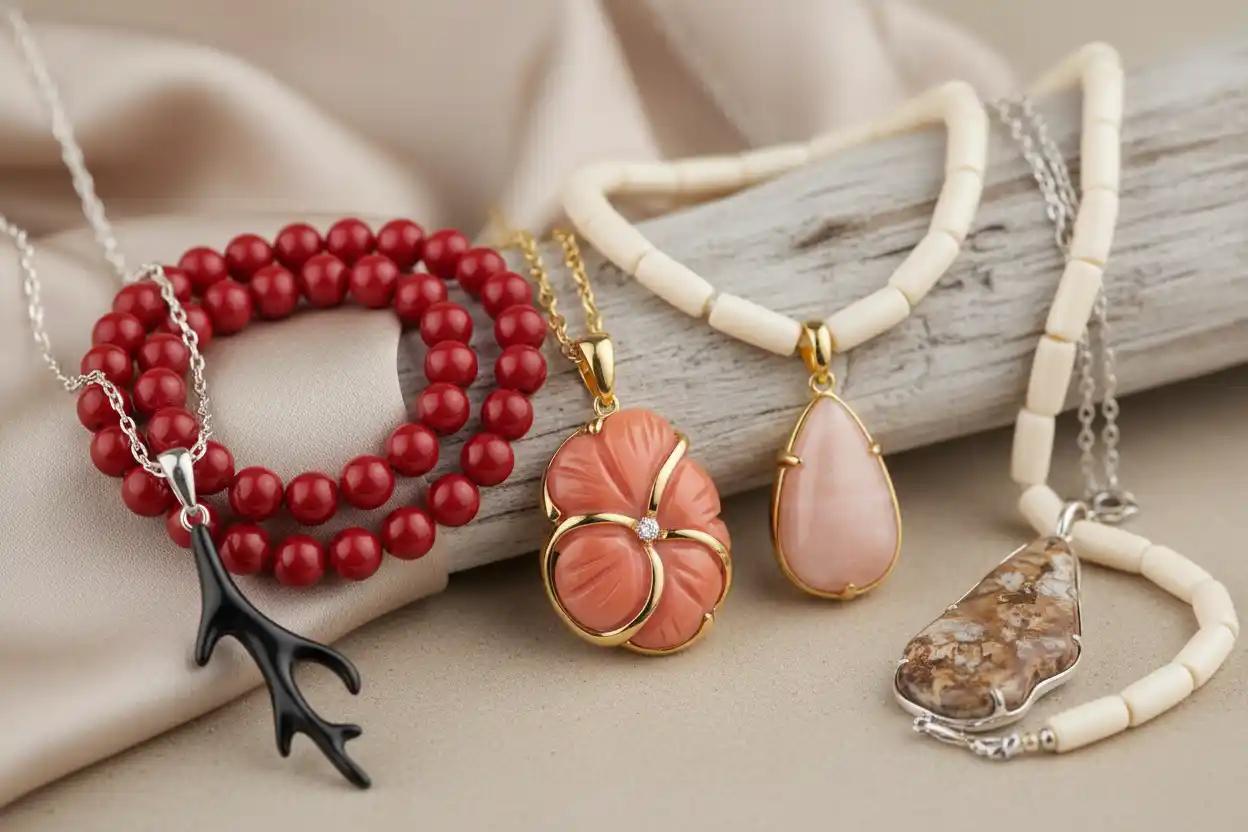
Coral Necklace: Styles, Lengths & Buying Tips
A coral necklace can range from a delicate strand of small pink beads to a substantial red coral pendant, carved centerpiece, graduated bead strand, branch-style necklace, or precious-metal design built around a single coral element. Although color usually attracts attention first, choosing a good coral necklace requires more practical judgment than simply finding the deepest red material. Coral is a relatively soft organic gem material, and the finished necklace depends on stringing quality, chain strength, clasp security, drill-hole condition, treatment disclosure, pendant weight, bail construction, and the way the piece rests against the neckline.
A well-made coral necklace should feel balanced when worn, sit at the intended position without repeatedly flipping, and use hardware strong enough for the weight of the coral. The material itself should be identified clearly, with natural, dyed, stabilized, reconstructed, fossil, or imitation products described honestly. Because coral is more vulnerable to chemicals, heat, abrasion, and impact than many crystalline gemstones, a necklace is actually one of the more practical forms in which to wear it—as long as the design and care routine respect those limitations.
What Makes a Good Coral Necklace?
The strongest coral necklace combines appropriate material quality with thoughtful construction. The coral should have an attractive color and polish for its type, while beads, cabochons, carvings, or branches should be free from major undisclosed fractures, crumbling drill holes, loose repairs, or surface damage inconsistent with the price.
Construction matters just as much. A strand needs durable stringing material and an appropriate clasp, while a pendant design needs a bail large and strong enough for the chain. A heavy coral centerpiece hanging from an extremely fine chain may look elegant in a product photograph but create an obvious mechanical weak point during wear.
If you are still evaluating the material itself, the buy coral guide provides a broader framework for identity, treatments, seller disclosure, and common buying red flags.
Coral Necklace Styles at a Glance
| Style | Main advantage | Main buying concern |
|---|---|---|
| Single-strand beads | Classic and easy to style | Stringing condition and clasp strength |
| Graduated bead strand | Strong visual balance | Consistent graduation and drill quality |
| Multi-strand necklace | Greater visual presence | Weight, tangling, clasp load |
| Coral pendant | Focuses on one coral element | Bail strength and pendant balance |
| Carved coral necklace | Shows craftsmanship | Thin carving details and repairs |
| Branch coral design | Organic natural appearance | Fragile projections and snagging |
| Station necklace | Lightweight, modern spacing | Connector strength |
| Coral-and-metal necklace | Strong design contrast | Metal disclosure and contact wear |
| Mixed-gem necklace | More color and variety | Harder gems scratching coral |
| Choker | Strong neckline emphasis | Fit and clasp comfort |
Each coral necklace style creates a different wear pattern. A bead strand puts stress on drill holes and stringing material, while a pendant concentrates the load at the bail, chain, and clasp.
Coral Is an Organic Gem Material
Coral differs fundamentally from quartz, sapphire, topaz, and other mineral gemstones. Jewelry coral comes from biological skeletal material produced by marine organisms, and precious coral used in traditional jewelry is composed primarily of calcium carbonate.
That biological origin contributes to both its beauty and its care requirements. Coral is relatively soft, generally around 3 to 4 on the Mohs scale, and polished surfaces can be scratched by common mineral dust or harder gemstones.
The coral meaning guide explains the biological and gemological identity in greater depth while keeping traditional symbolism separate from scientific facts.
Why a Necklace Is a Practical Form for Coral
A coral necklace usually receives less direct impact than a ring or bracelet because it is worn around the neck instead of on the hands or wrist. That makes necklaces particularly suitable for a material with limited scratch resistance.
The tradeoff is prolonged contact with skin, clothing, perfume, cosmetics, sweat, hair products, and sometimes metal components. A coral necklace therefore needs protection from chemical exposure even when impact risk is low.
Long pendant designs can also strike tables or hard surfaces when the wearer bends forward, while substantial strands can place significant load on the clasp. Lower impact does not mean zero mechanical risk.
Choosing the Right Coral Necklace Length
Length changes both appearance and practicality. The same coral necklace can look formal, casual, dramatic, or understated depending on where it falls relative to the collarbone and neckline.
Common necklace lengths include shorter choker-style designs, collarbone-length strands, longer princess or matinee-style pieces, and extended strands intended for layering. Exact fit depends on neck circumference, body proportions, pendant dimensions, clothing, and personal preference rather than one universal measurement.
Before buying online, measure a necklace you already like and compare its total wearable length with the listing. Product photographs on a model are useful, but they cannot predict exactly where the coral necklace will sit on your body.
Choker-Style Coral Necklaces
A choker places coral high on the neck and creates strong visual emphasis. Small beads and slim strands generally work better for close-fitting designs because large beads can feel bulky when pressed against the neck.
Fit should be secure without being restrictive. A coral necklace worn too tightly may become uncomfortable, increase rubbing between beads, and place unnecessary tension on the clasp or stringing material.
For a valuable choker, an adjustable extension can improve flexibility, provided the extension hardware is strong enough and does not shift the necklace off balance.
Collarbone-Length Coral Necklaces
A shorter strand that sits around the collarbone is one of the most versatile choices because it works with open collars, simple tops, dresses, and many everyday necklines. This length also keeps the coral relatively close to the body, reducing the swinging movement associated with longer designs.
If the coral necklace contains a pendant, check whether the pendant rests centrally or constantly rotates. A properly positioned bail and balanced chain should allow the piece to hang naturally.
For bead strands, examine whether the necklace forms a smooth curve instead of developing stiff angles caused by overly tight stringing.
Long Coral Necklaces
Longer coral necklaces can create dramatic vertical lines and work well for layering, but length increases movement. A long pendant may strike a desk, countertop, bag, or seat belt as the wearer moves.
Weight also becomes more important. A long strand containing substantial coral beads can be noticeably heavier than expected, and the clasp must support the entire load.
When buying a long coral necklace online, ask for total weight if the listing does not provide it. Appearance alone can underestimate how heavy a dense multi-bead strand will feel after extended wear.
Beaded Coral Necklaces
Beaded strands are among the most traditional coral necklace styles. Beads may be uniform, graduated, barrel-shaped, oval, round, carved, or irregular depending on the design and material.
Inspect drill holes carefully because this is where stress is concentrated. Major chipping, splitting, or powdery deterioration around a hole can weaken a bead even when the front surface looks polished.
A valuable bead strand should also be examined for matching. Perfect uniformity is not always necessary, especially with natural material, but color, shape, surface quality, and graduation should look intentional rather than random.
Graduated Coral Beads
A graduated coral necklace uses larger beads toward the center and progressively smaller beads toward the clasp. When executed well, the transition should appear smooth from one bead to the next.
Abrupt changes in diameter can make the strand look poorly matched, while an oversized center bead may create an uncomfortable front-heavy feel.
Graduation can also influence value because assembling a well-matched sequence of coral beads requires more selection than producing a strand from assorted sizes. However, matching quality should be considered alongside treatment, material type, construction, and provenance.
Knotted vs Unknotted Coral Strands
Fine bead necklaces are often individually knotted between beads. Knotting helps prevent every bead from scattering if the strand breaks and can reduce direct bead-to-bead contact.
For coral, this can be particularly useful because the material is soft. Well-positioned knots provide slight separation between beads and reduce rubbing, although knots themselves eventually wear and stretch.
Less valuable or smaller-bead coral necklace designs may be strung without individual knots. In that case, stringing material, tension, and bead condition become even more important.
Silk, Nylon, Wire, and Other Stringing Materials
Traditional fine bead strands are often strung on silk, while modern jewelers may use synthetic cords, coated wire, nylon, or other specialized materials depending on bead size and intended wear.
There is no single stringing material appropriate for every coral necklace. Silk can create a graceful drape but may eventually stretch or weaken from moisture and use. Modern synthetic materials can provide additional strength, while wire-based systems require careful crimping and suitable bead-hole protection.
Whatever the material, the strand should flex naturally without feeling excessively loose or rigid. Visible fraying near the clasp or beads is a sign that restringing may be necessary.
Coral Pendants
A pendant coral necklace places most visual attention on one coral element, which may be a cabochon, carved piece, branch, cameo, bead, or irregular natural form. The pendant can be mounted in gold, silver, or another metal or attached through a drilled hole.
This design reduces the need for many matched coral components but increases the importance of one structural point: the bail.
The bail should be large enough for the chain to move freely without excessive friction and strong enough to support the pendant’s weight. A thin decorative bail on a heavy carving may eventually distort or open.
Pendant Weight and Balance
Pendant weight affects both comfort and chain selection. A substantial coral necklace pendant hanging from a delicate chain may strain the chain links, clasp, jump ring, or bail.
Balance also matters. A pendant with an off-center bail may tilt continuously instead of facing forward. Natural branch forms are particularly prone to uneven weight distribution because their shape is irregular.
When shopping online, ask for a side view and hanging photograph if the pendant is asymmetrical. A beautiful carving that constantly flips against the chest may be frustrating in actual wear.
Choosing the Right Chain Gauge
Chain gauge describes the thickness and overall structural capacity of the chain. There is no universal chain size for coral because the appropriate gauge depends on pendant weight, chain style, metal, link construction, length, and expected wear.
A coral necklace with a light cabochon may work well on a fine chain, while a large carving deserves a substantially stronger design. The chain should look proportionate visually and mechanically.
Extremely thin chains paired with heavy pendants deserve particular scrutiny. Even if the chain itself is strong enough initially, repeated movement can accelerate wear at the bail or connecting ring.
Bail Construction
The bail connects the coral pendant to the chain, making it one of the most important components in a pendant coral necklace. Bails can be fixed, hinged, looped, decorative, hidden, or integrated into a bezel or cap.
Inspect whether the bail is soldered securely and whether connecting rings are fully closed. A split, distorted, or partially open jump ring can allow the pendant to detach.
If the coral is drilled directly for the bail, check the surrounding material for cracks. A hole placed too close to a thin edge may become a long-term failure point.
Clasp Types
A coral necklace may use a lobster clasp, spring ring, box clasp, toggle, hook, magnetic closure, barrel clasp, fishhook clasp, or decorative vintage mechanism. Each style offers a different balance of security and convenience.
For substantial coral bead strands, a clasp with enough structural strength for the necklace weight is essential. Decorative clasps should not be chosen only for appearance if their mechanism feels loose or underbuilt.
Older coral necklaces deserve careful clasp inspection because spring tension, hinges, locking tabs, and solder joints can weaken over time. A jeweler can often replace worn hardware without sacrificing the coral itself.
Necklace Extenders and Adjustable Designs
An extender lets one coral necklace work with several necklines, which can improve versatility. The extender should be made from metal compatible with the rest of the necklace and strong enough for the necklace weight.
On pendant designs, changing chain length can alter how the pendant hangs. A heavier centerpiece may feel stable at one length but swing excessively when lowered.
When an extender causes the clasp to migrate constantly toward the front, the necklace may need better overall weight balance rather than simply a longer chain.
Matching Coral With Necklines
Short coral necklaces work naturally with open necklines because the coral remains visible rather than disappearing beneath fabric. Longer pendants can complement higher necklines by creating contrast against a simple background.
Large red or pink coral can dominate a design, so neckline and clothing pattern should be considered together. A highly detailed coral necklace often reads more clearly against a simple top than against a competing print.
This is primarily a style decision, but placement can also affect wear. A coral pendant repeatedly rubbing against rough sequins, metal embellishments, or textured fabric may accumulate more surface wear than one resting against a smooth material.
Natural Coral Color
Precious coral occurs naturally in shades that can include red, salmon, orange, pink, pale pink, and white depending on the biological material. Color is an important value and design factor, but a bright hue should not be accepted as proof of untreated coral.
A natural coral necklace may display slight variations from bead to bead, especially in larger strands. Variation is not automatically a defect, and perfect uniformity is not automatically evidence of treatment.
The broader types of coral guide can help clarify how commercial coral colors and material categories differ.
Dyed Coral Necklaces
Dyeing is an important treatment to understand. Lighter or lower-value coral material may be dyed to produce stronger red, pink, or other colors.
A dyed coral necklace can still be attractive, durable enough for appropriate wear, and worth buying when the treatment is disclosed and the price reflects the material. The problem is paying a rare natural-color premium for treated material presented ambiguously.
Color concentration around drill holes, cracks, or porous areas can sometimes raise suspicion of dye, but visual signs are not definitive for every product. Higher-value purchases may justify specialist identification.
Stabilized and Reconstructed Coral
Soft or porous coral material can be impregnated or stabilized with resin or plastic to improve its working properties. Reconstructed coral can be produced from smaller particles or fragments combined with binders and formed into larger usable shapes.
These products are not necessarily poor jewelry. They simply occupy a different material category from a solid piece of natural precious coral.
A coral necklace containing reconstructed or stabilized material should be labeled accurately because treatment affects value, authenticity expectations, and sometimes cleaning.
Coral Imitations
Imitation coral may be made from glass, plastic, ceramic, bone, dyed limestone, shell, resin, marble, or other materials. Some are convincing after polishing and coloring.
Buying an imitation is perfectly reasonable when the seller is clear about what it is. It can be an affordable and potentially lower-impact way to achieve a coral-like appearance.
For an expensive coral necklace, avoid relying on one home test. Destructive scratch, heat, acid, or needle tests can damage genuine coral and are unnecessary when professional identification is available.
Coral Necklace Ethics and Sourcing
Because coral is biologically produced, sourcing deserves more attention than it would for many common mineral gemstones. Different coral groups have different conservation statuses, management systems, and trade rules.
Ask the seller what type of coral is being sold, where it came from, and whether source documentation exists when relevant. “Vintage,” “old stock,” and “responsibly sourced” should not be accepted automatically as complete explanations.
The coral ethics guide provides a dedicated framework for species, traceability, secondhand jewelry, responsible sourcing claims, and alternatives.
Vintage Coral Necklaces
Vintage and antique coral necklaces can be especially appealing because they combine jewelry history with material already circulating in the market. Older strands may also feature hand-carved beads, traditional clasps, or designs that are uncommon in contemporary production.
Age does not eliminate practical concerns. Silk may have weakened, clasps may be worn, beads may have cracked around holes, and a strand may already have been restrung several times.
Have important vintage pieces inspected before frequent wear. Restringing can preserve the coral while replacing weakened thread or unreliable hardware.
Coral Necklace Metal Choices
Gold, silver, platinum, and other metals can all be used with coral, but the metal description should be specific. “Gold tone” does not mean solid gold, and plated metal may reveal a different alloy as the surface wears.
Metal selection affects both price and design. Yellow gold can reinforce the warmth of red or orange coral, while white metals create stronger visual contrast. Rose gold can complement pink and salmon tones.
For people with metal sensitivities, the clasp, chain, connector rings, pendant bail, and any spacers touching the skin deserve as much attention as the coral itself.
Mixed-Gem Coral Necklaces
Coral is sometimes combined with pearls, turquoise, onyx, lapis lazuli, diamonds, quartz, or other gemstones. These combinations can be visually striking but create a durability issue when hard materials repeatedly contact soft coral.
Quartz, sapphire, and diamond can scratch coral easily. Beads should therefore be arranged and separated so hard stones do not constantly rub against coral surfaces.
Metal spacer beads can also create abrasion if their edges are sharp. In a mixed coral necklace, good design manages contact points rather than assuming all materials wear at the same rate.
Coral Necklace Price and Value
The price of a coral necklace depends on far more than total bead size. Material type, natural versus treated color, quality, size, matching, carving, provenance, source documentation, condition, metal, craftsmanship, clasp quality, and seller market can all affect the asking price.
For strands, matching can add significant value because assembling a harmonious sequence requires enough material of similar appearance. A carved centerpiece can add labor value, while substantial gold hardware may account for a meaningful portion of the finished jewelry price.
The dedicated coral price guide explains how to evaluate these factors without assuming one universal price for all coral.
How to Buy a Coral Necklace Online
Good online listings should provide the total necklace length, bead or pendant dimensions, material identity, treatment disclosure, metal specifications, clasp type, photographs from multiple angles, and return terms.
For beaded strands, ask whether the beads are knotted and what stringing material is used. For pendants, ask for pendant weight or overall necklace weight when the piece appears substantial, along with bail dimensions if you may change the chain.
Claims such as “natural Mediterranean coral,” “untreated,” “antique,” or “responsibly sourced” deserve evidence when they materially affect value.
Coral Necklace Buying Checklist
Before purchasing a coral necklace, check:
- The material is identified clearly as natural coral, treated coral, reconstructed material, fossil material, or imitation.
- Known dyeing, bleaching, stabilization, coating, or reconstruction is disclosed.
- The total wearable length is provided.
- Bead or pendant dimensions are stated.
- Larger pieces have a useful weight specification.
- Bead drill holes are free from major cracks or chipping.
- Graduated strands transition smoothly.
- Valuable bead strands are strung securely.
- Knots, cord, wire, or thread show no obvious fraying.
- The clasp is appropriate for the necklace weight.
- Pendant bails and jump rings are securely closed.
- Chain gauge suits the pendant weight.
- The pendant hangs centrally instead of constantly flipping.
- Metal type and purity are clearly identified.
- Natural-color and provenance claims have appropriate support.
- Sourcing information is available where relevant.
- The return policy allows proper inspection after delivery.
This checklist keeps the purchase focused on actual necklace performance rather than color alone.
How to Care for a Coral Necklace
Coral should be protected from perfume, hairspray, cosmetics, chlorine, acidic liquids, harsh cleaners, extreme heat, steam, and abrasive contact. Put the necklace on after personal-care products have dried, then remove it before swimming, showering, heavy exercise, or household cleaning.
Routine cleaning should be gentle. A soft cloth is often enough after normal wear. Avoid ultrasonic machines and steam cleaners, particularly because treatments, stringing materials, adhesives, and metal components can introduce additional vulnerabilities.
For a more complete routine, follow the how to clean coral jewelry guide.
Restringing a Coral Necklace
A bead strand should be restrung when thread becomes visibly stretched, frayed, discolored, or loose enough that large gaps appear between knots and beads. Frequent wear can gradually weaken the material even when the coral remains intact.
A competent jeweler or bead-stringing specialist can replace the thread while preserving the original bead sequence and clasp. For valuable coral, request knotting and stringing techniques appropriate to the bead size and condition.
Restringing is preventive maintenance. Waiting until the necklace breaks can lead to lost or damaged beads.
How to Store a Coral Necklace
Store coral separately from harder jewelry. A soft fabric pouch, lined jewelry box, or dedicated compartment reduces the risk of scratching.
Lay bead strands in a relaxed curve rather than tightly coiling them or hanging heavy necklaces indefinitely from a hook, which can place continuous strain on thread. Keep pendant chains untangled so metal links do not scrape repeatedly against the coral.
Proper storage protects both surface polish and structural components.
Is a Coral Necklace Good for Everyday Wear?
A coral necklace can be worn regularly when the design is sturdy and the wearer is willing to protect it from cosmetics, chemicals, abrasion, and impact. A short bead strand or secure pendant usually faces less physical risk than coral worn on the hands.
However, “everyday” should not mean wearing the piece through showers, swimming, sports, sleep, or chemical exposure. Removing the necklace for those situations can greatly reduce unnecessary wear.
If you want coral jewelry but prefer a form with different practical requirements, the coral earrings guide covers pair matching, earring weight, posts, hooks, and backs.
Coral Necklace Meaning and Symbolism
Coral has traditionally been associated with vitality, courage, protection, continuity, connection, and the sea. A coral necklace can carry those associations culturally or personally, especially when inherited, given as a gift, or connected with family history.
These meanings are symbolic rather than scientifically demonstrated effects. Wearing coral does not guarantee physical protection, emotional healing, relationship success, fertility, luck, or improved health.
A grounded approach is to let the jewelry represent something you want to remember—such as speaking confidently, maintaining a boundary, respecting nature, or preserving a family connection—without expecting the coral itself to control an outcome.
Final Thoughts on Choosing a Coral Necklace
A good coral necklace is a complete jewelry object, not simply a collection of attractive red or pink material. Length determines where it sits; bead size and pendant weight affect comfort; chain gauge and bail construction influence security; stringing quality protects individual beads; and the clasp determines whether the entire piece remains on the wearer.
The coral itself also needs careful evaluation. Material identity, natural or treated color, reconstruction, imitation risk, drill-hole condition, sourcing, matching, polish, and existing damage can all affect whether the necklace represents fair value.
Choose a coral necklace whose construction matches the way you plan to wear it. A substantial pendant deserves a strong chain and bail, a valuable bead strand deserves secure stringing and a reliable clasp, and delicate coral deserves protection from harder materials and harsh chemicals. When material disclosure and craftsmanship are as strong as the visual design, coral can work exceptionally well in necklace form without relying on generic jewelry claims or exaggerated symbolism.
FAQs
Is a coral necklace durable?
A coral necklace can be durable enough for regular careful wear, but coral is relatively soft at around 3 to 4 on the Mohs scale. It should be protected from scratching, chemicals, heat, hard impacts, and inappropriate cleaning.
What length coral necklace should I choose?
Choose according to neck size, clothing, pendant dimensions, and where you want the necklace to sit. Comparing the listed length with a necklace you already wear comfortably is more reliable than relying only on photographs.
Are coral bead necklaces usually knotted?
Fine bead strands are often individually knotted to reduce bead-to-bead contact and limit bead loss if the strand breaks. Not every coral necklace is knotted, so ask about the stringing method before buying.
How can I tell if a coral necklace is real?
Visual inspection alone cannot reliably distinguish every natural, treated, reconstructed, and imitation product. Higher-value pieces may require professional gemological examination, especially when natural color or rare-material claims affect price.
Can coral necklaces be dyed?
Yes. Coral can be dyed to alter or intensify color. Dyed material can still make attractive jewelry, but treatment should be disclosed and should not be priced as rare untreated natural-color coral.
What is reconstructed coral?
Reconstructed coral is produced by combining smaller coral particles or fragments with a binder and forming them into usable jewelry material. It should be identified separately from a solid natural piece of precious coral.
What clasp is best for a coral necklace?
The best clasp depends on necklace weight and style. Lobster, box, spring-ring, barrel, hook, and other clasps can all work when they are well constructed and appropriately sized for the load.
How strong should the chain be for a coral pendant?
The chain gauge should be proportionate to the pendant’s weight and bail design. A large coral pendant should not depend on an extremely fine chain or weak connecting ring.
How should I clean a coral necklace?
Use conservative coral-specific care. Wipe gently with a soft cloth, avoid harsh chemicals, acids, steam, and ultrasonic cleaning, and take special care with stringing material, coatings, dyes, and adhesives.
Can I wear a coral necklace with perfume?
It is better to apply perfume and other cosmetics before putting the necklace on and allow them to dry. Repeated chemical contact can affect coral surfaces and some treatments.
Why are some coral necklaces expensive?
Value can reflect material type, natural color, treatment status, bead size, matching, carving, provenance, sourcing documentation, condition, precious-metal components, construction quality, and craftsmanship.
Is vintage coral worth buying?
Documented vintage coral can be attractive because the material is already in circulation and older pieces may feature distinctive craftsmanship. Inspect stringing, drill holes, clasps, repairs, treatments, and provenance before paying an age-related premium.