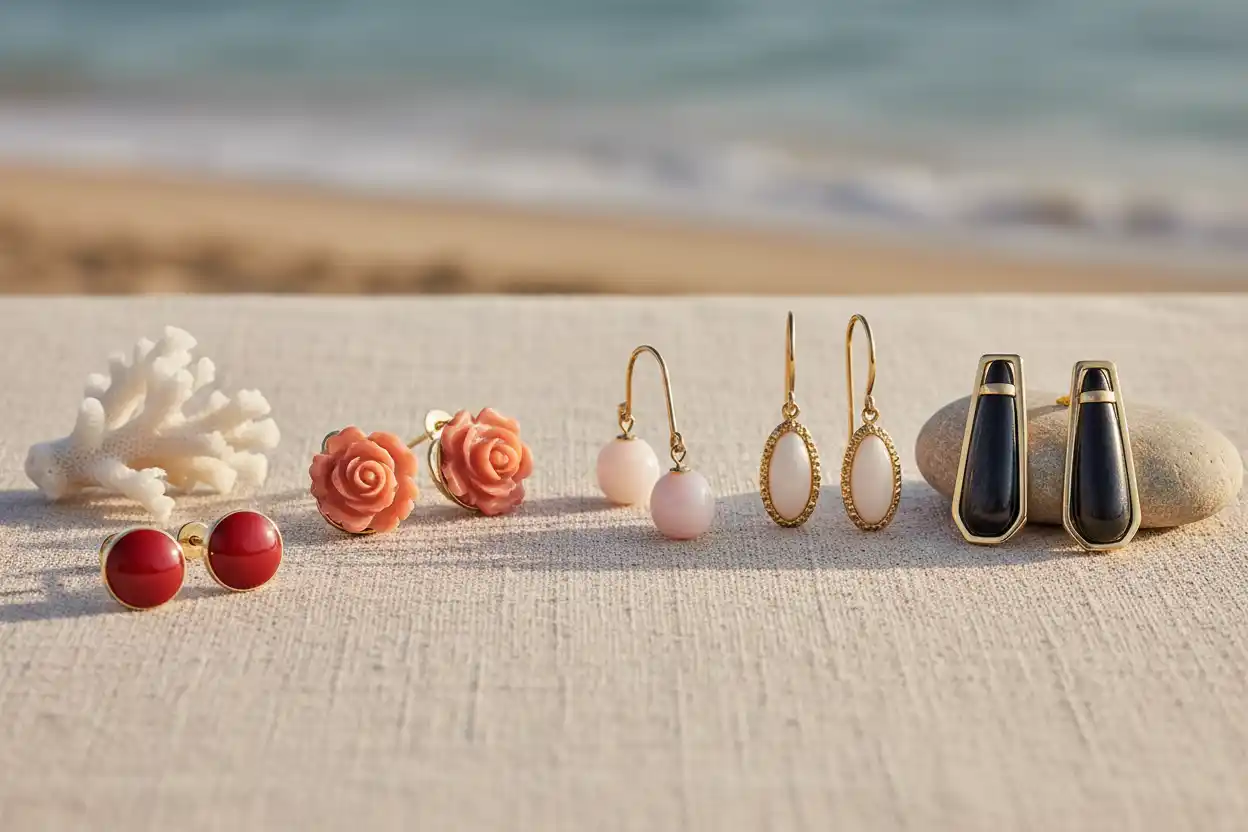
Coral Earrings: Styles, Settings & Buying Tips
Coral earrings can bring warm red, pink, orange, white, or other organic tones close to the face, but choosing a good pair involves more than matching a color to an outfit. Coral is an organic gem material rather than a conventional crystalline gemstone, and jewelry-quality coral is comparatively soft, vulnerable to chemicals and heat, and frequently encountered in treated, reconstructed, or imitation forms. A well-chosen pair of coral earrings should therefore balance material identification, pair matching, total earring weight, setting security, post or hook metal, treatment disclosure, comfort, and realistic care.
Earrings are one of the more practical ways to wear coral because they usually receive less impact and abrasion than rings or bracelets. Even so, coral earrings can still be scratched by harder jewelry, damaged by perfume or hairspray, chipped around drill holes, or lost because of weak posts, hooks, backs, or jump rings. The best pair is not simply the deepest red or the largest bead; it is a matched, comfortable, well-constructed pair whose seller clearly explains what the coral is, whether it has been treated, and how the earrings are assembled.
What Is Coral Used in Earrings?
Coral used in jewelry comes from the hard skeletal material produced by certain marine organisms. Gem-quality precious coral is especially associated with red, pink, orange, and white material that can take a smooth, porcelain-like polish, although the word “coral” is used broadly in retail listings and does not always identify the exact material or species.
This matters when buying coral earrings because genuine precious coral, other coral materials, reconstructed coral, dyed material, and imitations can look similar after polishing. Before comparing color or price, ask what material the seller is actually describing. The types of coral guide explains the major jewelry-related varieties and terminology in more detail.
Coral Earrings at a Glance
| Buying factor | What to check |
|---|---|
| Material identity | Genuine coral, reconstructed material, or imitation |
| Pair matching | Color, size, shape, luster, surface and carving |
| Hardness | Coral is comparatively soft, around 3–4 on the Mohs scale |
| Treatment | Dyeing, bleaching, waxing, resin/plastic stabilization or coating |
| Earring weight | Comfortable enough for the wearer’s lobes |
| Posts/hooks | Clearly disclosed metal and sturdy construction |
| Backs | Secure friction, screw, leverback, latch or other suitable system |
| Drill holes | Clean, centered and free from obvious chipping |
| Setting | Secure without excessive pressure on the coral |
| Care | Avoid harsh chemicals, heat, steam and ultrasonic cleaning |
| Seller disclosure | Material, treatments, metal, dimensions and return terms |
| Sourcing | Species/origin information and appropriate trade documentation where relevant |
These considerations make coral earrings a form-specific purchase. A necklace can distribute weight across a chain or strand, while earrings place the entire load on the piercing and depend on small pieces of hardware to keep the jewelry secure.
Why Coral Works Well for Earrings
Coral earrings have one practical advantage over many other coral jewelry forms: they spend less time hitting desks, door handles, tools, and other hard surfaces. That reduced impact makes earrings a sensible use for a material that is much softer than quartz, sapphire, or diamond.
They also place coral color close to the face, which makes pair matching especially visible. A small mismatch in red tone, bead diameter, carving depth, or surface polish can be more obvious in coral earrings than in a mixed necklace. Good makers therefore treat the two pieces as a matched set rather than as unrelated components.
Coral Hardness and Earring Durability
Coral used as a gem material is comparatively soft, generally around 3 to 4 on the Mohs scale. That means common dust containing quartz and contact with harder gemstones can scratch its polished surface. Coral earrings should not be tossed into a jewelry box beside diamond, sapphire, topaz, or quartz pieces.
Softness does not mean coral earrings are unsuitable for wear. Earrings normally experience limited surface contact, so a carefully worn pair can remain attractive for a long time. The main risks are scratches during storage, chips around drilled areas, knocks to dangling components, chemical damage, and wear at points where coral rubs against metal.
Stud Coral Earrings
Stud coral earrings are usually the simplest and most compact style. The coral may be a round bead, button, cabochon, carved piece, or polished disk attached to a post or mounted in a metal setting. Because the design sits close to the ear, studs are less likely to swing into clothing or strike nearby objects than long drops.
Inspect how the coral is attached. Some coral earrings use prongs or bezel-style metalwork, while others rely partly or entirely on adhesive. Adhesive construction is not automatically poor, especially for shapes that are difficult to secure mechanically, but the bond should be neat, stable, and disclosed when relevant. Excess glue around a post cup or cabochon edge can indicate rushed assembly.
Drop and Dangle Coral Earrings
Drop coral earrings create more movement and can showcase elongated branches, carved drops, beads, or multiple coral elements. Their extra length also introduces more mechanical points that can fail: jump rings, wire loops, pins, chains, hinges, and hooks all need inspection.
Pair balance matters. Hold or view both coral earrings side by side and check whether they hang to the same length, whether the main coral elements face consistently, and whether one earring visibly twists more than the other. In carved or natural-form coral, perfect mirror matching may be unrealistic, but the pair should still look intentionally coordinated.
Coral Hoop Earrings
Coral hoop earrings may use coral beads threaded onto a hoop, small coral pieces attached around a metal circle, or coral-colored inlay incorporated into a hoop design. The important durability question is whether the coral can move enough to rub repeatedly against metal or neighboring beads.
Check the hinge and closure before focusing on the coral. A beautiful pair of coral earrings is of little use if the hoop latch opens too easily. For bead-covered hoops, inspect every drill hole and look for chips where the coral contacts the wire, because repeated movement can gradually enlarge damaged holes.
Carved Coral Earrings
Carved coral earrings can feature flowers, leaves, faces, cameos, geometric forms, or abstract motifs. Fine carving can add substantial workmanship and individuality, but thin petals, projecting tips, and undercut areas are vulnerable because coral is soft.
Examine both earrings under good light. Look for missing points, freshly polished areas that may conceal old damage, hairline fractures, filled breaks, or carving details that differ because one component has been repaired. A small natural variation can add character; structural damage is a different issue.
Coral Bead Earrings
Beaded coral earrings should be judged partly by the quality of each drill hole. Holes should be reasonably centered and should not show major chips, splitting, or powdery edges. A bead drilled too close to one side may have a thin wall that is more vulnerable to breakage.
Also check how the bead is retained. Head pins should have secure loops, wire wrapping should be tidy, and decorative caps should sit without crushing the coral. If coral earrings use several beads, make sure the lower components cannot repeatedly strike each other during normal movement.
Pair Matching: One of the Most Important Quality Factors
Pair matching is central to coral earrings because the two pieces are viewed together. Compare hue, tone, saturation, luster, size, shape, polish, surface texture, and pattern. Natural material does not need to be perfectly identical, but a good pair should look balanced rather than accidental.
Color matching deserves particular attention in red and pink coral earrings. One piece may look more orange, pale, brownish, or purple than the other under neutral light. Dyed material may appear extremely uniform, but uniformity by itself does not prove treatment. It simply means color origin should be considered alongside seller disclosure and gemological evidence.
Choosing the Right Size
Large coral earrings can be visually striking, but size affects both comfort and durability. A large bead or carving can put more leverage on the piercing, while a long drop can swing and catch on clothing, hair, scarves, or headphones.
Do not judge size only from close-up photographs. Ask for millimeter dimensions and total earring length. For substantial coral earrings, total gram weight for each earring is also useful because two pairs of similar visual size can feel very different on the ear depending on the coral, metal, and construction.
Earring Weight and Earlobe Comfort
Weight is one of the most form-specific considerations when buying coral earrings. Heavy earrings can pull downward on the lobe, rotate forward, or become uncomfortable even if the coral itself is beautiful. Comfort depends on total weight, how that weight is distributed, piercing position, and the backing system.
For heavier studs, a larger supportive back may hold the earring more upright than a tiny friction back. Long coral earrings should be light enough that movement does not constantly tug on the piercing. If you already know that heavy earrings cause discomfort, prioritize smaller beads, thinner carvings, hollow or lightweight metalwork, and shorter drops.
Posts, Hooks, and Sensitive Ears
The coral receives most of the visual attention, but the part touching the piercing is metal. Coral earrings may use gold, silver, platinum, titanium, niobium, stainless steel, plated base metal, or other alloys, and sellers sometimes describe the hardware with vague phrases such as “gold tone” rather than stating its composition.
If your ears are sensitive, choose coral earrings with clearly disclosed post or hook material instead of assuming the visible metal color tells you what the alloy contains. Plating can wear and expose underlying metal. Persistent redness, swelling, itching, or pain should be treated as a health issue rather than as a normal effect of wearing coral.
Earring Backs and Security
A secure back is especially important when the coral has meaningful monetary or sentimental value. Friction backs are common for studs, while screw backs, locking backs, leverbacks, latch backs, and hooks with silicone stoppers offer different balances of convenience and security.
Test whether each back fits its post properly. A friction back that slides with almost no resistance may be too loose, while forcing an incorrect back onto a post can damage the hardware. For valuable coral earrings, the quality of the closure deserves the same attention as color and polish.
Settings: Prongs, Bezels, Cups, and Wire
Coral is soft enough that aggressive setting pressure can damage it. Prongs should secure a cabochon or carving without digging visibly into the surface, while a bezel edge should be smooth and evenly finished rather than crushing thin coral around the perimeter.
Cup settings can work well for rounded or carved coral earrings because they support the back of the material, although adhesive may be involved. Wire-mounted beads should move freely enough not to bind, but not so freely that they repeatedly strike hard metal surfaces.
A secure setting protects the coral without pretending it is a hard crystalline gem.
Natural Color, Dyed Coral, and Other Treatments
Treatment disclosure matters when buying coral earrings. Coral can be dyed to strengthen or change its color, bleached, impregnated with wax, stabilized with plastic or resin, and in some cases coated. Treatment can affect value, appearance, durability, and appropriate cleaning.
Dyed coral earrings can still be attractive and wearable when sold honestly at an appropriate price. The problem arises when treated material is represented as rare natural-color coral or when care requirements are hidden. Alcohol, acetone, strong chemicals, heat, and prolonged intense light can affect some dyes, coatings, or fillers.
Reconstructed Coral and Imitations
Not every item sold as coral earrings contains solid natural coral. Reconstructed material can be made from smaller coral pieces bonded together, while imitations may include glass, plastic, dyed limestone, ceramics, bone, marble, or other materials.
Some imitations are legitimate fashion jewelry when clearly labeled. The buying problem is misrepresentation. A seller should not charge a natural precious-coral premium for reconstructed or imitation material while relying on vague terms such as “coral style” or “coral stone.”
For a broader purchase framework, use the buy coral guide before making a higher-value purchase.
Color and Surface Quality
Fine coral earrings are often valued for attractive, reasonably even color and a smooth polish. Red, pink, salmon, orange, and white tones can all be desirable depending on the material and buyer preference; no single shade makes every pair superior.
Inspect the surface for pits, cracks, scratches, dull patches, obvious filled areas, or color concentrations around pores and drill holes. Some natural structure is expected in organic material, so the goal is not artificial perfection. The question is whether the condition is consistent with the seller’s quality description and price.
Precious Coral, Reef Coral, and Responsible Buying
The term coral covers biologically and commercially different materials, and jewelry coral should not be treated as though every coral species has the same conservation or trade status. Regulations can depend on species, origin, jurisdiction, and transaction route, while identification may require specialist knowledge.
For higher-value coral earrings, ask for a clear material description, provenance where available, and any documentation appropriate to lawful trade. Do not assume that a seller’s use of “vintage,” “Mediterranean,” “antique,” or another origin term automatically resolves sourcing questions. The dedicated coral ethics guide covers sourcing and conservation considerations in greater depth.
Coral Earrings vs Coral Necklace
Coral earrings and a coral necklace may use similar beads or carvings, but the mechanical demands differ. Necklaces place more emphasis on strand construction, clasp security, chain length, stringing material, and how the piece rests against the neck.
Coral earrings require closer attention to pair matching, total weight per ear, post or hook metal, backing security, movement, and left-right balance. A necklace bead that works perfectly in a strand may be too heavy or poorly drilled for an earring.
How Much Should Coral Earrings Cost?
There is no durable universal price for coral earrings because value depends on material identity, natural or treated color, species or variety, pair matching, size, condition, workmanship, carving, provenance, metal quality, and seller channel. Finished jewelry also includes the value of posts, hooks, settings, side stones, design, and labor.
When comparing coral earrings, separate the coral from the mounting mentally. A small pair in substantial high-quality precious metal may cost more than larger coral mounted in inexpensive hardware. Likewise, exceptional matching or carving can add value beyond raw material size. The coral price guide explains those value drivers without relying on a single price-per-carat figure.
How to Buy Coral Earrings Online
Online photographs should show both earrings together and individually from the front, side, and back. Look for enough detail to inspect color matching, drill holes, backs, posts, glue lines, settings, chips, and surface polish. Highly saturated images alone are not enough.
Ask for dimensions, total drop length, approximate weight per earring for larger designs, hardware metal and purity, treatment disclosure, material identification, and return terms. If the seller makes an important natural-color, species, locality, or provenance claim, ask what evidence supports it.
A seller who provides precise answers gives you much more useful information than one who responds only with marketing phrases such as “healing coral,” “rare ocean gem,” or “investment quality.”
Coral Earrings Buying Checklist
Before buying coral earrings, check:
- The material is identified clearly.
- Natural, reconstructed, treated, or imitation status is disclosed.
- The two earrings match reasonably in color, size, shape and luster.
- Drill holes are clean and not heavily chipped.
- Carved tips or thin areas are intact.
- Settings hold the coral without visible crushing or stress.
- Posts, hooks and backs are sturdy.
- Metal composition is clearly stated.
- The total earring weight is appropriate for comfortable wear.
- Long drops hang at matching lengths.
- Jump rings and wire loops are closed securely.
- Treatments and special care requirements are disclosed.
- Species or origin claims have appropriate support when they affect value.
- Sourcing information is adequate for the type of coral being sold.
- The return policy allows inspection after delivery.
This checklist helps keep coral earrings focused on measurable quality and construction instead of relying on color or storytelling alone.
How to Care for Coral Earrings
Coral earrings should be treated as delicate organic gem jewelry. Keep perfume, hairspray, cosmetics, chlorine, harsh cleaners, acids, and strong solvents away from the coral surface. Put the earrings on after personal-care products have dried rather than spraying products directly around them.
Do not use ultrasonic or steam cleaners. Wipe coral earrings gently after wear with a soft cloth, and use only conservative cleaning methods appropriate to the material and any treatments. The detailed how to clean coral jewelry guide covers safe methods and common mistakes.
Storing Coral Earrings
Store coral earrings separately from harder gemstones and metal pieces that can scratch the polished surface. A soft pouch or divided jewelry box works well, but long drops should be positioned so that the two coral elements do not strike each other.
Fasten or pair the backs with the earrings before storage so they are not lost. Avoid crushing carved pieces under heavier jewelry, and keep the pair away from excessive heat or harsh chemical environments.
When to Have Coral Earrings Repaired
Stop wearing coral earrings if the post bends significantly, a setting becomes loose, a bead develops a spreading crack around the drill hole, a jump ring opens, or a glued component begins to move. Continuing to wear the pair can turn a small repair into a lost coral element.
Choose a jeweler familiar with delicate organic gem materials. Heat used during metal repair can damage coral, so the jeweler may need to remove or isolate the coral before soldering or other high-temperature work.
Coral Meaning and Symbolism in Earrings
Coral has accumulated symbolic associations involving protection, vitality, connection with the sea, courage, and emotional steadiness in different cultural and modern crystal traditions. These ideas are historical or metaphysical interpretations rather than scientifically established effects of wearing coral earrings.
A grounded way to use the symbolism is as a personal reminder. A pair of coral earrings might represent speaking with confidence, preserving something meaningful, or approaching change with steadiness. The jewelry does not need to guarantee protection or healing for the symbolism to have personal value.
For the mineralogical, biological, historical, and symbolic background beyond the jewelry form, see the coral meaning guide.
Final Thoughts
Coral earrings are one of the more wearable forms of coral jewelry because earrings generally avoid the constant impact experienced by rings and bracelets, but the material still needs thoughtful buying and care. Coral is soft, sensitive to harsh chemicals and heat, and sold in natural, treated, reconstructed, and imitation forms, so pair matching and disclosure matter as much as color.
The strongest coral earrings combine an attractive matched pair with sensible weight, clean drill holes, secure settings, reliable posts or hooks, appropriate backs, clearly identified metal, honest treatment information, and sourcing documentation where relevant. A dramatic red color or large bead cannot compensate for weak hardware or poor disclosure.
Choose coral earrings for their appearance, craftsmanship, comfortable fit, organic character, or personal symbolism, then protect them according to what the material actually is. That approach makes the jewelry easier to wear confidently without relying on exaggerated rarity, healing claims, or generic gemstone advice.
FAQs
Are coral earrings durable?
Coral earrings are practical when worn carefully because earrings receive less impact than rings or bracelets, but coral is relatively soft at about 3 to 4 on the Mohs scale. Store the pair away from harder gemstones and protect it from chemicals, heat, and hard knocks.
How can I tell whether coral earrings are real?
Visual appearance alone is not always enough. Genuine coral, reconstructed coral, dyed material, glass, plastic, dyed limestone, ceramics, bone, and other imitations can overlap in appearance. Higher-value coral earrings may justify examination by an experienced gemologist or specialist.
Can coral earrings be dyed?
Yes. Dyeing is one treatment encountered in coral, and other processes can include bleaching, waxing, resin or plastic stabilization, and coating. Treatments should be disclosed because they can affect value and care.
What should I check when matching a pair?
Compare color, tone, size, shape, luster, surface condition, carving, drill-hole position, and total drop length. Coral earrings do not need to be perfectly identical, but they should look intentionally balanced when worn together.
Are coral studs better than coral drops?
Neither is universally better. Stud coral earrings are compact and less likely to catch on clothing, while drops provide more movement and visual presence. Drops require additional attention to weight, jump rings, wire loops, and left-right balance.
Are coral earrings good for sensitive ears?
The coral itself is not usually the part passing through the piercing, so hardware metal matters. Choose clearly disclosed post or hook materials and avoid vague alloy descriptions if you have metal sensitivities. Stop wearing any pair that causes persistent irritation.
How heavy should coral earrings be?
There is no single ideal weight because comfort varies by wearer and piercing. For large coral earrings, ask for the weight of each earring and consider how far the weight hangs from the lobe. Heavy, long drops create more leverage than compact studs.
Can I clean coral earrings in an ultrasonic cleaner?
No. Ultrasonic and steam cleaning are poor choices for coral. Use conservative care, avoid harsh chemicals and solvents, and follow a coral-specific cleaning method.
Why are some coral earrings much more expensive than others?
Price can reflect coral type, natural versus treated color, size, pair matching, condition, carving, provenance, metal quality, workmanship, and sourcing documentation. A high asking price by itself does not prove exceptional coral.
Can coral earrings get wet?
Brief careful contact during appropriate cleaning is different from prolonged soaking. Avoid swimming, chlorinated water, repeated soaking, and unnecessary exposure to chemicals because coral and its treatments can be sensitive.
What are common coral imitations?
Imitations can include glass, plastics, dyed limestone, ceramics, bone, marble, and reconstructed products made from smaller pieces bonded together. Clear seller disclosure is more reliable than assuming a visual test can identify every imitation.
What is the best setting for coral earrings?
The best setting supports the coral without excessive pressure and matches the shape being used. Bezels, cups, prongs, posts, and wire-mounted bead designs can all work when properly constructed. Because coral is soft, settings should not crush thin edges or create stress around drill holes.