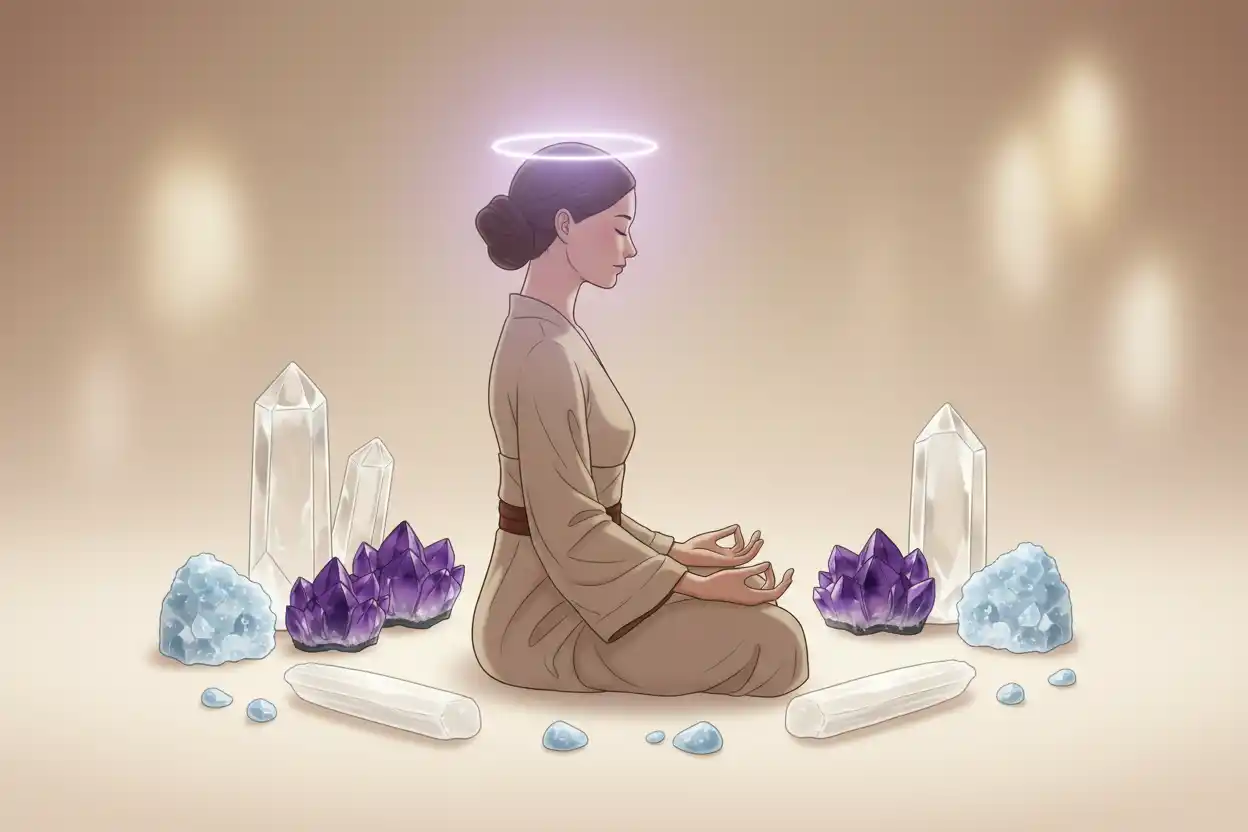
Crown Chakra Without the Myths: Meaning, History & Uses
The crown chakra is a spiritual and symbolic concept rather than a mineral, anatomical structure, measurable energy organ, or gemstone species, so understanding it responsibly begins by making that boundary explicit. In modern seven-chakra systems, the crown chakra is commonly placed at or just above the top of the head and associated with themes such as awareness, transcendence, meaning, consciousness, spiritual connection, contemplation, and a sense of relationship with something larger than the individual self. The Sanskrit name Sahasrara, often translated in English through imagery of a thousand-petaled lotus, is widely connected with crown symbolism, although historical South Asian chakra systems are more varied than the standardized diagrams common in contemporary wellness culture.
That distinction changes how a crown chakra page should be read. There is no mineralogical specimen that can be authenticated as “crown chakra,” no geological deposit that produces crown chakra material, and no laboratory instrument that can measure whether a crown chakra is physically open, blocked, overactive, or underactive. Crystals, meditation practices, colors, mantras, visualizations, yoga techniques, and ritual objects can be associated with the concept through religious, esoteric, cultural, or personal traditions, but those associations should not be described as if they were demonstrated anatomical or medical mechanisms.
Within Gems Lore’s broader Healing Crystal coverage, the crown chakra is therefore best treated as a symbolic framework around which people organize reflective practices. The physical objects used in those practices still require ordinary gemological identification, while claims about consciousness, spirituality, or personal meaning belong to a different category of evidence.
Crown Chakra at a Glance
| Question | Grounded answer |
|---|---|
| What is the crown chakra? | A spiritual or symbolic energy-center concept used in some yogic, tantric, esoteric, and modern wellness systems |
| Common Sanskrit name | Sahasrara |
| Common symbolic location | Crown or top of the head, sometimes conceptualized just above it |
| Common modern colors | Violet, white, clear, or combinations of these |
| Common symbolism | Awareness, transcendence, contemplation, unity, meaning, spiritual connection |
| Is it a physical organ? | No |
| Can medical imaging detect it? | No established anatomical structure corresponds to a crown chakra |
| Can it be scientifically measured as open or blocked? | No validated diagnostic test establishes such a state |
| Are associated crystals scientifically proven to activate it? | No |
| Can crystal use still have symbolic value? | Yes, as part of personal, cultural, meditative, or ritual practice |
| Important historical caution | Chakra systems vary significantly; the familiar standardized seven-color model should not be projected unchanged onto every historical tradition |
| Primary safety boundary | Spiritual practice should not replace medical or mental-health evaluation when symptoms or health concerns are present |
The central idea is not that the crown chakra must be dismissed because it cannot be measured like blood pressure or mineral hardness. Rather, it should be described according to the type of claim being made. Religious symbolism can be historically studied, meditation can be practiced personally, cultural traditions can carry genuine meaning, and crystals can function as physical focus objects. What should be avoided is turning those categories into unsupported statements about anatomy, disease, or experimentally proven energy transfer.
The Crown Chakra Is Not a Mineral Material
The workbook category surrounding the crown chakra includes many mineral and gemstone pages, which can make it tempting to discuss crown chakra meaning as though the chakra itself were a crystal material. It is not. A quartz point associated with the crown chakra remains quartz; an amethyst remains quartz colored by specific trace-element and structural processes; selenite remains gypsum; and any other object used during a crown chakra practice retains its own mineralogical identity regardless of the spiritual label applied to it.
This distinction is especially important in online shops. Phrases such as “crown chakra stone,” “Sahasrara crystal,” “crown activator,” or “seventh-chakra mineral” describe intended symbolic use rather than a scientifically recognized mineral category. A transparent stone marketed for crown chakra practice still needs to be identified through ordinary properties such as composition, hardness, refractive behavior, cleavage, crystal habit, inclusions, treatment, and provenance.
For that reason, an object sold under crown chakra branding can still require conventional examination. The crown chakra microscope and inclusion notebook is relevant when the practical question concerns the physical stone rather than the spiritual concept, because microscopic features can help evaluate a specimen even though they cannot reveal whether it possesses a metaphysical chakra function.
How the Crown Chakra Concept Took Shape
The crown chakra did not emerge from geology, crystallization, or a single universal anatomical model. Its background belongs instead to the diverse history of South Asian religious, yogic, and tantric thought, where subtle-body systems have been described in multiple ways. Different traditions have used different numbers of centers, locations, symbols, deities, sounds, petals, channels, ritual functions, and contemplative interpretations. Modern diagrams that present one fixed seven-chakra system should therefore be understood as a later standardized synthesis rather than the only historical model.
Sahasrara is commonly associated with thousand-petaled lotus imagery and with states of transcendence or consciousness beyond ordinary conceptual divisions. However, exact interpretations vary according to textual, sectarian, philosophical, and modern esoteric context. Some systems place strong emphasis on ascending subtle energy, others frame the symbolism differently, and many modern wellness descriptions substantially simplify older religious material.
This historical complexity matters because a claim can sound authoritative while blending several traditions together. Saying “the crown chakra has always meant exactly this” is usually less defensible than explaining which symbolic interpretation is being discussed. The same caution should be applied when modern crystal associations are presented as though every ancient chakra tradition used the same stones.
Why Violet and White Became Crown Chakra Colors
Violet and white are now widely associated with the crown chakra, but that color pairing should be treated as a modern symbolic convention rather than an unchanging rule embedded identically in every historical chakra system. Contemporary seven-chakra charts often align the centers with a rainbow-like sequence, placing violet at the crown, while white or clear imagery is frequently added to represent unity, pure awareness, light, openness, or transcendence.
These associations are symbolic. Violet does not contain a physical frequency that automatically activates a crown chakra simply because violet light occupies a measurable portion of the visible spectrum. Likewise, a colorless crystal does not become spiritually superior because transparency is interpreted metaphorically as clarity.
A separate physical question arises when an actual crystal is involved. If the concern is why a stone appears white, transparent, violet, iridescent, or colorless, the answer belongs to gemology and optics. The dedicated crown chakra optical properties and color behavior reference is useful for separating the visual properties of associated materials from the symbolic color system attached to the chakra concept.
“Formation” Means Historical Development, Not Deposit Geology
Because the crown chakra is not a mineral species, it does not form in hydrothermal veins, pegmatites, sedimentary environments, or metamorphic rocks. When people ask how the crown chakra “formed,” the meaningful question is how the concept developed historically and how modern interpretations came to combine subtle-body teachings, meditation, color symbolism, Western esotericism, crystal culture, and contemporary wellness language.
Physical stones used in crown chakra practice do have geological origins, and those origins should be investigated separately. A clear quartz crystal may form in a silica-rich geological environment, while another crown-associated material may have completely different chemistry and formation conditions. The crown chakra formation and deposit geology material should therefore be read as information about objects marketed within the crown chakra cluster, not as evidence that the chakra itself has a geological deposit.
Keeping those levels separate prevents a common conceptual error: treating spiritual classification as though it were mineral classification.
There Is No Diagnostic Test for an “Open” Crown Chakra
Descriptions of an open crown chakra often include calmness, perspective, spiritual connection, reduced attachment, insight, trust, or a sense of unity. Descriptions of a blocked crown chakra may include confusion, isolation, cynicism, disconnection, lack of meaning, or spiritual frustration. These lists can function as reflective prompts within a spiritual framework, but they are not validated diagnostic criteria.
There is no established blood test, imaging method, neurological marker, gemological reading, aura photograph, pendulum response, or crystal reaction that proves a crown chakra is open or blocked. Emotional states such as confusion, disconnection, low mood, unusual perceptions, insomnia, headaches, concentration difficulty, or anxiety can have many ordinary psychological, medical, environmental, and situational causes. Assigning them automatically to a crown chakra problem can obscure more appropriate explanations.
This is one of the clearest boundaries of crown chakra meaning: symbolic language can help someone frame a reflective question, but it should not become a substitute diagnostic system.
A Claim-Check Table for Crown Chakra Information
| Claim | What can be supported | What remains interpretation or unsupported |
|---|---|---|
| “The crown chakra is Sahasrara.” | Sahasrara is widely associated with crown symbolism in yoga and modern chakra literature | Every tradition using identical placement, meaning, or practice |
| “The crown chakra is violet.” | Violet is a widespread modern association | A universal ancient rule assigning violet to Sahasrara |
| “Clear quartz activates the crown chakra.” | Clear quartz is widely used symbolically in modern crystal practice | A scientifically demonstrated activation mechanism |
| “A blocked crown chakra causes headaches.” | Some modern metaphysical lists make this association | A medically established causal relationship |
| “Meditation can focus on crown symbolism.” | People can use imagery, breath, prayer, mantra, or attention in contemplative practice | Proof that a measurable chakra changes state |
| “Crystals raise crown frequency.” | This phrase has symbolic meaning in contemporary spiritual communities | A validated physical frequency transfer into consciousness |
| “White stones purify the crown chakra.” | White and clear stones can represent purity or clarity symbolically | Demonstrated removal of a physical or energetic contaminant |
| “A crown chakra crystal can be authenticated.” | The mineral itself can often be identified gemologically | Gemology cannot certify metaphysical chakra power |
| “Opening the crown chakra produces enlightenment.” | Some traditions connect crown symbolism with transcendent realization | A predictable result produced by a specific consumer ritual |
| “Ancient practitioners used today’s exact seven-stone system.” | Crystals and sacred materials have long cultural histories | A single unchanged modern crystal-chakra chart extending across all historical traditions |
This comparison is useful because crown chakra information often combines several kinds of statements in one paragraph. Historical claims should be judged by textual and cultural evidence, mineral claims by gemological evidence, health claims by medical evidence, and spiritual interpretations by the tradition or personal practice in which they are meaningful. One category should not be used to prove another.
Historical Context Without Backdating Modern Crystal Lore
The crown chakra has genuine historical roots in subtle-body and yogic traditions, but the modern pairing of specific commercial crystals with individual chakra colors should not automatically be projected backward. Contemporary lists may associate clear quartz, amethyst, selenite, howlite, moonstone, diamond, or other pale and violet materials with the crown chakra, yet those pairings can reflect recent color symbolism, crystal-healing culture, or modern esoteric synthesis rather than one ancient canonical list.
That does not make modern practice meaningless. Traditions evolve, communities reinterpret symbols, and individuals can build personally coherent ritual systems. The problem appears only when a recent association is presented as ancient fact without evidence.
The same source discipline applies throughout Gems Lore. The About page explains the site’s broader approach to separating material facts from symbolic interpretation, which is especially important on a subject where religious history, wellness language, and crystal marketing frequently overlap.
Common Crown Chakra Symbolism
Crown chakra meaning commonly centers on awareness, transcendence, spiritual connection, unity, surrender, contemplation, wisdom, and the search for meaning beyond immediate personal concerns. The thousand-petaled lotus image is often interpreted as a symbol of expanded consciousness or an opening toward a reality larger than the ordinary ego.
These themes can be psychologically or spiritually useful without becoming claims about anatomy. A person might use crown chakra symbolism to ask whether they are excessively absorbed in immediate problems, whether their worldview leaves room for uncertainty, whether they have neglected reflection, or whether their spiritual beliefs are being practiced consistently with their values.
The crown chakra can therefore function as a conceptual lens. It does not need to be described as a literal invisible organ to retain symbolic depth.
What “Opening the Crown Chakra” Can Mean Responsibly
In careful language, opening the crown chakra can mean engaging more deliberately with practices associated with contemplation, humility, spiritual inquiry, meditation, prayer, philosophical reflection, service, or awareness. The phrase can describe a change in attention or personal orientation without claiming that a measurable structure above the skull has physically opened.
Problems arise when the metaphor becomes a medical mechanism. No credible evidence shows that manipulating a crystal above the head mechanically opens a hidden anatomical center or guarantees altered consciousness. Likewise, unusual sensations during meditation should not automatically be interpreted as proof that spiritual energy has entered the brain.
A safer interpretation is experiential: the practice may feel meaningful, calming, centering, challenging, or emotionally significant to the individual. Those experiences can be described as experiences without claiming a universal physiological mechanism.
Crown Chakra Crystals Are Symbolic Associations
The dedicated crown chakra crystals guide can compare stones commonly associated with Sahasrara symbolism, but the important boundary on this page is that no gemstone is scientifically proven to activate a chakra. Selection usually follows color, transparency, cultural association, personal preference, or modern crystal-healing convention.
Clear quartz is a common example because transparency encourages metaphors involving clarity, openness, amplification, and light. Its actual mineral properties belong to clear quartz meaning, where silicon dioxide chemistry, hardness, crystal habit, inclusions, and modern symbolism can be distinguished properly.
An amethyst used for crown chakra practice remains amethyst. A white gypsum object remains gypsum. A diamond remains diamond. Spiritual use does not alter species identity.
How to Evaluate a Stone Sold as a “Crown Chakra Crystal”
First identify the physical material. Ask what mineral, mineraloid, glass, synthetic product, composite, or organic gem is being sold. A vendor who gives only a chakra label without identifying the actual material has omitted information needed for care, durability, treatment evaluation, and value.
Then separate manufacturing from symbolism. A carved point, sphere, tower, bead, or polished palm stone may be made from genuine mineral material even though its shape was created by people. The crown chakra cutting, orientation, and polish reference can help frame the lapidary side of such objects without implying that the manufactured shape possesses greater spiritual power.
Wearability is another physical question. If a crown-associated crystal is mounted in jewelry, hardness, cleavage, fracture, setting pressure, and exposure matter more than chakra terminology. The crown chakra setting and wear engineering material belongs to that practical decision rather than to claims about spiritual effectiveness.
Finally, ask whether the seller is using symbolism transparently. “Traditionally associated in modern crystal practice with the crown chakra” is materially different from “clinically proven to activate the brain’s spiritual center.”
Meditation and Crown Chakra Practice
A crown chakra meditation can be approached as a contemplative exercise rather than an attempt to force a hidden mechanism. A practitioner might sit comfortably, allow breathing to remain natural, direct attention toward the top of the head, visualize white or violet light if that imagery is personally meaningful, repeat a mantra from an appropriate tradition, or reflect on themes such as awareness, humility, connection, or meaning.
The practice does not require a dramatic sensation. Tingling, warmth, pressure, vivid imagery, emotion, or silence can all occur during meditation for many reasons, and the absence of unusual sensation does not mean the practice has failed. Chasing stronger sensations can become distracting from the reflective purpose.
The most useful measure is often behavioral. If the practice is intended to cultivate perspective or spiritual awareness, ask whether it supports greater patience, attentiveness, ethical consistency, or clarity afterward rather than whether a spectacular internal effect appeared during the session.
Crown Chakra Grids and Ritual Arrangements
Some people arrange crystals geometrically around a meditation space or central symbolic object. A crystal grid guide can help with layout, intention-setting, and practical arrangement, but geometry itself does not establish an invisible field with clinically demonstrated effects.
A crown chakra grid might use clear, white, or violet stones because those colors fit the user’s symbolic system. The arrangement can create a deliberate environment, reduce distractions, and make a reflective practice feel structured. Those are meaningful practical effects even when the proposed metaphysical mechanism remains unverified.
Care should still follow the individual minerals. A grid that combines quartz, gypsum, calcite, coated stones, metals, or fragile specimens should not be cleaned or handled as though every component has the same hardness and chemical stability.
Cultural Respect Matters More Than Decorative Accuracy
Chakra terminology comes from South Asian religious and philosophical traditions that are considerably richer than simplified commercial diagrams. Using a crown chakra framework does not require becoming a scholar of every source, but it does benefit from acknowledging that Sahasrara has cultural and religious contexts beyond crystal-shop color charts.
Respectful use means avoiding claims such as “all Hindu traditions teach exactly seven chakras,” “ancient yogis used these exact seven gemstones,” or “the original crown chakra has always been violet.” Different texts and lineages organize subtle-body concepts differently, and modern interpretations often combine Indian terminology with later Western esoteric systems.
Cultural respect also means distinguishing appreciation from authority. A modern practitioner can describe how they personally use crown chakra symbolism without claiming to speak for every yogic or tantric tradition.
Ethical Questions Belong to the Physical Object
A spiritual label does not answer ethical sourcing questions. If a crown chakra practice uses quartz, amethyst, gypsum, diamond, coral, or another material, labor conditions, environmental impact, legality, biological conservation, provenance, and treatment disclosure belong to the object itself.
The contrast becomes particularly clear in coral ethics, where biological sourcing and marine conservation create concerns very different from those surrounding mined quartz. Calling both materials “crown chakra stones” would not erase those differences.
Ethical evaluation therefore follows material identity and supply chain, not chakra category.
Provenance Cannot Prove Spiritual Power
A crystal may have excellent provenance without having any scientifically measurable chakra effect. Mine labels, dealer records, old collection cards, invoices, laboratory documentation, and chain-of-custody information can support claims about geographic or collecting history. None can certify that a specimen activates Sahasrara.
The crown chakra provenance disclosure checklist is useful when a seller uses a famous locality to justify rarity or price. “From a spiritually powerful mountain” may be meaningful within a belief system, but the geographic origin and the metaphysical interpretation remain separate claims.
This separation protects both sides of the discussion: provenance remains useful evidence, while symbolism remains honest about its interpretive status.
Conservation Still Matters for Symbolic Objects
People sometimes handle ritual stones more frequently than ordinary collection specimens, which makes condition and care relevant. A favorite crown chakra crystal can accumulate scratches, chips, residue, worn polish, loose settings, or cleaning damage even when its spiritual role remains unchanged.
A crown chakra specimen conservation record can be used to track condition for an important or inherited object, particularly when repairs, coatings, old labels, or provenance are involved. The point is not to bureaucratize a personal practice but to remember that the physical object has its own conservation needs.
“Cleansing” in a spiritual sense should not be confused with chemical cleaning. Salt, prolonged water exposure, sunlight, heat, smoke, oils, or abrasive substances can damage certain minerals even when those methods appear in ritual advice.
Safe Crown Chakra Practice
The safest approach to crown chakra work is to treat it as spiritual or reflective practice rather than medical treatment. Meditation, journaling, quiet contemplation, prayer, gentle visualization, or symbolic crystal use may fit a person’s beliefs, but persistent physical or psychological symptoms should be evaluated through appropriate professional channels rather than diagnosed as chakra imbalance.
Direct ingestion of crystals is unnecessary. Placing unknown minerals in drinking water, grinding them into powders, applying mineral dust to the skin, or heating them during rituals can introduce physical risks unrelated to the intended symbolism. Every stone should be treated according to its actual chemistry and structure.
The site’s Disclaimer is particularly relevant on this topic because crown chakra language can sound diagnostic when words such as blockage, healing, activation, or imbalance are used casually. Those terms should remain within their spiritual or metaphorical context.
What Can Be Verified and What Cannot
A physical crystal can often be identified. Its hardness can be measured, refractive properties examined, composition analyzed, inclusions studied, treatment investigated, and provenance documented to varying degrees. The crown chakra association attached to that crystal cannot be tested by the same methods.
Likewise, historical research can examine whether a chakra concept appears in particular traditions, how a Sanskrit term has been interpreted, or whether a modern color association developed later. Historical evidence cannot prove that a chakra physically exists as an anatomical structure.
Personal experience occupies another category. Someone can accurately say, “Meditating with this stone helps me focus,” because that reports an individual experience. The stronger statement “this stone objectively activates everyone’s crown chakra” requires evidence that personal testimony does not provide.
When a Gems Lore page makes a crown chakra claim that appears historically overconfident, medically misleading, or materially inconsistent with the stone being described, readers can use Contact to flag the specific statement for review rather than treating repetition across crystal websites as verification.
Frequently Asked Questions About the Crown Chakra
What is the crown chakra?
The crown chakra is a spiritual and symbolic concept commonly associated with the top of the head, awareness, transcendence, meaning, unity, and spiritual connection. It is not a recognized anatomical organ or mineral species.
What is the Sanskrit name for the crown chakra?
Sahasrara is the name most commonly associated with the crown chakra in modern yoga and chakra discussions. It is frequently represented through thousand-petaled lotus imagery.
What color is the crown chakra?
Violet and white are the most common modern associations, with clear or luminous imagery also used. These colors are symbolic conventions and should not be presented as one universal ancient rule.
Where is the crown chakra located?
Modern seven-chakra diagrams typically place it at or just above the crown of the head. This is a symbolic subtle-body location rather than an anatomical structure visible through medical imaging.
What does an open crown chakra mean?
Within modern spiritual language, an open crown chakra may symbolize perspective, spiritual connection, awareness, humility, meaning, or a reduced sense of separation. There is no validated medical test for this state.
What does a blocked crown chakra mean?
“Blocked crown chakra” is metaphysical language commonly used for feelings such as disconnection, lack of meaning, spiritual frustration, or rigid thinking. These experiences can have many causes and should not automatically be diagnosed through chakra terminology.
Can science detect the crown chakra?
No established scientific instrument or validated anatomical method detects a crown chakra as a physical organ or independently measurable energy center.
Which crystals are associated with the crown chakra?
Modern crystal practice commonly uses clear, white, and violet stones, including clear quartz and amethyst among others. These are symbolic associations rather than scientifically demonstrated activation tools.
Does clear quartz open the crown chakra?
There is no established scientific evidence that clear quartz physically opens or activates a crown chakra. It can still be used symbolically as a focus object for clarity, intention, or meditation.
Can crown chakra meditation be useful without believing in literal energy centers?
Yes. Someone can use crown chakra imagery as a contemplative framework for awareness, perspective, spirituality, or meaning without interpreting the chakra as a measurable anatomical structure.
Are headaches a sign that the crown chakra is opening?
A headache should not be assumed to prove spiritual activation. Headaches have many ordinary causes, and persistent, severe, or concerning symptoms should be addressed through appropriate medical evaluation rather than chakra interpretation alone.
Can opening the crown chakra be dangerous?
Ordinary gentle meditation or symbolic reflection does not require forceful techniques. Practices involving extreme breathing, prolonged deprivation, ingestion of minerals, unsafe physical postures, or ignoring significant psychological or physical symptoms deserve greater caution regardless of spiritual framing.
A Better Way to Understand Crown Chakra Meaning
Crown chakra meaning becomes clearer when it is allowed to remain a spiritual framework instead of being forced into categories where it does not belong. The crown chakra is not a gemstone, geological substance, endocrine gland, neurological structure, or laboratory-measurable organ. It is a symbolic concept whose significance depends on religious history, modern esoteric interpretation, individual belief, and the way a person chooses to use contemplative practice.
That does not make the concept empty. Sahasrara imagery can support reflection on awareness, humility, transcendence, purpose, interconnectedness, or the limits of individual perspective. Crystals can participate as intentional objects, colors can organize symbolism, and meditation can create structured time for reflection. Their value does not require pretending that mineral physics proves chakra physiology.
The most responsible crown chakra practice is therefore one that knows which question it is answering. History can explain where ideas came from, gemology can identify the stones placed beside them, personal practice can explore what the symbolism means to an individual, and medical science can address health concerns. Keeping those roles separate makes the crown chakra more coherent, not less meaningful.