Crown Chakra: Benefits, Uses & Best Practices
The crown chakra is a spiritual concept associated with higher awareness, contemplation, transcendence, meaning, and connection with something larger than the individual self. In modern seven-chakra systems, it is usually presented as the highest energetic center and placed at or just above the top of the head. In Sanskrit-derived traditions it is commonly connected with sahasrāra, the “thousand-petalled lotus,” although historical chakra systems vary and sahasrāra is not always treated simply as an ordinary seventh chakra.
That distinction matters. The crown chakra belongs to religious, yogic, Tantric, and modern metaphysical frameworks rather than scientifically established human anatomy. It is not a medically recognized organ, gland, nerve center, or measurable energy structure. Practices associated with the crown chakra can still be meaningful when approached as meditation, contemplation, values clarification, visualization, prayer, or personal ritual, but health benefits from meditation or yoga should not automatically be attributed to the opening or balancing of an invisible chakra.
Crown Chakra at a Glance
| Aspect | Common interpretation |
|---|---|
| Sanskrit association | Sahasrāra |
| Common translation | Thousand-petalled lotus |
| Modern system position | Highest or seventh chakra |
| Symbolic location | Crown of or slightly above the head |
| Common colors | Violet, white, clear or colorless |
| Common themes | Awareness, meaning, unity, transcendence, perspective |
| Traditional imagery | Lotus with a very large number of petals |
| Modern practices | Meditation, visualization, contemplation, prayer, journaling |
| Crystal associations | Often amethyst, clear quartz, selenite and other violet or white stones |
| Anatomical status | Spiritual concept, not established anatomical structure |
| Medical healing status | No proven chakra-specific medical effect |
The crown chakra is therefore best understood within the tradition or spiritual framework being practiced rather than as a biological mechanism.
What Is the Crown Chakra?
The crown chakra is the name commonly given to the uppermost center in the popular seven-chakra model. It is generally associated with sahasrāra, a Sanskrit term referring to the thousand-petalled lotus and traditionally placed at or above the crown of the head.
In subtle-body traditions, chakras function as components of a symbolic or yogic internal geography that may include channels, lotuses, mantras, deities, elements, and meditative practices. Different texts and lineages do not always describe identical numbers, locations, colors, or functions.
The widely recognized modern sequence—root, sacral, solar plexus, heart, throat, third eye, and crown chakra—is therefore useful as a contemporary framework, but it should not be presented as the only historical system.
Readers wanting the wider structure can compare crystals for chakras with the individual chakra guides throughout Gems Lore.
Crown Chakra and Sahasrara
Sahasrāra is commonly translated or interpreted as the thousand-petalled lotus. In traditional yogic descriptions, it may appear at the top of or above the head and represent a culminating state within subtle-body practice.
An important nuance is that sahasrāra is sometimes described beyond the six principal cakras rather than numbered simply as chakra seven. Contemporary teachings often simplify this into a seven-center sequence in which the crown chakra is the final center.
Neither description needs to invalidate the other when its context is made clear. Historical traditions developed in multiple lineages, while modern chakra practice has reorganized and combined concepts for contemporary meditation, yoga, and metaphysical use.
Where Is the Crown Chakra Located?
Modern practice usually places the crown chakra at the top center of the head or slightly above it. This is a symbolic location rather than a confirmed anatomical structure.
Some practitioners visualize the crown chakra touching the crown of the skull, while others imagine a lotus or field of awareness floating just above the head. Traditional descriptions may also distinguish sahasrāra from ordinary cakras positioned along a central subtle channel.
There is no medical scan, laboratory test, or anatomical examination that identifies a physical crown chakra in the body.
That does not prevent someone from using the location during visualization. It simply keeps spiritual practice separate from medical anatomy.
What Does the Crown Chakra Represent?
The crown chakra commonly represents consciousness, spiritual perspective, meaning, unity, contemplation, transcendence, wisdom, and connection with reality beyond ordinary self-centered concerns.
These broad ideas can be interpreted religiously, spiritually, philosophically, or psychologically depending on the practitioner. One person may understand crown chakra symbolism as connection with the divine, another as contemplation of consciousness, and another as a reminder to look beyond immediate worries.
A useful modern interpretation asks whether your decisions align with values larger than short-term impulses. In that sense, crown chakra practice can become a structured opportunity for perspective rather than a claim that invisible energy has been physically measured.
Crown Chakra Symbolism
The lotus is the central symbol associated with the crown chakra. Its many petals can represent expanded awareness, multiplicity within unity, spiritual unfolding, or the idea that understanding can develop beyond one limited viewpoint.
The image is symbolically powerful because a lotus unfolds rather than appearing fully developed at once. That makes it useful as a metaphor for learning, contemplation, and gradually changing perspective.
Crown chakra symbolism should nevertheless remain symbolism. A lotus visualization does not medically alter the brain or nervous system.
Crown Chakra Color
Violet and white are the colors most frequently associated with the crown chakra in contemporary seven-chakra systems. Clear, colorless, gold, or multicolored light may also appear in different modern teachings.
These color correspondences are not completely uniform across historical chakra traditions. Contemporary chakra systems have developed many standardized associations that are useful for meditation and visualization but should not automatically be projected backward onto every traditional source.
If violet symbolism appeals to you, the purple crystals guide provides related stones. For white or colorless symbolism, see white crystals.
Color can structure a visualization without needing to have a scientifically demonstrated energetic frequency tied specifically to the crown chakra.
Is the Crown Chakra a Physical Organ?
No. The crown chakra is not recognized in modern anatomy as a discrete organ or physiological structure.
It should not be equated directly with the brain, pineal gland, pituitary gland, cerebral cortex, nervous system, or endocrine system. Some modern metaphysical teachings create those correspondences symbolically, but that does not make them anatomically established.
This distinction is particularly important when discussing health. Headaches, dizziness, neurological symptoms, hormonal problems, sleep disturbances, confusion, or changes in consciousness should not be diagnosed as a blocked crown chakra.
Medical symptoms deserve appropriate professional evaluation.
What Does an “Open Crown Chakra” Mean?
An open crown chakra is usually metaphysical language for qualities such as perspective, spiritual connection, acceptance, awareness, contemplation, humility, or a sense of meaning.
There is no validated medical test that determines whether someone’s crown chakra is physically open.
A grounded interpretation asks what observable qualities the phrase represents. Someone describing an open crown chakra may mean that they feel less consumed by immediate worries, more connected with their values, more reflective, or more comfortable acknowledging uncertainty.
Those experiences can be explored without turning them into anatomical claims.
What Does a “Blocked Crown Chakra” Mean?
A blocked crown chakra is commonly described in modern spiritual literature through themes such as disconnection, lack of purpose, rigid thinking, cynicism, isolation, or difficulty seeing beyond immediate circumstances.
These descriptions should not be used as diagnoses.
Feeling disconnected, hopeless, confused, depressed, dissociated, or persistently unable to find meaning can have many psychological, social, environmental, or medical explanations. Calling the experience a crown chakra blockage should never prevent someone from seeking qualified help when distress is substantial or persistent.
For spiritual reflection, the phrase can instead serve as a prompt: Where have I become overly rigid? What values have I neglected? What source of meaning deserves renewed attention?
Crown Chakra Benefits: What Can Actually Be Claimed?
Crown chakra benefits are best divided into two categories.
Traditional or metaphysical benefits include spiritual connection, expanded awareness, wisdom, unity, clarity, and transcendence. These are beliefs and interpretations associated with crown chakra practice.
Practical benefits can come from the activities performed during the practice. Meditation may provide a structured period for attention and reflection. Journaling can clarify thoughts. Slow breathing can support relaxation. Contemplative reading can deepen understanding. Prayer can carry religious meaning for people within faith traditions.
Those potential benefits come from the practices themselves and should not be presented as proof that crown chakra energy has been scientifically activated.
Crown Chakra Meditation
Meditation is one of the most practical ways to explore the crown chakra because it requires no claim that a physical energy center exists.
Sit comfortably and allow your posture to remain upright without becoming rigid. Close your eyes if comfortable, or soften your gaze. Notice natural breathing before introducing any visualization.
Then imagine a point of light or lotus at or slightly above the crown of the head. Violet, white, clear, or another personally meaningful color can be used. Rather than trying to force a sensation, simply hold the image lightly.
If thoughts appear, notice them and return attention to breathing or the crown chakra image.
The purpose is focused contemplation, not producing a dramatic physical reaction.
A Practical Crown Chakra Meditation
A simple crown chakra meditation can follow five stages:
- Sit in a stable, comfortable position.
- Spend several breaths noticing physical contact with the floor or chair.
- Visualize a lotus or gentle light above the crown.
- Reflect on one question involving meaning, values, or perspective.
- End by returning attention to ordinary surroundings.
The grounding step at the beginning and end is useful because spiritual contemplation does not need to become detached from everyday responsibilities.
A crown chakra practice should ideally leave you more capable of engaging with ordinary life, not less interested in it.
Crown Chakra Breathing Practice
Breathing can accompany crown chakra meditation, but there is no need for forceful breath retention, rapid hyperventilation, or extreme respiratory techniques.
Use normal relaxed breathing. You might inhale while imagining attention becoming broader and exhale while releasing unnecessary mental tension.
If dizziness, tingling, panic, chest discomfort, or unusual distress develops, return to normal breathing and stop the exercise.
The goal of crown chakra practice is not to produce intense symptoms. Strong physical sensations do not prove that a chakra has opened.
Crown Chakra Visualization
Visualization is especially suitable for crown chakra practice because the traditional lotus imagery provides a clear mental object.
Imagine a lotus above the head opening gradually rather than explosively. Each petal can represent a perspective, value, source of knowledge, relationship, responsibility, or unanswered question.
Then shift from imagery to inquiry: What am I overlooking because I am focused too narrowly? Which belief deserves reconsideration? Which value should guide my next decision?
This turns crown chakra symbolism into practical reflection.
Crown Chakra Journaling
Journaling can prevent crown chakra practice from becoming vague. Instead of writing only about “energy,” connect the symbolic theme with observable experience.
Useful prompts include:
- What currently gives my life meaning?
- Which beliefs have I accepted without examining?
- What value should guide my next major decision?
- Where am I confusing certainty with understanding?
- What perspective have I not seriously considered?
- Which responsibilities connect me to something larger than myself?
- What can I accept even if I cannot control it?
- What have I learned that changed the way I understand myself?
Crown chakra journaling works because the questions encourage reflection, not because the paper or crystal controls consciousness.
Crown Chakra and Meditation Without Visualization
Not everyone finds imagery helpful. Crown chakra practice can also involve simple silent observation.
Sit quietly and notice thoughts as events that arise and pass rather than automatically following each one. Return attention to breathing whenever you become absorbed in a thought.
The crown chakra theme can remain in the background as a reminder of perspective and awareness.
This approach may be especially useful for people who find elaborate metaphysical visualization distracting.
Crown Chakra and Contemplative Reading
Another practical crown chakra exercise is contemplative reading. Choose a short passage from a philosophical, spiritual, ethical, or religious text that genuinely matters to you.
Read slowly, then ask what the passage claims, what assumptions it contains, where you agree or disagree, and what action—if any—should follow.
This approach respects the crown chakra association with wisdom without assuming that wisdom appears automatically through crystal placement.
Learning requires engagement with ideas.
Crown Chakra and Values
Meaning is one of the strongest practical themes for crown chakra work.
Write down five values that matter to you, such as honesty, learning, family, responsibility, compassion, freedom, creativity, faith, service, or curiosity. Then compare how you actually spend time with what you say matters.
A discrepancy does not necessarily mean the crown chakra is blocked. It may simply show that priorities and behavior have drifted apart.
The value of the exercise lies in seeing that discrepancy clearly enough to make a deliberate adjustment.
Crown Chakra and Perspective
Crown chakra symbolism is particularly useful for perspective because the highest position in the modern chakra sequence lends itself naturally to the idea of seeing a broader picture.
When a problem feels overwhelming, separate it into three levels:
- What is happening immediately?
- What will probably matter after the immediate pressure passes?
- What larger value should guide the response?
This does not minimize real problems. It prevents short-term emotional intensity from automatically determining every decision.
Crown Chakra vs Third Eye Chakra
The third eye chakra and crown chakra are adjacent in modern seven-chakra systems, so their meanings often overlap.
The third eye chakra is commonly associated with perception, intuition, discernment, imagination, and insight. The crown chakra is more often associated with transcendence, meaning, unity, spiritual awareness, and perspective beyond the individual self.
A practical distinction is that third-eye symbolism asks, “How am I seeing this?” while crown chakra symbolism asks, “What larger meaning or principle does this connect with?”
Neither should be treated as an anatomical diagnostic system.
Crown Chakra vs Throat Chakra
The throat chakra centers symbolically on communication, expression, listening, and truthfulness, while the crown chakra concerns meaning, contemplation, and broader awareness.
The relationship can still be useful. Reflection without communication may remain private, while communication without reflection can become impulsive.
A practical sequence is to use crown chakra reflection to decide what matters, then throat-chakra symbolism to consider how to express it clearly.
Crown Chakra vs Heart Chakra
The heart chakra is commonly associated with compassion, relationships, empathy, and emotional openness. The crown chakra is usually framed around meaning, spiritual connection, and expanded perspective.
They can complement each other symbolically. A belief system that emphasizes transcendence but ignores how people are treated in ordinary relationships can become detached from practical ethics.
A grounded crown chakra practice therefore asks not only what you believe but how those beliefs affect your behavior toward other people.
Crown Chakra vs Root Chakra
The root chakra represents stability, security, embodied life, and practical foundations in modern chakra systems. The crown chakra occupies the opposite end of that symbolic spectrum.
This contrast can be useful because contemplative practice needs grounding.
Someone spending significant time on crown chakra work should still attend to sleep, nutrition, finances, responsibilities, relationships, and physical safety. Spiritual symbolism should support functional life rather than encourage avoidance of it.
Crown Chakra and the Other Chakras
The modern seven-chakra framework is often treated as an interconnected sequence rather than seven isolated concepts.
The sacral chakra emphasizes creativity and emotional movement, while the solar plexus chakra is associated with agency and purposeful action. Heart, throat, and third-eye symbolism then introduce relational, communicative, and perceptual themes before the crown chakra represents broader meaning.
This structure can serve as a useful reflection model even for someone who does not interpret chakras as literal energy centers.
Crown Chakra Crystals
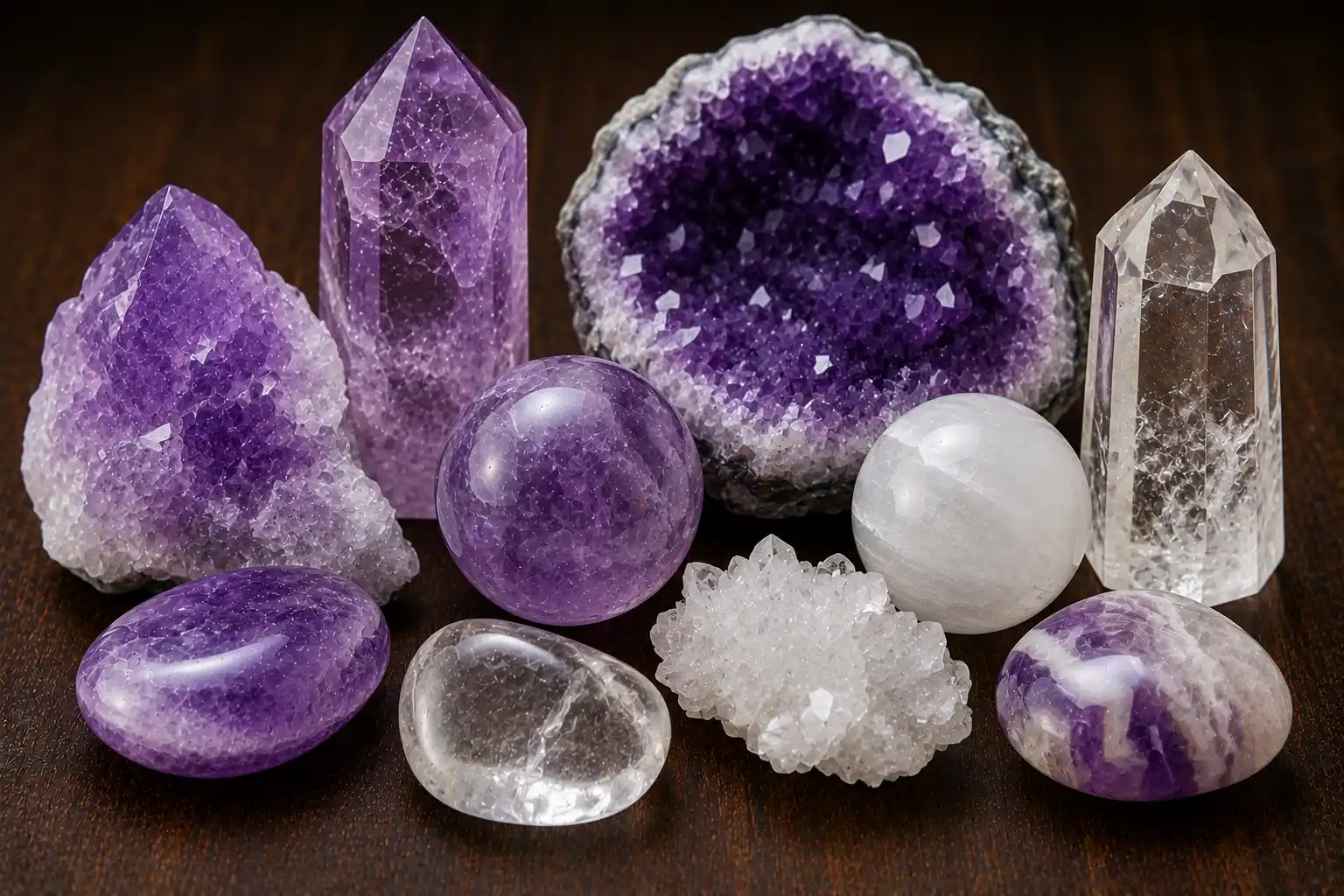
Modern crystal traditions commonly pair the crown chakra with violet, white, clear, or highly transparent stones. Typical examples include amethyst, clear quartz, selenite, and other minerals chosen because their colors or symbolic histories fit themes of clarity and spiritual reflection.
These correspondences vary among teachers and are not scientifically established chakra-mineral relationships.
For a dedicated selection guide, see crown chakra crystals.
A crystal should function as a visual or tactile reminder rather than as a guaranteed mechanism for opening the crown chakra.
Amethyst and the Crown Chakra
Amethyst is one of the stones most commonly associated with crown chakra practice because its violet color fits modern crown-chakra symbolism and because it has a long cultural history as an ornamental quartz variety.
Mineralogically, amethyst is purple quartz. Its actual properties come from quartz structure, trace chemistry, irradiation-related color centers, hardness, and geological formation.
Using amethyst during crown chakra meditation can provide a visual focus, but the mineral has not been shown scientifically to transfer spiritual energy into the brain or nervous system.
Clear Quartz and the Crown Chakra
Clear quartz is frequently included in crown chakra practices because transparency is symbolically associated with clarity, openness, and awareness.
Physically, clear quartz is crystalline silicon dioxide with well-established mineralogical properties. Metaphysical descriptions such as “amplification” are symbolic traditions rather than proven effects on human energy.
A clear quartz crystal can nevertheless work well as a meditation object because its transparency and internal features provide something specific to observe while attention settles.
Selenite and the Crown Chakra
Selenite is another popular crown chakra association, especially because white and translucent materials are widely used in modern crown symbolism.
The name selenite properly refers to a transparent crystalline variety of gypsum, although satin spar gypsum is frequently sold commercially under the same name.
Regardless of variety, gypsum is very soft and should be cared for according to its actual mineral properties.
A selenite object can support a crown chakra ritual as a symbolic reminder, but its presence does not establish that an invisible energy center has been medically cleansed.
Choosing Crown Chakra Crystals
Choose crown chakra stones according to three separate criteria: mineral identity, physical suitability, and personal symbolism.
First, know what the stone actually is. Second, understand whether it is durable enough for the intended use. Third, decide whether its color, appearance, cultural association, or personal history supports the meaning you want to explore.
The wider healing crystals guide explains how to keep traditional interpretations separate from mineral science and health claims.
There is no requirement to own a particular mineral to practice crown chakra meditation.
How to Use a Crystal With Crown Chakra Meditation
Place the crystal on a nearby table, hold a durable stone comfortably, or position it where you can see it. There is no need to place a mineral directly on the top of your head.
Begin with normal breathing and observe the stone’s real features: color, transparency, inclusions, shape, polish, or crystal faces.
Then shift toward the crown chakra theme you have chosen, such as perspective, meaning, humility, or contemplation.
The mineral becomes a physical anchor for attention. The reflective practice remains the active component.
Crown Chakra Affirmations
Affirmations work best when they are realistic enough to guide attention rather than making impossible promises.
Examples include:
“I can examine beliefs without needing immediate certainty.”
“I can act according to my values even when circumstances are complicated.”
“I am willing to consider perspectives beyond my first reaction.”
“I can seek meaning without pretending to have every answer.”
“I can remain curious about what I do not yet understand.”
These statements fit crown chakra symbolism without claiming supernatural outcomes.
Crown Chakra Yoga
Yoga traditions are historically much broader than modern chakra-focused exercise classes. Contemporary practitioners may nevertheless include postures, meditation, breathing, or relaxation as part of a crown chakra routine.
No specific posture has been scientifically proven to activate the crown chakra.
Simple seated meditation is sufficient. Extreme inversions such as headstands are unnecessary and may be inappropriate for beginners or people with certain health conditions.
If physical yoga is included, technique and individual health considerations matter more than achieving a symbolic chakra pose.
Do You Need a Headstand for Crown Chakra Work?
No.
The symbolic location above the head sometimes leads people to assume inversions are uniquely powerful for the crown chakra. There is no evidence that standing on the head opens sahasrāra, and a headstand introduces physical risks that ordinary seated meditation does not.
Crown chakra practice can be performed while sitting in a chair, standing comfortably, walking slowly, journaling, praying, or lying in a safe resting position.
Spiritual meaning does not depend on an extreme posture.
Crown Chakra and Prayer
For people within religious traditions, prayer can fit naturally with crown chakra themes of transcendence, humility, devotion, and relationship with the sacred.
However, it is important not to erase differences between traditions. Not every religion uses chakra concepts, and a person can pray meaningfully without adopting subtle-body terminology.
If crown chakra language and an established faith practice are combined, do so respectfully rather than assuming they are historically identical systems.
Crown Chakra and Gratitude
Gratitude can provide a practical way to explore crown chakra themes without making supernatural claims.
Write down something valuable that did not come entirely from your own effort: another person’s help, inherited knowledge, natural beauty, community support, an unexpected opportunity, or a lesson learned from difficulty.
The exercise expands attention beyond the isolated self, which fits the symbolic theme commonly associated with the crown chakra.
Gratitude should not be used to deny pain or injustice. Perspective can include both appreciation and honest recognition of difficulty.
Crown Chakra and Ego
Some spiritual descriptions say the crown chakra dissolves ego. That phrase can be misunderstood.
A functional sense of self is necessary for boundaries, responsibility, decision-making, and ordinary life. A more useful interpretation is reducing excessive self-centeredness rather than trying to eliminate personal identity.
Ask whether you are treating your own perspective as the only possible perspective, whether pride is preventing you from changing your mind, or whether fear of being wrong is interfering with learning.
That gives crown chakra symbolism an ethical and practical dimension.
Crown Chakra and Intuition
Intuition is more commonly associated with the third-eye chakra, but it sometimes appears in crown chakra descriptions as spiritual knowing or expanded awareness.
Intuition should not replace evidence when evidence is available.
A grounded practice is to notice an intuitive impression and then investigate it. Ask what experience may have produced the feeling, what alternative explanation exists, and what evidence would change your conclusion.
Spiritual reflection and critical thinking do not need to be enemies.
Crown Chakra and Mental Health
Crown chakra language should never be used to diagnose mental-health symptoms.
Intense meditation, sleep deprivation, fasting, hyperventilation, or highly suggestive spiritual practices can be distressing for some people. Experiences such as panic, severe anxiety, persistent confusion, loss of contact with reality, extreme mood changes, or inability to function should not simply be interpreted as signs of spiritual awakening.
Pause the practice and seek appropriate professional support when symptoms are concerning.
A healthy crown chakra framework should support grounded functioning rather than romanticize distress.
Is Crown Chakra Meditation Safe?
Gentle meditation is generally low risk for many people, but meditation is not completely free of adverse experiences. Some people report increased anxiety, uncomfortable memories, emotional distress, or other unwanted effects.
Start with short sessions and stop if the practice becomes destabilizing. Keeping attention partly on ordinary physical sensations—feet on the floor, breathing, sounds in the room—can make crown chakra meditation more grounded.
Long sessions, forced breathing, sleep deprivation, fasting, and extreme practices are unnecessary.
Can the Crown Chakra Cause Headaches?
There is no established evidence that a physically blocked or opening crown chakra causes headaches.
A headache during meditation could have ordinary explanations such as muscle tension, dehydration, eyestrain, posture, stress, illness, medication effects, or other medical causes.
Do not assume persistent or severe headaches are spiritual symptoms. Appropriate medical evaluation is warranted when symptoms are concerning.
Crown chakra terminology should never delay ordinary healthcare.
Can You Overactivate the Crown Chakra?
“Overactive crown chakra” is metaphysical terminology rather than a recognized medical diagnosis.
Practically, someone may use the phrase to describe becoming excessively absorbed in spiritual ideas while neglecting sleep, relationships, work, physical needs, or everyday responsibilities.
The solution does not require manipulating an invisible energy level. Reduce the intensity of the practice, return attention to daily routines, spend time outdoors, eat normally, sleep adequately, and reconnect with practical responsibilities.
This is where balancing crown chakra symbolism with root-chakra themes can be especially useful.
How to “Balance” the Crown Chakra Practically
A practical crown chakra balance routine can involve:
- Short, comfortable meditation
- Normal unforced breathing
- Reflective journaling
- Reading philosophy or spiritual texts carefully
- Clarifying personal values
- Practicing gratitude
- Spending time in quiet contemplation
- Remaining connected with ordinary responsibilities
- Discussing ideas with thoughtful people
- Allowing uncertainty instead of forcing certainty
- Getting adequate sleep and maintaining regular routines
- Seeking professional support when distress exceeds the scope of spiritual practice
None of these actions requires proving that a physical crown chakra exists.
Crown Chakra Best Practices
The most useful crown chakra practices share several principles.
Keep the tradition clear. Recognize that sahasrāra comes from complex South Asian religious and yogic contexts and that modern seven-chakra systems are interpretations rather than exact copies of one universal ancient model.
Keep claims proportionate. Meditation, prayer, journaling, and yoga can have their own value without attributing every effect to chakra activation.
Keep practice grounded. Spiritual exploration should coexist with ordinary responsibilities, relationships, sleep, nutrition, and health care.
Keep curiosity stronger than certainty. Crown chakra symbolism is particularly well suited to admitting what you do not know.
Common Crown Chakra Mistakes
One mistake is treating the crown chakra as an anatomical gland.
Another is assuming every historical chakra tradition used the same seven colors and seven centers found in modern charts.
A third is interpreting headaches, dizziness, panic, insomnia, or unusual perceptions as proof of crown chakra activation.
A fourth is believing expensive crystals are necessary.
A fifth is trying to force dramatic experiences through hyperventilation, sleep deprivation, fasting, or extreme meditation.
A sixth is using spiritual explanations instead of obtaining appropriate medical or psychological care.
A seventh is pursuing transcendence while neglecting relationships, work, finances, physical health, or other ordinary responsibilities.
Good crown chakra practice should increase perspective, not reduce practical judgment.
A Simple Crown Chakra Routine
Start with a comfortable seat and spend a short period noticing your breathing.
Then imagine a soft white or violet light above the head. Do not try to produce physical sensations.
Ask one question:
“What principle matters most in how I respond to my current situation?”
Remain quiet for several breaths. Write down whatever answer arises, then examine it rather than accepting it automatically.
Finish by identifying one practical action consistent with that principle.
This final step keeps crown chakra contemplation connected to everyday life.
When Crown Chakra Practice May Be Useful
Crown chakra practice may be particularly meaningful during periods of transition, uncertainty, philosophical questioning, major decisions, spiritual exploration, or reevaluation of priorities.
It can also provide a structured pause when short-term problems are consuming all available attention.
The aim is not to escape difficulty. It is to view difficulty from a wider frame and then return to practical action.
That distinction keeps crown chakra use grounded and useful.
When to Step Away From Crown Chakra Practice
Reduce or stop crown chakra practice if meditation consistently produces severe anxiety, panic, disorientation, disturbing perceptions, sleep disruption, or difficulty functioning.
Likewise, reconsider any practice that encourages you to stop medication, reject medical care, isolate from supportive relationships, spend beyond your means, or treat another person’s advice as unquestionable spiritual authority.
A spiritual framework should not require surrendering basic safety or critical judgment.
Final Thoughts on the Crown Chakra
The crown chakra is best understood as a spiritual and contemplative concept associated with sahasrāra, the thousand-petalled lotus at or above the crown of the head. Modern seven-chakra systems generally present it as the highest center and associate it with awareness, unity, meaning, spiritual connection, contemplation, and perspective, although historical subtle-body traditions are more varied than simplified contemporary charts sometimes suggest.
There is no established anatomical structure corresponding to a crown chakra, and claims about physically opening, blocking, activating, or medically healing it should not be presented as scientific facts. Meditation, yoga, journaling, prayer, breathing, and contemplative practices may have value on their own, but those effects should not automatically be attributed to invisible chakra mechanisms.
The most constructive crown chakra practice is therefore grounded rather than dramatic. Use the symbolism to examine values, broaden perspective, question assumptions, meditate, study, or think about what connects your everyday choices with a larger sense of meaning. Crystals such as amethyst, clear quartz, or selenite can serve as symbolic objects if desired, but they are optional.
Crown chakra work does not need extraordinary sensations, expensive tools, medical claims, or promises of enlightenment. Its strongest practical use is simpler: creating space to think beyond immediate reactions and then bringing whatever insight emerges back into responsible ordinary life.
FAQs
What is the crown chakra?
The crown chakra is the highest center in the popular seven-chakra system and is commonly associated with sahasrāra, the thousand-petalled lotus at or above the top of the head. It is a spiritual concept rather than a medically established anatomical structure.
What does the crown chakra represent?
The crown chakra commonly represents higher awareness, meaning, unity, contemplation, spiritual connection, transcendence, wisdom, and perspective beyond immediate self-centered concerns.
What color is the crown chakra?
Violet and white are the most common colors in modern crown chakra systems, although clear, gold, or multicolored imagery is also used. Color associations vary among traditions and teachers.
Is the crown chakra the seventh chakra?
In modern seven-chakra systems, yes. Historically, some traditions describe six primary cakras with sahasrāra above them rather than treating the thousand-petalled lotus simply as another ordinary chakra.
Where is the crown chakra located?
It is symbolically placed at or slightly above the crown of the head. No physical anatomical structure has been scientifically established as the crown chakra.
What does an open crown chakra feel like?
Descriptions vary and may include perspective, connection, peace, meaning, or spiritual awareness. These experiences are subjective and there is no validated test for whether the crown chakra is physically open.
What are signs of a blocked crown chakra?
Modern spiritual teachings may use the phrase for disconnection, rigid thinking, or lack of meaning. These are symbolic descriptions, not medical diagnoses. Persistent psychological or physical symptoms should be evaluated appropriately.
How do you balance the crown chakra?
A grounded approach can include meditation, journaling, contemplation, values clarification, gratitude, prayer, normal breathing, and maintaining practical daily routines. No dramatic activation technique is required.
Which crystals are associated with the crown chakra?
Common modern choices include amethyst, clear quartz, selenite, and other violet, white, or transparent stones. Their association with the crown chakra is symbolic rather than scientifically proven.
Do I need crystals for crown chakra meditation?
No. Crown chakra meditation can be practiced without any crystal. A stone may function as a visual or tactile reminder, but it is not required.
Can crown chakra meditation improve health?
Meditation and some yoga practices have been studied for various wellness outcomes, but those findings do not prove that activating a crown chakra causes health benefits. Chakra practice should not replace appropriate healthcare.
Can opening the crown chakra cause headaches?
There is no scientific evidence that crown chakra opening causes headaches. Headaches can have many ordinary causes and persistent, severe, or concerning symptoms should not be dismissed as spiritual activation.
Is the crown chakra connected to the pineal gland?
Modern metaphysical sources sometimes make anatomical correspondences between chakras and glands, but the crown chakra has not been scientifically established as the pineal gland or another endocrine structure.
Is the crown chakra connected to the third eye chakra?
They are adjacent in the modern seven-chakra sequence but represent somewhat different themes. The third eye commonly symbolizes perception and insight, while the crown chakra emphasizes meaning, unity, transcendence, and broader spiritual perspective.
What is the safest way to practice crown chakra meditation?
Use a comfortable posture, normal breathing, short sessions, and a grounded ending that returns attention to ordinary surroundings. Avoid forcing breath, extreme inversions, prolonged sleep deprivation, fasting, or interpreting distressing symptoms automatically as spiritual progress.
What is the most practical purpose of crown chakra work?
The most practical use is creating structured time to examine values, assumptions, perspective, meaning, and the larger principles behind everyday decisions. The practice can support reflection without requiring belief in medically measurable chakra energy.