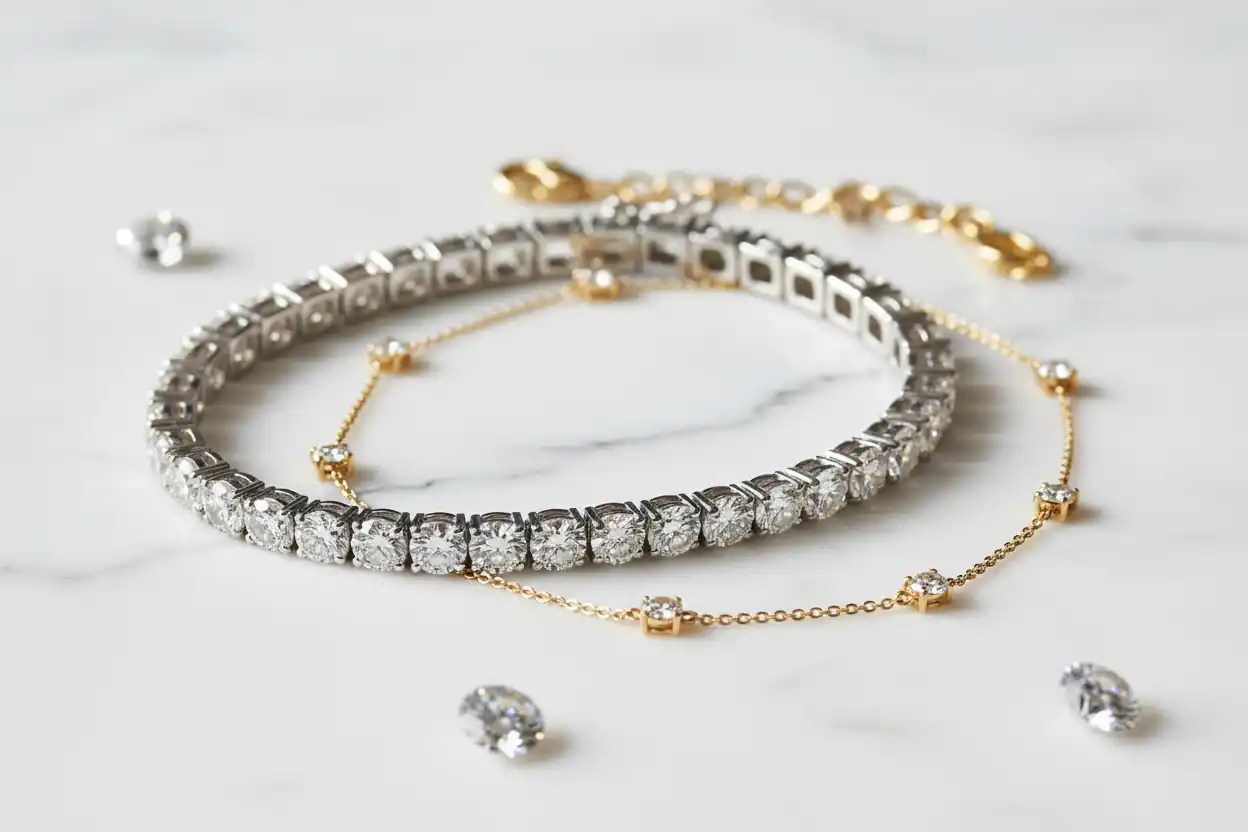
Diamond Bracelets: How to Choose, Size and Wear Them
A diamond bracelet can range from a delicate station chain to a continuous line of matched stones. Although diamond is the hardest natural gemstone, a bracelet still needs strong settings, flexible construction and a secure clasp because diamonds can chip from sharp impacts or be lost when metal components fail.
For most buyers, cut quality and visible matching matter more than chasing exceptionally high color or clarity grades. A well-made tennis bracelet with bright, consistently cut diamonds usually looks more impressive than a heavier piece containing poorly matched stones.
Diamond Bracelets at a Glance
| Factor | What to look for |
|---|---|
| Diamond quality | Balanced cut, color and clarity appropriate to stone size |
| Total carat weight | Weight of all diamonds combined, not one stone |
| Matching | Consistent dimensions, color, brightness and setting height |
| Construction | Smooth articulation without excessive gaps or stiffness |
| Setting | Secure prongs, bezels or channel-style protection |
| Clasp | Box clasp or other secure closure, ideally with safety feature |
| Fit | Comfortable movement without excessive sliding |
| Metal | Gold or platinum appropriate to design and budget |
| Documentation | Clear natural/laboratory-grown disclosure and grading where relevant |
| Main maintenance issue | Loose stones, worn links, stretched settings and clasp wear |
Diamond Bracelets and the 4Cs
Diamond quality is commonly evaluated through cut, color, clarity and carat weight.
In a bracelet, those factors work differently than they do in a single large solitaire. Because many stones are viewed together and may be relatively small, visual matching often matters more than obtaining the highest laboratory grades.
Cut controls how effectively each diamond handles light. Color becomes obvious when adjacent stones differ. Clarity usually matters less once inclusions cannot be seen without magnification, while carat weight describes the bracelet’s total gemstone mass.
The completed diamond buying guide explains the 4Cs across loose and mounted diamonds in more detail.
What Is a Tennis Bracelet?
A tennis bracelet is a flexible line bracelet set with individually mounted diamonds or other gemstones.
The term became widely popular after professional tennis player Chris Evert’s diamond bracelet reportedly came off during a match and play was paused while it was recovered.
Modern tennis bracelets usually use round brilliant diamonds in articulated links. Each stone is held by prongs or another low-profile setting so the row curves comfortably around the wrist.
The style works with casual clothing, formal wear and layered jewelry because the continuous diamond line is visually simple.
Classic Line Bracelets
A line bracelet uses diamonds continuously around most or all of the wrist.
Look at the piece laid flat. The links should follow a smooth line rather than twisting sharply or creating uneven spaces.
Then hold the bracelet in a natural curve. It should articulate freely without sections becoming rigid.
Matching is critical because even small variations in diamond diameter or setting height become obvious in a continuous row.
The clasp should close securely without requiring force.
Bezel-Set Diamond Bracelets
Bezel settings surround each diamond with metal.
They provide strong edge protection and create a modern, clean appearance. A bezel bracelet may also snag less than a multi-prong line design.
The tradeoff is additional visible metal around each diamond. For buyers who want the greatest apparent uninterrupted sparkle, prongs may feel more open.
Check that the bezels are uniform and that every diamond sits level. Uneven settings can interrupt the visual rhythm.
Prong-Set Tennis Bracelets
Prong settings expose more diamond surface and are common in classic tennis bracelets.
Three- and four-prong arrangements can create an almost continuous field of diamonds when viewed from above.
Every prong must remain secure. Because a bracelet flexes repeatedly, worn metal can eventually compromise one setting.
Examine the complete row rather than only the center section. Stones close to the clasp and underside of the wrist often receive substantial contact.
Channel-Set Bracelets
Channel settings place diamonds between two parallel metal walls.
This creates a smoother surface and reduces exposed prongs. The style works especially well with calibrated round, princess or baguette diamonds.
A poorly constructed channel may become difficult to repair if the metal bends or one stone loosens.
Check that the diamonds are aligned consistently and do not move when the bracelet flexes.
Channel-set bracelets often have a more geometric appearance than traditional prong-set tennis designs.
Diamond Station Bracelets
A station bracelet spaces diamonds along a chain rather than forming a continuous row.
This reduces total carat weight and creates a lighter visual effect. It can also make a high-quality diamond accent accessible at a lower overall price.
Bezel-set stations work especially well because they remain smooth and protected.
Check whether the diamonds constantly flip to the reverse side. Balanced stations and appropriate chain weight help them face outward more reliably.
Bangle Bracelets
Diamond bangles use a rigid or semi-rigid structure.
Diamonds may cover the complete circumference, only the top half or a small decorative section. Hinged bangles make fitting easier and should include a secure closure.
A bangle should pass comfortably over the hand when it lacks a hinge. Excessive looseness increases impact against desks and door frames.
Inspect the interior for rough edges and the hinge for side-to-side movement.
Diamond Cuff Bracelets
A cuff has an opening rather than a full closure.
Diamond cuffs may be minimalist, geometric or heavily pavé-set. The opening should be wide enough for comfortable placement without requiring repeated bending.
Do not squeeze a rigid cuff to adjust the fit unless the jeweler confirms that its construction allows it. Repeated flexing can fatigue metal and disturb stone settings.
Because cuffs often have larger decorative surfaces, they may suit occasional wear better than constant desk work.
Bolo and Adjustable Diamond Bracelets
Bolo bracelets use sliding mechanisms to adjust length.
They are convenient gifts because exact wrist sizing is less critical. However, the slider needs enough tension to hold the desired position without loosening during normal movement.
Inspect the chain ends and stops. Small terminal diamonds or decorative elements should remain secure.
A poorly designed adjustable bracelet may allow the central setting to rotate excessively or slide under the wrist.
Natural vs Laboratory-Grown Diamond Bracelets
Natural and laboratory-grown diamonds are both diamond, sharing essentially the same crystal structure and fundamental physical properties.
Their origin and market positioning differ. Laboratory-grown stones are produced through technological processes rather than geological formation.
The completed lab diamond meaning and properties guide explains this distinction. For jewelry purchases, the seller should state clearly whether the stones are natural or laboratory-grown.
A low price should never be used as the only clue. Written disclosure matters because small bracelet diamonds may not each carry individual inscriptions or reports.
Choosing Diamond Cut
Cut has a major influence on brightness and sparkle.
For round brilliant diamonds, choose stones that show lively, consistent light return rather than concentrating only on carat weight.
Small bracelet diamonds may not each have individual laboratory cut grades. In that case, compare the complete bracelet visually under diffuse and ordinary room light.
One dull stone can interrupt a row of otherwise bright diamonds.
Symmetry in diameter and facet appearance also improves the continuous line effect.
Choosing Diamond Color
Most diamonds used in white-diamond bracelets fall within the colorless-to-near-colorless range or slightly warmer categories.
Exact grade matters less when stones are small, but matching matters considerably. A noticeably yellow diamond placed between whiter stones will be visible.
Yellow gold can make slightly warmer diamonds appear harmonious, while platinum and white gold may emphasize color differences more strongly.
The completed guide to diamond color meaning and symbolism covers natural diamond colors beyond the standard colorless grading concept.
Choosing Diamond Clarity
Small bracelet diamonds do not usually need extremely high clarity.
Once inclusions cannot be seen at normal viewing distance and do not compromise durability, paying for very high laboratory clarity grades may produce little visible difference.
Avoid stones with obvious dark inclusions, cloudy transparency or fractures that weaken the gem.
For larger center or graduated diamonds, clarity becomes easier to evaluate visually and documentation may matter more.
The bracelet should look consistently bright rather than technically impressive only on paper.
Understanding Total Carat Weight
Bracelets are usually sold by total carat weight, often abbreviated tcw or ctw.
A 5-carat bracelet does not contain one 5-carat diamond. The weight is divided among all stones.
Therefore, compare stone count, individual approximate diameter and bracelet length alongside total weight.
Two bracelets with the same total carat weight may look very different when one uses fewer larger stones and the other uses many smaller ones.
Carat weight alone does not determine quality or beauty.
Matching Diamonds Across a Bracelet
Good matching creates visual continuity.
Compare color, diameter, cut, brightness and apparent depth. Slight clarity differences usually matter less when they do not affect transparency.
Graduated bracelets intentionally increase or decrease stone size, but transitions should look smooth rather than random.
View the piece both flat and on the wrist. Some mismatches become more visible once the bracelet curves.
Consistent setting height is also important because a crooked stone may look smaller or darker.
Choosing the Metal
Platinum provides a dense, naturally white setting and excellent long-term wear, although it carries greater weight and cost.
White gold provides a bright appearance at a lower price but may require periodic rhodium replating depending on the alloy and desired finish.
Yellow gold creates warm contrast and can pair attractively with diamonds that carry a slight warm tint.
Rose gold gives the bracelet a softer colored-metal appearance.
Ask for exact metal fineness and alloy information rather than relying on descriptions such as gold tone.
Bracelet Fit
A tennis bracelet should move slightly but should not slide halfway over the hand.
Measure the wrist snugly with a flexible tape, then add enough room for comfort. Desired extra length depends on wrist size and personal preference.
A bracelet that is too loose receives more impacts and may catch. One that is too tight places ongoing strain on links and clasps.
Try moving the wrist through ordinary positions before accepting the fit.
Sizing changes on intricate diamond bracelets should be performed by a qualified jeweler.
Choosing the Clasp
A box clasp is common on diamond tennis bracelets because it provides a low-profile connection.
High-value pieces often include one or two additional safety latches. These features provide backup if the primary clasp begins to open.
Lobster clasps may suit station chains, while hinged bangles require dependable mechanical closures.
Test the clasp several times. It should engage positively without wobbling or requiring excessive force.
Clasp quality is as important as diamond quality because a failure can result in losing the complete bracelet.
Certification and Documentation
Many small diamonds in a bracelet are not individually graded because the cost of separate reports would be disproportionate.
However, substantial bracelets should still come with accurate written disclosure of diamond origin, approximate quality, total weight and metal.
Large individual diamonds may have independent grading reports.
The completed diamond price guide explains how laboratory grading, size, cut and market factors affect value.
For an expensive bracelet, an independent appraisal can help with insurance documentation.
How to Buy a Diamond Bracelet Online
Confirm bracelet length, total carat weight, approximate diamond count, color and clarity range, metal, clasp style and return policy.
Ask whether photographs show the exact piece or a representative example.
Video is particularly useful because it reveals articulation, sparkle and how evenly the bracelet curves.
Read measurements rather than judging scale from magnified product photos.
Check whether resizing is possible before ordering, especially with continuous diamond designs.
Diamond Bracelet Pricing
Price depends on natural versus laboratory-grown origin, total carat weight, individual stone size, cut, color, clarity, metal and workmanship.
Larger individual diamonds raise cost disproportionately compared with an equal total weight divided among many smaller stones.
Branding and design complexity can also add substantial premiums.
Compare bracelets with similar specifications rather than only total carat weight.
An unusually low price may reflect laboratory-grown diamonds, warmer color, lower clarity, lightweight construction or another disclosed tradeoff rather than automatically indicating a bargain.
How to Wear a Diamond Bracelet
Put the bracelet on after applying lotion, perfume and cosmetics.
For desk work, consider wearing it on the non-dominant wrist to reduce repeated contact with hard surfaces.
Remove the piece before sports, strength training, gardening, cleaning and manual work.
Do not stack it tightly between harder diamond jewelry where settings can rub against each other.
A diamond may resist scratching exceptionally well, but metal prongs and links remain vulnerable to wear.
Stacking Diamond Bracelets
A tennis bracelet can be layered with a watch, plain gold bracelet or other diamond piece.
Leave enough freedom that settings do not grind constantly against one another.
A watch with a hard case or bracelet may abrade neighboring metal even when the diamonds themselves remain undamaged.
For delicate tennis bracelets, wearing the piece separately often preserves the setting better.
Use visual balance rather than trying to match every carat weight or diamond size exactly.
Cleaning a Diamond Bracelet
Diamonds attract grease readily, so skin oils and lotion can reduce brilliance even when the stone itself remains undamaged.
Warm water, mild dish soap and a soft toothbrush provide a practical home-cleaning method for many secure untreated diamond bracelets.
Clean over a bowl rather than an open drain and support the bracelet rather than pulling on one link.
The completed guide to cleaning diamond jewelry safely covers settings, treatments and inspection in greater detail.
Professional cleaning should include a setting check rather than polishing alone.
Diamonds Are Hard but Not Indestructible
Diamond ranks 10 on the Mohs scale and strongly resists scratching.
Hardness is not the same as complete resistance to breakage. A sharp blow in an unfavorable direction can chip a diamond, particularly around exposed girdles or points.
Other diamonds can also scratch diamond surfaces.
The surrounding metal is much softer than the stone and usually becomes the bracelet’s principal maintenance concern.
Therefore, rough activity can still damage a diamond bracelet even when none of the stones scratch.
Storage
Lay the bracelet flat in a padded compartment.
Avoid folding flexible links sharply or allowing the piece to knot around other jewelry.
Keep diamonds separated from softer gemstones because they can scratch nearly every common jewelry material.
Fasten the clasp before storage so that it cannot tangle.
For valuable pieces, keep grading, purchase and insurance documents separately.
When to Have a Bracelet Inspected
Professional inspection is warranted when a diamond moves, a prong catches, the bracelet develops an unusual gap or the clasp feels different.
A stretched or bent link may eventually fail even if all diamonds remain secure.
Tennis bracelets worn several times each week deserve periodic inspection because hundreds of small movements place repeated stress on settings and articulation points.
Do not continue wearing a bracelet with a known loose stone.
Conclusion
A strong diamond bracelet combines bright, well-matched diamonds with construction designed for repeated movement. Cut and matching often create more visible beauty than unnecessarily high clarity grades, particularly when the stones are small.
Choose a comfortable fit, smooth articulation and a dependable clasp with appropriate safety features. Then protect the bracelet from rough work even though diamond itself is exceptionally hard.
The best purchase balances gemstone quality, secure metalwork and realistic wear rather than maximizing total carat weight alone.
Frequently Asked Questions
1. What is the most popular diamond bracelet style?
The classic diamond tennis bracelet is the best-known style, featuring a continuous flexible row of diamonds.
2. How should a diamond tennis bracelet fit?
It should move comfortably without sliding excessively over the hand or hanging far below the wrist.
3. Is cut important in a diamond bracelet?
Yes. Good cut improves brightness and sparkle, while consistent cutting helps the stones look matched.
4. Does a diamond bracelet need very high clarity?
Usually not. Small eye-clean diamonds can look excellent without exceptionally high clarity grades.
5. What does total carat weight mean?
It is the combined weight of all diamonds in the bracelet rather than the weight of one individual stone.
6. Are laboratory-grown diamond bracelets real diamond?
Laboratory-grown diamonds are diamond, but their origin differs from natural diamonds and should be disclosed clearly.
7. What clasp is best for a tennis bracelet?
A well-made box clasp with an additional safety latch is a strong choice for valuable line bracelets.
8. Can diamond bracelets be worn every day?
They can be worn regularly, but should be removed for sports, cleaning, gardening and other activities that can damage settings.
9. Can diamonds in a bracelet chip?
Yes. Diamonds resist scratching exceptionally well but can chip after certain hard impacts.
10. How should a diamond bracelet be cleaned?
Warm mild soapy water and a soft brush work for many secure untreated pieces. Inspect settings during cleaning.
11. Should every diamond in a bracelet have a grading report?
Usually not. Small stones are commonly sold as a matched parcel, while larger individual diamonds may justify separate reports.
12. How should a diamond bracelet be stored?
Store it fastened and flat in a padded compartment away from softer gemstones that diamonds could scratch.