
How to Clean Diamond Jewelry Safely: Rings, Lab Diamonds & Care
Knowing how to clean diamond jewelry properly can restore much of the sparkle lost to skin oil, lotion, sunscreen, soap residue and cosmetics without exposing the stone or its setting to unnecessary risk. For most untreated natural or laboratory-grown diamonds in secure jewelry, the safest home method is warm water, a small amount of mild liquid dish soap, a soft-bristled brush and careful rinsing.
Diamond is extraordinarily resistant to scratching, but that does not make diamond jewelry indestructible. A diamond can chip along cleavage directions, prongs can loosen, precious metals can scratch, fracture filling can be damaged and another gemstone in the same piece may require much gentler treatment.
That is why learning how to clean diamond jewelry means looking beyond the diamond itself. The treatment history, setting, metal, accent stones and physical condition of the entire piece determine which method is appropriate.
Natural and lab-grown diamonds require essentially the same routine cleaning. Their growth origins differ, but both are crystalline diamond and both readily collect oily films that reduce brilliance.
How to Clean Diamond Jewelry at a Glance
| Situation | Recommended approach |
|---|---|
| Sound untreated diamond in secure setting | Warm water, mild liquid soap and soft brush |
| Laboratory-grown diamond | Same basic method as natural diamond |
| Fracture-filled diamond | Gentle manual cleaning only |
| Coated diamond | Gentle cleaning; avoid harsh chemicals, heat and abrasion |
| Loose or damaged setting | Do not clean until professionally inspected |
| Diamond with emerald, opal, pearl or other delicate gem | Follow the care limits of the most sensitive material |
| Antique jewelry | Conservative manual cleaning after condition check |
| Pavé or delicate setting | Very gentle brushing; inspect closely |
| Ultrasonic cleaner | Only after treatment and setting suitability are established |
| Steam cleaner | Better left to professionals after inspection |
| Unknown treatment | Use mild manual cleaning |
| Routine oily film | Warm soapy water is usually sufficient |
The safest answer to how to clean diamond jewelry at home is therefore deliberately simple. Stronger products rarely provide a meaningful advantage over gentle cleaning when ordinary skin residue is causing the dull appearance.
Why Diamond Jewelry Gets Dull
Diamond has a strong affinity for grease.
Skin oil, hand cream, makeup, sunscreen, cooking oils and soap film readily adhere to its surface. This is one reason even a high-quality diamond can begin looking surprisingly flat after regular wear.
The problem is often most noticeable beneath the stone.
Light entering and leaving a faceted diamond depends on clean surfaces. When the pavilion is coated in residue, the diamond may lose brightness even if the table still looks reasonably clean.
Understanding how to clean diamond jewelry therefore means cleaning behind and beneath the stone rather than simply polishing the visible top.
The broader diamond guide explains how diamond’s refractive properties, dispersion and cutting create brilliance in the first place.
Diamond Is Hard, but Jewelry Can Still Be Damaged
Diamond ranks 10 on the Mohs scale and resists scratching better than any common natural gemstone.
However, hardness measures resistance to scratching—not resistance to every type of damage.
Diamond has perfect cleavage in specific crystallographic directions. A severe blow near a vulnerable point, girdle or corner can cause a chip.
The distinction between scratching and breakage is explained in gemstone toughness versus hardness, while gemstone cleavage explains why even extremely hard gemstones can split under particular impacts.
This matters when deciding how to clean diamond jewelry because forceful scrubbing, metal tools and careless machine cleaning add risk without improving ordinary home cleaning.
The setting is usually softer than the diamond. Gold, platinum and silver can all develop scratches or deformation long before the diamond surface is affected.
Inspect the Jewelry Before Cleaning
Before deciding how to clean diamond jewelry, inspect the piece under bright light.
Look closely at every prong.
Check bezels, channels, pavé beads, clasps, hinges and links.
Very gently check whether the center stone moves. Do not twist it.
If you hear clicking, see a gap or notice any movement, stop. The piece should be repaired before it is washed or brushed.
Check small accent diamonds carefully as well. Pavé jewelry can contain dozens of tiny stones held by very small beads or prongs. A loose accent may disappear during cleaning before you realize there was a problem.
Older jewelry deserves extra caution. Antique pieces may include delicate solder, enamel, glue, foil-backed elements or earlier repairs that cannot be treated like a simple modern solitaire.
How to clean diamond jewelry safely always begins with condition, not cleaning solution.
Check Whether the Diamond Has Been Treated
Not every diamond is untreated.
Color or apparent clarity may have been modified through processes such as HPHT treatment, irradiation, annealing, coating, laser drilling or fracture filling.
These treatments do not all create the same cleaning restrictions.
HPHT processing and irradiation alter color through changes within the diamond and generally do not create the same routine cleaning concern as a surface coating or fracture filler.
Fracture-filled diamonds require particular caution because heat, chemicals and ultrasonic vibration can affect the filling material.
Surface coatings can also be vulnerable to abrasion or chemicals.
If treatment is uncertain, use gentle manual cleaning and inform a jeweler before machine cleaning or repair.
The treated diamond guide explains how natural origin, laboratory growth and treatment differ, while gemstone treatments covers the wider enhancement terminology.
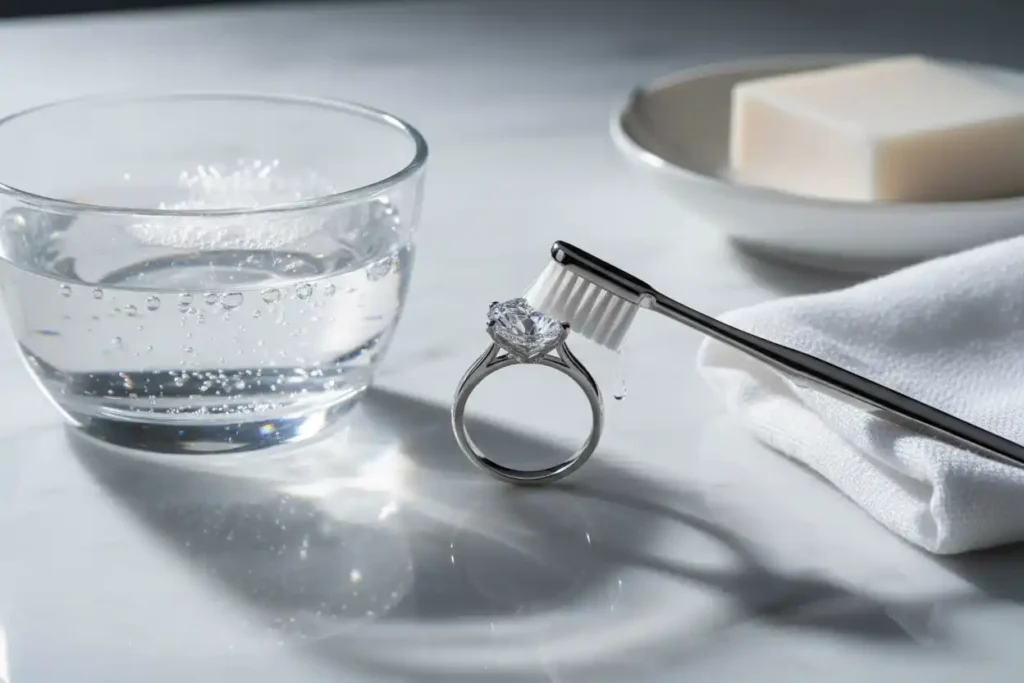
What You Need to Clean Diamond Jewelry at Home
You do not need a complicated kit to learn how to clean diamond jewelry.
Use:
- A small bowl
- Warm water
- A few drops of mild liquid dish soap
- A very soft, clean toothbrush or jewelry brush
- A second bowl of clean warm water
- A lint-free soft cloth
Use a bowl instead of cleaning directly over an open sink.
A loose earring, accent stone or small ring can disappear into a drain surprisingly quickly.
The water should be comfortably warm rather than hot. Extreme heat adds no benefit for ordinary grease removal.
How to Clean Diamond Jewelry Step by Step
The following method works for most sound natural and lab-grown diamond jewelry whose treatment and companion materials are compatible with mild soap and water.
1. Prepare a Mild Cleaning Solution
Fill a small bowl with warm water.
Add only a few drops of mild liquid dish soap and mix gently.
You do not need a concentrated solution.
When learning how to clean diamond jewelry, more detergent is not better. Excess soap can simply leave additional film that needs to be rinsed away.
Avoid products containing bleach, abrasive particles, strong acids, aggressive degreasers or unknown additives.
2. Let Ordinary Residue Loosen
Place the jewelry in the mild solution for a short period.
A brief soak helps soften ordinary oil and soap film.
Long soaking is usually unnecessary.
If the jewelry contains glue, delicate antique construction, sensitive accent stones or an uncertain treatment, skip prolonged soaking and clean more conservatively.
How to clean diamond jewelry should always be adapted to the complete piece rather than the center stone alone.
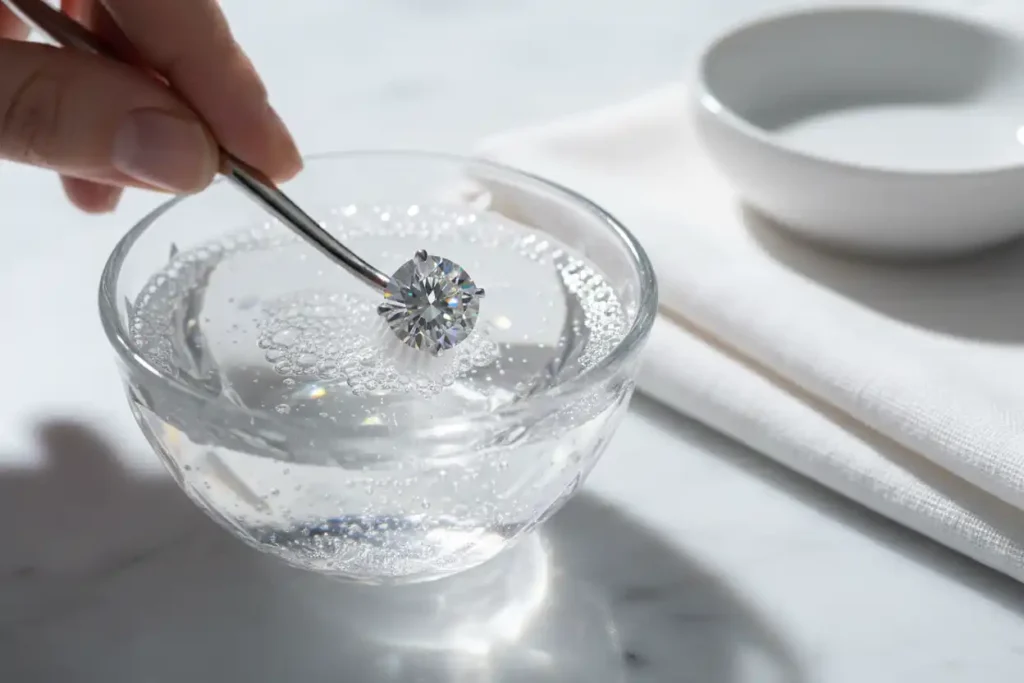
3. Brush the Diamond Gently
Hold the jewelry securely over the bowl.
Use the soft brush to clean around the diamond from every accessible direction.
Pay special attention to the pavilion and underside of the stone.
Also brush carefully around:
- Prongs
- Gallery openings
- Halo settings
- Channel walls
- Basket settings
- The inside of the ring shank near the stone
Use light pressure.
The brush is intended to loosen oily film, not scrape the surface aggressively.
4. Do Not Use Metal Picks
Never insert a needle, pin, knife, dental tool or other metal object underneath a diamond to remove compacted dirt.
This can scratch the mounting, deform a prong or push directly against a vulnerable girdle.
If debris will not release through gentle brushing, professional cleaning is safer.
An important part of knowing how to clean diamond jewelry is recognizing when not to keep escalating the home method.
5. Rinse Carefully
Move the piece into a separate bowl of clean warm water.
Rinse away all soap residue.
Using a bowl rather than an open drain reduces the chance of losing the jewelry if your grip slips.
Check beneath the center diamond, where soap can collect around prongs and gallery openings.
6. Dry Without Heat
Blot the jewelry gently with a lint-free cloth.
Allow remaining moisture in small openings to evaporate naturally at room temperature.
Do not use a hair dryer, radiator or other heat source to speed drying.
Afterward, inspect the setting again.
If a prong catches on the cloth or a stone appears to have moved, stop wearing the jewelry until it is professionally checked.
That completes the safest general method for how to clean diamond jewelry at home.
How to Clean Lab-Grown Diamond Jewelry
Natural and laboratory-grown diamonds do not need separate basic cleaning routines.
This is the most important point to preserve when learning how to clean diamond jewelry that contains a lab-grown stone.
A laboratory-grown diamond has essentially the same crystalline carbon structure, Mohs hardness and grease-attracting surface behavior as natural diamond.
Warm water, mild liquid soap and a soft brush are suitable for ordinary cleaning when the stone is sound and the setting is secure.
The difference between natural and laboratory-grown diamond is origin, not a fundamentally different response to mild soap.
The broader lab-grown versus natural gemstones comparison explains that distinction.
Does HPHT or CVD Growth Change Cleaning?
No special home cleaning method is required simply because a diamond was grown by HPHT or CVD.
Growth method should not determine whether you choose warm soapy water.
What matters more is whether the finished diamond received a later treatment, whether it contains potentially vulnerable fractures and whether the mounting is secure.
Post-growth color treatment can occur in laboratory-grown diamonds, so treatment history should still be considered.
How to clean diamond jewelry containing a lab-grown center stone is therefore best decided exactly as it is for natural diamond: examine the actual finished stone, treatment and setting.
How to Clean a Diamond Ring
Rings usually require more frequent cleaning than pendants because they encounter hand lotion, soap, sanitizer, food residue, sunscreen and skin oils constantly.
When learning how to clean diamond jewelry in ring form, pay particular attention beneath the center stone.
The openings underneath a diamond ring can accumulate a dense film that greatly reduces brilliance.
Brush through the gallery rather than focusing only on the table.
Inspect every prong after cleaning.
For a diamond engagement ring worn daily, professional setting inspections are especially useful because small amounts of wear can eventually loosen a center stone.
Remove diamond rings before gardening, lifting weights, heavy manual work and similar high-impact activities.
Cleaning cannot repair a chipped girdle or worn prong.
How to Clean Diamond Earrings
Diamond earrings collect hair products, cosmetics, skin oils and residue around the posts, backs and baskets.
Use the same mild method for how to clean diamond jewelry, but clean both the gemstone and the fittings.
Brush gently behind the stone.
Clean the earring post and back.
For screw-back earrings, remove residue from the threading without bending the post.
Allow every component to dry thoroughly before reassembling or storing the pair.
The wider diamond earrings guide covers settings, backs, quality and wear considerations beyond cleaning.
How to Clean a Diamond Necklace or Pendant
A diamond necklace commonly accumulates perfume, sunscreen and skin oil across its rear surfaces.
When deciding how to clean diamond jewelry worn around the neck, inspect the chain and clasp as closely as the gemstone.
A clean diamond does little good if a damaged chain breaks.
Support the necklace rather than allowing its full weight to pull against the pendant during washing.
Prevent an exposed diamond girdle from rubbing repeatedly against chain links.
Applying perfume and cosmetics before putting on the jewelry can reduce buildup.
For different necklace and pendant configurations, see diamond necklaces and pendants.
How to Clean a Diamond Bracelet
Diamond bracelets contain more moving parts than most rings or pendants.
A tennis bracelet may contain many small stones, flexible links, hinges, tiny prongs and a clasp.
When following how to clean diamond jewelry for a bracelet, support the piece in your hand or bowl rather than allowing sections to hang under their own weight.
Clean one area at a time.
After rinsing and drying, inspect every stone.
A diamond bracelet worn frequently should receive periodic professional inspection because one worn link or loose setting can be difficult to notice at home.
Can You Use an Ultrasonic Cleaner on Diamond Jewelry?
Sometimes—but not automatically.
Ultrasonic machines use high-frequency vibration to loosen residue.
A sound untreated diamond in a secure modern setting may tolerate professional ultrasonic cleaning well.
The problem is that the machine does not know whether a prong is nearly worn through, a fracture is vulnerable or a filler has been used.
Avoid ultrasonic cleaning when the jewelry contains:
- Fracture-filled diamond
- Surface coating
- Loose prongs
- Delicate pavé
- Significant fractures
- Glue
- Antique construction
- An uncertain treatment
- Sensitive companion gemstones
The detailed ultrasonic gemstone guide explains which materials need additional caution.
For routine home care, knowing how to clean diamond jewelry with warm soapy water removes the need to use a machine in most cases.
Can You Steam Clean Diamond Jewelry?
Diamond itself can tolerate conditions that many other gemstones cannot, but the complete jewelry piece determines whether steam is appropriate.
Steam combines heat and pressure.
That can be unsuitable for fracture fillers, coatings, delicate repairs and certain companion gemstones.
A loose stone can also be dislodged during cleaning.
Professional jewelers inspect jewelry before machine cleaning for precisely this reason.
If you do not know the treatment and construction history, warm water and mild soap remain the safer answer to how to clean diamond jewelry at home.
What if the Ring Contains Other Gemstones?
Follow the care requirements of the most vulnerable material in the piece.
A diamond-and-emerald ring is not simply diamond jewelry from a cleaning perspective.
Emerald commonly contains fissures and clarity enhancement.
Opal is sensitive to heat and requires conservative care.
Pearl is much softer and chemically more sensitive than diamond.
Turquoise can be porous and treated.
If a piece contains several gemstones, do not choose a cleaning method simply because diamond can tolerate it.
How to clean diamond jewelry safely becomes a mixed-material question as soon as another stone is present.
Can You Clean Diamond Jewelry With Toothpaste?
Do not use toothpaste.
Toothpaste is formulated for teeth, not jewelry.
Some formulas contain abrasive particles that can scratch or dull gold, silver, platinum finishes or plated surfaces.
The diamond may survive the abrasion while the setting does not.
Mild liquid soap provides a safer and more predictable approach.
Can You Use Baking Soda?
Baking soda is unnecessary for ordinary diamond cleaning.
Its abrasive texture can affect polished metal surfaces and collect in small settings.
You do not need scrubbing powder to remove skin oils from diamond.
Warm water, mild soap and a soft brush are sufficient for most routine buildup.
Can You Use Bleach or Chlorine?
Avoid bleach and chlorine-based household cleaners.
Even when the diamond itself is chemically resistant, aggressive chemicals may affect metal alloys, solder, plating or another material in the jewelry.
Swimming pools and hot tubs also expose jewelry to chemicals while creating an additional risk of loss.
Remove valuable rings before swimming rather than relying on diamond hardness.
Can You Clean Diamond Jewelry With Alcohol?
Alcohol may remove oils from some materials, but it is not necessary for routine cleaning and should not be treated as universally safe for finished jewelry.
Coatings, fillers, glue, antique components and accompanying gemstones can alter the answer.
If the construction and treatment history are uncertain, use mild soap and water.
A stronger solvent should solve a specific confirmed problem rather than being used simply because diamond itself is durable.
How Often Should You Clean Diamond Jewelry?
There is no mandatory schedule.
Clean when visible oil and residue begin reducing brilliance.
A frequently worn engagement ring may need gentle cleaning much more often than earrings worn only occasionally.
Daily habits matter.
Hand cream, sunscreen, cooking, cosmetics and frequent handling increase buildup.
Instead of following an arbitrary calendar, inspect the diamond under ordinary light.
If the pavilion is visibly coated or the stone has lost brightness from surface film, it is time to clean.
How to clean diamond jewelry safely matters more than how often you clean it.
How to Keep Diamond Jewelry Cleaner Longer
Prevention reduces the amount of cleaning required.
Apply lotion, sunscreen, perfume and cosmetics before putting jewelry on when practical.
Remove rings before cooking greasy foods, cleaning with household chemicals or doing heavy manual work.
Handle loose diamonds and diamond pendants by their edges or settings rather than repeatedly touching the polished facets.
Store pieces separately.
Diamond can scratch other gemstones and can also scratch another diamond.
A lined compartment or individual pouch prevents unnecessary contact.
When Cleaning Will Not Restore Sparkle
Sometimes dullness is not caused by dirt.
A diamond may look less lively because of its cut, inclusions, a chipped facet or damage to the setting.
A coating may have worn.
Another gemstone mistaken for diamond may have accumulated surface abrasion.
A persistent hazy appearance after careful cleaning deserves inspection rather than stronger scrubbing.
The real vs fake diamond guide explains how natural diamond, laboratory-grown diamond and simulants differ.
Cleaning should never become an improvised authenticity test.
When to Take Diamond Jewelry to a Professional
Professional inspection is preferable when:
the stone moves,
a prong is bent or missing,
the jewelry suffered a hard impact,
the diamond is fracture filled,
treatment is uncertain,
the piece is antique,
the mounting contains delicate materials,
there is residue you cannot remove gently,
or an important stone still looks unusual after cleaning.
A jeweler can inspect the mounting before choosing ultrasound, steam or another cleaning method.
The purpose is not merely to produce more sparkle.
It is to make sure the stone remains securely wearable.
Frequently Asked Questions
What is the safest way to clean diamond jewelry?
The safest general method for how to clean diamond jewelry is warm water, a few drops of mild liquid dish soap and gentle brushing with a very soft brush. Rinse in a separate bowl and dry with a lint-free cloth.
How do you clean diamond jewelry at home?
Inspect the setting first, prepare warm soapy water, briefly loosen the residue, brush gently around and beneath the diamond, rinse carefully and allow the piece to dry at room temperature.
How do you clean lab-grown diamond jewelry?
Use the same basic method used for natural diamond: warm water, mild soap and a soft brush. Lab-grown and natural diamonds share essentially the same basic material properties, although treatments and settings still need individual consideration.
Are lab-grown diamonds harder to clean?
No. Growth origin does not make routine cleaning more difficult. When deciding how to clean diamond jewelry containing a lab-grown stone, focus on residue, treatment, structural condition and the mounting.
Can I soak a diamond ring overnight?
Long soaking is unnecessary. A short exposure to mild soapy water is generally enough to loosen common residue. Antique, glued, treated or mixed-gem jewelry may require even more conservative cleaning.
Can I clean my diamond ring every week?
A sound ring can receive regular gentle cleaning when needed. The important issue is using a mild method and inspecting the setting rather than following a strict frequency.
Can I use a toothbrush on diamond jewelry?
Yes, provided it is clean and very soft. Use light pressure, especially around delicate prongs and pavé settings.
Can toothpaste clean a diamond ring?
Do not use toothpaste. Abrasive ingredients can damage polished metal even though the diamond itself resists scratching.
Can baking soda clean diamonds?
Baking soda is unnecessary and may abrade jewelry metal or collect in small settings. Mild liquid soap is a safer routine choice.
Can you use an ultrasonic cleaner on a diamond?
Some sound untreated diamonds in secure settings may tolerate ultrasonic cleaning, but fracture-filled, coated, damaged, loose, antique or mixed-gem jewelry may not. Professional assessment is safer than assuming every diamond can go into the machine.
Can you steam clean a diamond?
A secure untreated diamond may tolerate professional steam cleaning, but fillers, coatings, loose settings and companion gems can make steam inappropriate. It should not be the default home method.
Why does my diamond look cloudy?
Skin oil, lotion and soap residue are common causes. Clean the pavilion and underside carefully. If the cloudy appearance remains, inclusions, damage, treatment or another issue may be responsible.
Why does my diamond get dirty so quickly?
Diamond readily attracts grease. Hand cream, natural skin oil, cosmetics, sunscreen and cooking residue can coat the facets quickly, especially on frequently worn rings.
Can chlorine damage a diamond?
The diamond itself is highly resistant, but chlorine can affect some jewelry metals and components. Remove diamond jewelry before swimming or using chlorine-based cleaners.
Does hot water damage diamond jewelry?
Ordinary warmth is sufficient for cleaning. Very hot water provides no benefit and may be inappropriate for treatments, glue, other gemstones or delicate construction.
Can natural and lab-grown diamonds be cleaned together?
Yes, when both stones and their settings are sound and compatible with the chosen method. Natural versus laboratory origin does not require separate mild-soap cleaning routines.
How do I clean underneath a diamond ring?
Use a soft brush through the gallery openings beneath the stone. Do not insert metal picks, pins or other hard objects under the diamond.
How do I know if my diamond ring is too loose to clean?
If the stone moves, clicks, a prong has a visible gap or the setting looks damaged, do not continue cleaning. Have the jewelry professionally inspected first.
How do I clean a diamond ring with emeralds or other gemstones?
Follow the care requirements of the most sensitive gemstone or material in the piece. A cleaning method suitable for diamond may be unsafe for emerald, opal, pearl, turquoise or another companion stone.
Does cleaning damage a lab-grown diamond?
Normal warm-soapy-water cleaning does not harm a sound lab-grown diamond. Damage risks usually come from the setting, fractures, treatments, harsh chemicals or inappropriate machine cleaning—not the laboratory-grown origin itself.
How often should a diamond ring be professionally inspected?
There is no universal interval for every piece. Jewelry worn daily, especially engagement rings with prongs or pavé, benefits from periodic inspection and should be checked promptly after a significant impact or whenever a stone seems loose.
Keeping Diamond Jewelry Bright Without Overcleaning
Once you know how to clean diamond jewelry, maintaining brilliance does not require harsh chemicals or complicated equipment.
Start with the setting.
Make sure the stones are secure.
Use warm water, a small amount of mild soap and a soft brush.
Clean beneath the diamond, where grease has the greatest effect on light return.
Rinse carefully.
Dry without excessive heat.
Use exactly the same core approach for a sound laboratory-grown diamond, because its manufactured origin does not create a separate category of routine cleaning.
Reserve ultrasound, steam and stronger procedures for situations where the treatment, setting and complete jewelry construction have been assessed appropriately.
Most importantly, remember that the hardest gemstone is only one part of the piece. Gold can scratch. Prongs can bend. Fillers can change. Companion gemstones can be far more delicate. A careful method protects all of them.
That is the real key to how to clean diamond jewelry safely: remove the residue that hides the sparkle without creating a larger problem than the dirt itself.