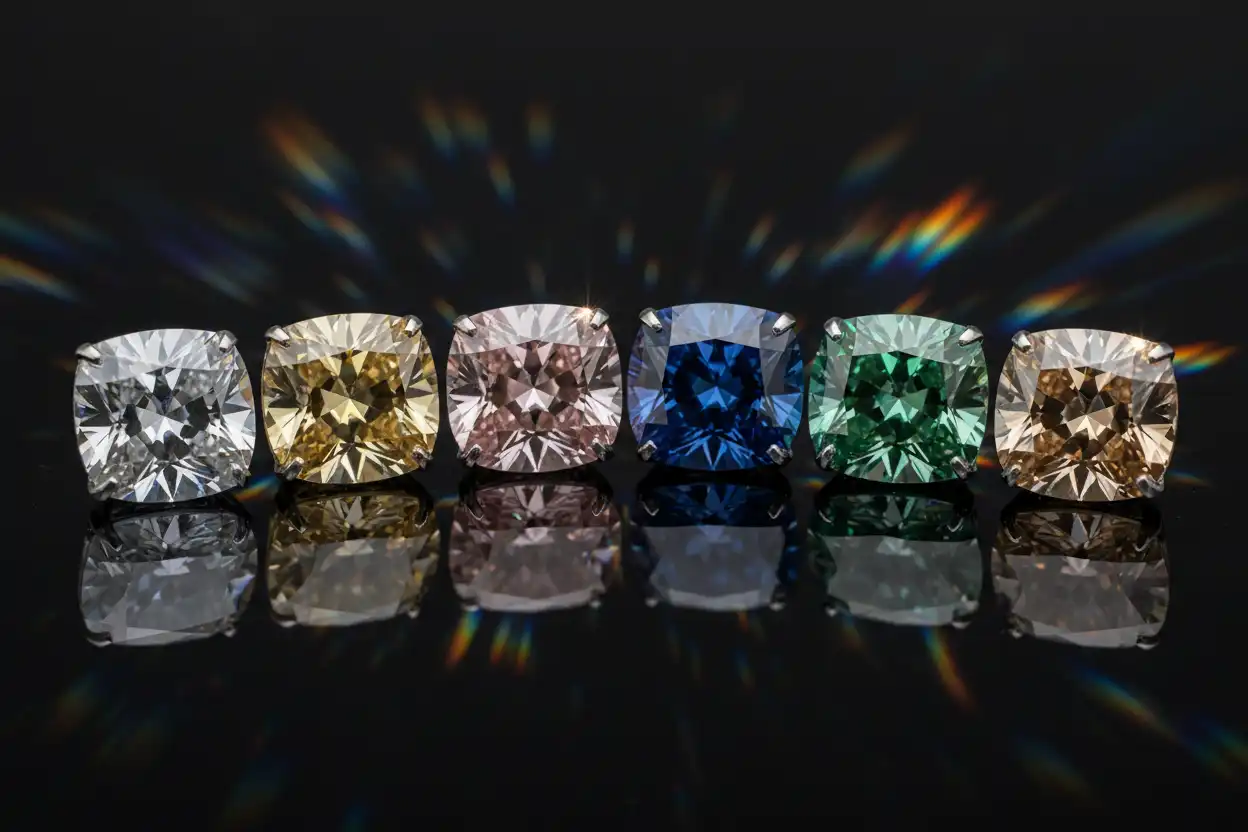
Diamond Color Meaning: D–Z Grades, Fancy Colors & Lab Diamonds
Diamond color meaning has two very different sides. In gemology, color describes a measurable characteristic that affects grading, identification and value. In symbolism and jewelry traditions, different diamond colors can represent ideas such as clarity, warmth, individuality, commitment or resilience.
For colorless-to-light-yellow or light-brown natural diamonds, less visible body color generally receives a higher grade on the D–Z scale. Fancy-color diamonds work differently: a distinct, attractive hue with stronger saturation can become more desirable and considerably rarer.
Laboratory-grown diamonds add another important layer to diamond color meaning. They are genuine crystalline diamond, but their color may reflect controlled growth conditions, impurities, lattice defects or post-growth treatment. Current reporting practices also differ between laboratories, so buyers should read the actual report rather than assuming every lab uses identical terminology.
Understanding those distinctions makes diamond color meaning far more useful than simply asking whether one color is “better” than another.
Diamond Color Meaning at a Glance
| Diamond category | Color description | What matters most |
|---|---|---|
| D–F natural diamond | Colorless | Absence of visible body color |
| G–J natural diamond | Near colorless | Slight warmth and overall appearance |
| K–M | Faint color | Intentional or noticeable warmth |
| N–R | Very light color | Clearly visible yellow, brown or gray component |
| S–Z | Light color | Strong normal-range body color |
| Fancy-color diamond | Yellow, pink, blue, green, red, orange, brown, gray, black and mixed hues | Hue, tone, saturation, distribution and color origin |
| Lab-grown colorless or near-colorless diamond | Depends on reporting laboratory | Growth origin, color appearance, report system and post-growth treatment |
| Lab-grown fancy-color diamond | Distinct manufactured color | Hue, saturation, distribution, growth process and treatment disclosure |
The broader diamond guide explains diamond formation, crystal structure, hardness and physical properties. Here, diamond color meaning stays focused on what color tells you about appearance, grading, origin, treatment, buying and symbolism.
What Does Diamond Color Meaning Actually Refer To?
Diamond color meaning can describe three separate questions.
The first is gemological color: what causes a diamond to absorb certain wavelengths of light and display yellow, brown, blue, pink, green or another hue?
The second is commercial color: how does a laboratory describe that appearance, and how does the grade affect rarity and price?
The third is symbolic color: what meanings have jewelers, wearers and modern traditions attached to different colors?
Keeping these questions separate prevents a common mistake. A yellow diamond can have a scientifically identifiable color center, a commercially valuable fancy-color grade and a personal symbolism associated with optimism. Those statements belong to different categories and should not be treated as interchangeable facts.
Diamond Color Meaning on the D–Z Scale
For natural diamonds within the normal color range, diamond color meaning is primarily about the absence or increasing presence of yellow, brown or gray.
GIA’s established natural-diamond scale begins at D and continues through Z. Diamonds are compared with master stones under controlled viewing conditions because neighboring grades can be extremely subtle.
D–F: Colorless Diamond Color Meaning
D, E and F belong to the colorless range.
A D diamond represents the highest absence-of-color position on the D–Z scale. That does not mean every observer can distinguish D from E or F once the stones are mounted.
Diamond color meaning at this end of the scale is mainly about rarity and grading precision. A D-color stone may command a premium even when its everyday visual difference from a well-cut F or G stone is small.
Colorless diamonds are especially popular in platinum and white-gold jewelry because the surrounding metal reinforces a cool, bright appearance.
In symbolic contexts, colorless diamond color meaning is commonly associated with clarity, commitment, simplicity and endurance. Those are cultural associations, not scientifically measurable properties of the stone.
G–J: Near-Colorless Diamond Color Meaning
G through J diamonds contain slightly more perceptible warmth.
G and H stones frequently appear colorless face-up to many viewers, especially when they are well cut. I and J diamonds can show more warmth, particularly from the side or when compared directly with a higher-color stone.
This part of diamond color meaning is important for value-conscious buying. Moving down several color grades may release budget for better cut, greater carat weight or another feature that makes a larger visual difference.
The practical trade-offs among the Four Cs are explored in the diamond buying guide.
A near-colorless grade is not defective or impure in the everyday sense. It simply occupies a lower position on a controlled color scale.
K–M: Faint Diamond Color Meaning
K, L and M diamonds show recognizable warmth.
Depending on the individual stone, the color may appear ivory, cream, yellowish or brownish. Larger diamonds tend to reveal body color more readily because light travels through more material.
Diamond color meaning in this range becomes partly a design question. A warm diamond in yellow or rose gold may look intentional and harmonious rather than like a lower-grade substitute for a colorless stone.
Antique-inspired settings and older cutting styles can work particularly well with this warmer appearance.
N–R: Very Light Diamond Color Meaning
N through R diamonds display obvious body color under ordinary viewing conditions.
At this stage, the warmth is difficult to treat as merely a minor grading detail. The setting, stone shape and personal preference become central to the design.
Very-light yellow or brown material should not automatically be marketed as fancy-color diamond. Fancy classification uses a separate system and depends on the hue and strength of the color.
S–Z: Light Diamond Color Meaning
S through Z represent the strongest body color within the standard D–Z range.
Yellow, brown or gray is clearly visible. These diamonds can still be attractive, but the buyer should understand that diamond color meaning remains tied to the normal absence-of-color scale.
A yellow diamond just beyond this range may enter fancy-color grading, where stronger color can become desirable rather than penalized.
The types of diamond guide explains how color classifications intersect with origin, crystal type and other diamond categories.
Why Does Diamond Color Meaning Start With D Instead of A?
The D grade was deliberately chosen as a fresh starting point.
Earlier diamond merchants used inconsistent descriptions and systems, including A grades, repeated A letters, numbers and terms such as “blue white.” GIA created the D–Z system to avoid carrying those older commercial labels into a standardized scale.
Therefore, D does not mean fourth-best.
Within modern natural-diamond grading, it represents the top colorless position.
That historical detail is important because diamond color meaning is often misunderstood when shoppers assume ordinary school-style letter grading.
How Diamond Color Is Graded
Diamond color meaning becomes reliable commercially only when evaluation conditions are controlled.
For D–Z grading, a loose diamond is typically examined face-down. Viewing the pavilion and side reduces the distracting effects of brilliance, fire and facet reflections.
The grader compares the diamond against reference stones in standardized lighting.
Mounted diamonds are harder to evaluate accurately because metal color, prongs, dirt and surrounding stones influence perception.
This is why an independent grading document can matter when one color grade materially changes the price. The gemstone certification guide explains how laboratory reports differ from appraisals and seller descriptions.
When reviewing any report, the gem lab report guide helps interpret measurements, grades, comments, treatments and identification statements.
Fancy Diamond Color Meaning Works in the Opposite Direction
Fancy-color grading changes the logic completely.
For most D–Z diamonds, less color generally means a higher grade. For fancy colors, stronger attractive coloration can increase rarity and value.
Diamond color meaning for a fancy stone depends mainly on:
Hue — the principal color and any modifiers.
Tone — how light or dark the color appears.
Saturation — the strength or intensity of the hue.
Distribution — how evenly the color appears across the face of the cut stone.
Fancy-color terminology can include levels such as Fancy Light, Fancy, Fancy Intense, Fancy Vivid, Fancy Deep and Fancy Dark, depending on the individual color and report.
Fancy-color diamonds are generally evaluated face-up because their visible color is the central feature.
Cutters may therefore use proportions and facet arrangements that strengthen color rather than simply maximize the light-return pattern favored in colorless diamonds.
What Causes Yellow Diamond Color?
Nitrogen is responsible for much natural yellow diamond color.
Nitrogen-related defects absorb parts of visible light, allowing yellow to dominate the appearance. The arrangement and concentration of nitrogen influence the exact result.
Diamond color meaning changes commercially as yellow becomes stronger. Pale yellow can reduce the grade within the D–Z scale, while sufficiently distinct yellow can enter the fancy-color market.
Yellow fancy diamonds are also compared with other yellow gems in the yellow gemstones guide.
Symbolically, yellow diamond color meaning is commonly associated with optimism, confidence, visibility and warmth. These are modern or cultural interpretations rather than physical effects caused by nitrogen in the crystal.
What Causes Brown Diamond Color?
Brown color often develops from structural deformation and lattice defects.
Geological stress can distort the diamond’s crystal structure and change how light is absorbed. Brown diamonds may be marketed with names such as champagne, cognac or chocolate, although such terms are commercial descriptions rather than universal laboratory grades.
Brown diamond color meaning in jewelry often emphasizes warmth, earthiness and understated style.
From a buying perspective, the key questions are whether the color is natural, whether treatment has altered it and whether the price reflects the actual report.
Some brown diamonds can be modified through HPHT processing, so treatment disclosure matters.
Pink and Red Diamond Color Meaning
Natural pink color is strongly associated with deformation of the diamond lattice rather than a simple high concentration of one trace element.
Color may appear in bands or zones created by structural distortion.
Natural red diamonds occupy an exceptionally scarce part of the market, while pink diamonds range more widely in saturation and modifiers.
For buyers comparing diamond with other pink stones, the pink gemstones guide separates diamond from sapphire, spinel, morganite and other choices.
Modern pink diamond color meaning often centers on affection, individuality and tenderness. Red is more commonly associated with intensity, boldness or passion.
Neither color can create or guarantee romantic outcomes.
Blue Diamond Color Meaning
Boron is one important cause of natural blue diamond color.
Even very small amounts can produce blue or gray-blue appearances. Some diamonds with blue or violet components involve more complex defects.
Fancy blue natural diamonds are scarce enough that a reliable report becomes particularly important when natural color origin affects value.
The blue gemstones guide provides context for comparing diamond with sapphire, aquamarine, topaz and other blue materials.
Symbolically, blue diamond color meaning is commonly linked with composure, loyalty, communication and perspective. Those interpretations belong to jewelry symbolism rather than mineral physics.
Green Diamond Color Meaning
Natural green color can develop when radiation affects the diamond crystal while it remains underground.
The resulting defects alter light absorption. In some diamonds, green coloration is concentrated near the surface.
Artificial irradiation can also create green color, which makes natural-color determination a specialized laboratory problem.
A visually green stone cannot be assumed to have natural color simply because the diamond itself is natural.
Diamond color meaning for green therefore involves both appearance and color origin.
Modern symbolism commonly associates green diamonds with renewal, growth and adaptability, but the stone does not scientifically cause those outcomes.
Black Diamond Color Meaning
Black diamonds do not behave visually like transparent colorless diamonds.
Many natural black diamonds appear dark because of dense inclusions, fractures and other internal features. Commercial stones can also be treated to achieve a more uniform black appearance.
For similar dark jewelry options, the black gemstones guide compares diamond with onyx, spinel and other materials.
Black diamond color meaning in contemporary jewelry often emphasizes individuality, contrast, strength and unconventional design.
Treatment disclosure remains important because natural-color and treated black diamonds occupy different commercial categories.
Gray Diamond Color Meaning
Gray diamonds can receive their appearance from several causes, including structural defects, inclusions and, in some cases, boron-related features.
A gray component may occur within D–Z grading or become part of a fancy-color description.
Gray diamond color meaning is often associated symbolically with neutrality, restraint and modern design.
Because gray may interact with blue, brown or green modifiers, the complete laboratory description matters more than a seller’s simplified color name.
Natural and Lab-Grown Diamond Color Meaning
A laboratory-grown diamond is crystalline carbon rather than a diamond simulant.
HPHT and CVD growth can produce colorless, near-colorless and colored diamonds. Impurities and defects may be intentionally controlled during growth, while post-growth processes can also modify color.
This is where the consolidated diamond color meaning becomes especially important: natural and laboratory-grown stones can display similar visible colors, but the origin of those colors may be very different.
A yellow natural diamond may owe its color to nitrogen incorporated during geological growth.
An HPHT-grown diamond can also contain nitrogen.
Blue laboratory-grown diamond can involve boron.
Pink, red, green and other lab-grown colors may involve engineered defects, irradiation, annealing or combinations of growth and post-growth processes.
Color alone does not reliably prove whether a diamond formed in the Earth or in a manufacturing facility.
The broader distinction between natural and manufactured gems is explained in lab-grown vs natural gemstones.
Do Lab-Grown Diamonds Use the Same D–Z Color Grades?
Not always.
This is an important modern detail in diamond color meaning because reporting systems now differ by laboratory.
GIA currently uses an overall Premium or Standard quality assessment for eligible colorless-to-near-colorless laboratory-grown diamonds rather than issuing the same consumer-facing natural-diamond color nomenclature as its natural diamond reports. The assessment combines color with clarity, cut and finish criteria. GIA continues to issue dedicated reports for colored laboratory-grown diamonds.
IGI currently reports laboratory-grown diamond color using D–Z terminology and identifies the stone as laboratory grown.
Therefore, a buyer should not assume that a lab-grown diamond must have one specific report format.
Diamond color meaning should always be interpreted in the context of the laboratory that issued the document.
Lab-Grown Yellow Diamond Color Meaning
Yellow lab-grown diamond may result from nitrogen-related defects introduced or retained during growth.
Growth conditions can be manipulated far more directly than geological conditions, so manufacturers can deliberately produce or modify particular appearances.
Yellow lab-grown diamond color meaning symbolically can be exactly as personal as the meaning assigned to a natural yellow diamond.
Its commercial rarity, however, should not be assumed to match the rarity of natural fancy yellow material.
Origin and scarcity are separate questions.
Lab-Grown Pink and Red Diamond Color Meaning
Pink and red laboratory-grown diamonds may receive their appearance from defect engineering and post-growth processes rather than the same geological deformation history associated with many natural pink stones.
That distinction matters for both identification and value.
A laboratory-grown pink diamond can still be visually attractive and chemically diamond. What it should not be sold as is a naturally formed pink diamond.
Diamond color meaning in a sentimental ring comes from the wearer and occasion; geological rarity is a different characteristic.
Lab-Grown Blue and Green Diamond Color Meaning
Blue laboratory-grown diamonds may incorporate boron, while green material can be produced through defect-related processes or irradiation.
Because both natural and laboratory-grown diamonds can show these colors, visual inspection alone cannot establish origin.
A strong blue or green color therefore makes report interpretation especially important.
The distinction between identification, treatment and origin is covered more deeply in treated and synthetic diamond identification.
Can Diamond Color Reveal Whether a Stone Is Natural or Lab-Grown?
No.
Diamond color meaning can provide clues, but color by itself is not a reliable origin test.
Natural and laboratory-grown diamonds overlap substantially in color.
Both can be colorless.
Both can be yellow.
Both can be blue, pink, green, brown, gray or black.
Professional identification may use spectroscopy, fluorescence imaging, growth structures, inclusions and other laboratory observations.
If the basic question is whether a stone is diamond at all, real vs fake diamond explains the difference among natural diamond, laboratory-grown diamond and simulants such as cubic zirconia and moissanite.
Avoid home tests that risk scratching or damaging jewelry.
Diamond Color Treatments
Treatment changes diamond color meaning because visible appearance alone does not reveal how the color developed.
Common color-modification approaches can include HPHT processing, irradiation, annealing and surface coatings.
HPHT processing can alter certain brownish diamonds toward more colorless appearances or create different color states.
Irradiation can create color centers that produce green, blue and other hues.
Annealing after irradiation may shift the resulting color.
Coatings can modify face-up appearance but may be less durable than color produced throughout the crystal structure.
The wider gemstone treatments guide explains why treatment disclosure affects care, identification and value.
A treated diamond is not automatically undesirable. The important issues are accurate disclosure, stable treatment, appropriate pricing and suitable care.
Fluorescence and Diamond Color Meaning
Fluorescence is not the same thing as body color.
Some diamonds emit visible light under ultraviolet radiation, with blue being a common fluorescence color.
Fluorescence is reported separately from the D–Z color grade.
In some warmer diamonds, blue fluorescence can make yellow body color appear less noticeable in certain lighting. In high-color diamonds, strong fluorescence may influence market preference even when appearance remains attractive.
The effect should be judged on the individual stone rather than from a report term alone.
Diamond color meaning should therefore keep color grade, fluorescence and face-up appearance as related but separate characteristics.
How Cut Changes Diamond Color
Cut can make two diamonds with the same color grade look different.
A well-cut round brilliant can return enough light to make modest warmth less obvious when viewed face-up.
Elongated shapes such as pears and marquises may concentrate color near their tips.
Step cuts such as emerald and Asscher styles can reveal body color more readily because their broad facets create a different viewing pattern.
Fancy-color cutters often pursue the opposite objective: they may use radiant, cushion or modified brilliant arrangements to strengthen the visible hue.
Diamond color meaning therefore cannot be separated completely from cut.
Color grade describes the material under controlled conditions; appearance describes what the finished stone actually looks like.
How Carat Weight Changes Visible Color
Larger diamonds generally reveal body color more readily.
Light travels through more material, so a subtle yellow or brown component can become easier to see as carat weight increases.
A J-color small diamond may look nearly colorless in many settings, while a much larger J-color diamond can show noticeable warmth.
This is why diamond color meaning becomes increasingly important when comparing larger stones.
The same principle helps explain why fancy-color saturation can become particularly striking in larger diamonds.
How Setting Metal Affects Diamond Color Meaning
Jewelry metal changes the visual reference around the diamond.
White gold and platinum can emphasize the icy appearance of high-color diamonds. They may also make warmth more obvious in lower D–Z grades.
Yellow gold can make a warmer diamond appear comparatively whiter while also reflecting some yellow tone into the pavilion.
Rose gold produces a different warm contrast.
Mixed-metal settings provide another option, such as a yellow-gold band with white prongs around the center diamond.
The diamond engagement ring guide covers how setting style, prongs, shape and metal interact with the center stone.
Diamond color meaning should therefore be evaluated in the actual jewelry context, not only against a laboratory master set.
Diamond Color Meaning and Price
Color can materially affect diamond price, but the relationship depends on the category.
For natural D–Z diamonds, moving toward D generally increases value when other factors remain comparable.
The price difference can be substantial even when the visible difference between two neighboring grades is small.
For fancy-color natural diamonds, stronger saturation and rare hues may increase value dramatically.
Natural red, blue, green and pink diamonds occupy very different scarcity levels from common brown or yellow material.
Laboratory-grown diamond pricing follows another market structure because manufacturing supply is different from geological rarity.
The diamond price guide explains how color interacts with cut, clarity, carat weight, fluorescence, origin and treatment.
Diamond color meaning should never be reduced to “higher letter equals better value.” Value depends on what type of diamond is being graded.
Choosing a D–Z Diamond by Color
For many buyers, the most sensible diamond color meaning is simply: Can I see a difference that matters to me?
If the answer is no, paying for a higher paper grade may not provide the best use of the budget.
D–F suits buyers who specifically value top colorless grades.
G–H often provides a strongly colorless appearance without the highest rarity premium.
I–J may offer excellent value when slight warmth is acceptable.
K and lower can work beautifully when warmth is intentional, particularly with yellow gold or vintage styling.
Always consider cut first. A poorly cut D-color diamond can look less lively than a well-cut H-color diamond.
Choosing a Fancy-Color Diamond
Fancy-color buying requires a different set of priorities.
Start with hue.
Then examine tone, saturation and distribution.
Look for attractive face-up color rather than assuming the strongest grade is automatically the most beautiful.
Check whether the color is natural or treated.
Verify whether the diamond itself is natural or laboratory grown.
Review the report rather than relying on marketing phrases.
If the purchase is being presented primarily as an asset, colored diamond investment explains why rarity does not automatically create easy resale, predictable appreciation or liquidity.
Diamond color meaning can influence emotional appeal, but buying decisions should remain grounded in identification and market reality.
Diamond Color Meaning in Engagement Rings
Color often becomes especially personal in engagement jewelry.
Colorless diamonds traditionally emphasize the classic bright-white look.
Warm near-colorless diamonds can complement yellow or rose gold.
Yellow diamonds provide a visibly colored center while retaining the durability and brilliance associated with diamond.
Pink and blue diamonds make stronger individual statements but can enter dramatically different price ranges depending on natural origin, saturation and rarity.
Black diamond creates strong contrast and a less conventional style.
Lab-grown fancy colors can make some visual styles accessible at substantially different prices from rare natural counterparts.
The ring’s meaning comes from the people and commitment it represents—not from a scientifically proven power associated with the diamond’s hue.
Symbolic Diamond Color Meaning
Color symbolism varies by culture, period and individual interpretation.
| Diamond color | Common modern symbolic association |
|---|---|
| Colorless | Clarity, commitment, precision, simplicity |
| Yellow | Warmth, optimism, confidence |
| Brown or champagne | Stability, earthiness, understated elegance |
| Pink | Affection, individuality, tenderness |
| Red | Intensity, courage, passion |
| Blue | Loyalty, composure, perspective |
| Green | Renewal, adaptability, growth |
| Gray | Balance, restraint, modernity |
| Black | Strength, privacy, independence, contrast |
These diamond color meaning associations are interpretive.
A pink diamond does not scientifically attract love. A green diamond does not cause growth or prosperity. A black diamond cannot create supernatural protection.
The significance comes from tradition, design, personal experience and the occasion attached to the jewelry.
Does Natural Color Have More Meaning Than Lab-Grown Color?
Not inherently.
Geological origin and personal meaning are separate.
Someone may value a natural diamond because it formed deep within Earth over an immense period. Another person may value laboratory-grown diamond because of design priorities, budget, technology or personal purchasing preferences.
A family heirloom may carry meaning because of its history rather than its laboratory grade.
Diamond color meaning is therefore partly factual and partly personal.
The factual side describes color origin, grading and treatment.
The personal side belongs to the wearer.
Caring for Colored Diamonds
Diamond is extremely resistant to scratching, but it is not indestructible.
Diamond has perfect cleavage and can chip from certain impacts. Protect pointed corners, girdles and vulnerable inclusions.
Ordinary untreated diamond jewelry can often be cleaned with warm water, mild soap and a soft brush.
Treatment changes the care decision. Filled, coated or otherwise modified material may require more conservative handling, particularly around heat and chemicals.
Before professional repair or cleaning, disclose known treatments to the jeweler.
Color itself does not make a diamond fragile, but the treatment or setting may introduce additional considerations.
Frequently Asked Questions
What does diamond color meaning mean in grading?
Diamond color meaning in grading describes how much body color is present and how the laboratory categorizes it. Natural D–Z diamonds are evaluated by increasing yellow, brown or gray, while fancy-color diamonds are judged primarily by the presence and quality of color.
What is the best diamond color?
There is no universal best grade. D is the top colorless grade on the natural D–Z scale, but G or H may look similarly colorless to many buyers while costing less. Fancy-color diamonds follow a different system entirely.
Is D-color diamond always worth the extra money?
Not necessarily. The visual difference between D and slightly lower color grades may be difficult to detect after mounting. Cut quality, size, setting and budget should be considered together.
Is G color a good diamond color?
Yes. G belongs to the near-colorless range and commonly offers a very white face-up appearance in a well-cut diamond.
Is H color good for an engagement ring?
H is a popular near-colorless choice because it can provide a bright appearance without the premium attached to D–F grades. The setting metal and diamond shape influence how much warmth is visible.
Why does the diamond color scale start at D?
The scale starts at D because its creators wanted a new standardized system that would not be confused with older A, AA, AAA and other inconsistent commercial grading terms.
What does fancy diamond color mean?
Fancy diamond color meaning refers to diamonds whose distinct body color falls outside the ordinary D–Z framework. Hue, tone, saturation, distribution and color origin become central grading and value factors.
Are yellow diamonds lower quality?
Not automatically. Pale yellow within the D–Z range lowers the color grade, but a sufficiently strong yellow diamond can receive a fancy-color classification where saturated color is desirable.
Are lab-grown diamonds graded for color?
Yes, but the reporting terminology depends on the laboratory. Some laboratories continue to issue D–Z color grades for lab-grown diamonds, while GIA currently uses Premium and Standard overall quality assessments for eligible colorless-to-near-colorless lab-grown stones.
Can lab-grown diamonds have fancy colors?
Yes. Laboratory-grown diamonds can be produced in yellow, blue, pink, red, green, brown, gray, black and other appearances through controlled growth conditions, impurities, defects and post-growth processes.
Can color tell if a diamond is lab-grown?
No. Natural and laboratory-grown diamonds overlap in color. Reliable origin identification requires suitable gemological testing rather than color alone.
Are colored diamonds treated?
Some are and some are not. HPHT processing, irradiation, annealing and coatings can alter diamond color. A reputable report should clarify color origin or treatment when the determination is relevant.
Does fluorescence change a diamond’s color grade?
Fluorescence is reported separately from the D–Z color grade. It can affect apparent color under certain lighting conditions, but it is not itself the body-color grade.
Why do two diamonds with the same color grade look different?
Cut, shape, carat weight, fluorescence, surrounding metal and viewing conditions can all change face-up appearance even when the laboratory color grade is the same.
Does diamond color have spiritual meaning?
Different colors carry symbolic associations in jewelry and contemporary spiritual traditions, but there is no scientific evidence that a diamond’s color produces emotional, medical, relationship or supernatural outcomes.
Understanding Diamond Color Beyond the Letter Grade
Diamond color meaning becomes much clearer once the grading systems are separated.
D–Z grading measures increasingly visible normal-range color in natural diamonds. Fancy grading evaluates the presence and quality of distinct color. Laboratory-grown diamonds can reproduce many of the same visible hues, but their growth history, color causes, treatments and reporting conventions need to be identified separately.
For buyers, that means looking beyond a single letter.
Consider how the diamond appears face-up. Compare the color with the setting metal. Examine how cut and size influence warmth. Confirm whether the stone is natural or laboratory grown. Check whether color is natural or treated. Read the report issued for the actual diamond.
Symbolic diamond color meaning can then remain what it should be: a personal or cultural layer placed on top of verified gemological facts, rather than a substitute for them.
Disclaimer: Diamond color symbolism reflects cultural, historical, jewelry and contemporary interpretive traditions rather than scientifically established effects. A diamond’s color does not guarantee love, protection, prosperity, emotional change or another life outcome. For purchases where natural origin, laboratory growth, treatment or color grade materially affects value, rely on appropriate gemological testing and a report from a reputable laboratory.