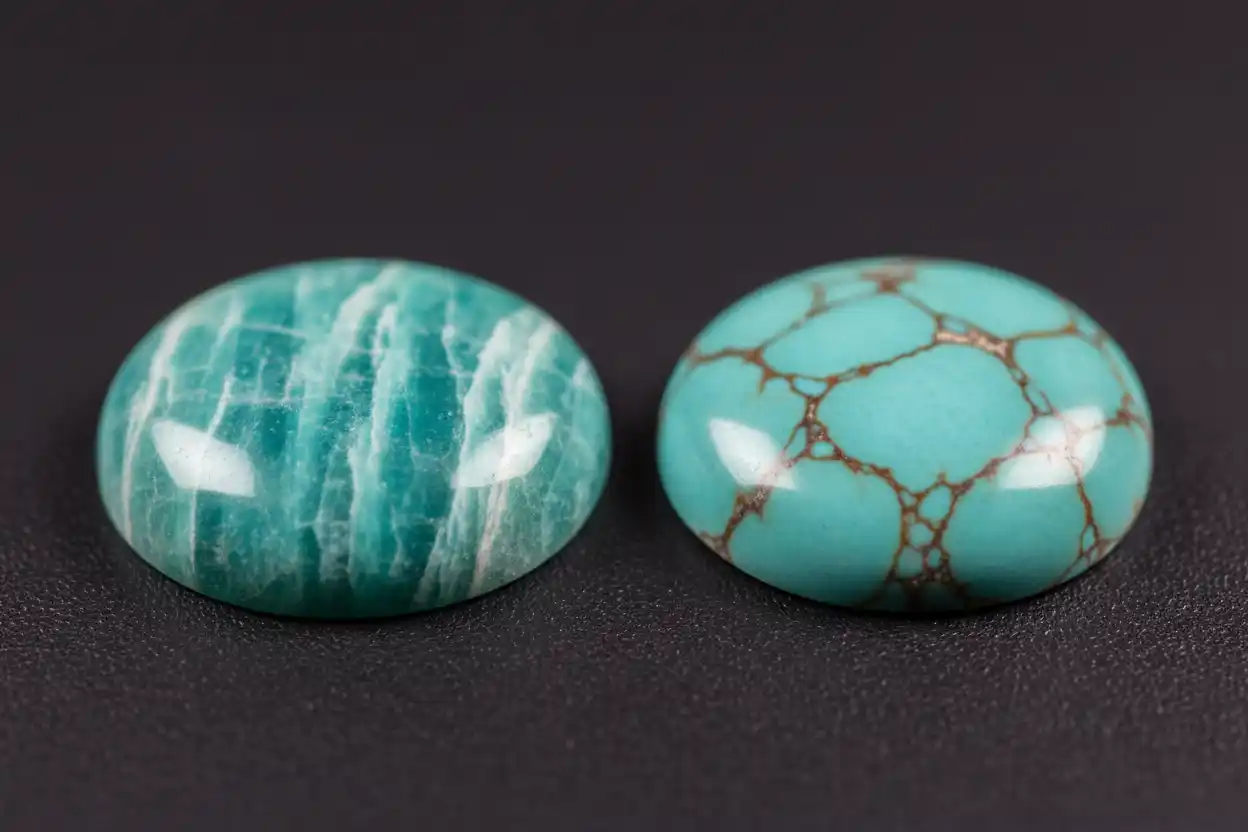
Amazonite vs Turquoise: Identity, Wear & Value Compared
Amazonite and turquoise can occupy almost the same visual territory—soft blue, greenish blue, turquoise-green, opaque to translucent surfaces, white or dark markings, cabochon cuts, beads, and polished carvings—yet mineralogically they are unrelated. Amazonite is chiefly blue-green microcline, a potassium feldspar with the ideal composition KAlSi₃O₈, whereas turquoise is a hydrated copper aluminum phosphate with the idealized composition CuAl₆(PO₄)₄(OH)₈·4H₂O.
That difference affects nearly everything that matters in ownership. Amazonite is generally harder but has two excellent cleavage directions that make sharp impacts important; turquoise is softer, commonly porous, and much more sensitive to oils, cosmetics, chemicals, heat, and the effects of treatment. Amazonite commonly displays whitish feldspar intergrowths, while turquoise can contain brown, black, tan, or other host-rock matrix. Neither pattern is an authentication shortcut.
For someone deciding between amazonite vs turquoise, the practical choice should therefore come from identity, appearance, treatment disclosure, durability, intended jewelry use, and value context—not simply from which stone looks “more blue.”
The broader Identification section applies this same evidence-first approach to other gemstones that can resemble one another visually.
Amazonite vs Turquoise at a Glance
| Property | Amazonite | Turquoise |
|---|---|---|
| Mineral identity | Variety of potassium feldspar, usually microcline | Distinct mineral species |
| Ideal chemistry | KAlSi₃O₈ for microcline | CuAl₆(PO₄)₄(OH)₈·4H₂O |
| Mineral group | Feldspar | Turquoise group / phosphate mineral |
| Typical structure | Crystalline feldspar, commonly perthitic | Fine-grained to cryptocrystalline aggregate |
| Crystal system | Triclinic for microcline | Triclinic |
| Typical color | Green, blue-green, turquoise-green | Blue, greenish blue, blue-green, green |
| Typical transparency | Translucent to opaque | Semitranslucent to opaque |
| Common pale markings | White feldspar intergrowths, cleavage or alteration features | Pale matrix or altered host-rock features can occur |
| Common dark markings | Less characteristic as a defining feature | Brown, black, tan, yellowish or other matrix can occur |
| Mohs hardness | About 6–6.5 | About 5–6 |
| Approximate specific gravity | 2.54–2.57 | About 2.76, with substantial natural variation |
| Approximate refractive index | Roughly 1.514–1.539 across principal directions | About 1.610–1.650 |
| Cleavage | Two perfect directions near 90° | Cleavage usually not an ownership-defining concern |
| Important durability issue | Cleavage and brittle impact behavior | Porosity, softness, chemicals, oils and treatment |
| Common treatments | Wax or polymer impregnation can occur | Waxing, polymer/resin impregnation, dyeing and other enhancements are common |
| Typical cutting | Cabochons, beads, carvings, slabs | Cabochons, beads, carvings, inlay |
| Strong visual identifier? | No | No |
| Strong routine gemological separator | Optical properties plus structure | Optical properties plus structure |
The strongest distinction in this table is not color. It is the fact that these are different mineral systems with substantially different optical and physical properties.
A green-blue polished object should therefore begin as an unidentified material rather than being named amazonite or turquoise from a photograph.
The Core Difference: Feldspar Versus Phosphate
Amazonite is predominantly microcline, one of the potassium feldspars. Its structure is a three-dimensional framework of aluminum and silicon tetrahedra with potassium occupying larger structural sites. The green to blue-green amazonite color is associated principally with lead-related color centers in suitable potassium feldspar, with structural water and irradiation playing important roles in the established model.
Turquoise is chemically and structurally different. Copper is integral to its phosphate-mineral chemistry and contributes strongly to the blue coloration for which the material is famous. Iron-related variation can shift turquoise toward greener appearances.
This immediately eliminates several common shortcuts.
Amazonite is not “a type of turquoise” merely because the color overlaps.
Turquoise is not feldspar.
Amazonite marketed under expressions such as “Amazon jade” is also not actual jade.
A similar discipline helps elsewhere in colored-stone identification. Aventurine vs jade demonstrates how two commonly green materials can belong to completely different mineral systems even when commercial descriptions blur the distinction.
Which One Looks Bluer?
Either one can.
Fine turquoise is famous for even medium blue coloration, but turquoise also extends through greenish blue and into green. Amazonite commonly occupies blue-green, greenish blue, and turquoise-green territory, with some stones approaching a surprisingly vivid blue-green appearance.
Color overlap is therefore substantial.
A photograph of a medium blue cabochon with no visible matrix might make turquoise seem more likely, while a green-blue stone with white blocky streaking might suggest amazonite. Those are reasonable preliminary observations, but neither reaches the level of identification.
Lighting makes the problem harder. Warm illumination can push both materials visually greener, while a cool light source can make them appear bluer. Phone cameras then apply automatic white balance, exposure adjustment, contrast, sharpening, and computational color processing.
The same problem appears in other comparison pairs. Apatite vs aquamarine cannot be resolved safely from blue coloration alone, and aquamarine vs blue topaz shows how overlapping blue hues can hide significant differences in mineral identity.
Color begins the investigation. It should not end it.
White Patterns Usually Point in Different Directions
One of the most practical amazonite vs turquoise clues is the nature of pale markings.
Amazonite frequently contains white or cream streaks, patches, grids, or irregular intergrowths. Microcline commonly develops perthitic texture, in which sodium-rich albite occurs as intergrowths within potassium feldspar after structural separation during cooling. Cleavage, fractures, alteration, and attached quartz can contribute additional white features.
Turquoise matrix has a different origin. Because turquoise commonly develops within or replaces portions of host rock, remnants of that surrounding material can remain as veins, networks, irregular patches, or spiderweb-like patterns. GIA describes matrix colors that may include dark brown, black, tan, yellowish, and related shades depending on the host material.
White does not automatically equal amazonite, and dark matrix does not automatically equal turquoise.
However, the structure of a pattern can provide a useful clue. A pale intergrowth that appears crystallographically integrated with blocky feldspar is different from a branching host-rock vein crossing a fine-grained turquoise cabochon.
That distinction becomes especially useful under magnification.
Surface Texture Provides Another Clue
Well-polished amazonite often has the vitreous character expected from feldspar, although cleavage surfaces can appear somewhat pearly. Even opaque material can develop a crisp polish when the rough is structurally sound.
Turquoise is fine-grained and naturally porous to varying degrees. Fine, dense turquoise can take an excellent smooth polish, while chalkier or more porous material may appear duller before stabilization or other treatment.
This creates a trap.
A brilliantly polished turquoise cabochon might owe part of its surface quality to unusually dense natural material, or it might have been treated to improve its stability and polish. The polish itself does not settle that question.
Likewise, a polished amazonite with intense blue-green color should not automatically be regarded as untreated merely because amazonite is feldspar.
Surface quality is evidence about condition. Treatment status is a separate evidence problem.
Optical Data Separate Them Much More Effectively
The refractive properties of amazonite and turquoise occupy substantially different ranges, making optical testing much more informative than visual color comparison.
Microcline has principal refractive indices beginning around the low 1.51 range and extending into the low-to-mid 1.53 range depending on orientation and composition.
Turquoise is considerably higher, with GIA listing an approximate refractive-index range of 1.610–1.650.
That gap is large enough to become diagnostically useful when an appropriate polished surface can be tested reliably.
The stones also differ in optical presentation. Microcline is a crystalline biaxial mineral. Turquoise normally behaves gemologically as an extremely fine-grained aggregate, and detectable birefringence is generally not available as a straightforward observation in fashioned material.
This is one reason professional gem identification does not depend on “which stone looks more turquoise colored.”
A similar principle applies in white topaz vs diamond: appearance can overlap in a photograph while optical properties establish that the materials are fundamentally different.
Specific Gravity Helps, but It Is Not the First Test to Trust Blindly
Typical microcline has a specific gravity around 2.54–2.57.
GIA lists turquoise around 2.76 with a relatively broad permitted variation, reflecting differences in composition, porosity, matrix, and treatment.
In ideal loose specimens, density therefore provides another useful distinction. A hydrostatic specific-gravity measurement can support an amazonite or turquoise identification when combined with optical and microscopic observations.
Treatment complicates turquoise measurements.
Polymer or resin impregnation can alter the physical behavior of a porous piece, while matrix contributes material that is not turquoise itself. A heavily matrix-bearing cabochon should not be expected to behave exactly like pure fine-textured turquoise.
Density is consequently supporting evidence, not a magic number.
Hardness Favors Amazonite—But That Does Not Make It Indestructible
Amazonite has a Mohs hardness of approximately 6–6.5, whereas turquoise is around 5–6.
That difference means amazonite generally offers greater resistance to scratching. In real jewelry, especially bracelets and rings, this can become noticeable over prolonged contact with harder materials and abrasive dust.
The comparison changes when impact is considered.
Microcline has two perfect cleavage directions near a right angle. A sufficiently sharp blow can exploit those structural weaknesses and produce a chip or split even though the surface is harder than turquoise.
Turquoise lacks that same feldspar cleavage issue, but its lower hardness, variable porosity, and fine-grained structure create their own durability concerns.
Neither gemstone should therefore be summarized simply as “the tougher one.”
Amazonite has the hardness advantage. Turquoise often demands greater chemical and surface-care caution. Amazonite demands particular respect for cleavage and sharp impact.
That distinction is more useful for ownership than comparing Mohs numbers alone.
Which Is Better for a Ring?
For an everyday ring, neither material is as forgiving as sapphire or spinel, and both benefit from protective design.
Amazonite’s better scratch resistance gives it an advantage over turquoise in surface wear, but exposed corners and girdle edges remain vulnerable because of feldspar cleavage. A low-profile bezel or other setting that protects the perimeter is preferable to a highly exposed stone.
Natural turquoise can perform successfully in rings—historic jewelry provides abundant evidence—but the stone is softer and can be porous. Daily exposure to hand lotion, cosmetics, soap residues, perspiration, household chemicals, knocks, and abrasion makes treatment disclosure and setting protection especially important.
If the intended ring will be worn only occasionally, the choice can be largely aesthetic.
If it will be worn continuously during hands-on work, neither gemstone is maintenance-free.
The same ownership reasoning appears when comparing other superficially similar materials. Carnelian vs orange calcite demonstrates why hardness and structural durability can matter more than color when selecting a stone for repeated wear.
Which Is Better for Beads, Pendants, and Earrings?
Both amazonite and turquoise are well suited to beads and pendants when the material is sound.
A pendant reduces direct impact compared with a ring, allowing amazonite’s cleavage to become less troublesome during normal wear. Turquoise also benefits because the piece has less sustained contact with cosmetics and skin oils than a tight bracelet or ring may experience.
Beads require inspection around drill holes.
Amazonite can develop chips where drilling intersects cleavage or internal fractures. Turquoise may show weakened areas where porous material, matrix, or treatment boundaries meet the drill channel.
Earrings generally present one of the lower-risk uses because they experience limited abrasion and impact.
The practical lesson is that jewelry construction can matter as much as mineral identity.
Treatments Create One of the Biggest Ownership Differences
Turquoise has a substantial treatment landscape because naturally porous or chalky material may benefit commercially from improved color, polish, and structural stability.
Documented treatments include wax impregnation, polymer or plastic stabilization, resin filling or impregnation, dyeing, oiling, and other processes. Some treatments mainly reduce porosity or improve polish; others change apparent color; some do both.
The presence of treatment does not automatically make turquoise unsuitable. It changes what is being evaluated and how the material should be maintained.
Amazonite can also be impregnated with wax or polymer. GIA includes amazonite among opaque gem materials encountered with impregnation treatment, so “amazonite is never treated” is not a defensible assumption.
The difference is one of prevalence and practical importance. Treatment is particularly central to the turquoise trade because porosity varies widely and lower-grade material is commonly stabilized or otherwise enhanced.
A disclosure such as natural turquoise is also incomplete if it leaves the treatment question unanswered. A stone can be naturally formed turquoise and still be impregnated or dyed.
Can You Spot Stabilized or Dyed Turquoise by Eye?
Sometimes suspicious features are visible; often they are not decisive.
Concentrated color in pores, fractures, cavities, or around drill holes can suggest dye. Resin visible in cavities can raise a treatment question. Artificial-looking color boundaries or unusually uniform saturation in highly porous material may justify closer investigation.
Those observations do not detect every treatment.
Advanced turquoise enhancement can retain gemological properties close to untreated material. GIA research on proprietary enhancement methods demonstrates that some treatments require chemical or spectroscopic analysis rather than naked-eye inspection.
The correct wording is therefore not “I cannot see treatment, so it is untreated.”
It is “I cannot establish treatment from this visual examination.”
That evidence discipline also matters in zircon vs cubic zirconia, where a familiar trade name can cause buyers to draw conclusions that physical testing does not support.
Original Same-Light Photo Comparison Protocol
When amazonite and turquoise are being compared from photographs, image conditions should be standardized before visual differences are interpreted.
Place both specimens on the same neutral gray background and photograph them in the same frame whenever possible. A single frame is better than two separate photographs because the camera cannot silently apply radically different exposure or white-balance corrections between stones.
Use one neutral white light source and keep its distance and angle constant.
Include a millimeter scale, but keep it away from reflective gem surfaces so it does not introduce unwanted color.
Photograph the face-up surface first, then photograph the side or back where structural texture, matrix, drill holes, coatings, fractures, or treatment evidence may be easier to see.
Capture a close view of every white or dark pattern. On amazonite, ask whether pale material looks like feldspar intergrowth or cleavage-related structure. On turquoise, ask whether darker lines appear to be host-rock matrix.
Turn off beauty filters, automatic scene enhancement, artificial background replacement, and deliberate saturation increases where the device permits.
Retain the original image files.
Finally, label the outcome correctly. The photo exercise can produce conclusions such as visually more consistent with amazonite, visually more consistent with turquoise, or indeterminate.
It should not produce laboratory-confirmed amazonite.
Amazonite vs Turquoise Decision Matrix
The following matrix converts the comparison into ownership decisions rather than a generic “which is better?” ranking.
| Situation | Better starting choice | Reason | Important qualification |
|---|---|---|---|
| You want stronger scratch resistance | Amazonite | Hardness around 6–6.5 versus turquoise around 5–6 | Amazonite still has perfect cleavage |
| You want classic even sky-blue color | Turquoise | Fine turquoise is strongly associated with even medium blue | Amazonite can also be attractive blue-green |
| You prefer white streaks and feldspar patterning | Amazonite | Perthitic and feldspar-related pale patterns are characteristic | Confirm material rather than relying on pattern |
| You prefer natural host-rock spiderweb matrix | Turquoise | Matrix can form distinctive web-like patterns | Matrix type and authenticity still need evaluation |
| You want a frequently worn ring | Neither without protection | Both have meaningful wear limitations | Setting design and treatment disclosure can change the decision |
| You want earrings or an occasional pendant | Either | Lower exposure reduces practical risk | Treat unknown stones conservatively |
| You want minimal sensitivity to skin oils | Amazonite usually has the practical advantage | Turquoise can absorb oils when porous | Impregnated materials behave differently |
| You want historically important opaque blue gem material | Turquoise | Turquoise has a major global ornamental history | Historical importance does not authenticate a modern stone |
| You dislike heavily treated material | Depends on the individual specimen | Treatment occurs in both categories | Turquoise requires particularly careful disclosure |
| You need confident separation of two loose stones | Test them | RI and other gemological properties provide stronger evidence than color | Laboratory analysis may be warranted for treatment questions |
| You are buying chiefly for color | Either | Their color fields overlap considerably | Choose appearance only after material is correctly disclosed |
| You prioritize untreated rarity and provenance | Turquoise can become a specialized collector decision | Fine natural turquoise can receive premiums for quality and documented origin | Mine-name claims need evidence |
| You want straightforward moderate-cost decorative feldspar | Amazonite can suit that role | Attractive material is widely used in beads and carvings | Price alone never authenticates it |
| You cannot determine whether a blue-green cabochon is one or the other | Do not guess | Visual overlap is too broad | Seek gemological testing |
The matrix shows why one universal winner would be misleading. Amazonite and turquoise solve different ownership priorities.
How Value Works Differently
Turquoise has a well-established quality hierarchy in which color, texture, porosity, matrix, treatment status, polish, and sometimes documented origin matter.
GIA identifies color, texture, and matrix as central turquoise quality factors. An even, intense medium blue with fine texture is conventionally highly desirable, while attractive spiderweb matrix has its own collector market. Coarse porous material is more likely to require treatment, which changes the comparison.
Mine or geographic names can add collector interest, but quality generally remains more important than a famous locality label by itself.
Amazonite should not be graded through that same framework.
An attractive amazonite is judged more logically by blue-green color quality, saturation, uniformity or attractive patterning, degree of white intergrowth, polish, fractures, size, cutting quality, treatment disclosure, and specimen aesthetics. Large mineral crystals can additionally carry collector value based on locality, crystal form, associations, condition, and provenance.
The two value systems therefore overlap only partially.
A flawless-looking, evenly colored turquoise cabochon and an exceptional amazonite crystal specimen are not directly comparable simply because both are blue-green.
This principle extends to other comparison pages. Carnelian vs citrine separates chalcedony from quartz variety pricing, while carnelian vs sunstone compares materials whose optical appearance and value drivers come from entirely different structures.
Does Matrix Increase or Reduce Turquoise Value?
It can do either depending on quality, pattern, market preference, and the material being compared.
Conventionally, fine evenly colored blue turquoise with no matrix can command very high quality status. Attractive spiderweb matrix is nevertheless actively collected, particularly when the pattern is fine, balanced, and visually complementary to strong body color.
Random coarse host rock that dominates the face of the stone is not equivalent to an attractive spiderweb pattern.
Matrix should therefore be described rather than automatically scored as good or bad.
For amazonite, white feldspar intergrowths are similarly preference-dependent. Some buyers seek saturated, relatively uniform blue-green material, while others prefer strong white patterning because it makes the feldspar visually recognizable.
Personal preference affects appearance. It does not change mineral identity.
Why Color Comparisons Alone Fail
A consumer who sees a blue-green opaque stone often tries to solve identification through a color analogy: “It looks like turquoise, so it must be turquoise.”
That method fails because mineral color is highly non-unique.
Purple overlap does not make amethyst vs charoite the same material. Orange overlap cannot collapse carnelian vs sunstone into one identity. Similar transparent blue colors do not erase the structural distinctions considered in aquamarine vs topaz.
Even much more visually convincing substitutes require property-based separation, as the zircon vs cubic zirconia comparison illustrates.
Color describes appearance.
Mineral names describe materials.
A reliable comparison keeps those tasks separate.
Care: Turquoise Requires the More Conservative Chemical Routine
Both stones can be cleaned conservatively with a soft cloth and limited warm, mildly soapy water when treatment and setting conditions permit, but turquoise deserves greater caution around substances encountered in ordinary personal care.
Natural porous turquoise can absorb oils and contaminants. Cosmetics, perfume, perspiration, metal polish, household cleaning chemicals, and repeated skin contact can alter its appearance. GIA specifically warns that high heat can discolor or damage turquoise and recommends against steam or ultrasonic cleaning.
Treated turquoise may introduce additional sensitivity because heat and solvents can damage wax, polymer, resin, or other enhancement materials.
Amazonite is less famous for porosity-related discoloration, but that does not justify aggressive treatment. Its cleavage, fractures, and possible impregnation still make steam, ultrasonics, strong chemicals, and sudden mechanical stress unnecessary risks when the stone’s history is unknown.
For both, conservative manual cleaning is preferable to testing the limits of the material.
Can You Wear Amazonite and Turquoise Together?
Yes, provided the jewelry is designed so that the stones are not repeatedly striking or rubbing against harder components.
The main issue is mechanical rather than symbolic compatibility.
A turquoise bead repeatedly rubbing against a harder amazonite bead can experience greater surface wear over time because turquoise is generally softer. Metal spacers, movement within bracelets, rough drill holes, and harder accompanying gemstones can increase abrasion.
Amazonite itself can chip at drill holes or along cleavage-related weaknesses if beads collide strongly.
Mixed-stone jewelry should therefore be assessed as a construction system, not just as a collection of mineral hardness numbers.
When Home Identification Should Stop
A loupe, controlled photography, weight, dimensions, pattern analysis, and general surface observations can eliminate some obvious mistakes, but they reach a natural limit.
If a polished blue-green cabochon has no diagnostic crystal morphology, no obvious matrix, and a uniform surface, routine visual identification may be genuinely ambiguous.
At that point, refractive-index testing can provide a powerful distinction because amazonite and turquoise occupy very different ranges.
Microscopy can characterize texture, intergrowths, pores, matrix, dye concentrations, and fillers.
Infrared and Raman spectroscopy can add mineral and treatment information. X-ray diffraction can identify crystalline phases in difficult material. Chemical analysis becomes relevant when treatment chemistry, exact feldspar composition, or sophisticated turquoise enhancement needs to be resolved.
Some turquoise treatments cannot be confidently excluded by appearance alone.
The correct decision in a high-value or materially important case is therefore not to become more confident from the same photograph. It is to move to a stronger form of evidence.
Which Should You Choose?
Choose amazonite when you specifically prefer blue-green feldspar, white structural patterning, moderately greater scratch resistance, and the appearance of polished microcline. Accept that cleavage makes sharp impact a genuine consideration.
Choose turquoise when you specifically value turquoise as a mineral, prefer classic blue or matrix-rich aesthetics, or appreciate its distinctive history and collector traditions. Accept that porosity, treatment status, chemicals, cosmetics, oils, and lower hardness deserve greater attention.
If the choice is purely visual, compare the actual stones under the same illumination rather than choosing from heavily processed photographs.
If the choice is commercial, compare disclosure quality as seriously as color.
If the choice depends on authenticity, test the material.
That final principle is the most important conclusion in amazonite vs turquoise: appearance can guide a preference, but mineral properties should determine identity.
Similar evidence-first comparisons across Gems Lore include apatite vs aquamarine, carnelian vs orange calcite, aquamarine vs blue topaz, carnelian vs citrine, aquamarine vs topaz, white topaz vs diamond, and aventurine vs jade.
Gems Lore’s approach to evidence boundaries and mineral-focused comparisons is described on the About page. Health and non-scientific claims are governed by the site’s Disclaimer, questions or factual corrections can be sent through Contact, and information-handling practices are explained in the Privacy Policy.