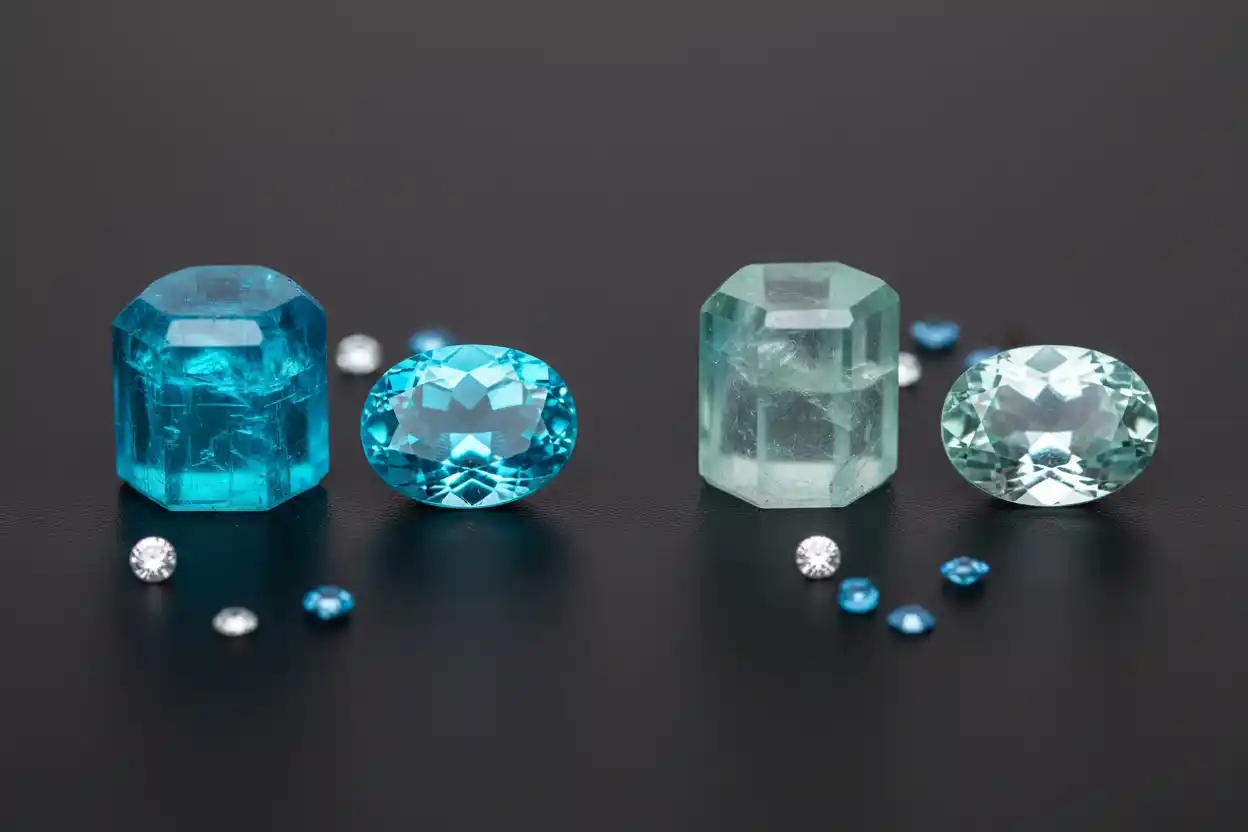
Apatite vs Aquamarine: Differences, Tests & Best Uses
Apatite vs aquamarine can be a difficult visual comparison when both stones are transparent blue or blue-green, but they are fundamentally different gem materials. Aquamarine is the blue to greenish-blue variety of beryl, with the chemical composition Be₃Al₂Si₆O₁₈ and a Mohs hardness of about 7.5–8. Gem apatite is commonly fluorapatite or closely related apatite-group material, built around a calcium-phosphate structure and measuring only about 5 on the Mohs scale.
That difference immediately affects identification and ownership. Aquamarine is generally the better choice for rings and frequent jewelry wear because it resists scratching substantially better. Apatite can offer stronger electric blue, blue-green, green, yellow, violet, and other colors, but it is softer and more vulnerable to abrasion. The two can also be separated gemologically because their refractive indices and specific gravities occupy distinctly different ranges.
The short answer is therefore straightforward: choose aquamarine when durability, established jewelry use, larger clean stones, and restrained blue color matter most. Choose apatite when unusual saturation, a broader color palette, collector appeal, or occasional-wear jewelry matters more than resistance to everyday scratching.
That answer does not mean one stone is universally “better.” The right choice depends on whether the object will be worn, collected, compared for value, or identified scientifically.
Apatite vs Aquamarine at a Glance
| Property | Apatite | Aquamarine |
|---|---|---|
| Material identity | Apatite-group phosphate; gem material commonly fluorapatite | Blue to greenish-blue variety of beryl |
| Common formula | Often represented by Ca₅(PO₄)₃(F,Cl,OH) | Be₃Al₂Si₆O₁₈ |
| Common gem species | Frequently fluorapatite | Beryl |
| Crystal system | Commonly hexagonal | Hexagonal |
| Typical colors | Blue, blue-green, green, yellow, violet, purple, pink, brown, colorless | Blue to slightly greenish blue |
| Mohs hardness | 5 | 7.5–8 |
| Typical specific gravity | About 3.1–3.25 | About 2.72 |
| Typical refractive index | Roughly 1.63–1.65 | Roughly 1.577–1.583 |
| Optical character | Commonly uniaxial negative | Uniaxial negative |
| Pleochroism | Can be visible in colored stones | Commonly near-colorless to stronger blue directions |
| Cleavage | Poor | Indistinct to poor |
| Tenacity | Brittle | Brittle but substantially more practical for jewelry |
| Typical clarity | Variable; inclusions and fractures can be noticeable | Fine material commonly very transparent and relatively clean |
| Common treatment issue | Some colors may be modified by heat or other processes; disclosure matters | Heat commonly used to reduce greenish color and produce a bluer appearance |
| Everyday jewelry suitability | Limited; better protected or occasional wear | Generally good with sensible care |
| Visual identification alone | Unreliable | Unreliable when compared with similar blue gems |
The table shows why color should be only the beginning of an apatite vs aquamarine identification. Their blue shades can overlap, but hardness, density, refractive index, market behavior, and durability are materially different.
The Fastest Practical Difference
For someone choosing jewelry rather than conducting a laboratory examination, durability is the most consequential difference.
Aquamarine is much harder.
Apatite defines hardness 5 on the Mohs scale. Quartz, which is common in ordinary dust and environmental grit, is harder than apatite. Repeated contact with harder particles can gradually abrade a polished apatite surface and soften facet junctions.
Aquamarine falls around 7.5–8. That does not make it impossible to damage, but it gives the stone far greater resistance to routine scratching.
If the intended piece is an everyday ring, aquamarine usually wins before other variables are considered.
If the stone will be a pendant, protected earring, collector gem, or occasional-wear piece, apatite becomes much more practical.
That durability principle can also be applied when comparing other jewelry stones through guides such as aquamarine vs blue topaz and aquamarine vs topaz, where appearance alone likewise does not answer the ownership question.
They Can Look Surprisingly Similar
Blue apatite can range from restrained blue-green to vivid tropical-water colors. Aquamarine typically occupies a lighter blue to greenish-blue range, although stronger blue stones exist.
The difficulty is that photography can compress these distinctions.
A pale blue-green apatite photographed under soft lighting may resemble aquamarine. A strongly colored aquamarine photographed with increased saturation can appear more like commercially promoted blue apatite. White balance, background color, camera processing, reflections, and stone thickness can change the apparent hue of either gem.
Even in person, a clean blue apatite cannot be identified safely as apatite simply because it seems “too bright for aquamarine.”
Color intensity is evidence of appearance, not species.
This principle is the same reason a green-blue stone should not be identified by resemblance alone in comparisons such as amazonite vs turquoise or aventurine vs jade.
Mineral Identity: Phosphate Versus Beryl
The deepest difference between apatite and aquamarine is chemical and structural.
Aquamarine belongs to the beryl mineral species. Beryl contains beryllium, aluminium, silicon, and oxygen arranged in a hexagonal framework. Aquamarine is defined primarily by its blue to greenish-blue color within that species.
Apatite belongs to a phosphate mineral group. Gem-quality material is commonly fluorapatite, although the word apatite can cover related compositions in which fluorine, chlorine, or hydroxyl occupy structural sites.
Therefore, two blue stones can share a broadly similar hexagonal crystal appearance while being chemically unrelated.
That is an important identification lesson. Crystal system does not establish species.
A hexagonal transparent crystal might be beryl, apatite, quartz viewed in a deceptive orientation, or another material entirely. Composition, optical properties, density, and other measurements are needed before a confident identification is made.
Color Range Favors Apatite
Apatite has the broader natural palette.
Blue and blue-green gems receive much of the commercial attention, but apatite also occurs in green, yellow, violet, purple, pink, brown, white, and colorless varieties. Some material can show zoning or other visually complex color behavior.
Aquamarine occupies a much narrower identity range because color is part of its varietal definition. It is blue, greenish blue, or related watery shades within beryl. If beryl becomes distinctly green enough to fall into emerald or green beryl terminology, it is no longer being described simply as aquamarine.
This makes apatite a better choice for someone who wants an unusual phosphate gem collection spanning several colors.
Aquamarine is stronger when the goal is a classic, recognizable blue gemstone with established jewelry traditions.
Do Not Use “Neon” as an Identification Test
Some blue apatite is marketed as neon apatite because its saturation can be striking. The descriptor may communicate appearance, but it is not a mineral species or laboratory grade.
A brightly saturated stone is not automatically apatite.
Likewise, aquamarine should not be excluded because a specimen appears stronger in color than the pale examples commonly seen in mass-market jewelry. Fine aquamarine can have substantially stronger blue color than low-saturation commercial material.
The word neon therefore belongs in aesthetic description, not identification.
This same caution applies whenever marketing adjectives substitute for measurable properties. A color name cannot replace testing.
Refractive Index Separates Them Cleanly
A refractometer is one of the most useful conventional instruments for separating transparent faceted apatite from aquamarine.
Aquamarine typically has refractive indices around 1.577–1.583.
Gem fluorapatite is substantially higher, commonly around 1.63–1.65.
Those ranges do not normally overlap.
That makes refractive index far more useful than blue color for a loose polished stone with a surface suitable for measurement. A reading in the aquamarine range strongly contradicts apatite. A reading around the apatite range strongly contradicts aquamarine.
There are limitations. A stone may be mounted so tightly that the required facet cannot be placed on the refractometer. Very small stones can be difficult to handle. Damaged, curved, coated, or poorly polished surfaces can complicate readings. Instrument technique also matters.
Nevertheless, among routine nondestructive tests, refractive index provides one of the clearest answers to apatite vs aquamarine.
Specific Gravity Provides a Second Strong Separation
Apatite is noticeably denser than aquamarine.
Typical fluorapatite specific gravity falls around 3.1–3.25, whereas aquamarine is around 2.72.
For loose stones large enough to weigh accurately, hydrostatic specific-gravity testing can therefore provide useful corroborating evidence.
Imagine two similarly sized faceted blue stones. The apatite can weigh more because the material packs more mass into a comparable volume.
That observation should not be turned into the claim that “the heavier blue stone is apatite.” Cut depth, shape, dimensions, inclusions, and measurement error can change apparent heft.
Density becomes diagnostic when properly measured, not when estimated casually in the hand.
Hardness Is Useful Knowledge but a Poor Gem Test
The hardness difference is enormous for ownership decisions but should not normally be tested directly on a finished gemstone.
Scratching a stone simply to determine whether it is hardness 5 or hardness 8 can permanently damage the surface.
A gemologist generally has better nondestructive options.
Hardness should therefore be treated as an identification property already known from mineralogical data, not an invitation to drag a steel point or quartz crystal across a polished gem.
This distinction is especially important with apatite because a scratch produced during testing may substantially reduce the quality of a stone that could have been identified by optical methods.
Pleochroism Does Not Solve the Comparison Alone
Both materials can display directional color behavior.
Aquamarine is dichroic, commonly showing a stronger blue direction and a near-colorless or weaker blue direction.
Colored apatite can also show pleochroism, ranging from weak to much more obvious depending on composition and color.
A dichroscope can therefore provide useful information, but “the stone is pleochroic” does not answer apatite vs aquamarine.
The strength, colors, orientation, refractive indices, and other measurements need to be considered together.
This is a recurring theme in gemstone comparison. A single shared property narrows the field much less than a set of independent observations.
Crystal Shape Is Also Shared
Both apatite and aquamarine can form six-sided prismatic crystals.
That similarity is one reason an attractive rough specimen can be mislabeled by inexperienced sellers or collectors.
Aquamarine crystals commonly grow as elongated beryl prisms, sometimes reaching impressive dimensions and excellent transparency.
Apatite may form short or elongated hexagonal prisms, tabular crystals, and other habits. Many fine apatite crystals are smaller and can show different termination geometry, but habit varies too much for a simple rule such as “long equals aquamarine.”
Matrix and associated minerals can help when the original geological context is preserved, yet locality and association still do not substitute for species testing.
Clarity Usually Favors Aquamarine
Fine aquamarine is well known for high transparency and relatively clean material. Large eye-clean gems are possible because beryl crystals can grow to substantial size while retaining good transparent areas.
Apatite can also be transparent and clean enough for excellent faceting, but internal fractures, tubes, mineral inclusions, clouds, and other features are commonly encountered.
This difference has practical consequences in the market. Aquamarine can remain visually clean at sizes that would be unusual for many colored stones. Apatite becomes increasingly interesting as size and clarity improve together, particularly when desirable color is maintained.
Clarity still should not be used for species identification.
A flawless-looking blue stone is not automatically aquamarine, and an included stone is not automatically apatite.
An Original Side-by-Side Photo Protocol
When comparing apatite and aquamarine remotely, use photographs as controlled observations rather than decorative images.
A useful seller or collector image set should contain:
| Photograph | What to look for |
|---|---|
| Both stones together under the same neutral light | Relative hue, tone, saturation, and brightness |
| Face-up image on a neutral gray background | Color without strong background contamination |
| Side view | Depth, pavilion color concentration, inclusions, windowing |
| Backlit image | Internal zoning, fractures, transparency |
| Rotated sequence | Pleochroism, extinction, color consistency |
| Macro image of facet junctions | Abrasion, polishing quality, surface condition |
| Rough crystal with matrix when available | Habit and geological context |
| Scale reference | Whether apparent size has been exaggerated photographically |
The most important requirement is consistency.
Comparing an apatite photographed under cool LED lighting with an aquamarine photographed under warm daylight tells very little about their actual color difference.
No photograph in this protocol proves species. The images help describe the stones before testing.
Apatite vs Aquamarine Diagnostic Decision Matrix
The following matrix provides the original decision model required for this comparison.
| Observation or test | More consistent with apatite | More consistent with aquamarine | Diagnostic strength |
|---|---|---|---|
| Very broad natural color range | Yes | No | Low |
| Blue to greenish-blue only | Possible | Characteristic | Low |
| Mohs hardness around 5 | Yes | No | Strong in theory, but avoid destructive testing |
| Mohs hardness around 7.5–8 | No | Yes | Strong in theory |
| RI around 1.63–1.65 | Yes | No | Very strong |
| RI around 1.577–1.583 | No | Yes | Very strong |
| SG around 3.1–3.25 | Yes | No | Strong |
| SG near 2.72 | No | Yes | Strong |
| Hexagonal crystal | Possible | Possible | Weak |
| Strong blue-green saturation | Common in some material | Possible | Weak |
| Very large clean transparent gem | Possible but less typical | More characteristic | Moderate context only |
| Noticeable facet-edge abrasion after wear | More plausible | Less likely under equal conditions | Moderate condition clue |
| Heat treatment commonly used to remove green component | Not the defining commercial treatment pattern | Yes | Contextual |
| Seller calls it “neon blue” | Common marketing for apatite | Not diagnostic | Very weak |
| Confirmatory spectroscopy/Raman | Can identify apatite material | Can identify beryl | Very strong |
The matrix demonstrates why visual clues should be weighted differently from measurements. Color gets low diagnostic strength. Refractive index gets very high diagnostic strength.
That hierarchy prevents attractive photography from outranking mineral physics.
Three Realistic Decision Cases
Case 1: An Everyday Blue Ring
A buyer wants a blue gemstone ring to wear most days and is choosing between a vivid apatite and a slightly lighter aquamarine of similar dimensions.
Aquamarine is generally the better material choice.
Its hardness of 7.5–8 offers substantially greater protection from routine scratching than apatite at hardness 5. It can still chip if struck, but ordinary exposure to environmental grit is less damaging.
The apatite may have the more exciting color, but the ring format exposes the stone to desks, handles, bags, countertops, and repeated contact.
Decision: aquamarine unless the buyer accepts significant additional wear risk and chooses an unusually protective setting.
Case 2: A Pendant Where Color Matters Most
A collector wants a saturated blue-green pendant worn occasionally and strongly prefers the vivid color of apatite.
The durability disadvantage matters less in a pendant because the stone receives fewer direct impacts and less surface abrasion than an exposed ring.
Decision: apatite can be an excellent choice if the owner understands its softness, the mounting protects exposed edges, and cleaning remains conservative.
Case 3: A Large, Clean Collector Gem
A buyer is comparing a large pale aquamarine with a smaller but highly saturated clean apatite for a display collection.
There is no universal winner because the objective is collecting rather than daily wear.
The aquamarine may offer exceptional size and transparency. The apatite may offer greater rarity of color or a more unusual material identity.
Decision: choose based on specimen quality, optical interest, provenance, treatment disclosure, and collection goals rather than hardness alone.
These cases show why “Which is better?” is incomplete until the intended use is known.
Treatments: Aquamarine Has the More Familiar Pattern
Heat treatment is well established for aquamarine. Much natural aquamarine contains a green component, and controlled heating can reduce that component to produce a purer blue appearance.
The resulting blue is generally considered stable under ordinary wear.
Treatment does not make aquamarine synthetic. The underlying beryl formed naturally; heat altered its visible color.
Fracture filling may also occur in aquamarine, although it is far less central to the trade than heat treatment. A filled stone may require more conservative cleaning.
The key purchasing point is disclosure. “Natural aquamarine” answers whether the gem formed naturally; it does not automatically mean “unheated.”
Apatite Treatment Requires More Cautious Wording
Apatite also can undergo treatment, including experiments and commercial processes intended to alter color. Heat can affect some apatite colors, while the response depends on composition, defects, starting color, and treatment conditions.
That makes two absolute statements equally unreliable:
“Every vivid apatite is treated.”
“Apatite is never treated.”
Neither is justified.
Color alone generally cannot establish treatment history. When treatment matters commercially, seller disclosure and appropriate gemological testing are preferable to assumptions based on saturation.
A buyer should also distinguish a treatment from ordinary cutting and polishing. Faceting natural rough is manufacturing, but it does not make the material laboratory-grown.
Laboratory-Grown and Imitation Risks Are Different Questions
A stone can fail an apatite vs aquamarine comparison in several ways.
It might be apatite represented as aquamarine.
It might be aquamarine represented as apatite.
It might be another natural gem that resembles both.
It might be manufactured glass.
It might be laboratory-grown beryl represented without proper disclosure.
These are different identification problems.
A simple comparison test should first determine material identity. Natural versus laboratory-grown origin can then require additional evidence, especially for beryl.
This is why an independent gemological report can be valuable when the price or claim justifies the cost. A report should be read for what it actually establishes rather than treated as a generic certificate of quality.
Which Gem Is Better for Rings?
Aquamarine.
This is the clearest use-case answer in the entire comparison.
Apatite can physically be set into a ring, but setting feasibility is not the same as suitability for frequent wear. Hardness 5 leaves apatite vulnerable to accumulated scratches, and brittle material can also suffer edge damage.
Aquamarine’s 7.5–8 hardness makes it much better suited to regular ring wear.
Apatite rings make more sense as carefully worn pieces, protected designs, or jewelry accepted as requiring eventual repolishing or replacement.
Stone durability should always be considered separately from setting craftsmanship.
Which Gem Is Better for Earrings?
Both can work.
Earrings usually experience less abrasion and impact than rings. That reduces apatite’s greatest disadvantage and allows its strong color to become the deciding factor.
Aquamarine remains the lower-maintenance option, particularly for valuable earrings intended for frequent wear.
Apatite becomes attractive when vivid color, unusual gemstone identity, or lower-impact occasional use is the priority.
The correct decision depends more on exposure than on whether the stone is technically “jewelry quality.”
Which Gem Is Better for Pendants?
Both are practical, with an advantage to aquamarine for durability and an advantage to apatite for certain colors.
A protected apatite pendant can provide excellent visual impact without subjecting the stone to the repetitive abrasion experienced by rings.
Aquamarine remains easier to own and can tolerate a broader range of routine wear.
A pendant buyer should therefore make the decision primarily from color preference, treatment disclosure, setting protection, and expected frequency of use.
Which Is Easier to Care For?
Aquamarine is generally easier.
Warm soapy water is a conservative cleaning method for both materials when treatments and construction permit.
Aquamarine normally tolerates ordinary jewelry ownership well. Ultrasonic or steam cleaning may be suitable for many untreated, sound aquamarines, although stones containing significant fractures, liquid inclusions, or filling should be handled more conservatively.
Apatite deserves gentler treatment because it is softer and brittle. Warm soapy water with minimal mechanical abrasion is preferable to aggressive scrubbing. Steam and ultrasonic cleaning are poor default choices when internal condition or treatment history is unknown.
The main practical difference is not that apatite is chemically unstable in normal ownership. It is that mechanical damage is easier.
Which Is More Valuable?
There is no universal answer.
Aquamarine has a larger and more established jewelry market. Fine color, transparency, large size, cut quality, and treatment disclosure all influence value. Because beryl can form large clean crystals, substantial aquamarines are available, although fine deeply saturated blue material can command significant premiums.
Apatite generally occupies a more specialized market. Common small material can be modestly priced, while unusually vivid blue-green color, larger transparent size, fine cutting, chatoyancy, color change, rare composition, or exceptional specimen quality can increase desirability.
Price per carat alone does not reveal which purchase offers better value.
A poorly cut aquamarine can cost more than a visually stronger apatite because of market recognition. A fine apatite may be harder to replace than an ordinary pale aquamarine while still lacking aquamarine’s broad consumer demand.
Value therefore has to be interpreted within each species rather than through one cross-species price table.
Origin Does Not Prove Quality
Aquamarine occurs in several important gem-producing regions, and some localities have strong reputations. Apatite also comes from numerous geological environments and geographic sources.
A famous country name does not make an individual stone fine.
Likewise, a stone cannot be assigned to a famous source simply because its color resembles material associated with that region.
Origin is provenance evidence. Quality is a separate judgment based on the stone itself.
This same distinction appears repeatedly across identification comparisons, including citrine vs yellow sapphire and carnelian vs red jasper.
When Visual Identification Is Not Enough
There are several situations where guessing should stop.
A laboratory or qualified gemological examination becomes especially useful when:
the stone is expensive relative to the cost of testing;
the seller’s identification is uncertain;
treatment disclosure affects the purchase;
the gem is mounted in a way that prevents simple measurements;
color is unusually intense;
a report or invoice contradicts the observed properties;
natural versus laboratory-grown beryl matters;
an insurance, resale, estate, or legal decision depends on correct identification.
Basic gemological measurements can often separate apatite from aquamarine quickly. More advanced analysis becomes relevant when the question shifts from species identity to treatment, exact composition, or origin.
Do Not Identify Them by One Inclusion
Inclusions can be useful, but one internal feature rarely proves the entire identification.
Apatite can contain tubes, mineral crystals, fractures, fluid-related features, and other inclusions.
Aquamarine can contain liquid inclusions, tubes, mineral crystals, healed fractures, and growth-related features.
Some inclusions are more characteristic of certain environments or species than others, yet interpretation requires context.
An inclusion should therefore support the identification reached from optical and physical evidence rather than replace it.
A Buyer-Facing Decision Matrix
| Your priority | Better default choice | Why |
|---|---|---|
| Everyday ring | Aquamarine | Much greater scratch resistance |
| Engagement-style daily ring | Aquamarine | Better long-term wear profile |
| Occasional statement pendant | Apatite or aquamarine | Lower impact allows color preference to lead |
| Earrings | Either | Both workable; apatite needs more care |
| Maximum blue-green saturation | Often apatite | Some material reaches unusually vivid colors |
| Classic watery blue | Aquamarine | Defining appearance of the variety |
| Large clean transparent stone | Often aquamarine | Beryl commonly produces large clean crystals |
| Broad color collection | Apatite | Much wider natural color range |
| Low-maintenance jewelry | Aquamarine | Better resistance to abrasion |
| Mineralogical novelty | Apatite | Phosphate-group gem with varied compositions |
| Birthstone context | Aquamarine | Established March birthstone tradition |
| Collector specimen | Either | Crystal quality, provenance, matrix, and rarity decide |
| Cheapest stone | Neither automatically | Quality and seller context vary |
| Highest resale liquidity | Usually aquamarine has broader recognition | Recognition does not guarantee resale value |
| Best investment | Neither should be bought on guarantees | Gem markets do not ensure appreciation |
This matrix deliberately avoids declaring an overall winner because different decisions require different material properties.
Why Aquamarine Usually Wins for Daily Wear
Suppose two stones are equally attractive today.
After repeated everyday use, their surfaces may not remain equally attractive.
Environmental quartz particles can scratch apatite but generally cannot scratch aquamarine because aquamarine is harder than quartz. Over time, apatite facet edges can become visibly abraded in conditions where aquamarine remains much sharper.
That difference is more meaningful than a slight advantage in saturation at the time of purchase if the jewelry will be worn constantly.
Durability is not glamorous, but it has direct economic consequences because repolishing removes material and may alter dimensions.
Why Apatite Can Still Be the Better Choice
Apatite wins when its particular visual character is the point.
A vivid blue-green apatite can have an appearance that is difficult to replace precisely with aquamarine. Its unusual phosphate identity, broader color range, collector appeal, or inclusions may matter more to the owner than everyday hardness.
A gemstone does not need to survive decades of ring wear to be worthwhile.
A carefully protected pendant, display gem, crystal specimen, or occasional piece can make excellent use of apatite’s strengths while avoiding its most demanding exposure conditions.
“Less durable” does not mean “low quality.” It means the material should be used appropriately.
Related Comparisons Require the Same Evidence Standard
The same identification principle applies across apparently simple color comparisons.
Carnelian vs sunstone requires separating chalcedony from feldspar rather than relying on orange color.
Carnelian vs orange calcite involves a major hardness and chemistry difference despite overlapping warm hues.
Carnelian vs citrine demonstrates why quartz varieties can still require careful attention to transparency and microstructure.
Amethyst vs charoite compares materials that may overlap in purple color but differ dramatically in structure and visual texture.
These examples reinforce the central rule of apatite vs aquamarine: color is where comparison starts, not where identification ends.
A Practical Test Sequence
For a loose transparent blue stone suspected to be either apatite or aquamarine, use this sequence:
1. Record the stone without assuming identity
Note dimensions, weight, color, transparency, cut, visible inclusions, surface wear, and seller claims.
2. Inspect under magnification
Look for facet-edge abrasion, fractures, tubes, crystals, filling, surface coatings, and obvious manufacturing clues.
3. Measure refractive index
A reading around the aquamarine range or apatite range often resolves the main comparison immediately.
4. Check optic behavior if useful
Confirm observations rather than relying on pleochroism alone.
5. Measure specific gravity where practical
This provides a valuable independent check because apatite is considerably denser.
6. Use spectroscopy or other analytical methods if the question remains unresolved
Higher-value or unusual material may justify further testing.
7. Investigate treatment separately
Correct species identification does not automatically establish untreated status.
8. Investigate provenance separately
Correct species and treatment status still do not prove where the stone was mined.
This sequence minimizes destructive testing and prevents one answer from being stretched into several unrelated conclusions.
What Not to Do
Do not scratch a valuable stone simply because apatite is hardness 5.
Do not identify aquamarine because a stone is pale blue.
Do not identify apatite because a gem is neon blue-green.
Do not assume a hexagonal rough crystal is beryl.
Do not assume “natural” means untreated.
Do not assign geographic origin from color.
Do not interpret a seller’s AAA grade as an internationally standardized gem grade.
Do not treat a laboratory identification report as an appraisal.
And do not choose a daily-wear stone without considering durability.
These rules are part of the evidence-focused approach described on About Gems Lore.
Frequently Asked Questions
What is the main difference between apatite and aquamarine?
Apatite is commonly a calcium-phosphate gem material, often fluorapatite, while aquamarine is blue to greenish-blue beryl. Aquamarine is much harder and more suitable for frequent jewelry wear.
Which is harder, apatite or aquamarine?
Aquamarine. It measures approximately 7.5–8 on the Mohs scale, compared with about 5 for apatite.
Can apatite and aquamarine look the same?
Yes. Transparent blue or blue-green examples can overlap visually, especially in photographs. Gemological measurements such as refractive index and specific gravity separate them much more reliably.
Which is denser?
Apatite. Gem fluorapatite commonly has a specific gravity around 3.1–3.25, while aquamarine is close to 2.72.
Which has the higher refractive index?
Apatite. Typical gem apatite falls around 1.63–1.65, while aquamarine is approximately 1.577–1.583.
Can a refractometer distinguish apatite from aquamarine?
Usually very effectively. Their normal refractive-index ranges are sufficiently different that a sound reading can provide strong separation.
Is blue apatite aquamarine?
No. Blue apatite and aquamarine are different gem materials even when their colors overlap.
Is aquamarine a type of apatite?
No. Aquamarine is a variety of beryl. Apatite belongs to a phosphate mineral group.
Are both minerals hexagonal?
Gem apatite commonly crystallizes in the hexagonal system, and beryl is also hexagonal. Shared crystal symmetry does not make them chemically related.
Which has stronger color?
Some apatite can display exceptionally vivid blue or blue-green saturation. Aquamarine typically has lighter to moderately strong blue or slightly greenish-blue color, although fine strongly colored aquamarine exists.
Which is clearer?
Fine examples of both can be transparent, but aquamarine is especially known for producing large, relatively clean gems. Apatite more commonly shows inclusions or fractures in commercial material.
Which is better for an everyday ring?
Aquamarine is the better default because it has substantially greater resistance to scratching.
Can apatite be used in a ring?
Yes, but it requires greater care. Protected settings and occasional wear are more appropriate than assuming it will behave like aquamarine.
Which is better for earrings?
Either can work. Earrings usually expose stones to less abrasion, which makes apatite much more practical.
Which is better for a pendant?
Both can be good choices. Apatite is particularly attractive when vivid color is the main priority, while aquamarine generally requires less maintenance.
Is aquamarine heat treated?
Heat treatment is commonly used to reduce a green component and create a bluer appearance. The resulting color is generally stable under normal use.
Is apatite treated?
Treatment is possible, including color modification by heat in some material. Not every vivid apatite is treated, and treatment status should not be determined from color alone.
Which is more expensive?
Either can cost more depending on quality, size, cut, color, treatment, rarity, and retail setting. Aquamarine has a broader established jewelry market, while exceptional apatite can carry significant premiums within its specialized market.
Is apatite rarer than aquamarine?
That question depends on the quality being compared. Apatite as a mineral is widespread, but fine transparent material with exceptional color can be uncommon. Aquamarine also varies dramatically from abundant commercial material to much scarcer fine color.
Which stone is better value?
For frequent jewelry wear, aquamarine often provides stronger practical value because it lasts better. For saturated color or specialized collecting, apatite can offer greater visual interest for the buyer’s priorities.
Can I distinguish them by weight in my hand?
Not reliably. Apatite is denser, but differences in cut and size make casual heft misleading. Measured specific gravity is useful; guessing by hand is not.
Can I distinguish them with a scratch test?
Their hardnesses differ substantially, but scratch testing a finished gemstone is destructive and unnecessary when nondestructive gemological tests are available.
Can inclusions identify them?
Inclusions can support an identification but should not normally be used alone. Both stones can contain several types of crystals, tubes, fractures, and fluid-related features.
Does a certificate prove which stone I have?
A legitimate gemological identification report can provide strong evidence of material identity. Read what the report actually states regarding natural origin and detectable treatments rather than assuming it establishes quality, value, or geographic origin automatically.
Which one should I choose?
Choose aquamarine for frequent wear, classic blue color, easier maintenance, or large clean stones. Choose apatite when vivid color, unusual phosphate mineralogy, broader color options, or collector appeal matters more than maximum durability.
Where can I learn more about gemstone comparisons?
Related identification guides include aquamarine vs blue topaz, aquamarine vs topaz, amazonite vs turquoise, aventurine vs jade, carnelian vs red jasper, carnelian vs sunstone, carnelian vs orange calcite, carnelian vs citrine, and citrine vs yellow sapphire.
Apatite vs aquamarine becomes a relatively straightforward identification once appearance is separated from measurement. Both can be transparent, blue to blue-green, pleochroic, and hexagonal in crystal form, so photographs and color impressions can mislead. Their physical data are much less ambiguous: apatite is softer, denser, and more refractive, while aquamarine is significantly harder and belongs to an entirely different mineral species.
For ownership, that distinction becomes practical. Aquamarine is usually the stronger choice for daily jewelry. Apatite is often the more compelling choice when exceptional saturation, unusual color, or mineral-collector interest takes priority over abrasion resistance.
Neither conclusion requires guessing from a photograph. A structured comparison using refractive index, density, microscopy, treatment disclosure, and intended use provides a stronger answer than color alone.
Gems Lore separates material evidence from marketing claims and subjective preferences under its disclaimer. Questions about a specific comparison can be submitted through Contact Gems Lore, with submitted information handled according to the Privacy Policy.